
The default assumption that “any pre‑match offer is a financial win” is wrong. Once you run the numbers, many pre‑match deals are barely neutral—and some are flatly worse than waiting for the Match.
Let me walk through this like a data problem, not a feelings problem.
1. What a Pre‑Match Offer Really Is (Financially)
Strip away the emotion and prestige. A pre‑match offer is just an employment contract with three components:
- Base compensation
- Benefits (insurance, retirement, CME, etc.)
- Risk profile (probability you match elsewhere, probability you do not match)
The question is not “Do I like this program?”
The question is: “Given my realistic Match outcomes, is locking in this contract now financially better than rolling the dice?”
To answer that, you need to compare:
- Guaranteed value of the pre‑match offer
- Expected value of your Match outcomes (weighted by probabilities)
- Non‑financial constraints (geography, specialty switch risk, visa status) that can indirectly change your financial trajectory
Most residents never do this explicitly. They eyeball the base salary and decide. That is how people end up underpaid in high‑cost cities for three years.
2. Core Financial Levers: What You Should Actually Compare
Let us start with the main variables that move real dollars. Not vibes.
| Component | Direct or Indirect | Typical Range / Effect |
|---|---|---|
| Base PGY-1 Salary | Direct | $58,000–$72,000 |
| Overtime / Extra Shifts | Direct | $0–$15,000+ per year |
| Health / Dental / Vision | Indirect | $3,000–$8,000 value per year |
| Retirement Match | Indirect | 0–5% of salary |
| Signing Bonus | Direct | $0–$10,000 (usually taxed) |
| Housing / Meal Stipends | Direct | $0–$10,000 (sometimes tax‑favored) |
| Loan Repayment / PSLF Fit | Indirect | Can be 5‑6 figures over time |
The data shows that base salary alone underestimates total comp by 10–30%. Programs are quietly very different once you include benefits and cost of living.
2.1 Base Salary vs Cost of Living (COL)
A $70,000 PGY‑1 salary in Manhattan is not better than $62,000 in a midwestern city with half the rent. After taxes and housing, the “richer” resident is often the one with the lower nominal salary.
Here is a simple normalized comparison using hypothetical numbers:
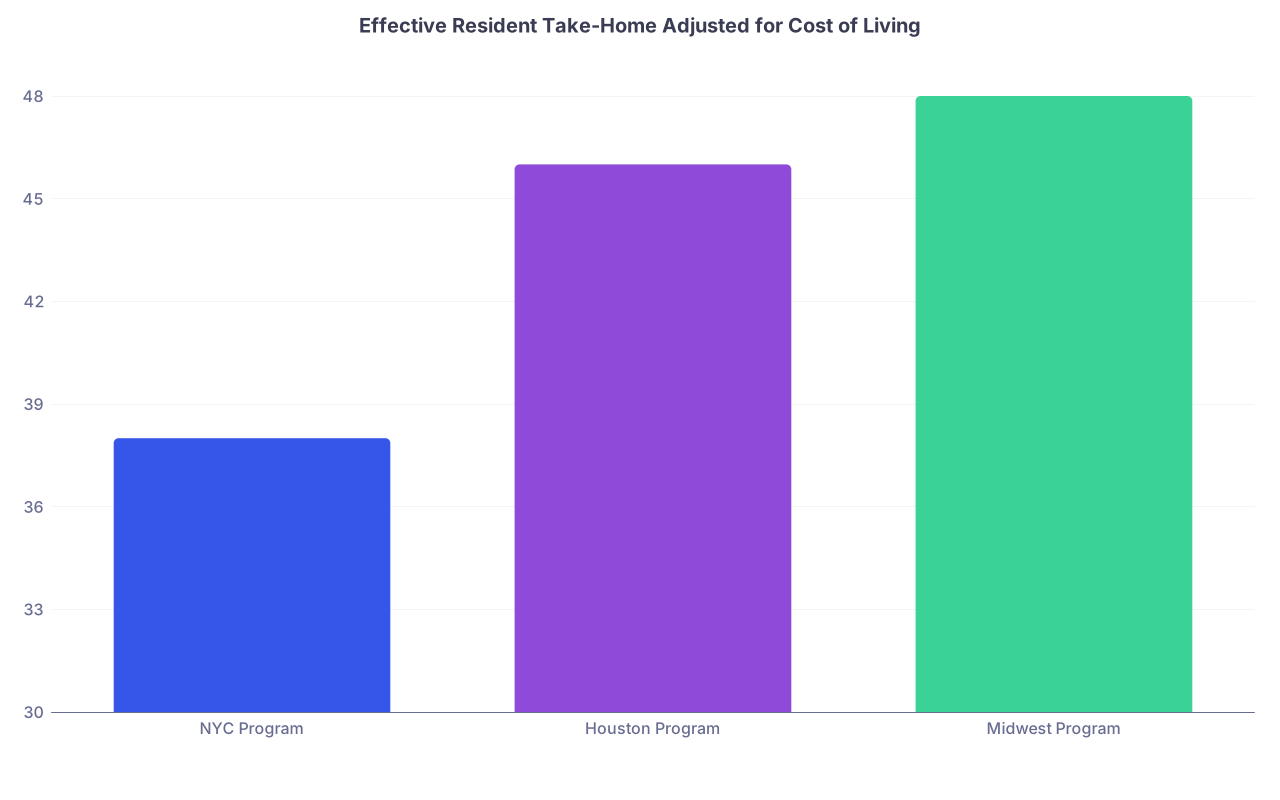
| Category | Value |
|---|---|
| NYC Program | 38 |
| Houston Program | 46 |
| Midwest Program | 48 |
Interpretation of the chart:
- NYC Program: $72k salary, but after federal/state/local tax and sky‑high rent, effective discretionary take‑home ≈ $38k
- Houston Program: $65k salary, no state income tax, moderate rent → ≈ $46k
- Midwest Program: $60k salary, lower rent and COL → ≈ $48k
So if your pre‑match is NYC at $72k, and a likely Match outcome is a $60k Midwest program, the “pay cut on paper” might be a pay raise in real terms.
You should be comparing after‑tax, after‑rent, after‑COL disposable income, not line‑1 salary.
2.2 Overtime, Moonlighting, and Shift Differentials
I have seen two programs both advertising “$65k PGY‑1”, but:
- Program A: Strict work‑hour cap, no internal moonlighting, minimal bonuses → real annual comp ≈ $65k
- Program B: Predictable moonlighting as PGY‑2/3 worth $10k–$15k/year, night float differential ~$3k/year → real comp ≈ $75k–$80k
If your pre‑match program bans moonlighting and your likely Match programs do not, they are asking you to give up 5‑figures per year in future upside. That matters.
2.3 Benefits That Quietly Add Thousands
Three specific benefit categories move the needle:
- Health insurance: resident‑only premium vs heavily subsidized family coverage; high deductible vs low; HSA eligibility
- Retirement: some academic centers contribute 3–5% of salary even for residents, others contribute 0%
- Stipends: housing, transportation, meals, exam fees, Step 3 reimbursement
When I compare programs side by side with actual numbers, the spread in total annual value commonly hits $5,000–$10,000. That is not hypothetical; it is in the HR PDFs if you dig.
| Benefit Category | Program X (Pre-match) | Program Y (Match Option) |
|---|---|---|
| Health Insurance | $4,500 | $7,000 |
| Retirement Match | $0 | $2,500 |
| Housing Stipend | $3,000 | $0 |
| CME / Exam Support | $1,000 | $2,000 |
| **Total Benefits** | **$8,500** | **$11,500** |
Program Y looks “lower salary” on paper, but its benefit delta is +$3,000/year. Over 3 years: +$9,000. After compounding, more.
3. Risk and Expected Value: The Core Calculation
Now to the real question: “Is accepting the pre‑match offer financially better than waiting for the Match?” That is a probability problem.
You need, roughly:
- Probability you match at an “average” program
- Probability you match at a better‑paying / better‑COL / better‑benefit program
- Probability you do not match at all (or SOAP into a less favorable outcome)
- Financial value of each outcome
Even crude estimates here are better than blind guessing.
3.1 A Simple Expected Value Model
Let us say:
- Pre‑match Program A (guaranteed if accepted):
- Real annual value (salary + benefits – COL penalty) ≈ $65k
- 3‑year total (ignoring raises) ≈ $195k
You think if you go into the Match:
- 60% chance you match into Program B:
- Real annual value ≈ $70k → 3‑year ≈ $210k
- 25% chance you match into Program C (worse pay/COL):
- Real annual value ≈ $60k → 3‑year ≈ $180k
- 15% chance of no match / SOAP outcome with forced gap / prelim + scramble:
- Effective 3‑year value ≈ $120k (lost year, relocation, chaos, etc.)
Expected 3‑year value of “wait for Match”:
EV = 0.60×210 + 0.25×180 + 0.15×120
EV = 126 + 45 + 18 = $189k
Pre‑match guaranteed: $195k
From a strictly financial expected value standpoint, the pre‑match is slightly better here, even though some outcomes in the Match are individually richer.
Change the assumptions and the answer flips. If you are a strong applicant with:
- 80% chance of $210k outcome
- 15% chance of $180k outcome
- 5% chance of $120k outcome
EV = 0.80×210 + 0.15×180 + 0.05×120
EV = 168 + 27 + 6 = $201k
Now the Match path beats the $195k pre‑match on expected value. That is the logic you need.
4. Specialty and Competitiveness: Where the Numbers Change
The value of locking in a pre‑match offer explodes in high‑risk scenarios and shrinks in low‑risk ones.
4.1 Competitive Specialties (Derm, Ortho, Plastics, ENT, etc.)
Data from NRMP shows match rates for US allopathic seniors in some competitive specialties hovering in the 60–80% range overall. For IMGs, often much lower.
If your realistic “no match” probability is 20–40% for the specialty you want—and your pre‑match locks in that specialty at a slightly below‑average salary—then financially, this is often a good trade:
- You avoid a lost year (which is a 5‑figure opportunity cost plus more exam and application fees).
- You avoid the risk of being forced into a less favored specialty at lower lifetime earnings.
I have seen IMGs in internal medicine ignore decent pre‑match offers and end up unmatched, then reapply with older scores and worse odds. Financially, that is almost always a losing play.
4.2 Less Competitive Specialties (FM, Psych, Peds, Many IM Programs)
Here the baseline match probabilities for solid applicants are high. If you are a US grad with average stats applying to family medicine, your “no match” risk is tiny if you apply broadly and on time.
In that context, the financial premium of certainty is small. You can be more demanding:
- If the pre‑match is in a very high‑cost city with mediocre benefits, the data often favors waiting.
- If you have geographic flexibility, you can usually find comparable or better comp via the Match.
5. Visa Status and Immigration Risk
For non‑US citizens, the equation tilts again.
A pre‑match offer tied to a reliable visa (often J‑1, sometimes H‑1B) has value beyond salary:
- Failing to match may mean leaving the country.
- SOAP positions with visa support are more limited.
- Scramble‑year research jobs may not solve immigration issues.
Strictly in financial terms, being forced to leave the US or take a low‑paid research job for a year is often a 5‑figure to 6‑figure negative swing over the subsequent decade.
So if you are visa‑dependent, you must inflate the “cost” of the no‑match branch in your EV calculation. That tends to make pre‑match offers more financially attractive, even if the salary looks “average”.
6. How to Actually Compare Two Offers (Step‑By‑Step)
Let me put this in a more concrete, almost mechanical process. You can do this on a napkin or in Excel.
Step 1: Convert Each Program to an Annual “Real Compensation” Number
For each program (pre‑match and likely Match targets), estimate:
- Base salary
- Signing bonus (amortized over 3 years)
- Average overtime / moonlighting (for PGY‑2/3)
- Monetary value of benefits (insurance, retirement match, stipends)
- Subtract a COL penalty based on housing + taxes
Example (Pre‑match Program A, NYC):
- Base: $72,000
- Benefits: $8,000
- COL penalty vs your home reference city: −$12,000
- No moonlighting allowed
Real annual comp ≈ 72k + 8k − 12k = $68k
Example (Typical Match Program B, Midwest):
- Base: $60,000
- Benefits: $11,000
- COL advantage vs your home reference city: +$5,000
- Future moonlighting (PGY‑2/3): averaged $7,000/year over 3 years → +$4,666/year
Real annual comp ≈ 60k + 11k + 5k + 4.7k ≈ $80.7k
This is how the “low salary” program silently beats the big‑city one.
Step 2: Estimate 3‑Year Totals
Multiply by 3, adjust roughly for small annual raises (2–3%). Precision is not critical; order of magnitude is.
- Program A: $68k × 3 ≈ $204k
- Program B: $80.7k × 3 ≈ $242k
Difference ≈ $38k over residency.
If your odds of landing Program B or something similar are high, you can see where this is going.
Step 3: Layer in Probabilities
This is the part almost nobody does, but it is the actual decision engine.
Let us say:
- 50% chance of a Program B‑level outcome
- 35% chance of a Program C‑level outcome (worse Midwest with less moonlighting, say $75k/year real)
- 15% chance of no match / SOAP → $40k/year real over 3 years (lost year, then weaker program, etc.)
3‑year values:
- Program B type: 242k
- Program C type: 225k
- No‑match/SOAP: 120k
EV(wait) = 0.50×242 + 0.35×225 + 0.15×120
= 121 + 78.75 + 18 = $217.75k
Versus pre‑match locked‑in ≈ $204k.
Financially, in this scenario, accepting the pre‑match is leaving around $13k in expected value on the table. Not catastrophic, but not a win either.
Now change the no‑match risk to 30% (IMG, competitive specialty, late application):
EV(wait) = 0.50×242 + 0.20×225 + 0.30×120
= 121 + 45 + 36 = $202k
Suddenly, the pre‑match at $204k edges out waiting. Same offers, different probabilities. Decision flips.
7. Ancillary Financial Effects Most People Ignore
Pre‑match vs Match choices ripple into later earnings too.
7.1 Fellowship and Career Trajectory
Some programs:
- Have higher fellowship match rates into better‑paid subspecialties
- Have reputations that improve your odds at lucrative attending jobs
If your pre‑match is at a strong academic IM program with great cardiology or GI placement, and your likely Match fallback is a community IM program with weaker fellowship outcomes, that can become a 6‑figure lifetime swing. But only if you actually plan to subspecialize and can realistically match there.
You cannot quantify this perfectly, but you can:
- Look at recent fellowship match lists
- Talk to current residents about real placement, not brochure claims
7.2 Geography and Spousal Income
If you have a partner, their earning power changes the equation.
- Big city: your COL is worse, but their job options may be massively better.
- Smaller city: your COL is better, but they might struggle to find work in their field.
Family household income can easily overshadow a $5k–$10k difference in resident salary. You need to model household net income, not just your paycheck.
7.3 Debt, PSLF, and State Programs
Some states and systems offer loan repayment for working in underserved areas after residency. Primary care in certain regions gets significant federal/state support.
If a pre‑match locks you into a health system that later offers strong loan repayment for staying on as faculty, that future option is an invisible asset.
Conversely, a pre‑match at a hospital with no 501(c)(3) status may break your PSLF pathway entirely. That can cost six figures.
8. Tactics: How to Prepare for and Respond to Pre‑Match Offers
You are in the “Residency Match and Applications” phase, so timing matters.
8.1 Before You Get Any Offer: Build Your Comparison Template
Do this now, not when an attending tosses a contract at you and says, “We’d love to have you.”
- Create a simple spreadsheet with columns: Salary, Benefits Value, COL Adjustment, Moonlighting, 3‑Year Total, Notes.
- Populate it with sample numbers from 3–5 typical programs based on FREIDA, program websites, and surveys (e.g., Medscape, AAMC, AMGA data).
- Add one column for “Subjective Fit” just so you acknowledge it, but keep it separate from the numbers.
When the pre‑match comes, you plug in real data and compare.
8.2 When an Offer Arrives: Slow Down 48–72 Hours
The worst financial decisions I see: people say yes in the hallway.
- Ask for the offer in writing.
- Request at least a week to review (you might not get a full week, but you often get a few days if you ask professionally).
- Use that time to update your probability estimates: talk to advisors, look at NRMP Charting Outcomes, revisit your specialty competitiveness.

| Step | Description |
|---|---|
| Step 1 | Receive Pre-match Offer |
| Step 2 | Gather Full Compensation Details |
| Step 3 | Estimate Real Annual Value |
| Step 4 | Estimate Match Outcome Probabilities |
| Step 5 | Calculate Expected Value of Waiting |
| Step 6 | Strong Lean to Accept |
| Step 7 | Strong Lean to Decline |
| Step 8 | Layer Non-financial Factors |
| Step 9 | Final Decision |
| Step 10 | Pre-match EV >= Match EV? |
That is the process. Linear, rational, replicable.
9. So, Are Pre‑Match Offers Financially Better?
The honest, data‑driven answer:
- For high‑risk applicants (IMGs, competitive specialties, visa‑dependent) with meaningful no‑match risk, yes, pre‑match offers are often financially better even when salary is only average, because they eliminate a large downside tail.
- For solid candidates in less competitive fields with broad geographic flexibility, no, pre‑match offers are often not financially better unless the program is clearly strong on total compensation or long‑term career outcomes.
- For borderline cases, the decision hinges less on raw salary and more on cost of living, moonlighting/benefits differences, and your true no‑match probability—not the one you tell yourself to feel better.
The trap is treating any guaranteed position as a “win” without pricing the guarantee.
Key Takeaways
- You should compare pre‑match offers using real annual compensation (salary + benefits − COL + moonlighting), not just base PGY‑1 salary.
- The right way to decide is to compute the expected value of waiting for the Match based on realistic match and no‑match probabilities, then compare that to the guaranteed value of the pre‑match.
- Pre‑match offers become financially attractive as your no‑match risk, visa dependency, and downside cost rise; they are less attractive for strong, flexible applicants who can likely secure better total compensation and career trajectories through the Match.