
The idea that “only desperate applicants get pre-match offers” is wrong. Flat-out wrong. And if you believe it, you’re at real risk of making a terrible strategic mistake.
Programs don’t pre-match you because you’re weak. They pre-match you because they want control. Control over you, over their rank list risk, over their fill rate, and sometimes over specific service needs. That’s not the same thing as “you’re a backup candidate” – and the data from match outcomes, SOAP patterns, and program behavior makes that pretty clear.
Let’s tear this apart properly.
The myth: Pre-match = bottom-of-the-barrel applicant
You’ve heard the hallway talk:
- “If they really liked you, they’d just rank you to match.”
- “Pre-match is for borderline applicants.”
- “Top programs don’t need to pre-match.”
People say this with the fake confidence of someone who’s never actually sat in a program director’s meeting.
Here’s reality: programs use pre-match offers (in systems that allow it or in functionally similar ways via strong “you’ll match here” signals) for a mix of reasons that have nothing to do with you being weak:
- They’re scared of being burned by the match algorithm.
- They’re competing with other programs for the same limited pool of candidates.
- They have specific service lines they must fill (ICU, night float, rural clinic).
- They want to “lock in” applicants who fit their culture or language needs or geography.
A lot of the applicants who get those calls? Mid-to-strong candidates with some leverage. Not only “desperate” ones.
What actually happens on the program side
Let me walk you through how this looks behind closed doors.
Step 1: Risk calculus, not charity
Program leadership sits with a board of names and scores. They know three things:
- They must fill every spot or they look bad (and their residents suffer).
- The NRMP algorithm favors applicants, not programs.
- Top applicants hedge their bets and rank big-name places over them.
So they ask:
- “Who do we absolutely not want to lose?”
- “Who is strong enough to match elsewhere but realistically might say yes to us early?”
- “Who meets our actual service needs for next year?”
Those are often the people who get the pre-match outreach, not the ones hanging by a thread.
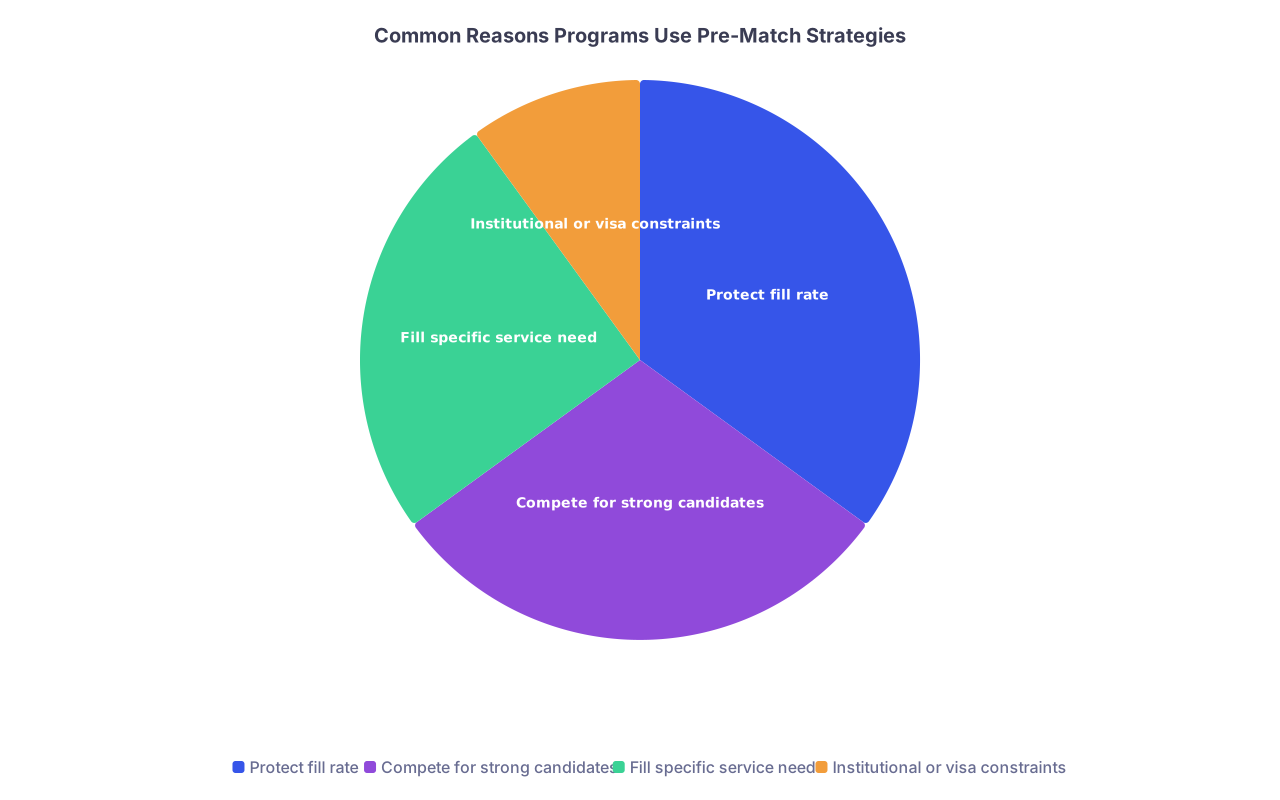
| Category | Value |
|---|---|
| Protect fill rate | 35 |
| Compete for strong candidates | 30 |
| Fill specific service need | 25 |
| Institutional or visa constraints | 10 |
Notice what’s not on that chart: “Because the applicant is desperate.”
Step 2: Tiering candidates
Most programs don’t just have “good” and “bad” piles. They have tiers:
- Tier 1: Dream applicants – competitive everywhere, might not rank them high.
- Tier 2: Very solid, realistic to match there, strong fit.
- Tier 3: Acceptable, often used to secure fill if top tiers don’t land.
Pre-match-style behavior is most common in Tier 1 and Tier 2. Tier 3 usually gets ranked and left to the algorithm. Why? Because Tier 3 is less likely to get snatched by higher-tier places. They’re safer to leave to the match.
So if you’re getting early interest, repeated emails, “if you rank us first, you’ll match here” or explicit pre-match offers where permitted? You’re probably not sitting in the “desperate” bucket. You’re in the “we’re worried someone else will take you” bucket.
Very different story.
What the data and patterns actually show
We don’t have a neat NRMP table that says “these are the exact stats of pre-matched applicants,” because formal pre-match systems have shrunk and a lot of the behavior now is “informal pre-match”: highly suggestive emails, phone calls, and wink-wink “you will match here if you rank us first” language.
But we do have solid adjacent data:
Programs that fail to fill in the main Match have higher rates of:
- Lower board scores in their incoming classes
- Higher use of SOAP
- Less competitive institutional reputation
Translation: the true “desperate” fill usually happens in SOAP, not in pre-match recruitment.
Highly competitive applicants (high Step 2 CK, strong US grads, solid research) report:
- Multiple “we will rank you very highly” messages
- Some explicit “if you rank us first, you’ll match here” communications
This is just pre-match in a suit and tie. It’s still a program trying to lock you in.
Programs in less desirable locations or with high service burden:
- Are more aggressive with early interest, strong signals, and “commit” talk to secure applicants who could match elsewhere.
Again, you’re not desperate; they are.
- Are more aggressive with early interest, strong signals, and “commit” talk to secure applicants who could match elsewhere.

So why do people think pre-match is only for weak candidates?
Because applicant gossip is terrible at understanding incentives.
Here’s the psychology I’ve seen over and over:
- Applicant A gets a strong pre-match-style signal from a mid-tier program, takes it, withdraws from the Match, and disappears from public comparison.
- Applicant B doesn’t get those calls, goes through the Match, lands mid-tier as well.
- Rumor starts: “Oh, that program only pre-matches weaker candidates to guarantee fill.”
What’s really happening: the program is hedging by locking in candidates who are good enough to lose but not so star-level that they’d never consider them.
Programs also rarely advertise: “We tried to pre-match three of our top candidates and all of them refused.” But that happens constantly.
When a pre-match offer is actually a red flag
Now, let’s be clear. Some pre-match-like behavior is sketchy. Some is flat-out manipulative.
These situations should make you suspicious:
- They pressure you to answer extremely fast (24–48 hours) with no time to think.
- They avoid giving anything in writing and insist on verbal “trust me.”
- They hint that if you don’t accept now, they might not rank you at all.
- They refuse to clearly state whether a “guarantee” is official or just their “opinion.”
Those are desperation signs. But it’s program desperation, not automatically yours.
The existence of a pre-match offer doesn’t mark you as weak. The quality of that offer and the context around it tells you what’s really going on.
How to prepare for pre-match offers strategically (not emotionally)
This is where people blow it. They treat pre-match like a compliment or an insult, rather than a contract decision with long-term consequences.
You prepare in three ways: numbers, scenarios, and scripts.
1. Know your numbers and realistic market position
Before offers even start:
- Look at your Step 2 CK, clinical grades, research, and red flags honestly.
- Compare to NRMP’s Charting Outcomes for your specialty and background (US MD vs DO vs IMG).
- Place yourself into a rough competitiveness band: “likely to match broadly,” “solid but not bulletproof,” “at real risk of going unmatched.”
That band determines how much risk you can take turning down a pre-match offer.
| Applicant Band | Match Risk Level | Turning Down Pre-Match |
|---|---|---|
| Strong US MD, no red flags | Low | Often reasonable |
| Average US MD / strong DO | Moderate | Case-by-case |
| IMG or multiple red flags | Higher | Decline very cautiously |
2. Run worst-case and best-case scenarios
Ask yourself:
- Best case if I accept this pre-match: I’m securely matched, I like this program enough, I stop stressing.
- Worst case if I accept: I later get interview traction at clearly better programs, but I’m locked and can’t take them.
- Best case if I decline: I match at a program that’s a better fit (location, reputation, training).
- Worst case if I decline: I go unmatched and end up in SOAP with fewer, weaker options.
Notice how different that feels if you’re a strong US MD vs an IMG with marginal scores.
This is not about ego. It’s risk management.
Reading a pre-match offer for what it really says
Strip away the flattery. Instead, interpret the signal:
“We’re willing to commit to you early.”
That means you crossed a bar. They aren’t doing this for every random applicant.“We want to secure you before other places grab you.”
That suggests they consider you competitive enough to lose.“We need to protect our position in the Match.”
That’s their problem, not a judgment of your worth.
A common trap: applicants think, “If they’re pre-matching me, this must be my level; I shouldn’t expect better.” That’s just wrong. I’ve seen applicants with 250+ Step 2, publications, and honors, get aggressive pre-match overtures from mid-tier community programs terrified of losing them. Those same applicants later matched at big academic centers they preferred.
The pre-match did not define their value. It revealed the program’s anxiety.
How to respond: practical scripts that don’t burn bridges
You need language ready before you get the call or email. Otherwise you’ll panic and say something you regret.
If you’re interested but not ready to commit:
“I’m genuinely very interested in your program and honored by the offer. This is a major decision for me. Can you share the exact timeline you need an answer by, and whether the offer details can be sent in writing so I can review carefully?”
This does three things: slows the pace, forces clarity, and pushes them toward written specifics.
If you likely want to decline but want to stay ranked:
“I really appreciate your confidence in me. At this point I’m planning to complete the regular Match process, but I would be very happy to remain highly ranked on your list. I had a great experience on interview day.”
You’re saying no without spitting in their face.
If a program is being manipulative:
“To make a fair decision, I’ll need clear written terms and at least a few days to consider. If that’s not possible, I fully understand, but I also don’t feel comfortable committing under pressure.”
If they don’t respect that? They’re showing you exactly what working with them will feel like.

| Step | Description |
|---|---|
| Step 1 | Receive Pre-Match Offer |
| Step 2 | Compare vs Dream Programs |
| Step 3 | Weigh Security vs Preference |
| Step 4 | Prioritize Guaranteed Spot |
| Step 5 | Leaning Accept |
| Step 6 | Likely Decline |
| Step 7 | Ask For Details and Time |
| Step 8 | Decline Politely |
| Step 9 | Know Your Risk Level |
| Step 10 | Offer Acceptable? |
Redefining “desperation” correctly
There is desperation in this process. But it’s not where most people think.
True desperation is:
- A program going into SOAP with multiple unfilled positions.
- An applicant going unmatched because they misjudged their market and over-reached.
- Last-minute scrambling for any open spot just to have “a place.”
Pre-match offers, when done above-board, are not that. They’re a negotiation tool in a market that’s structurally stacked toward applicants in the algorithm, but stacked toward programs in information and power.
You’re not desperate for getting an offer. You become desperate when you misunderstand what that offer means.
Bottom line: what the evidence actually shows
The highest-yield way to think about pre-match offers is not “Is this for desperate people?” but “What does this signal about my risk and their risk?”
Patterns from real programs and applicant outcomes show:
- Good candidates get pre-match attention all the time.
- Truly weak candidates are more likely to end up in SOAP than in some golden pre-match.
- Programs with the most to lose (fill risk, location disadvantage, service-heavy) are the ones most likely to push hard for commitments.
So no, programs don’t “only pre-match desperate applicants.” They pre-match applicants they’re afraid to lose. Sometimes that’s you, even if you’re stronger than you think.
Years from now, you won’t remember exactly when that pre-match email hit your inbox. You’ll remember whether you understood your own value clearly enough to make the right call.