
Pre-match offers do not mean you are the program’s top choice. They mean you are a strategic choice. Those are not the same thing.
If you assume “early offer = I’m their number one,” you’re setting yourself up to misread leverage, misjudge risk, and sometimes sign a contract you’ll regret.
Let’s dismantle the hero narrative around pre-match offers and look at how programs actually think.
What a Pre-Match Offer Really Signals (And What It Doesn’t)
First, clarity: I’m talking about off-cycle or early contract offers outside the main Match algorithm (common in some specialties and countries, and in certain US contexts like prelims, off-cycle spots, or SOAP-like chaos). The exact mechanics vary by system, but the psychology is the same.
A pre-match offer almost always signals:
- The program is worried about filling.
- The program wants to lock in a certain minimum level of candidate quality.
- The program believes you are good enough and might go elsewhere if they wait.
What it does not reliably signal:
- That you are the #1 candidate on their list.
- That they won’t rank other people above you later.
- That they’re done recruiting for that position.
I’ve watched this play out in real time. PDs saying things like:
- “Let’s secure him before he gets a better offer.”
- “She’s solid. Not a superstar, but safe.”
- “We need a body in that spot. Offer now, decide on the others later.”
Romantic? No. Real? Yes.
Programs are managing risk. They’re playing probabilities, not handing out golden tickets.
Why Programs Push Pre-Match Offers: The Unromantic Math
Strip away the nice language in the email. Underneath is a risk calculation.
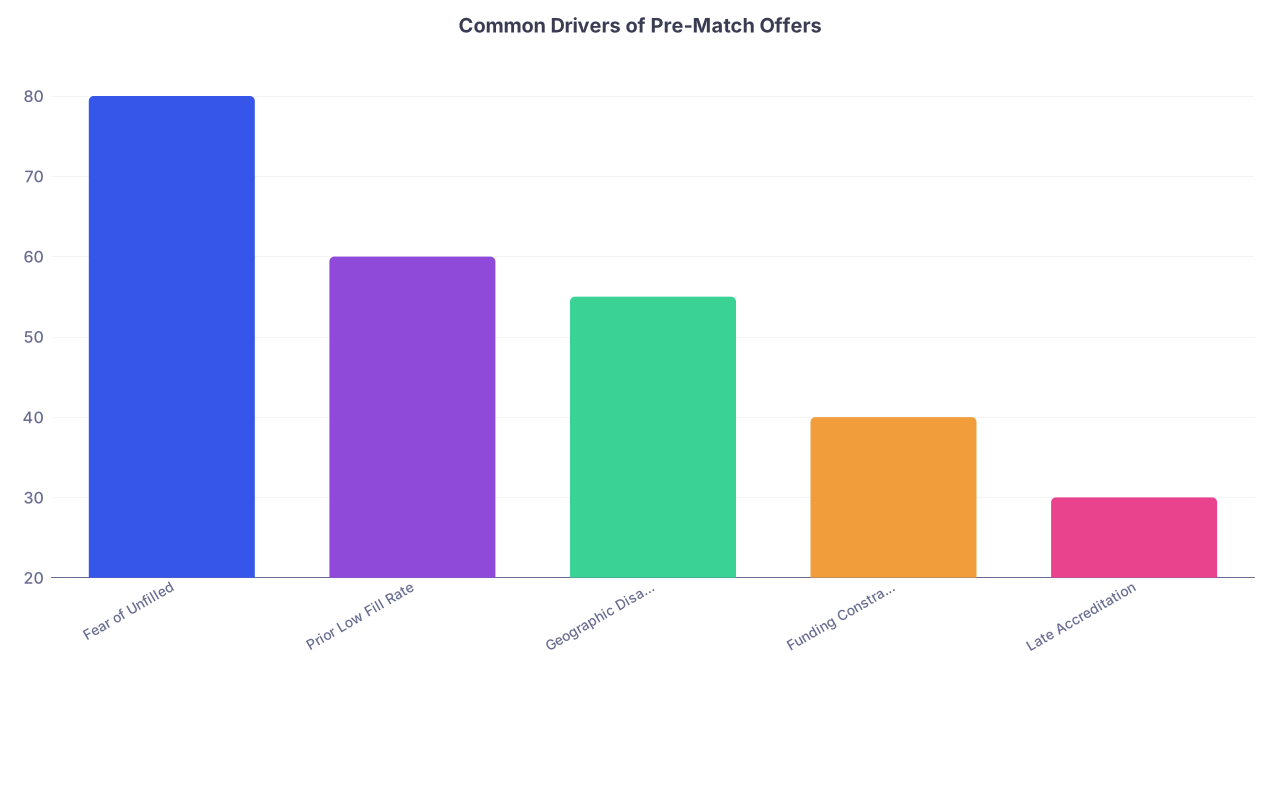
| Category | Value |
|---|---|
| Fear of Unfilled | 80 |
| Prior Low Fill Rate | 60 |
| Geographic Disadvantage | 55 |
| Funding Constraints | 40 |
| Late Accreditation | 30 |
Here’s the actual logic I’ve heard in PD meetings and selection committees:
Programs that have gone unfilled before—or are in less popular locations—are jumpy. They’ve lived the nightmare of scrambling for whoever’s left. They’ll happily trade “maybe we could have done a bit better” for “we are not desperate in March.”
So they pre-match solid candidates. Not necessarily the best. The safest.
- They don’t trust their own attractiveness
Community programs, new programs, or those with bad reputations know they’re not everyone’s dream. They worry that if they wait for the Match, their best candidates will rank bigger names higher and disappear.
Solution: pressure you early, when your options are still theoretical.
- They want to set a quality floor, not find a ceiling
A lot of pre-match strategy is: “If we can fill 3 of 6 spots with dependable, average-to-good residents, we can gamble on the rest.”
Pre-match offers are often about establishing a baseline: “We will not go below this level of quality.” That’s not the same thing as “You are our top catch.”
- Contract timing and hospital politics
Sometimes the pressure isn’t even the PD’s fault. Hospital admin wants positions filled on paper by a certain date for budgeting and planning. That can push early offers well before the field has fully shaped up.
Bottom line: pre-match offers are about program anxiety, not just your brilliance.
You vs. Their Rank List: The Ugly Truth
Let me be very direct: many programs that give pre-match offers are still interviewing and ranking other candidates they like more.
They just don’t tell you that.
Here’s how this looks inside a program:
- October: You interview. They like you. You’re clearly competent, no red flags.
- November: Committee meets. “We should secure at least one candidate early. How about [you]?”
- They send a pre-match offer. Meanwhile…
- December–January: They interview several stellar candidates—higher scores, AOAs, stronger letters, better “fit.”
- Those people get ranked above where you would have been if you stayed in the Match.
If you accept the pre-match, great, they’ve locked a safe option.
If you reject it, they might still rank you. Or not. Depends on how the rest of the season goes.
Do not confuse:
- “We would be happy to have you,”
with - “We won’t find anyone we like more than you.”
Two very different statements.
How Pre-Match Offers Can Lower Your Leverage
The biggest myth: “A pre-match offer gives me power.”
Mostly, it gives the program power. Here’s why.
Once you accept:
- You’re off the market.
- You lose the ability to compare multiple programs side by side.
- You often cancel other interviews (or they cancel you when they hear you matched elsewhere).
Programs know this.
It’s classic “exploding offer” psychology: put you under time pressure, appeal to your fear of ending up unmatched, make you ignore the asymmetric information.
You know:
- Your score
- Your application history
- How anxious you feel
They know:
- Their prior fill rates
- How many strong applicants are in their pipeline
- How you compare to the rest of their current pool
They have a more complete picture of the game than you do, and they’re making the move that benefits them first.
When Pre-Match Offers Actually Indicate You’re Top-Tier
To be fair, sometimes a pre-match does mean you’re one of their favorites. Not always, not never. Context matters.
A pre-match is more likely to reflect “you’re at the top” when:
- It’s a strong, in-demand program with a consistent history of filling.
- They explicitly say they’re not offering many pre-match contracts (and you later confirm that through the grapevine).
- They move very quickly after your interview and personalize communication heavily (not just a boilerplate email).
- Faculty and PD made it very clear on interview day that you’re exactly their target profile, and they’ve been consistent with that messaging.
But even in that rosy scenario, “top-tier” often means “top several,” not necessarily “#1 overall.”
If you treat “pre-match = #1,” you’ll misread signals and may credit the program with more loyalty than it has earned.
How to Evaluate a Pre-Match Offer Like an Adult, Not a Panicked MS4
You can’t make a good decision if you keep repeating “An offer is an offer, I should be grateful” in your head. That’s how people walk into miserable PGY-1 years.
You need a framework that cuts through the flattery.
| Question Category | Ask Yourself Honestly |
|---|---|
| Program Quality | Would I be happy here if it were my only option? |
| Market Position | Is this program typically competitive or not? |
| My Competitiveness | Do my stats reasonably get me interviews elsewhere? |
| Risk Tolerance | How terrified am I of scrambling/unmatched? |
| Gut Check | If this were a March Match result, would I feel relieved or disappointed? |
Now let’s break how to think about this.
1. Know who actually benefits more
Ask: “If I walk away from this offer, who is more scared: me or them?”
- If they are a historically unfilled program and you’re above their usual stats → they’re more scared.
- If you barely got any interviews, or you’re in a very competitive specialty with no backup → you’re more scared.
The more scared party is the one giving up leverage.
2. Compare against your realistic—not fantasy—ceiling
Forget “I’d love to be at MGH” if your application screams mid-tier community. You should be asking:
“In my honest, data-based estimation, is this offer:
- below what I can probably get,
- about what I can probably get,
- or better than I expected?”
If it’s better than you expected, taking it is rational.
If it’s clearly below, you’re selling yourself short because you panicked.
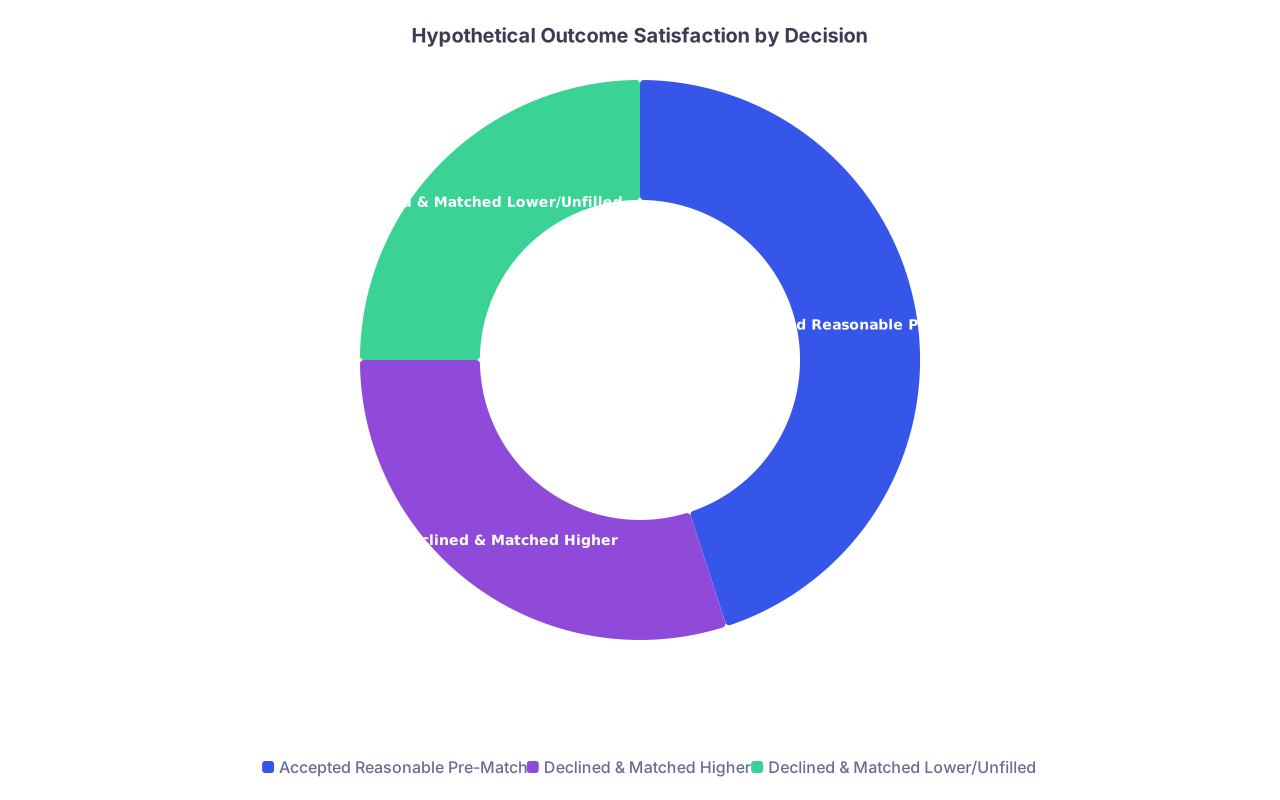
| Category | Value |
|---|---|
| Accepted Reasonable Pre-Match | 45 |
| Declined & Matched Higher | 30 |
| Declined & Matched Lower/Unfilled | 25 |
That 25% “declined & matched lower/unfilled” slice is why pre-match offers are so psychologically powerful. Your brain fixates on the downside, not the upside.
3. Look at program behavior, not their compliments
Red flag behaviors:
- Vague answers about prior fill rates.
- No transparency about how many offers they’re sending.
- Hard time limits: “You must decide in 48–72 hours.”
- Dodging questions about call burden, supervision, or support.
Normal/neutral behaviors:
- Giving you at least a week to decide.
- Willingness to connect you with current residents.
- Clear explanation of past fill history and why they’re using pre-match.
If they act like a pushy timeshare salesman, treat the offer accordingly.
The Timeline Trap: How Pre-Match Warps Your Season
Your decision isn’t made in a vacuum. It affects your entire application cycle.

| Step | Description |
|---|---|
| Step 1 | Receive Pre Match Offer |
| Step 2 | Withdraw Future Interviews |
| Step 3 | Continue Interviewing |
| Step 4 | Less Comparison Data |
| Step 5 | Guaranteed Spot |
| Step 6 | More Options |
| Step 7 | Risk of Unfilled |
| Step 8 | Accept Offer? |
If you accept:
- You’ll probably cancel later interviews. Less data. Less perspective.
- You won’t see how higher-tier programs react to your application.
- You might never find out you could have matched at a better place.
If you decline:
- You’ll live with more uncertainty.
- You gain more data points about how programs perceive you.
- You keep the ability to aim higher but accept the risk of landing lower.
Neither path is inherently “right.” It depends on your risk tolerance and how much you trust your own competitiveness.
Reading the Hidden Signals in a Pre-Match Offer
Here’s the decoding guide most applicants never get.
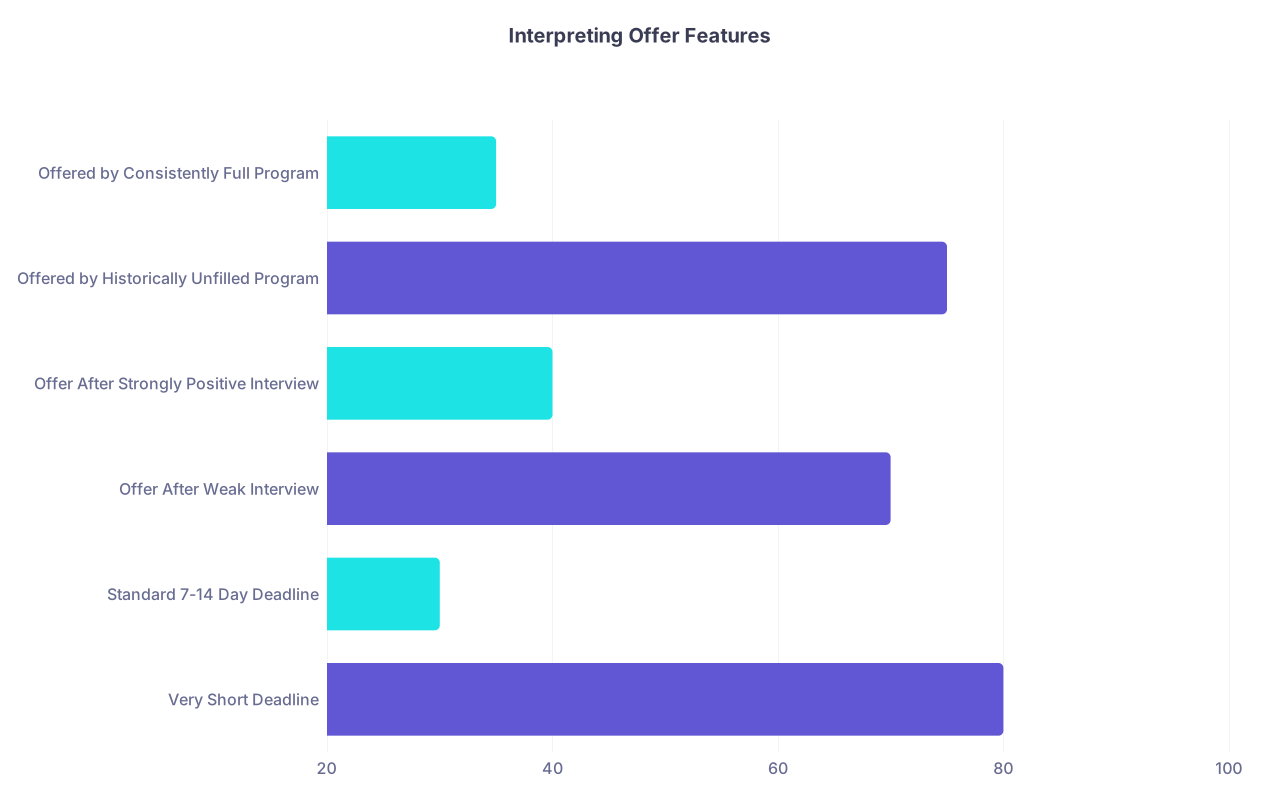
| Category | Value |
|---|---|
| Very Short Deadline | 80 |
| Standard 7-14 Day Deadline | 30 |
| Offer After Weak Interview | 70 |
| Offer After Strongly Positive Interview | 40 |
| Offered by Historically Unfilled Program | 75 |
| Offered by Consistently Full Program | 35 |
Rough takeaways:
- Very short deadline → They’re nervous or manipulating scarcity. Usually means they worry you’ll get better options.
- Offer after a mediocre-feeling interview → You might be a safety option. They want to lock down their floor.
- Offer from a program that often goes unfilled → This is risk-control on their side, not a sign you’re a superstar.
- Offer from a program that always fills and is well-regarded → Stronger signal you’re high on their internal list (still not guaranteed “top”).
Ask direct questions like:
- “How many pre-match offers are you planning to send?”
- “What percentage of your positions are you planning to fill this way?”
- “What’s your fill history in the last 3 years?”
If they dodge or get uncomfortable, that tells you something.
How to Respond Strategically (Instead of Emotionally)
Here’s how to handle the moment the offer hits your inbox without losing your mind.
Do not reply immediately.
Thank them. Ask for the exact deadline. Buy time.Get real data fast:
- Talk to current residents off-script (not just the ones they hand-picked).
- Look up program fill history where available.
- Ask trusted mentors to give you a cold, harsh assessment of your competitiveness.
- Run the “future self” test:
Picture two scenarios:
- Scenario A: You accept this offer now. In March, you watch classmates match at places higher on your original list. How do you feel? Relieved? Jealous? Trapped?
- Scenario B: You decline. In March, you end up with a slightly worse program or even scrambling. How do you feel? Crushed? Still okay with the gamble?
Whichever future regret feels more unbearable is your answer.
- If you’re going to ask for more time, be precise and professional.
Something like:
“Thank you very much for the offer. I’m very interested in your program and want to make a thoughtful decision. Would it be possible to have until [specific date] to consider this?”
Sometimes they say yes. If they say no, that’s also data—about how they operate.
The Core Myths You Need to Drop
Let me boil it down.
Myth: “A pre-match offer means I’m their top candidate.”
Reality: It means you’re good enough and they’re anxious enough. You might be top-tier, middle-tier, or just “safe.”Myth: “Turning this down is stupid; an offer is an offer.”
Reality: Taking the wrong offer can lock you into years of training misery. It’s not disrespectful to evaluate your options like a professional.Myth: “Programs offering pre-match contracts are doing me a favor.”
Reality: They are serving their own staffing and fill-rate needs first. You benefit if, and only if, your goals align with theirs.
If you remember nothing else, remember this:
- A pre-match offer is a data point, not a coronation.
- Your job is to interpret what it says about them as much as what it says about you.
- The decision is not “am I worthy of this program?” It’s “does this trade of certainty for optionality make sense for me, right now, given my actual risk profile?”
That framing alone will put you miles ahead of most applicants who see “Offer” in the subject line and stop thinking critically.