
No, Pre-Match Offers Are Not Always ‘Better’ Than Matching Higher
What do you actually lose when you grab that early pre‑match offer… and then find out in March you could have matched somewhere objectively better?
Let’s puncture the fantasy right away: “Any pre‑match is gold; only an idiot risks the Match when they already have a contract.” That line gets thrown around every cycle in WhatsApp groups, hallway gossip, and, yes, by some anxious attendings reliving their own war stories.
It’s also wrong. Or at least dangerously oversimplified.
Pre‑match offers can be fantastic. They can also quietly trap you into a worse career trajectory, lower training quality, and fewer options, all because you were scared to wait three more months.
Let’s walk through what the data and actual outcomes show — not the fear-driven mythology.
What a Pre‑Match Offer Actually Is (And What It Is Not)
First, basics. A pre‑match offer is an early contract issued outside the regular NRMP Match timeline, usually by non‑NRMP or “opt‑out” programs (FMG-heavy institutions, some community programs, certain specialties in some states). In some countries, pre‑match is the norm; in the NRMP system, it’s a carve‑out.
You’ll hear two myths immediately:
- “Pre‑match is proof you’re a top candidate.”
- “Once you have an offer, only a lunatic keeps interviewing or waiting.”
Both are sloppy takes.
Programs pre‑match for all kinds of reasons that have nothing to do with your greatness:
- They’re historically less competitive, so they lock people in early.
- They’ve had trouble filling in the regular Match.
- They’re IMG/FM‑heavy and want to secure visa candidates before others.
- Their location is less desirable, so they dangle “security” instead of prestige.
Yes, sometimes a strong program pre‑matches a superstar they’re afraid of losing. But the presence of a pre‑match system alone does not magically mean “better for you.”
Pre‑match = they want you early. Nothing more. Nothing less.
The Core Trade-Off: Risk vs. Long-Term Value
When you say “yes” to a pre‑match, you’re making one core trade-off:
You reduce short‑term uncertainty
in exchange for
potentially sacrificing long‑term training quality, reputation, and opportunity.
And this is where people get intellectually lazy. They overvalue how awful it feels to be uncertain and undervalue how much training environment and program reputation matter over 30–40 years of career.
I’ve actually heard a PGY‑2 say, “Yeah, I turned down University of X; I already had a pre‑match at Y and didn’t want to roll the dice.” He’s now in a small, poorly structured community program emailing everyone on earth trying to lateral into a fellowship. Guess what fellowship directors ask: “Where did you train?” Then they go quiet.
Let’s ground this in something a bit more structured.
| Factor | Strong Pre-match Now | Higher Match Later (Potential) |
|---|---|---|
| Short-term anxiety | Much lower | Higher until Match Day |
| Contract security | High | None until Match results |
| Program reputation | Often lower | Often higher if you match higher |
| Fellowship opportunities | Can be limited | Typically stronger |
| Geographic flexibility | Fixed early | More options if you rank widely |
| Visa security (if IMG) | Often better early | Depends on match outcome |
Security feels great in October. It matters a lot less in 2035 when you’re stuck in a weaker job market because your training program was the most convenient choice at age 27.
What the Data and Patterns Actually Show
There isn’t a giant randomized trial of “people who took pre‑match vs those who waited.” But there are consistent patterns in NRMP and fellowship data that tell you enough to stop pretending all offers are equal.
1. Program reputation tracks with fellowship and job outcomes
Look at the NRMP’s Charting Outcomes for fellowship matches and workforce surveys. Time and again, training location and program type show up as:
- University vs community
- Top‑tier academic vs lower‑visibility regional
- Big‑name vs “Where is that again?”
Are there exceptions? Sure. But averages matter. Matching into a stronger program — especially academic — raises your odds of:
- Competitive fellowships (cards, GI, heme/onc, ortho subspecialties, etc.)
- Getting your first choice of geography for jobs
- Having faculty who can actually call someone they know at a desired fellowship
A pre‑match at a low‑visibility, historically weaker program can absolutely close some of those doors, even if everyone pretends “it all evens out.” It doesn’t always.
2. Programs that routinely pre‑match are often not the top of the heap
Notice the word: “often,” not always.
Take a look at which programs heavily market pre‑match offers, particularly to IMGs. You’ll see patterns:
- High IMG percentage
- Lower historical board pass rates
- Struggle to fill via regular Match in previous years
- Limited research infrastructure and weak fellowship pipelines
Not universally. But enough that you should stop treating “pre‑match” as a synonym for “premium.”
If a University Hospital that almost always fills in the main Match suddenly pre‑matches you, that’s a different conversation. But that’s not the typical scenario.
3. Residents who locked in early sometimes regret it — loudly
I’ve sat in lounges where senior residents bluntly told interns:
“Do not pre‑match here if you’ve got legitimate shots elsewhere. I only did it because I panicked.”
I’ve seen people:
- Take a pre‑match at a small community IM program.
- Then see their friends match at university IM with strong fellowships.
- Spend 3 years scrambling to make up the gap with research, away electives, and networking.
Can they overcome it? Often, yes — with a lot more work. Were they actually “safer” long-term? Arguable.
When a Pre‑Match Offer Is Rationally Better
Now, let me be clear. I’m not on some ideological crusade against pre‑match. I’m against treating it like it’s always the smarter move.
There are scenarios where grabbing a pre‑match is absolutely rational, even optimal.
1. You’re borderline to match at all
If your Step 2 score is weak, you have multiple failures, big red flags, or you’re coming from a low‑support international school with past cycles leaving many unmatched peers, a solid pre‑match might be the only real lifeline.
In that case, your decision matrix isn’t:
“Pre‑match vs Top‑20 university.”
It’s:
“Pre‑match vs potential total shutout and scrambling into prelim limbo.”
Pre‑match is clearly advantageous when the realistic alternative is no categorical position.
2. Visa and immigration risk is massive for you
If you’re an IMG and your visa status is fragile, an early contract with guaranteed sponsorship can be worth more than a marginally better program that may not rank you high enough or could change visa policies.
I’ve seen J‑1 candidates who played chicken with the Match, didn’t match, and spent an entire year in limbo. For them, a known pre‑match with reliable visa backing would have been the smarter play.
3. The pre‑match is actually top‑tier for your goals
Occasionally, the pre‑match program is one of your top realistic options:
- University‑affiliated program with strong fellowship matches.
- Location where you genuinely intend to stay long-term.
- Mentors and subspecialty interests that line up perfectly.
If you’re looking at your rank list and realize, “Honestly, I’d rank this pre‑match as #1 or #2 anyway,” then accepting it can remove uncertainty without much downside.
Just be honest: many pre‑match offers people grab are not that scenario. They’re more like #6–#10 on a true merit-based list, bumped to #1 because of fear.
How to Decide Without Lying to Yourself
Let’s stop with the vague “go with your gut” nonsense. Your gut is anxious and unreliable under stress. Instead, be clinical about it.
Step 1: Build two separate rank lists
First list: If there were no pre‑match at all, how would you rank every program purely based on:
- Training quality
- Reputation
- Fellowship outcomes
- Location you actually want
- Support/fit
Second list: Including the pre‑match reality, where the pre‑match is a guaranteed contract and everything else is a probability game.
If your pre‑match program would naturally be in your top 2–3 on that first, “no-pre‑match” list, then taking it is much easier to justify. If it’s sitting at 7th or 8th but you’re just scared of “what if I don’t match higher,” you’re making a fear choice, not a rational one.
Step 2: Estimate your actual competitiveness
Look at NRMP’s Charting Outcomes for your specialty. Compare:
- Your Step 2 score to matched medians.
- Number of programs you applied/interviewed at.
- Whether those programs historically fill and with what profiles.
You’re not trying to be perfect; you’re trying to avoid magical thinking. If you’re clearly above the median of matched applicants and have a decent spread of interviews, the probability you’d match into something “better” than a weak pre‑match is not trivial.
On the flip side, if you have 3 interviews total in a competitive specialty and one of them is offering a pre‑match… the math looks different.
Step 3: Quantify your long-term downside, not just short-term relief
Ask yourself bluntly:
“If I wake up in 10 years and realize this program limited my fellowship or job options, will I still say, ‘At least I had less anxiety that one winter’?”
That’s the trade. Security now. Optionality later.
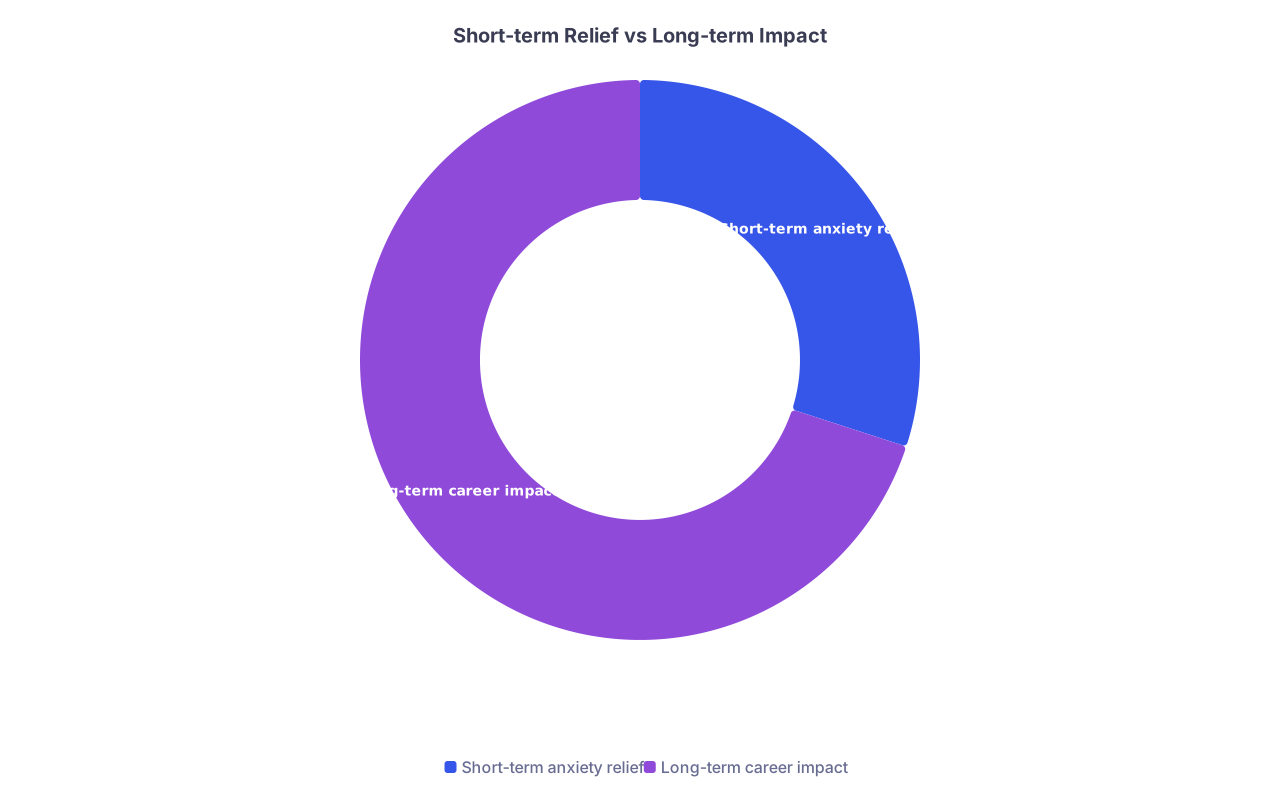
| Category | Value |
|---|---|
| Short-term anxiety relief | 30 |
| Long-term career impact | 70 |
Most people flip that ratio in their head. They act like the anxiety reduction is 90% of the equation and the long-term career impact is 10%. It’s actually closer to the opposite.
Red Flags That a Pre‑Match Might Be a Trap
There are patterns I’d treat as big yellow lights, if not outright red.
Program can’t stop talking about “We pre‑match!”
If the main selling point is “we give early offers,” not board pass rates, fellowships, or teaching quality, ask why.Residents quietly warn you
When you ask, “Would you come here again if you had a choice?” and the room gets awkward or the answer is a soft “Honestly… probably not,” believe that over the brochure.No strong fellowship track record in your area of interest
If you want cards or GI and the program has produced one fellow in 5 years — all by sheer individual hustle — understand you’ll be swimming upstream.You’d never rank this program high without the “safety” factor
If, in a world with guaranteed match, this place would be middle or low on your list, you’re not picking it for fit. You’re picking it for fear.
A Quick Reality Check With Some Numbers
Let’s sketch a hypothetical.
You’re applying IM as an IMG:
- Step 2: 239
- Decent but not amazing letters
- 9 total interviews: 2 decent university‑affiliated, 4 mid‑tier community, 3 lower‑tier community
One of the lower‑tier community programs gives a pre‑match.
You’re not choosing between “pre‑match or homelessness.” You’re choosing between:
- Guaranteed low‑tier community
- Very high probability of matching somewhere across 9 interviews, with a non‑trivial chance of landing at a better community or even university‑affiliated program
Now contrast that with:
- Step 2: 215
- 3 total interviews, all community, one of which offers pre‑match
Different story. Different move.
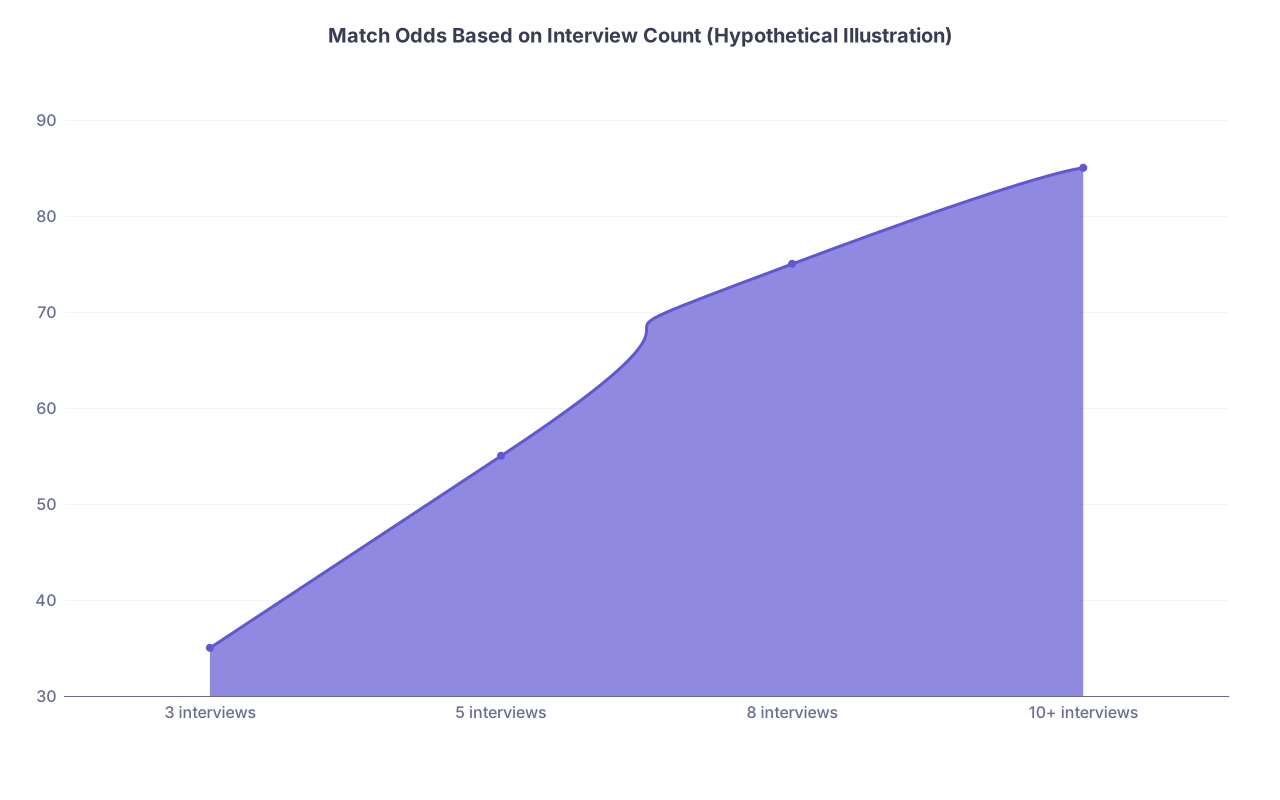
| Category | Value |
|---|---|
| 3 interviews | 35 |
| 5 interviews | 55 |
| 8 interviews | 75 |
| 10+ interviews | 85 |
The more interviews you have — especially at stronger programs — the less sense it makes to blindly grab a weak pre‑match just because it’s early.
How to Prepare Now So You Aren’t Pre‑Match Desperate Later
Everyone wants a magical fix in October. The real “pre‑match strategy” starts earlier.
Strengthen your position so that if you do get a pre‑match, it’s from a program you’d actually be proud to train at.
That means:
- Targeting programs that match your profile, not spraying applications at every open door.
- Doing rotations or auditions where you can actually impress faculty who have sway.
- Getting real intel from current residents, not just PD sales pitches.
- Keeping Step 2, letters, and clinical performance strong enough that you’re not clinging to the first lifeboat you see.
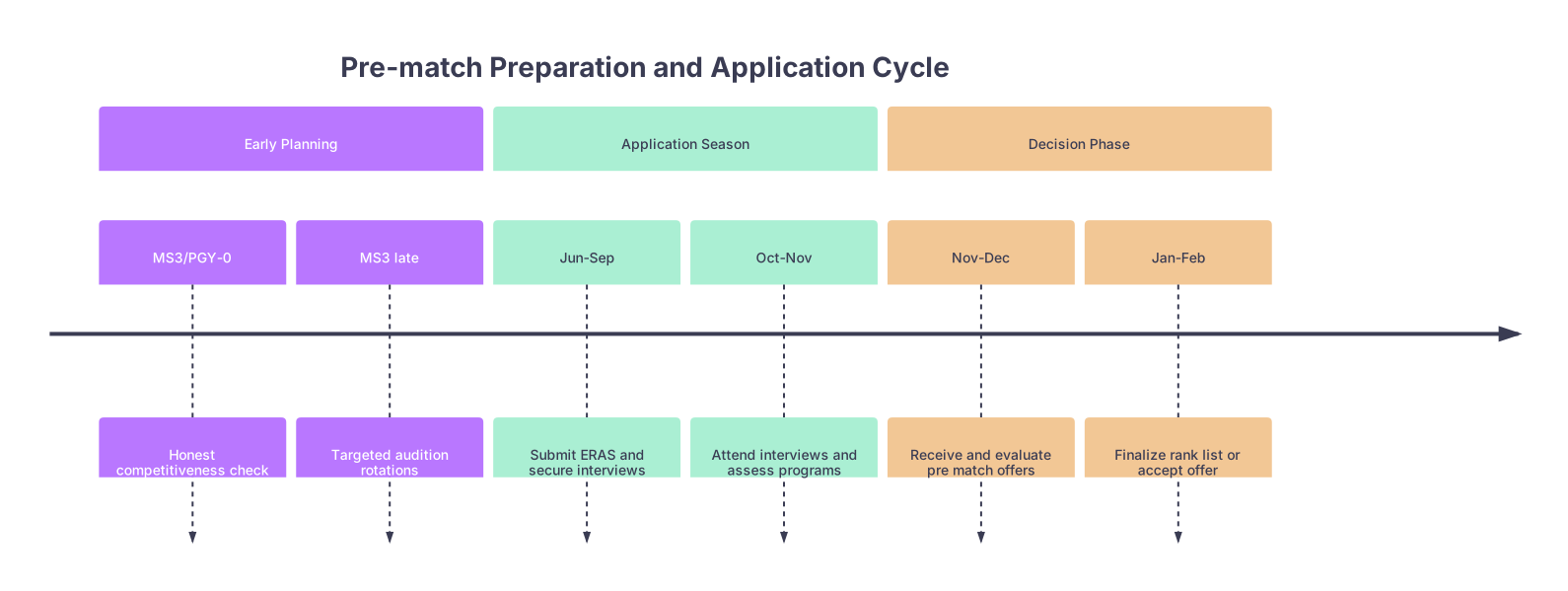
| Period | Event |
|---|---|
| Early Planning - MS3/PGY-0 | Honest competitiveness check |
| Early Planning - MS3 late | Targeted audition rotations |
| Application Season - Jun-Sep | Submit ERAS and secure interviews |
| Application Season - Oct-Nov | Attend interviews and assess programs |
| Decision Phase - Nov-Dec | Receive and evaluate pre match offers |
| Decision Phase - Jan-Feb | Finalize rank list or accept offer |
If you prepare like someone who expects options, you’ll usually have them.
When You Do Say Yes: Make It Worth It
If you decide to take a pre‑match — and sometimes you absolutely should — then commit like an adult, not a hostage.
- Stop comparing endlessly to hypothetical “better” matches.
- Use the saved mental bandwidth to over‑perform: research, QI, leadership, mentorship.
- Build the fellowship or job portfolio you want from where you are, not from where you wish you were.
The tragedy isn’t taking a pre‑match. The tragedy is taking a mediocre one and then coasting because “at least I matched.”
Key Takeaways
- A pre‑match offer is not automatically “better” than matching higher; it’s a trade of short‑term certainty for possible long‑term limitations.
- It makes the most sense when your match odds are genuinely poor, visa risk is high, or the offering program is already near the top of your true preference list.
- If you’d never rank the pre‑match program highly without the word “guaranteed” attached, you’re making a fear-based decision — and you’ll feel that for a long time.