
What actually happens to people who turn down a pre-match offer—do they match somewhere better, or do they end up scrambling in a panic, regretting everything?
Let me be blunt: the idea that “if you decline a pre-match, you’ll never match anywhere” is one of the most overblown myths I hear from applicants. It’s pushed by scared seniors, aggressive program coordinators, and sometimes your own anxiety. Not by data.
Let’s break the fear down and then dismantle it.
What a Pre-Match Actually Is (And What It Is Not)
A pre-match (or outside-the-match contract in some specialties/systems) is basically a program saying:
“We like you enough to bypass the uncertainty of the Match. Sign now and you’re locked in. We’re locked in too.”
Sounds flattering. It’s also—very intentionally—leveraging your fear.
Here’s what a pre-match is not:
- It’s not a guarantee that no one else will want you.
- It’s not some magical “once-in-a-lifetime” opportunity that will vanish forever if you dare to say no.
- It’s not an official NRMP penalty generator (as long as you follow rules and local regulations).
In many countries and some US specialties/programs that still do this aggressively (FM, IM community programs, some prelim/TY spots, some non-NRMP systems abroad), pre-matches are a market mechanism. Programs that feel less competitive or are worried about filling use them more.
That alone should already make you pause.
The Big Myth: “If You Decline, You’re Done”
Let me state this clearly:
Declining a pre-match is not career suicide.
There are real risks and real tradeoffs, but the catastrophe scenario—“Say no once, and you’re blacklisted from medicine forever”—is pure fiction.
Here’s what the data and patterns actually show:
- Applicants who reasonably assess their competitiveness and decline a pre-match they’ve clearly outgrown often match at the same or higher tier program.
- Applicants who grossly overestimate themselves and decline the only serious offer they get sometimes end up in SOAP/left unmatched.
- Programs do not have some global blacklist. They don’t “tell everyone you’re disloyal.” They barely have time to answer their inbox, let alone organize a vendetta.
You’re not being judged on whether you accept the first thing you’re offered. You’re being judged on your overall application strength, professionalism, and how you communicate your decisions.
Who Actually Gets Pre-Match Offers (And Why That Matters)
There’s a reason some of you are seeing pre-match offers and some aren’t. It isn’t just “you’re amazing.”
Typical pre-match targets:
- IMGs (US and non-US), especially in internal medicine, family medicine, psychiatry, pediatrics, prelim spots, and community hospitals.
- Applicants with borderline stats for categorical positions but strong clinical performance at that specific program.
- People who did audition rotations and were perceived as “fit” and likely to say yes.
- Applicants in less competitive specialties or geography that historically struggle to fill.
Programs use pre-match offers as insurance against the chaos of the Match. And they’re not doing this primarily for you. They’re doing it for them.
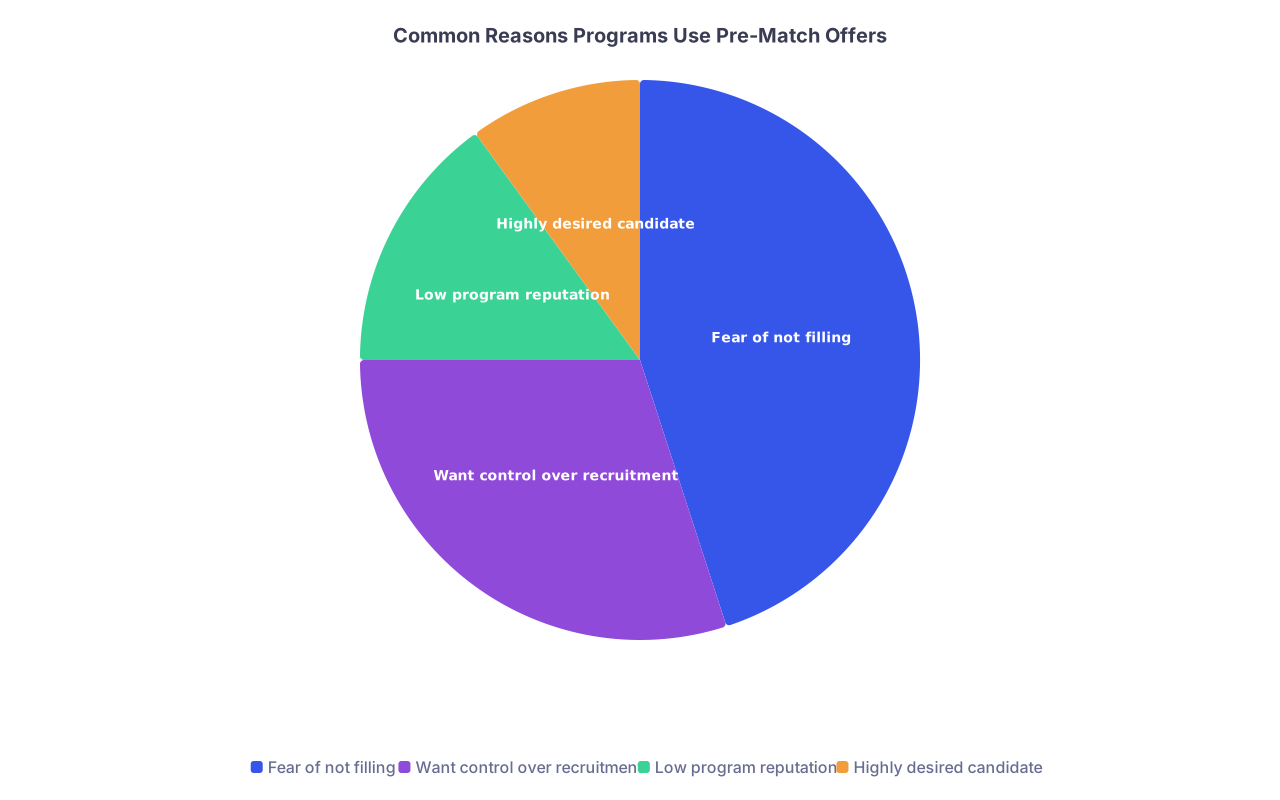
| Category | Value |
|---|---|
| Fear of not filling | 45 |
| Want control over recruitment | 30 |
| Low program reputation | 15 |
| Highly desired candidate | 10 |
Look at that last slice. Only a fraction of pre-matches are “we must lock this star down.” Most are “we’re not confident we’ll fill through the main Match alone.”
So when you treat every pre-match as if it’s a golden ticket, you’re misreading the game.
The Real Question: How Risky Is Declining For You?
Instead of asking, “Is declining suicide?”, ask:
“Given my specific profile, what’s the risk that this is the best I’ll get?”
Here’s a very unromantic breakdown by profile. Is this absolute? No. But it’s closer to reality than the hallway gossip.
| Applicant Profile | Risk of Declining | Comment |
|---|---|---|
| Strong US MD, solid specialty, mid-tier offer | Low | Usually can match equal or better |
| US MD with red flags, lower-tier specialty offer | Moderate | Decline only with clear backup strategy |
| US DO applying IM/FM/Psych with broad apps | Low–Moderate | Depends on board scores and geography |
| Competitive specialty (Derm, Ortho, etc.) offer | Very High | Outside-the-match offers here are rare and valuable |
| IMG with average scores, limited interviews | High | Pre-match might be your safety net |
| IMG with strong scores, 15+ interviews IM/FM | Low–Moderate | Usually can aim higher if you want |
You’re not a generic “applicant”. Your decision lives in your context.
When Declining a Pre-Match Makes Sense (And Works)
Let’s talk about when saying “no” is not only reasonable, but sometimes the smart move.
1. The Program Is Clearly Below Your Trajectory
You’re a US MD with solid scores, all passes, strong letters, no professionalism issues, and 15–20 interviews at decently reputable programs. Then a small community hospital that struggles to fill hands you a pre-match.
What they’re really saying is: “We know we’d probably lose you in the Match.”
If your gut, your mentors, and your interview list all agree you can do better, locking yourself into a weaker training environment just to avoid discomfort is not smart. It’s fear-based decision-making disguised as “prudence.”
I’ve seen people in this exact position sign early, then spend three years complaining about case volume, fellowship prospects, or location. They didn’t avoid risk; they just accepted a different kind of long-term risk: career stagnation.
2. You Have Multiple Interviews and Real Backups
If you’ve got:
- A decent number of interviews (for primary care, think 10+; for more competitive but not insane specialties, maybe 8–10),
- Programs in multiple regions,
- A few academic or strong community places—
then locking into the first pre-match at an undesirable location just because “what if” is often irrational.
You don’t need to aim for “dream only,” but you also don’t need to grab the first life raft when you’re not actually drowning.
3. Program Red Flags You’re Trying to Ignore
Common red flags I’ve heard directly from residents at pre-match-heavy programs:
- Chronic understaffing; “We’re always short on nights.”
- Toxic leadership; “People disappear from the schedule and no one talks about it.”
- 100% in-house coverage with minimal support; scut-heavy, edu-light.
- Terrible fellowship placement for your specialty goals.
If you’re already rationalizing these away before you’ve even started, signing a binding contract to spend years there just to avoid Match anxiety is backwards.
When Declining Is Genuinely Dangerous
Flip side. There are also situations where declining a pre-match is almost begging the universe to humble you.
1. You’re an IMG With Few Interviews
If you’re an IMG with:
- Marginal USMLE scores (e.g., barely passing or just above),
- 3–5 interviews total,
- One of those interviews offering you a pre-match—
this may very well be your best (or only) secure path to training in that country.
Is it glamorous? No. Is it limiting? Maybe. But is it career suicide to accept? Not even remotely. Many fantastic physicians came from “non-dream” programs because they trained well, worked hard, and leveraged every opportunity afterward.
In this context, declining can seriously be high-risk.
2. You Have Red Flags and Limited Leverage
If you have failed attempts, professionalism concerns, extended time in med school, or other major red flags, and a program still pre-matches you? They’re telling you clearly: “We’re willing to look past this.”
The rest of the Match may not be so forgiving. This is where pride can quietly wreck careers. Declining here may indeed push you toward SOAP or going unmatched.
3. Hyper-Competitive Specialty Out-of-Match Offers
In some places, very competitive specialties (derm, ortho, plastics, certain surgical subspecialties) will occasionally pre-match a candidate. If that’s you, and you’re not sitting on an absurdly stacked interview list, turning that down is playing chicken with a train.
Those spots are precious. They know it. You should too.
How to Decide Without Lying to Yourself
You need a framework, not vibes.
Here’s the short version of what I tell people on the phone when they’re spiraling about a pre-match:
Count your interviews honestly.
For non-ultra-competitive specialties:- 0–4: Be cautious. Pre-match is lifeline territory.
- 5–8: Mixed. Think very carefully about your range and program quality.
- 9–15: Usually safe to be selective if you’re not carrying massive red flags.
- 15+: You have options. Use them.
Classify your pre-match program realistically.
Not as “they liked me so they’re great.” But by:- Accreditation status and history.
- Board pass rates.
- Procedure/case volume.
- Fellowship placement (if it matters in your field).
- Resident satisfaction (not what PD says; what residents whisper when the door closes).
Ask yourself: if I matched here through the normal Match, would I be content… or devastated?
If you’d be content (not ecstatic, but not miserable), pre-match is a solid safety.
If you’d be devastated and feel trapped for years… you have your answer.Run it past someone who’s not emotionally invested.
Not your classmate who’s more anxious than you.
A faculty advisor. Recent grad in your field. Someone who’s watched people go through this for years.

| Step | Description |
|---|---|
| Step 1 | Receive Pre Match Offer |
| Step 2 | Keep as backup mentally |
| Step 3 | Reasonable to decline |
| Step 4 | Strongly consider accepting |
| Step 5 | Case by case - seek mentor input |
| Step 6 | Interviews 9 or more? |
| Step 7 | Program acceptable long term? |
| Step 8 | Interviews 4 or less? |
You don’t need a complicated algorithm. You need honesty.
How to Decline Without Burning Bridges
Here’s where people overcomplicate things. You can decline professionally without making enemies.
Key points:
- Don’t vanish. Ghosting is the only real career suicide move here.
- Be prompt once you’ve truly decided. Dragging things out for weeks after they gave you a contract is disrespectful.
- Be concise, respectful, and avoid insulting the program.
A simple template:
Dear Dr. [PD Name],
Thank you very much for the opportunity to join your residency program and for the confidence you’ve placed in me. After careful consideration of my personal and professional goals, I’ve decided to remain in the Match process this year and will not be able to accept an outside-the-match position.
I’m very grateful for the chance to interview with your team and to learn more about your program. I appreciate your time and consideration.
Sincerely,
[Your Name]
That’s it. No explanation about “better options,” no ranking comparisons, no drama. Just clarity and gratitude.
Do some PDs get annoyed when pre-match offers are declined? Of course. They’re human. But they also live in the Match ecosystem. They know it happens.
What Actually Happens to People Who Decline
I’ve seen three outcomes repeatedly:
They match at an equal or stronger program.
This is common among reasonably strong applicants who did not panic and had multiple interviews. They look back and say, “I’m so glad I didn’t lock myself in early.”They match at a similar or slightly lower-tier program they hadn’t pre-matched at.
Not dramatically different quality, just different geography or structure. Was the pre-match “career defining”? No. It was one of several roughly similar options.They don’t match and end up in SOAP or waiting a year.
This happens. It’s usually people who overreached or had limited interviews and treated a safety-net pre-match like an insult.
But even then, career suicide? No. It’s a detour. Painful, expensive, stressful. Not fatal.
The problem is people only talk loudly about outcome #3. The people in group #1 are too busy living their lives. The people in #2 don’t consider it dramatic enough to post about. So your sample is biased toward horror stories.
FAQs
1. Will other programs know I declined a pre-match offer?
Usually no, unless:
- You tell them,
- The PD personally knows others and happens to mention it (rare, and they have better things to do),
- Or you break a formal agreement or NRMP rule (then you have real problems).
Programs are not running a centralized “who said no” registry. They’re busy filling their own rank lists.
2. Can I accept a pre-match and still be in the Match?
In many systems and under NRMP rules, no—if you sign a binding outside-the-match contract for a position covered by the Match, you’re expected to withdraw from that Match. Violating that can get you in genuine trouble.
Always check:
- NRMP rules (if applicable),
- Your country’s match-equivalent rules,
- The language in the contract.
Do not try to game this. Cheating the system is one of the few things that can actually torpedo your career.
3. Is it better to be in any residency than to risk going unmatched?
For many IMGs and borderline applicants, yes, “any accredited, non-toxic residency” can be much better than no residency. For strong applicants with multiple interviews and clear long-term goals, accepting any residency just to feel safe can limit your future.
The point is not “always accept” or “always decline.” The point is: match your risk tolerance to your actual competitiveness, not your anxiety.
Key takeaways:
- Declining a pre-match is not inherently career suicide; the risk depends on your profile, interview count, and program quality.
- Accepting a weak pre-match out of fear can quietly damage your long-term career more than taking a calculated risk in the Match.
- The mature move isn’t to always say yes or always say no—it’s to be brutally honest about your chances, get input from people who’ve seen the cycle many times, and then own your decision.