Last week, a fourth-year I know texted me at 1:37 a.m. She’d just found a scathing review of a program at the very top of her rank list. “Is this it?” she wrote. “Did I just find out my dream program is actually malignant and I’m an idiot?”
I wish I could say that’s rare. It’s not. It’s basically the unofficial Step 3 of residency applications: late-night doom-scrolling through Reddit, Scutwork, and SDN, convincing yourself every single program is secretly toxic and you’re walking into a trap.
Let me say the quiet part out loud: one bad online review can feel like a siren going off in your brain. It’s your worst-case-scenario radar screaming, “Danger, danger, you’ll be miserable, you’ll burn out, you’ll hate your life.”
But does one bad review actually mean a residency program is toxic? Or is your anxiety just hijacking the wheel?
Let’s pick this apart like someone whose entire future depends on getting this decision right. Because honestly, that’s how it feels.
How Much Should You Freak Out About One Bad Review?
Here’s the uncomfortable truth: one bad review can be a legit red flag. It can also be totally meaningless.
The problem is we’re wired to overweight negative information. You can read 20 neutral blurbs about a program—“good training, busy, overall solid”—and then you see one long rant: “This place is malignant, absolutely do not come here, worst mistake of my life.” And suddenly that’s all you remember.
You don’t remember the 20 “it’s fine” posts. Your brain remembers the nuclear one.
And on the internet, the people who are most likely to post are:
- The very happy
- The very angry
Everyone in the “it’s okay, has pros and cons, decent enough” middle rarely writes essays.
So no, one bad online review does not automatically mean the program is toxic. But it does mean you should stop, breathe, and investigate. Not panic. Investigate.
The key question isn’t “Is there a bad review?”
It’s: “What exactly is this review saying—and does it match anything else I’m seeing or sensing?”
What You Actually Need to Read Between the Lines
You can’t just count reviews. You have to dissect them.
Here’s what I immediately look for when I see a negative write-up:
1. Specific vs. Vague
“I hated this place, it’s toxic, don’t come here” is almost useless. That could be about anything—schedule, personalities, personal life circumstances, or even someone who failed out and is venting.
Compare that to:
- “Average 90–100 hour weeks, Q2 28-hour calls with no post-call days protected.”
- “Repeated violations of ACGME duty hours; people told not to log honestly.”
- “PD retaliates against residents who report issues; people mysteriously don’t have contracts renewed.”
- “Outpatient clinic is dangerously understaffed; patients scheduled every 10 minutes with no supervision.”
Specific = more credible. Especially if those specifics could be verified or seen elsewhere.
Vague = emotional noise. Not completely ignorable, but lower weight.
2. Systemic Patterns vs. One-Off Drama
Does the review describe:
- A systemic issue? (chronic understaffing, persistent duty hour violations, retaliation, culture of humiliation)
or - A personal conflict? (“I didn’t get along with one attending,” “my schedule was bad,” “other residents weren’t my type of people”)
Toxic programs have patterns. Over and over. Across multiple residents and years.
A truly malignant place will leak the same complaints in different words:
- “You can’t ever call in sick”
- “You’re punished for being pregnant or needing leave”
- “They’ll tell you ‘we’re a family’ and then hang you out to dry when stuff hits the fan”
If your single review is a messy story about one rotation or one faculty member and everything else you can find is neutral or positive? That’s different from seeing a theme.
When One Bad Review Should Seriously Worry You
Here’s where my spidey-sense goes way up even if there’s just one big ugly review.
If a lone review mentions any of these, I don’t dismiss it:
- Open retaliation:
“Resident reported harassment → suddenly on probation / non-renewed / bad evals from that same attending.” - Documented or repeated ACGME citations plus denial from leadership:
“We had a site visit for duty hours, PD told us to lie.” - Safety issues:
“No supervision at night, interns signing notes alone on ICU patients for months.” - Illegally pushing work beyond allowable hours while pressuring people not to log it.
Those are the types of things that usually don’t come from nowhere. People don’t casually invent those kinds of details.
And if a program has even one detailed, credible-sounding retaliation story? I’d be skeptical as hell until I find evidence contradicting it.
But What If Everything Else Looks Fine?
This is where it gets maddening.
You might have:
- A solid interview day
- Chill vibes from the residents
- A PD who seems genuinely invested
- No obvious bad patterns online
… and then that one horrible, detailed review on Reddit from 2 years ago.
So you start spiraling:
- “Are the residents just lying because they’re being watched?”
- “Is the PD just a good salesperson?”
- “What if the one person was actually the only honest one?”
I’ve watched applicants rank a place they liked 10 spots lower because of one anonymous post. I’ve also watched people ignore glaring, consistent red flags because they were dazzled on interview day.
The move here isn’t to blindly trust the internet or blindly trust your gut. It’s to cross-check.
You basically want to run a mini-investigation, residency edition.
How to Sanity-Check That Bad Review Instead of Letting It Own You
You’re not crazy for wanting to verify this stuff. You should verify it. Just don’t let your anxiety convince you you’re not allowed to ask.
Talk to More Than the Hand-Picked Cheer Squad
Programs often showcase their happiest residents on interview day. That’s not evil, that’s just marketing.
What you want is at least one:
- Upper-level who’s not directly in front of faculty
- Recent grad if you can find one
- Resident who’s not on the official “resident panel”
Ask questions that target culture without sounding like an interrogation:
- “How does leadership respond when residents raise concerns?”
- “Have there been any major changes after resident feedback in the last year or two?”
- “Do you feel safe calling in sick or saying you’re overwhelmed?”
- “If someone’s struggling, what actually happens? Is there real support, or just ‘work harder’?”
You’re listening less to the words and more to:
- Pauses
- Tight smiles
- “Well, every program has its challenges…” followed by vague platitudes
If everyone visibly relaxes and gives specific examples of problems that were fixed? Very good sign.
If they all suddenly look like they’re on a witness stand? Not as good.
Compare What They Say With What’s Public
You’re trying to see if the narrative lines up.
If a review says:
- “Insane call schedule, no days off, everyone miserable”
You check:
- ACGME accreditation status (any warning status?)
- Program website schedule (does it look theoretically compliant but residents hint “it’s actually way worse”?)
- Other online posts over different years
If one angry person from 2017 says “malignant,” but:
- Every other post from 2018–2024 is neutral or positive
- Residents on Zoom look tired but not broken
- You get candid answers like “Yeah, it used to be bad, leadership changed, they fixed X, Y, Z”
That’s very different from seeing a steady stream of “this place is still trash.”
Use Backchannel Intel (Carefully)
People do this more than they admit.
You ask:
- Your med school’s recent grads
- Upper-levels who rotated there
- Faculty who actually know the program, not just its name
But here’s the catch: faculty often protect institutions. Residents and recent grads are more brutally honest.
If you keep hearing:
- “Great training, rough but fair”
- “Good people, just high volume”
- “They had issues a few years ago, but it’s honestly fine now”
That one old review might be a relic from before a leadership change.
If instead you hear:
- “Yeah… we don’t really send people there anymore”
- Long, awkward silence followed by “Umm, it depends what you’re looking for”
- “People leave mid-year and it’s not a surprise”
That’s smoke. Maybe fire.
Toxic vs Just Tough: They’re Not the Same
This is where applicants drive themselves insane.
You’re terrified of a “toxic program,” but what does that even mean? Because some places are just… hard. High volume. Intense. Not warm and fuzzy. But not malignant.
Let me draw a rough line.
A tough but non-toxic program might look like:
- Long hours, but accurately logged and within ACGME rules
- Leadership that’s busy but reachable and occasionally human
- Residents tired, sometimes cranky, but not actively broken
- People graduate competent, match into decent fellowships, don’t warn you away
A toxic program feels more like:
- Chronic duty hour violations paired with pressure to falsify logs
- Public shaming or humiliation as a “teaching style”
- Retaliation against residents who speak up
- High attrition or people begging to switch programs
- Whisper networks saying “don’t go there” while official channels smile and nod
One bad review rarely contains all that. It might be a fragment of something real. Or it might be one person’s personal hell in an otherwise functional environment.
The Miserable Possibility: You Won’t Be 100% Sure
Here’s the part I hate saying: you will not get perfect information. Some programs are really good at image management. Some residents won’t talk freely. Some online posts are exaggerated.
You could do everything right:
- Read every post
- Talk to multiple residents
- Ask your advisors
- Compare schedules, accreditation, outcomes
…and still end up surprised.
That doesn’t mean you failed.
Residency isn’t pass/fail “toxic or not.” It’s a spectrum. Every program has politics, at least one awful attending, at least one bitter resident, a few broken systems, and some amount of “this could be better but no one has time to fix it.”
Your job isn’t to magically detect the one perfect, safe harbor program where nothing bad ever happens. That doesn’t exist.
Your job is to:
- Avoid places with obvious systemic danger signs
- Pick somewhere that seems mostly honest, mostly functional, and aligned with your goals
- Have a plan if it ends up being worse than advertised (transfer options, wellness resources, mentors outside your program)
That’s it. That’s the uncomfortable truth.
A Quick Reality Check: How Often Are Reviews Totally Wrong?
Almost never 100% wrong. But often incomplete.
That furious online review might be:
- 40% real systemic issue
- 40% personal circumstance (burnout, personal life collapse, mismatch)
- 20% emotion and exaggeration
What you’re trying to do is isolate that first 40%.
If you can’t find any supporting evidence, can’t get anyone else to even hint at something similar, and everything else you see looks normal? I’d tentatively treat it as a data point, not a verdict.
If you can corroborate pieces of it? Then I’d take it seriously, even if it’s just one loud voice.
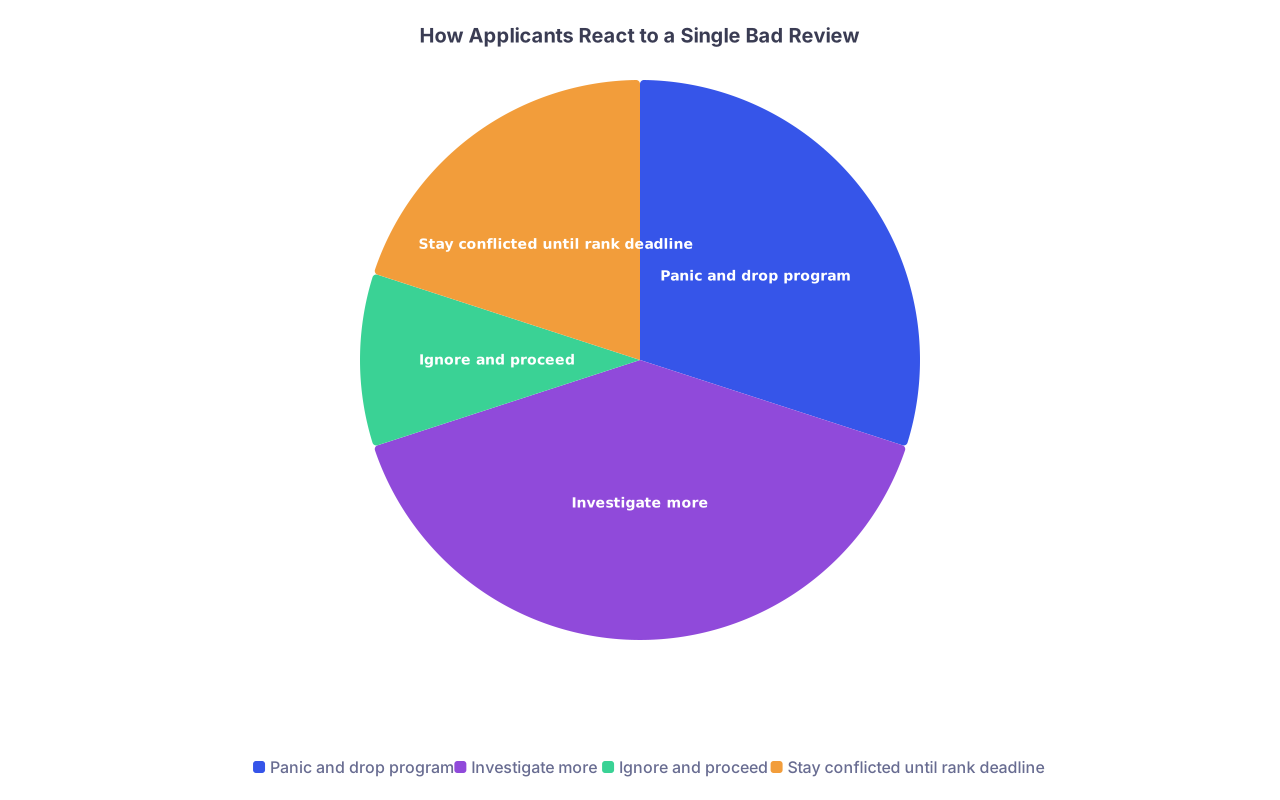
| Category | Value |
|---|---|
| Panic and drop program | 30 |
| Investigate more | 40 |
| Ignore and proceed | 10 |
| Stay conflicted until rank deadline | 20 |
When Your Anxiety Won’t Shut Up About That One Review
You might do all this analysis and still feel sick every time you think about ranking that program.
So here’s the brutal but useful question: if you match there and something goes wrong, will you blame yourself forever because “there was that one review and I ignored it”?
If yes, and you have other reasonable options? Drop it a few spots. Or off the list. Protect your future self from that specific kind of regret.
But if:
- It’s clearly one of your strongest training options
- You’ve done real due diligence
- No one else is waving you off
- Your mentors say it’s solid
Then winning the war against your anxiety might mean accepting some uncertainty and ranking it high anyway.
That’s the part no one tells you: sometimes courage looks like ranking a place you’re scared might be bad, because the evidence says it’s likely okay and the upside is worth it.

| Step | Description |
|---|---|
| Step 1 | See bad online review |
| Step 2 | Treat as low-weight data |
| Step 3 | Investigate further |
| Step 4 | Talk to residents and grads |
| Step 5 | Check accreditation and outcomes |
| Step 6 | Consider ranking lower or removing |
| Step 7 | Keep on list with caution |
| Step 8 | Specific and serious? |
| Step 9 | Pattern confirmed? |
| Situation | How Much to Worry |
|---|---|
| One vague rant, no specifics, nothing else negative | Low |
| One detailed review, no other sources mention it | Moderate |
| One detailed review + subtle resident unease | High |
| One detailed review + backchannel confirms pattern | Very High |
| Multiple consistent reviews over years | Extreme |

FAQs
1. If a program has one really bad review on Reddit, should I remove it from my rank list?
Not automatically. One review shouldn’t have veto power over your entire future. Use it as a prompt to dig deeper. If everything else—resident conversations, faculty you trust, accreditation status, schedule—points to a reasonably functional program, I wouldn’t nuke it solely based on a single anonymous post. If that review lines up with multiple subtle warning signs you’re already picking up, then yeah, it might belong lower or off the list.
2. How do I ask residents about negative things I read online without sounding confrontational?
You don’t need to say “Reddit said your program is malignant, thoughts?” Try: “Every program has areas they’re working on—what would you say is the biggest current challenge here?” or “How has the program changed over the last few years?” or “Do residents feel comfortable raising concerns? What happens when they do?” You’re fishing for culture and patterns, not trying to fact-check line by line.
3. What if residents seem happy on interview day, but online reviews say the culture is bad?
I’d trust residents more than anonymous posts—but only if you get them without faculty hovering, and if their answers feel genuine, not rehearsed. Ask at least two or three different people privately. If everyone independently describes something that feels consistent and balanced (both pros and cons), that usually beats one dramatic post. If they sound guarded or too-perfect, and the reviews are all bad, I’d lean toward caution.
4. Are negative reviews more common for certain specialties?
Yeah. High-burnout, high-volume specialties—like general surgery, OB/GYN, EM, some IM programs—tend to attract more venting. It doesn’t always mean the program is uniquely awful; sometimes it just reflects the reality that the work is brutal everywhere. That’s why you have to compare across similar programs, not pretend a chill derm program and a county surgery program should have the same “vibe” online.
5. What if I only find one review about a program anywhere? Is that a red flag by itself?
Sparse data is annoying but not inherently suspicious. Smaller or community-heavy programs often have almost no online presence. One random review in that context might say more about the reviewer than the program. In that situation, I’d put more weight on direct contact—away rotations, talking to residents, asking your school’s recent grads—than on the single online voice.
6. Can I contact the program directly and ask about a bad review I saw?
You can, but I’d be strategic. Don’t email the PD saying “Reddit says you’re malignant, comment?” That’ll just make things awkward. If there’s a specific structural concern (duty hours, supervision, prior probation), you can phrase it generically: “How does your program approach duty hour compliance and resident wellness?” or “Have there been any major changes in response to resident feedback over the last few years?” You’re probing the underlying issue without quoting the exact post.
If you remember nothing else, remember this: one bad online review is a data point, not a death sentence. Look for patterns, listen to real residents, and don’t let anonymous rage threads outrank your own careful, grown-up fact-finding. You won’t get certainty—but you can get enough clarity to make a decision you won’t hate yourself for later.