

You’re at the dining table with two laptops open. One of you has interviews at a program everyone raves about: great teaching, happy residents, strong fellowship matches. The other… has a program that sends shivers down your spine: malignant rumors, chaotic call schedules, vague answers on interview day, bad Glassdoor reviews from staff.
You’re couples matching. And the most likely way to end up in the same city is: one of you lands in the dream program, and the other ends up in the one full of red flags.
Here’s the dilemma you’re actually facing, stripped of fluff:
- Do you rank the strong + red-flag combo high and “take the hit” for one partner?
- Do you sacrifice the great program for both of you to land in two decent-but-not-amazing spots nearby?
- Do you prioritize career trajectory, relationship, or survival/sanity?
Let’s walk through this like I would with two fourth-years sitting in my office in January, half-burnt out, half-panicked.
1. First: Name Exactly What You’re Up Against
Before you start moving programs around on the rank list, you need clarity. Vague dread doesn’t help; concrete risks do.
Ask three questions separately for each of you:
- How good is the “strong” program really?
- How bad is the “red flag” program really?
- What are your realistic alternatives as a couple?
Do this on paper. Not in your head. Not while doom-scrolling Reddit.
| Program Type | Culture | Education | Workload | Reputation |
|---|---|---|---|---|
| Strong Program | Supportive | Structured | Heavy | Excellent |
| Red Flag Program | Variable | Disorganized | Unsustainable | Mixed/Negative |
| Mid-Tier Alternative | Decent | Adequate | Reasonable | Regional |
Now let’s translate those categories into reality.
What does “strong” actually mean?
A strong program usually has:
- Cohesive leadership that shows up on interview day and has clear answers.
- Residents who don’t look dead inside at noon.
- People who say, unprompted, “I feel supported here” or “I’d choose this program again.”
- Clear educational structure: conferences that actually happen, protected didactics, feedback that feels real.
- Track record of fellowship placements or solid job placements in the field you want.
If this describes one of your options, that’s not just “nice.” That’s career trajectory, mentorship, and your mental health.
What does “red flag” actually mean?
Let’s be specific. Common red flags I’ve seen and heard:
- Residents warn you off in one-on-one chats: “We survive, but I wouldn’t do this again.”
- Off-the-record “Don’t quote me on this but…” stories about retaliation, toxic chiefs, or chairs.
- Everyone hedges when you ask, “How does the program respond to struggling residents?”
- Schedule that looks insane and no one pretends it will be manageable.
- High attrition, people transferring out, or multiple recent disciplinary / dismissal stories.
- PD or APD seems defensive, vague, or outright hostile when discussing duty hours or wellness.
Now your job is to answer this honestly: is this “kind of rough but survivable,” or “this will break me”?
That distinction matters more than almost anything else.
2. Relationship vs Career vs Survival: Pick Your Hierarchy
You can’t maximize everything at once. Couples Match forces you to declare what matters most for the next 3–7 years.
Be blunt with each other. I’ve seen couples tank their relationship by pretending they’re on the same page when they’re not.
There are three different priority stacks I see:
Relationship > Everything
“We’re staying together geographically, even if one of us eats a garbage program.”Career > Relationship
“We’ll prioritize the best training for each of us, even if it means long-distance.”Survival / Sanity > Both
“We’re not willing to match into a malignant program even if it keeps us in the same city.”
None of those is “wrong.” But pretending you’re doing #1 while you’re secretly acting like #2? That’s where resentment shows up PGY-2.
Write this down individually first: “In order, over the next 5 years, I prioritize: X, then Y, then Z.” Then share.
If either of you has “Survival / Mental Health” as #1, red-flag programs need to drop quickly.
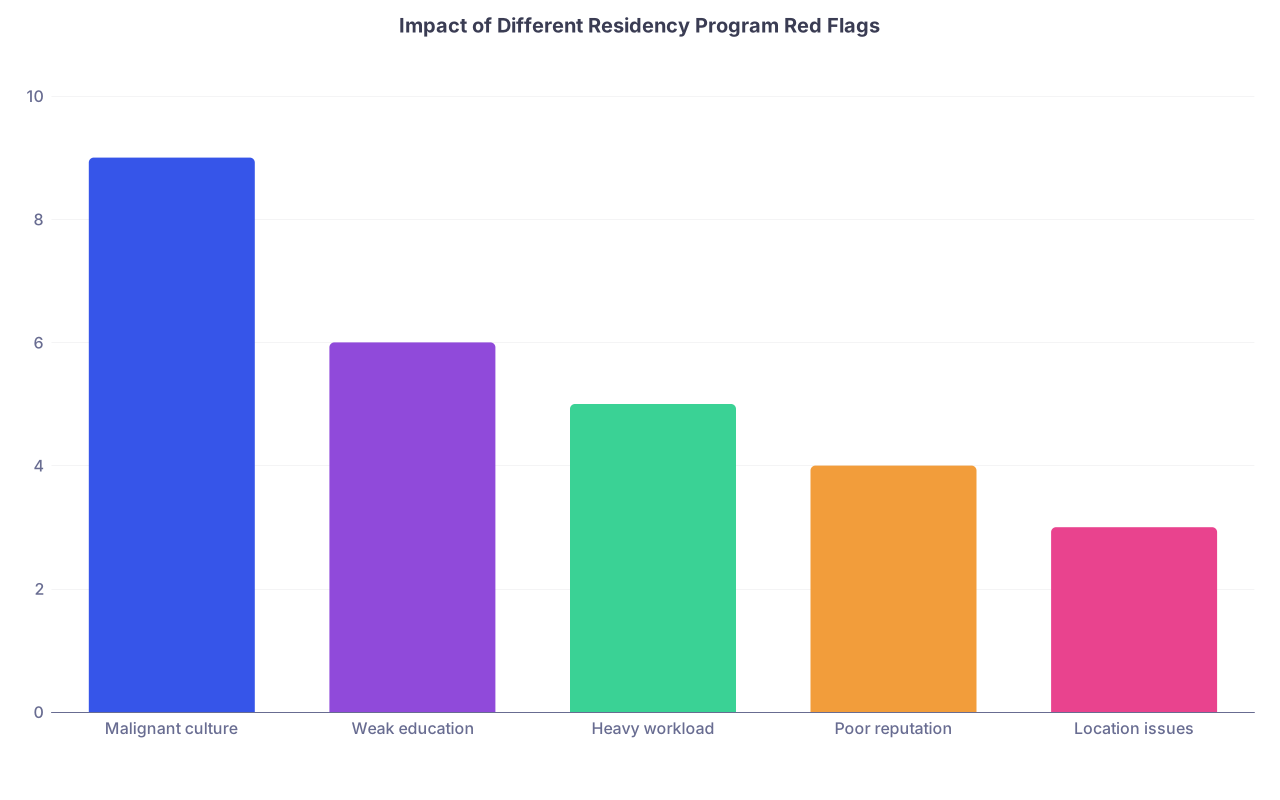
3. Dissect the Red-Flag Program: Is It Actually Unacceptable?
You don’t treat all red flags the same. Some are annoying. Some are career-ruining. Some are dangerous.
Here’s how to pressure-test that “bad” program.
| Category | Value |
|---|---|
| Malignant culture | 9 |
| Weak education | 6 |
| Heavy workload | 5 |
| Poor reputation | 4 |
| Location issues | 3 |
Let’s break it out:
Category A: Hard No’s
These are things I would not recommend you tolerate, even for the couples match:
- Systematic bullying, shaming, or retaliation.
- Program leadership known for gaslighting or silencing residents.
- Serious patient safety issues ignored when raised.
- Multiple residents leaving or being pushed out with vague explanations.
- Chronic duty hour violations that everyone laughs off instead of trying to fix.
If your “red-flag” program is in this category, you don’t rank it high. I don’t care how strong the partner program is. You will pay for it, with burnout, depression, or delays in graduating.
Category B: Rough but survivable
- Overworked but not malicious: too many admits, too many nights, but good peers.
- Weak didactics but good self-directed learning opportunities.
- Mediocre name but solid case volume.
- Leadership that’s disorganized or slow but not cruel.
These can be endured with the right coping strategies, especially if there’s a clear end date and some upsides (location close to family, partner’s stellar program across town, etc.).
Category C: “This might actually be fine”
Sometimes Reddit, SDN, or group chats paint a program as a nightmare when:
- They’re just demanding but rigorous.
- Someone who failed out or didn’t get promoted is venting online.
- The program used to be bad but has new leadership.
- Your personal interview experience was actually decent, but gossip spooked you.
For these, you need more data, not panic.
4. Get More Data Before You Rank
If you’re even considering pairing a fantastic program with a questionable one high on the list, you need better intel than “heard some bad stuff.”
Here’s what to actually do in January/February:
Reach out to residents you met, 1:1, off the record.
Email or message: “I’m couples matching and seriously considering ranking your program highly. Would you be comfortable sharing your honest experience, especially about support, workload, and how leadership responds when problems come up?”Talk to upperclassmen or alumni from your school who went there.
They’ll usually be more blunt than anyone on interview day.Ask your dean / advisor directly:
“I keep hearing concerning things about Program X. What’s your sense of how residents are doing there?”
Deans know which programs routinely generate “help me transfer” emails.Reframe your questions.
Instead of “Do you like your program?” ask residents:- “If your best friend was considering coming here, what would you tell them?”
- “Has anyone left in the past few years? Why?”
- “If you had to pick again, would you choose this program?”
Map your risk tolerance.
After you gather more information, ask yourselves: “On a 1–10 scale, how risky does it feel to spend 3–7 years here?”
You’re trying to avoid 8–10 unless you have zero options.
5. How to Structure the Actual Rank List
Now the part everyone really wants: “Tell me what to put where.”
I can’t give you your exact rank order, but I can give you rules.
Rule 1: Never rank a combination you truly cannot accept
If you’d both be devastated to match into “Dream Program + Toxic Program,” don’t rank that pair high “just in case.” The algorithm doesn’t care that you were “hoping it wouldn’t happen.”
For each potential pair, ask: “If this is where we end up on Match Day, will we look at each other and say, ‘Okay, we can do this’ or ‘What did we do to ourselves’?”
If it’s the second, push that pair way down or off entirely.
Rule 2: Build tiers, not a perfect linear list
You’ll go insane trying to micro-rank 30 couple combinations.
Think in tiers:
- Tier 1: Both in solid/great programs, same city or nearby.
- Tier 2: One great, one acceptable-but-hard, same city.
- Tier 3: Both in acceptable programs, maybe different cities within driving distance.
- Tier 4: One great, one truly marginal, with a clear exit strategy (transfer, prelim year only, etc.).
- Tier 5: Long-distance but both in strong/solid programs.
Within a tier, don’t stress over tiny differences. Focus on whether a pair moves you between tiers.

| Step | Description |
|---|---|
| Step 1 | Start - List All Programs |
| Step 2 | Remove Hard No Combos |
| Step 3 | Group by Geographic Region |
| Step 4 | Create Tiers by Program Quality |
| Step 5 | Place in Lower Tier |
| Step 6 | Drop Those Pairs |
| Step 7 | Finalize Rank List |
| Step 8 | Any Hard No Programs? |
| Step 9 | Red Flag Acceptable? |
Rule 3: Have a backstop for both of you
If you do rank a “Strong + Questionable” combo anywhere near the top, you need:
- A ranked pair where both of you hit at least “decent” programs, even if geographically worse.
- A ranked pair where, if one lands in the bad program, it’s at least for a prelim-only year (if that’s a real option in your specialty).
Don’t build a list where the only way to avoid long-distance is for one person to eat a malignant program. That’s how you trap yourselves.
6. What If You End Up in the Red-Flag Program Anyway?
Let’s say you do this thoughtfully and still land in the pairing where one of you is at the powerhouse and the other is at the questionable shop.
Then the question becomes survival and leverage.
Here’s how to handle that first year strategically:
Before you start:
- Identify who at that program seems safe: one chief, one APD, one senior resident.
- Find out if they’ve had transfers out. Not to threaten, but to know if it’s possible.
During orientation:
- Watch how leadership behaves when things go wrong. Do they blame or problem-solve?
- Listen for coded language: “We’re a tough program” + laughter usually means “we violate duty hours and call it ‘resilience.’”
First 3–6 months:
- Document. Not obsessively, but if there are true duty-hour or safety violations, keep a record.
- Build allies: co-interns and seniors who actually care about patients and about each other.
Exit strategy if needed:
- If it’s truly malignant, talk to your PD or APD early about concerns and ask directly what changes are realistic.
- If they shrug, start quiet conversations with your home institution or mentors about transfer possibilities.
One thing I’ve seen: couples who name this upfront – “We’ll reassess at 6 and 12 months; if this is destroying one of us, we’ll change cities or programs” – survive a lot better than couples who white-knuckle it out of pride.
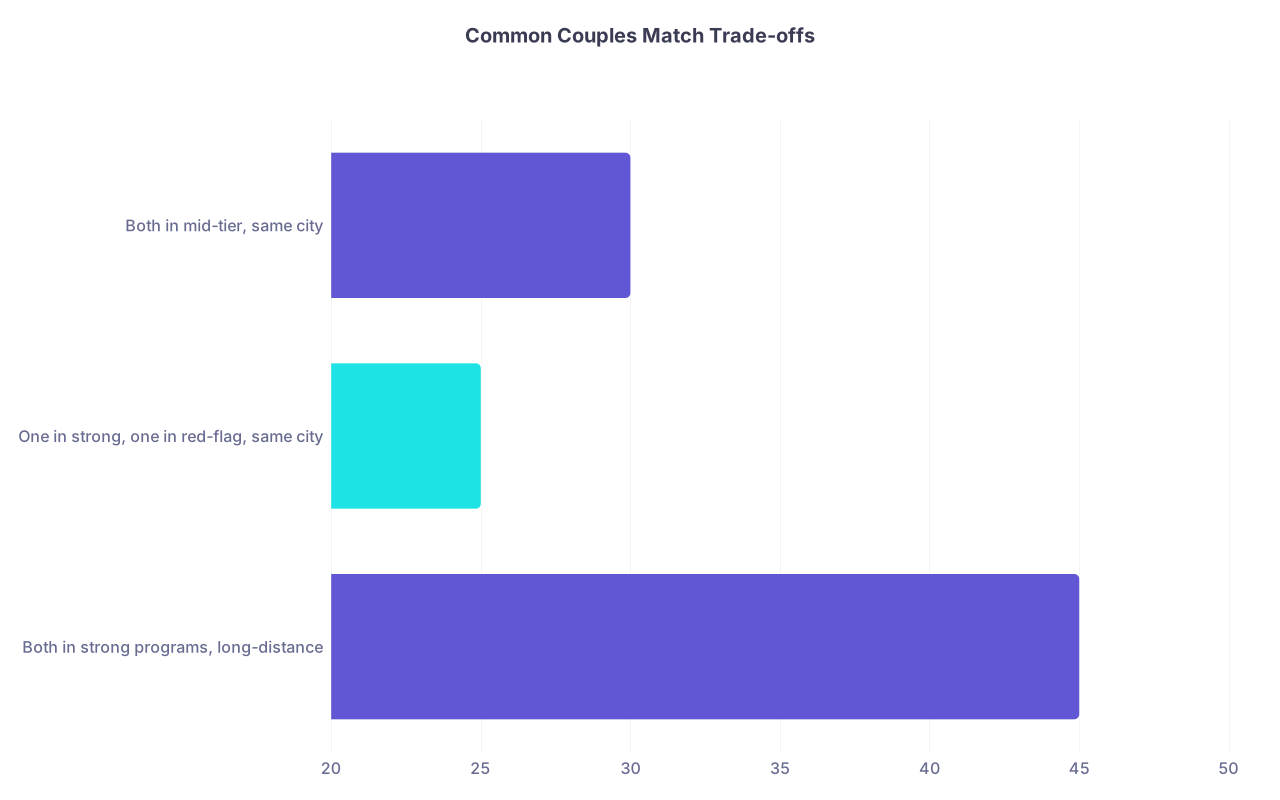
7. When Long-Distance Is Actually the Less Bad Option
Uncomfortable truth: sometimes long-distance for residency is healthier than couples matching into a bad setup.
I’ve worked with couples who:
- Chose separate strong programs in different cities 3–5 hours apart.
- Saw each other 1–2 times a month.
- Finished training with careers they were proud of and a relationship that wasn’t built on mutual burnout and resentment.
And I’ve seen couples who stayed together geographically by putting one partner in a trash-fire program. That partner spiraled – mental health tanked, confidence eroded, career options narrowed. The relationship did not improve from “we’re both miserable but in the same ZIP code.”
So you ask yourselves directly:
“Would we rather be:
- In the same city, with one of us suffering daily in a malignant program, or
- In different cities for 3–4 years, but both in programs we can tolerate or even thrive in?”
When you put it that bluntly, a lot of couples quietly pick long-distance as the less bad road.
| Category | Value |
|---|---|
| Both in strong programs, long-distance | 45 |
| One in strong, one in red-flag, same city | 25 |
| Both in mid-tier, same city | 30 |
8. Specific Red-Flag Situations and What I’d Do
Let’s hit a few concrete scenarios. You’ll probably recognize yourself in one of these.
Scenario 1: One of you has a unicorn program; the other has only one interview, and it’s the red-flag one
If the “unicorn” is like: big-name academic, dream fellowship pipeline, supportive culture? You don’t casually toss that.
My advice:
- Rank some pairs where unicorn + red-flag are in play, but not at the very top.
- Put higher priority on pairs where unicorn + “OK but mid-tier elsewhere, maybe long-distance” are first.
- If the red-flag program is Category A (malignant), I would not rank unicorn + malignant at #1. That’s a high price for the relationship to pay.
Scenario 2: Both of you have “good enough” mid-tier options in another city, plus this strong + red-flag combo in City A
This is classic:
- City A: one amazing, one ugly.
- City B: two decents.
If the red-flag program is Category B (rough but survivable), then ranking City A pairs just below City B pairs is reasonable: you give yourselves a shot at the unicorn but protect yourselves with the “two decent” pairing higher.
If the red-flag program is Category A, I’d flip it: both mid-tier in City B at the top. Strong + malignant lower.
Scenario 3: The red-flag program is in your hometown near family
People overvalue this sometimes.
Support from family can make a tough program survivable. It cannot make a malignant program healthy.
If the program is nasty but your parents live 15 minutes away, that doesn’t magically fix:
- Getting screamed at by attendings.
- Chronic sleep deprivation.
- Retaliation if you report mistreatment.
Family helps with child care, meals, and emotional backup. It does not neutralize systemic abuse.
So again, categorize the program honestly. Hometown is a plus, not a cure.
9. How to Talk About This Without Nuking the Relationship
This is the emotional landmine part. One of you is “the strong applicant” and one is “the weaker” in this pairing. That dynamic can get ugly fast if you’re not careful.
Rules for the conversations:
- No martyrdom: “I’ll just throw away my career so you can be okay” sounds noble but breeds resentment later.
- No scorekeeping: “Well I got more interviews so my preferences matter more” is poison.
- Use “I statements” and be uncomfortably direct:
“I am genuinely scared that if I go to Program X, I will burn out and hate myself.”
“I feel like if I pass on Program Y, I may not get an opportunity like that again.”
Then ask: “Given these truths, what’s a rank strategy that neither of us will regret five years from now, even if we don’t match our top choice?”
If you can’t have that conversation, that’s actually the bigger red flag than any program.
FAQ (Exactly 3 Questions)
1. Is it ever rational to rank a clearly malignant program high just to stay with my partner?
Rarely. If by “malignant” you mean Category A – bullying, retaliation, blatant duty-hour abuse, ignored safety issues – you’re signing up for trauma to save geography. I’ve seen those choices explode and take the relationship down anyway. If you’re going to do it, at least be explicit: “We’re choosing this knowing it may cost us X, Y, and Z,” not “Maybe it won’t be that bad.”
2. How do I know if internet rumors about a program are overblown?
You cross-check them with people whose careers are tied to being honest with you: your dean’s office, alumni, and current residents you speak to one-on-one. If three independent, trustworthy sources say “It’s rough but ok,” that’s different from “Run.” Don’t let one anonymous Reddit comment outweigh five honest conversations.
3. What if we completely disagree on what’s acceptable and can’t align our priorities?
Then the real decision isn’t about programs; it’s about the relationship. You can couples match and still effectively be on different teams. If one of you is okay with the other suffering in a malignant program, and the other refuses, you have a value mismatch. At that point, considering separate rank lists and possibly long-distance – or even not couples matching at all – is more honest than forcing a fake compromise.
Key points to leave with:
- Don’t lie to yourselves about how bad the red-flag program is. Classify it honestly: malignant vs rough vs fine.
- Never rank a pair you truly cannot live with. The algorithm is ruthless; it does not care about your “hope.”
- If long-distance gets both of you into survivable or strong programs, that’s often a better long-term bet than tying one partner to a toxic residency just to share a ZIP code.


