
Why do the loudest “This program is AMAZING 15/10!!!” online reviews so often come from programs everyone whispers about on the interview trail?
Let me be blunt: uniformly glowing online reviews are not a green flag. They’re not automatically a red flag either. They’re a data point. And usually a distorted one.
If you’re trying to choose a residency based on Reddit threads, Scutwork reviews, or anonymous Google ratings, you’re playing the game on hard mode without realizing it. The whole ecosystem of program reviews is biased, self-selected, and sometimes outright gamed by the programs themselves.
Let’s dismantle a few myths about rave online reviews and what they actually tell you.
How Online Residency Reviews Really Get Written
You don’t get a balanced, representative sample of residents casually logging on to write four-paragraph nuanced program reviews after a 28‑hour call. That’s fantasy.
You mostly get:
- Residents who are very angry
- Applicants who are very anxious
- Programs that are very defensive or very image‑conscious
Everyone else? Silent.
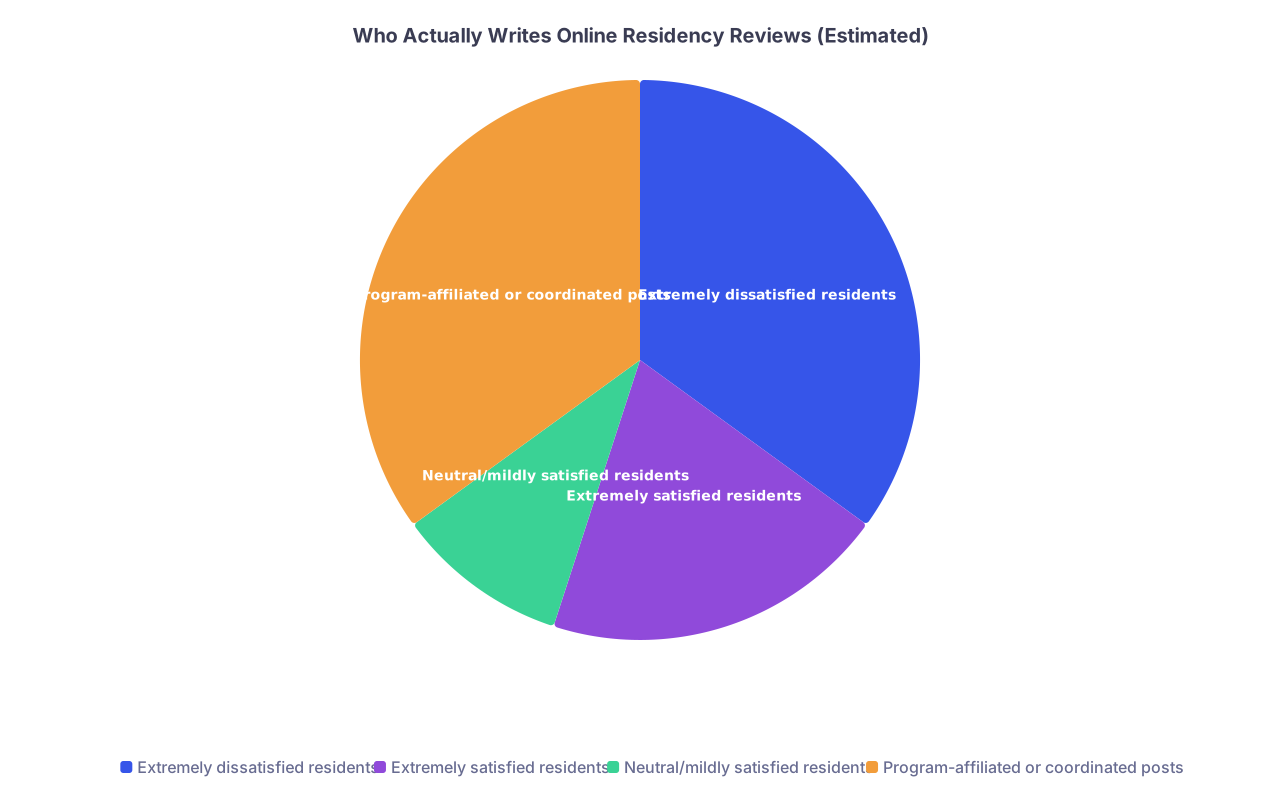
| Category | Value |
|---|---|
| Extremely dissatisfied residents | 35 |
| Extremely satisfied residents | 20 |
| Neutral/mildly satisfied residents | 10 |
| Program-affiliated or coordinated posts | 35 |
Are those exact numbers? No. But that’s the pattern you see in any voluntary, high-friction review system: extremes show up, the middle disappears.
Here’s the less pretty reality I’ve seen:
- A CA-3 in anesthesia who just got ignored for a fellowship spot they were promised for two years suddenly has a lot of time and motivation to torch the program online.
- A new PD trying to “rebrand” a malignant surgery program quietly encourages chief residents to “share their positive experiences online”—sometimes even during protected didactics.
- A terrified M4 who loved an interview day but has literally zero longitudinal data about the program posts on Reddit: “Program X is incredible!!! Faculty so supportive!! Residents seem happy!!” off a single 6‑hour curated visit.
All of those end up in the same bucket you’re reading as “online reviews.”
So when you see rave reviews, your first question shouldn’t be, “Is this program amazing?” It should be, “Who benefits if I believe this?”
The Myth: “If Everyone Online Loves It, It Must Be Great”
The seductive myth is simple: lots of glowing reviews = good, safe program.
Reality: lots of glowing, similar-sounding reviews in a short time window should raise your eyebrow, not your confidence.
Pattern #1: Coordinated Positivity
I’ve watched this happen in real time. A program suddenly gets hit with a string of bad word-of-mouth on the trail or a brutal thread on Reddit. Within weeks, you see:
- New Scutwork reviews from “PGY‑2 internal medicine” and “Current resident.”
- Language that sounds… suspiciously similar. “Open-door policy,” “supportive culture,” “amazing exposure,” “unlimited opportunities.”
- All 5-star ratings. No criticism. No nuance. Reads like a brochure.
That’s not organic. That’s a messaging response.

A truly strong program with solid culture doesn’t need to astroturf. Residents might occasionally post something positive, but it’ll be scattered, specific, and often mixed with mild complaints. That’s what normal satisfaction looks like: “Good training, some annoying admin stuff, call can suck, but I’d choose it again.”
If you see a wave of perfectly manicured positivity, particularly after an obvious negative event (ACGME citation, big leadership turnover, public scandal), treat that as PR, not data.
Pattern #2: The “Happy Hostage” Effect
There are residents who will publicly rave about a program that is objectively overworking and under-supporting them.
Why? Because they’ve already invested years of their life and their identity into it. Admitting the program is bad feels like admitting they made a horrible decision. Cognitive dissonance is powerful.
So you get:
“Yes we work super hard, but that’s why our grads are so strong!! 100% would choose again!!”
Translation: “If this place is toxic, what does that say about the three years I just spent here?”
You will never get a fully honest review from someone still dependent on that program for:
- Letters of recommendation
- Fellowship spots
- A smooth path to graduation
- Not being retaliated against for “unprofessionalism”
People underestimate how much fear and politics filter what residents publicly say until they’re long gone.
What the Data Actually Shows (When We Have Any)
Here’s the annoying truth: there is almost no robust, publicly available, specialty‑wide data correlating online program reviews with objective outcomes like:
- Board pass rates
- ACGME citations
- Resident attrition
- Duty hour violations
- Fellowship match outcomes
Most of what you’re reading online is anecdote stacked on anecdote.
But we do have solid research in a related area: patient reviews of physicians and hospitals.
In those studies, patterns show:
- Online ratings correlate weakly, if at all, with objective quality metrics (mortality, readmission rates, adherence to guidelines).
- They correlate more strongly with things like waiting room time, parking, front-desk friendliness, and expectations.
- Extreme 1-star and 5-star reviews are over-represented compared to actual patient satisfaction distributions.
Residency reviews follow the same structural problems:
- Self-selected respondents
- Extreme experiences over-represented
- Social dynamics and expectations shaping what gets written
So if you’re treating rave reviews as a quality metric, you’re basically using Yelp to pick a neurosurgeon. It doesn’t work the way you hope.
When Rave Reviews Do Make Me Suspicious
There are specific patterns of positivity that, in my experience, correlate with red flags more than green ones.
1. Vague, Emotional, and Content-Free
If reviews sound like this:
“BEST PROGRAM EVER. Everyone is so nice. Amazing culture, like a family. Training is unbeatable. You’d be crazy not to rank this highly!”
but contain zero concrete examples, no mention of:
- schedule
- support systems
- how they handle sick residents
- what happens when someone struggles academically
- workload specifics
I don’t trust it.
Genuine positive reviews usually have texture:
“On my first ICU month, I got crushed, but the upper level checked on me at 2am and helped me close my notes. PD knew by the morning and actually asked how things were going. That’s not normal everywhere.”
That rings true. That’s someone describing a real moment, not a talking point.
2. Overcompensation Around Known Weaknesses
Another flag: when reviews lean hard into exactly the issues people whisper about on the trail.
- Everyone says the place is malignant? Reviews emphasize “we’re like a family” three times in 200 words.
- Everyone says it’s pure scut and no education? Reviews say “incredible didactics” but never describe them.
- Known for terrible call? You get, “Yeah, call is busy but it prepares you so well!” with zero detail.
If the online praise sounds like it was written by someone trying to talk themselves out of the obvious problem, assume that problem exists.
3. All‑Or‑Nothing Polarity
A healthy program will have mixed reviews.
Some residents like the location, others hate it. Some find the call schedule tolerable, others brutal. Even at stellar places, you’ll hear “love the training, admin is a mess” or “great people, EMR is garbage.”
If every single online review is 5-star, breathless, and claims the program is basically flawless, two things are likely:
- You’re not hearing from the unhappy residents at all.
- There’s pressure, explicit or not, to keep negativity off the internet.
And that’s its own red flag.
When Positive Reviews Actually Mean Something
Let’s be fair. Not all rave reviews are trash.
There are a few patterns that do carry weight:
Specific, Balanced Praise
If someone writes:
“Workload is heavy on inpatient months—nights can feel punishing—but attendings don’t humiliate people, PD knows everyone by name, and I’ve never felt unsafe calling for help. If you want a big academic center with strong cards exposure, it’s excellent. If you want lifestyle, this isn’t it.”
That’s believable. There’s:
- Acknowledgement of downsides
- Concrete descriptions of upsides
- No attempt to claim universal perfection
That kind of review, especially repeated from multiple independent sources, is useful.
Consistency Across Platforms And People
If:
- Scutwork reviews from different years
- Word of mouth from current residents you talk to on interview day
- Mentors at your home institution who know grads from there
all describe basically the same culture and workload, then online positivity is likely more signal than noise.
What you’re hunting for is congruence. Do the online rave reviews match what your gut feels during the pre‑interview dinner? Or do they feel like they’re describing a parallel universe?

| Step | Description |
|---|---|
| Step 1 | Read rave online reviews |
| Step 2 | Consider reviews modest positive signal |
| Step 3 | Assume reviews partly real, partly biased |
| Step 4 | Treat reviews as marketing or noise |
| Step 5 | Match interview vibe? |
| Step 6 | Multiple independent residents confirm positivity? |
What You Should Actually Use Reviews For
Here’s the contrarian take: stop using reviews to decide if a program is “good.” Most ACGME‑accredited programs will train you to be competent. The real questions are about fit and risk.
Use online reviews to:
Generate hypotheses, not conclusions.
“Several people say the PD is micromanaging and retaliatory” = you go in with your radar tuned, and you ask targeted questions.Identify recurring themes.
One person saying “toxic” means little. Ten people in five years saying:- terrible scheduling
- chronic duty hour violations
- no backup when residents are sick
That’s a pattern.
Cross-check against hard data.
Look at:- Board pass rates
- ACGME citations (if you can find them or hear about them)
- Resident attrition rumors (people “quietly” not finishing)
- Fellowship match lists
Online Reviews vs Harder Data Signals Source Type What It Is Good For Online reviews Culture hints, recurring complaint themes Board pass rates Academic rigor, support for struggling residents ACGME issues Systemic problems, supervision issues Attrition stories Hidden toxicity, burnout, lack of support Fellowship match Reputation, training depth in subspecialties Shape your interview questions.
“I’ve heard some people mention X. How does your program handle that?”
Watch the reaction more than the content of the answer.
The Future: Are We Stuck With Garbage Reviews Forever?
We might actually be heading toward something slightly better—but not yet.
A few possibilities I can see coming:
- More standardized resident satisfaction surveys with de‑identified program-level summaries that leak informally (they already do in some specialties).
- Specialty organizations quietly sharing attrition and grievance data with medical schools and advisors.
- More residents forming private signal groups (Slack/Discord/WhatsApp) where information is shared semi‑anonymously but with more accountability than total strangers on Reddit.
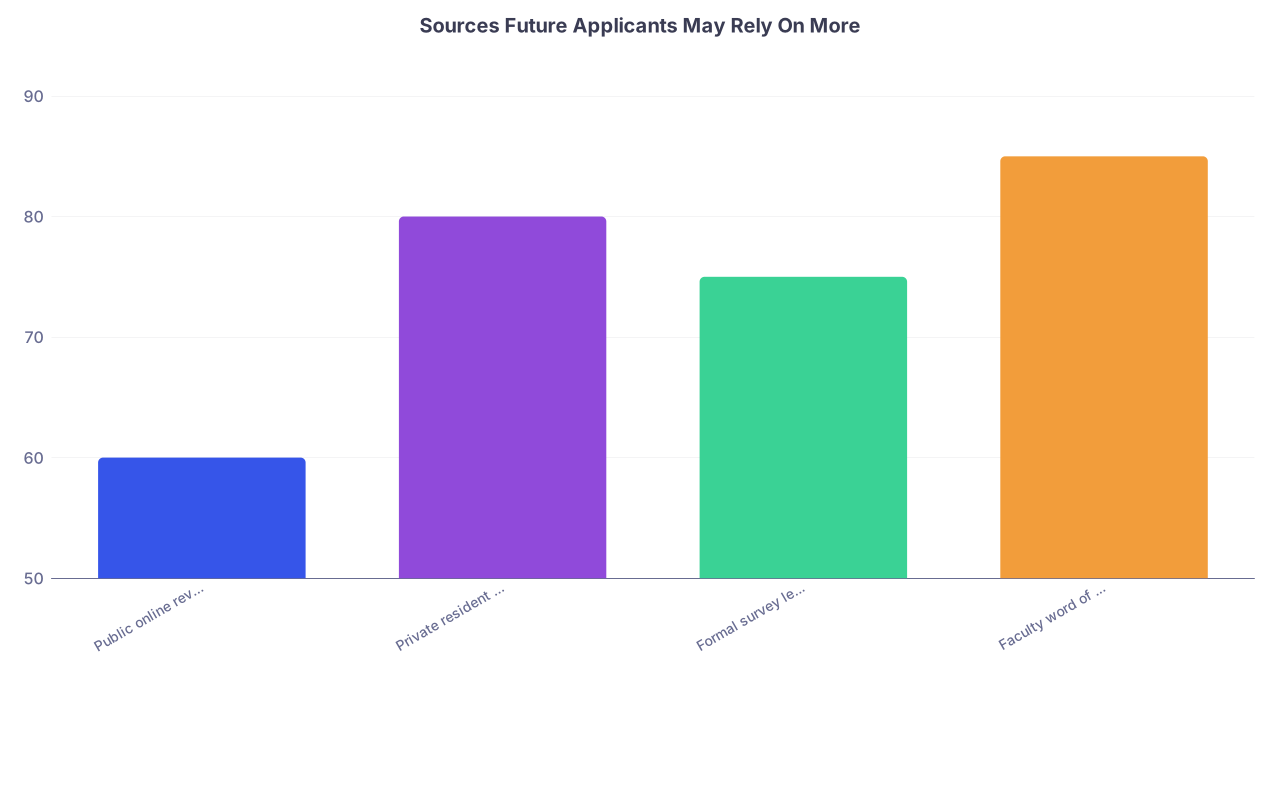
| Category | Value |
|---|---|
| Public online reviews | 60 |
| Private resident networks | 80 |
| Formal survey leaks | 75 |
| Faculty word of mouth | 85 |
But the fantasy—some centralized, honest, transparent “Glassdoor for residency” with no retaliation and 100% candor—is unlikely. Too many politics. Too much power imbalance.
You’re still going to be piecing together:
- Biased online reviews
- Sanitized official presentations
- Half-whispered stories from residents in call rooms
- Hints from attendings who “don’t want this in writing”
So you need to become an evidence‑weighing machine, not a star‑rating consumer.
How To Read a Glowing Review Like a Skeptic
When you see a 5‑star, love‑letter review, run it through this checklist in your head:
Who is likely writing this?
Current resident? Applicant? PD’s favorite chief? Someone angling for a fellowship?What do they stand to lose by being honest?
If they’re still there, the answer is: a lot. That will bias things.What’s missing from the review?
If they never talk about workload, backup, or how conflict is handled, assume the review is curated.Does the tone feel like marketing or confession?
“This place is perfect” = sales pitch.
“Here’s what sucks and why I still chose to stay” = probably real.Does this line up with at least two independent non-online sources?
If not, it’s a weak signal. Don’t throw it out—just downgrade its weight.

The Bottom Line
Rave online reviews are not a residency green flag. They’re barely a flag at all unless you know how to read them.
Three key points:
- Online reviews are heavily biased, often coordinated, and shaped by fear, politics, and extreme experiences—treat them as hypotheses, not verdicts.
- Uniform, vague, all‑positive reviews are more suspicious than reassuring; believable praise is specific, textured, and willing to admit downsides.
- Use reviews to guide what you ask, where you probe, and how you cross-check with real outcomes and off-the-record conversations—not to build your rank list by star average.


