
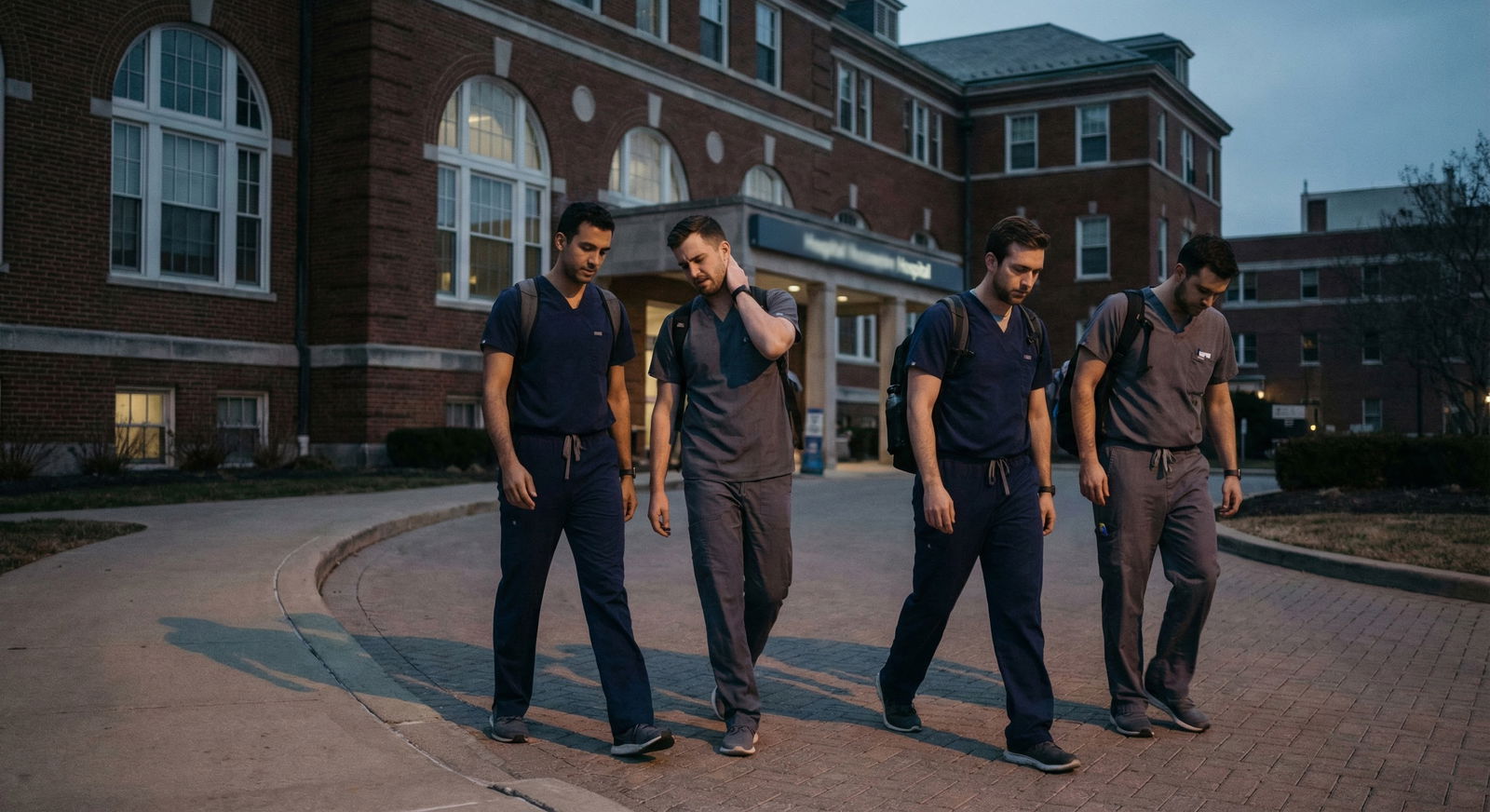
12% of residents say their program’s research culture was honestly represented during recruitment. Everyone else? They realized later they’d been sold a “scholarly activity” brochure that looked nothing like reality.
The Big Myth: “You Must Have Misunderstood”
Let me start with the common script.
Resident: “This isn’t what was described on interview day. You said protected time and mentorship. I’m drowning in service and being pushed to publish.”
Program: “You must have misinterpreted our expectations. All residents are expected to participate in scholarly activity. It’s in the handbook.”
Translation: We over-promised, under-disclosed, and now we’re going to gaslight you into thinking this is just normal academic life.
Here’s the uncomfortable truth: misreading research expectations is usually not the resident’s fault. It’s usually a systems problem—vague language, selective honesty on interview day, and programs chasing ACGME “scholarly activity” metrics without owning the cost to residents.
Is that a red flag? Sometimes. But not always. The trick is knowing when you’ve just run into normal academic chaos… and when you’ve walked into a culture that will happily burn you out to generate one more PubMed ID.
Let’s sort out the fiction from the data-backed reality.
What Programs Say vs What They Actually Do
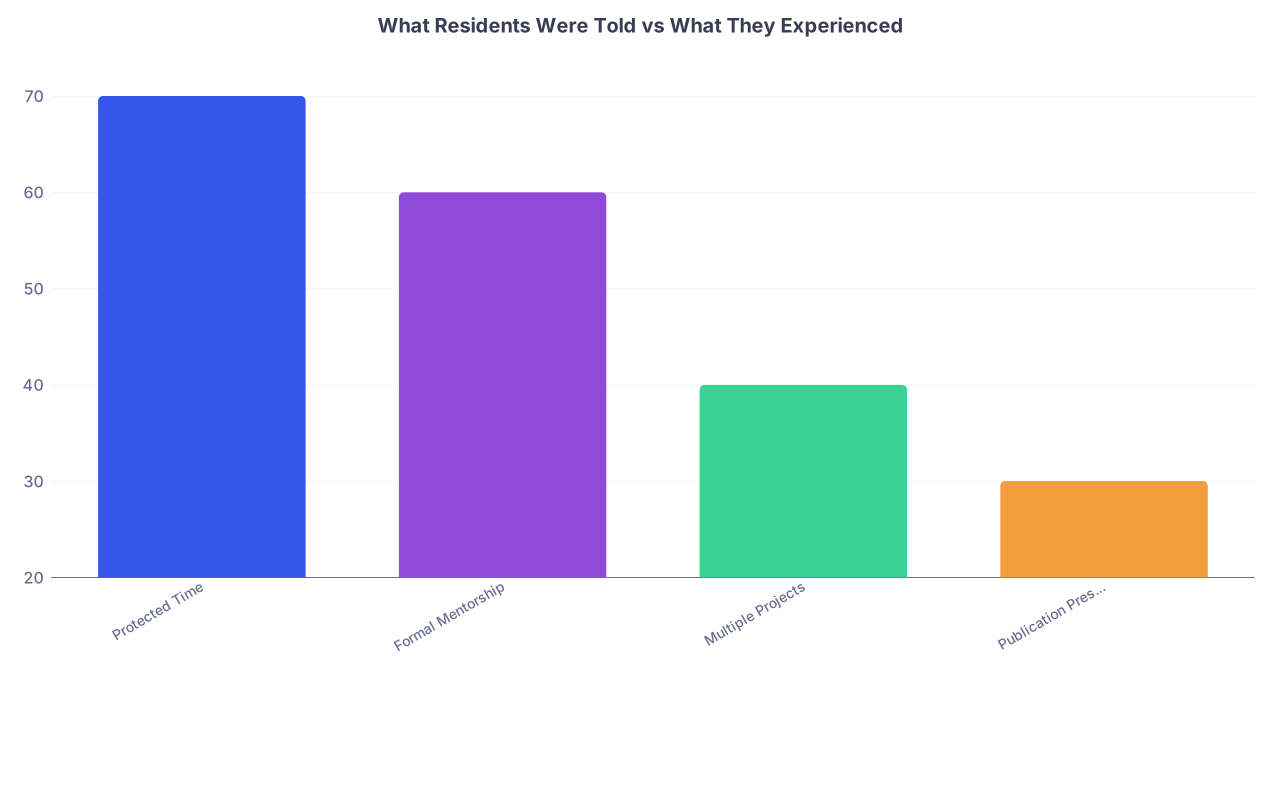
| Category | Value |
|---|---|
| Protected Time | 70 |
| Formal Mentorship | 60 |
| Multiple Projects | 40 |
| Publication Pressure | 30 |
Imagine a mid-tier university internal medicine program. Interview day slide deck:
- “Dedicated research track with protected time.”
- “Every resident graduates with at least one publication.”
- “Robust mentorship and QI support.”
Fast‑forward to PGY-2:
- “Protected time” = maybe 2 half-days a month, often canceled “due to clinical need.”
- “Mentorship” = you cold-email five faculty and two never respond, two say “circle back when things slow down,” and one sends you a dataset and disappears.
- “Every resident publishes” = four people per class actually publish; the rest slap their names on a QI poster that barely got printed on time.
Was the resident naïve? Maybe a little. But the bigger problem is how the game is structured.
Programs love slippery language. “Strong support for scholarly activity.” “Opportunities for research.” “Dedicated time when possible.” None of these phrases have operational definitions. They all sound great in a brochure.
Here’s what the data actually shows from surveys and match studies (NRMP, specialty societies, program director surveys):
- Program directors rank “evidence of scholarly activity” as important, especially in competitive fields (derm, rad onc, plastics, ortho). So they need residents producing.
- Residents, especially in academic centers, report significant mismatch between promised and actual research time and mentorship.
- Published output per resident is heavily skewed—usually a minority of research‑heavy residents generate the majority of output.
So when you “misread” expectations, most of the time you’re not misreading. You’re decoding vague marketing language without a Rosetta Stone.
Normal Academic Life vs True Red Flag: The Line
Not every hard research push is toxic. Some of it is just what academic medicine looks like: disorganized, opportunistic, and slightly exploitative.
The key is this: does the program acknowledge reality and work with you, or do they deny it and blame you?
Let’s split this into two buckets.

“Normal Academic Chaos” – Annoying but Not a Red Flag
These are frustrating but fairly standard in academic residency:
Shifting expectations over time
New PD, new chair, new ACGME pressure. Suddenly “a QI project” becomes “we want a manuscript or abstract from each resident.” The program actually tells people the bar changed, even if late.Inconsistent mentorship quality
Some attendings are rockstar mentors; others ghost you. This is normal in any institution. The red flag is not uneven quality—the red flag is no system to help you find the good ones.Vague “protected time” that still gets occasionally eaten by clinical demands
A sick patient or a short-staffed day cancels your “research afternoon” once in a while. Annoying, but medicine is unpredictable. If it’s occasional and acknowledged, that’s life.Output expectations that are flexible
“We’d like everyone to at least present something—QI, poster, case report—but we understand not everyone wants a full research career.” They might annoy you with reminders but they’re not threatening your evaluation over it.
This stuff feels bad in the moment, but it does not mean the program is malignant. It means academic medicine is messy and often oversells structure it does not fully have.
Actual Red Flags – Where Your “Misreading” Is a Symptom
Now the other side. This is where the phrase “you must have misunderstood” is cover for dysfunction.
Here’s where I draw a hard line:
Retconning expectations after you match, then blaming you
Example I’ve heard verbatim:
“We’ve always expected everyone to complete at least one first-author publication. That was clear from the beginning.”Except: it wasn’t in the recruitment materials, no one said it on interview day, and half the seniors have zero publications.
That’s not miscommunication. That’s rewriting history.
Using research expectations punitively in evaluations
When “insufficient scholarly output” starts showing up in semiannual evals as a professionalism or “engagement” issue—despite no clear standard being published—that’s a genuine red flag. Especially in non‑research tracks of bread-and-butter specialties.
No transparent structure, but high-pressure rhetoric
Watch for this combo:
- “We expect everyone to be involved in research.”
- No clear list of available mentors.
- No centralized project list.
- No deadlines, no assigned research advisor, no realistic protected time.
That’s not a research culture. That’s free labor fishing.
Public shaming or comparison of residents’ CVs
Programs that openly compare residents in meetings (“Look at how many abstracts your co-resident has; others should aim for that.”) or post “top publishers” on slides without context are waving a big red flag. That’s culture, not just miscommunication.
Pushing unethical authorship or ghost work
“Just collect the data and I’ll handle the rest; we’ll see if you make the author list.”
“We already started the project; you can be middle author if you handle all the data cleaning this month.”That’s not “normal academic grind.” That’s exploitation.
What the Data Says About “Research-Heavy” Programs
Here’s another misconception: people assume “research-heavy” is automatically toxic, and “community program” is automatically chill. Reality is more nuanced.
| Program Type | Typical Reality |
|---|---|
| Big-name academic IM | High output, few super-users drive it |
| Mid-tier university | Patchy mentorship, variable expectations |
| Community with university affiliation | A few faculty with active projects |
| Pure community | Mostly QI/case reports, low pressure |
| Small competitive specialty | Intense research but openly so |
Where problems usually cluster:
- Mid-tier university programs that want to look more academic than they are. They talk like Mass General, function like a busy county hospital, and do not acknowledge the gap.
- Programs under new leadership chasing better “scholarly activity” numbers to look good to the Dean or the ACGME. Residents become the metric-generator.
One more data point: multiple specialty surveys show that a minority of residents actually care about research as a career, even in academic programs. But the institutional incentives don’t care about that mismatch.
So when you’re being told, “Everyone is excited about research here,” check the evidence:
- How many graduates actually go into research-heavy fellowships or academic careers?
- How many total publications/posters per grad in the last 3 years? (Not just the star fellow-bound resident.)
- How much of that is real scholarship vs one rushed QI poster at a local day?
If you can’t get straight numbers, you’re not misreading things. They’re not being transparent.
How To Tell If You “Misread” or They Misrepresented

| Step | Description |
|---|---|
| Step 1 | Hear research expectations |
| Step 2 | High risk of misrepresentation |
| Step 3 | Check reality vs promise |
| Step 4 | Normal academic chaos |
| Step 5 | Were specifics given? |
| Step 6 | Do seniors confirm it? |
If you’re already in the program and wondering if you’re the problem, run through this quietly:
Cross-check with multiple seniors
Ask three different upper levels:
“What’s the real expectation here for research to be considered in good standing?”
If answers are inconsistent or hedged, that’s not you misreading. That’s them never defining it.Look at actual outcomes, not slogans
- How many PGY-3s have nothing besides an in-house QI poster?
- Has anyone ever had their evaluation “dinged” for not publishing?
- Did anyone have to scramble in PGY-3 because some new requirement popped up?
If seniors are suddenly rushing a project in the last year to avoid “looking bad,” your so-called misunderstanding is systemic.
See how the program responds when you push back
If you say, “I was under the impression scholarly activity could be QI or a case report, not necessarily a manuscript,” and the response is:
- “Yes, that’s still acceptable, let’s find something reasonable” → gray-zone, probably normal.
- “No, we’ve always meant manuscripts; you must have misunderstood” → gaslighting territory.
If You’re Still a Student: How Not to Get Tricked
You’re not going to fix the incentives that push programs to stretch the truth. You can, however, interrogate them better.
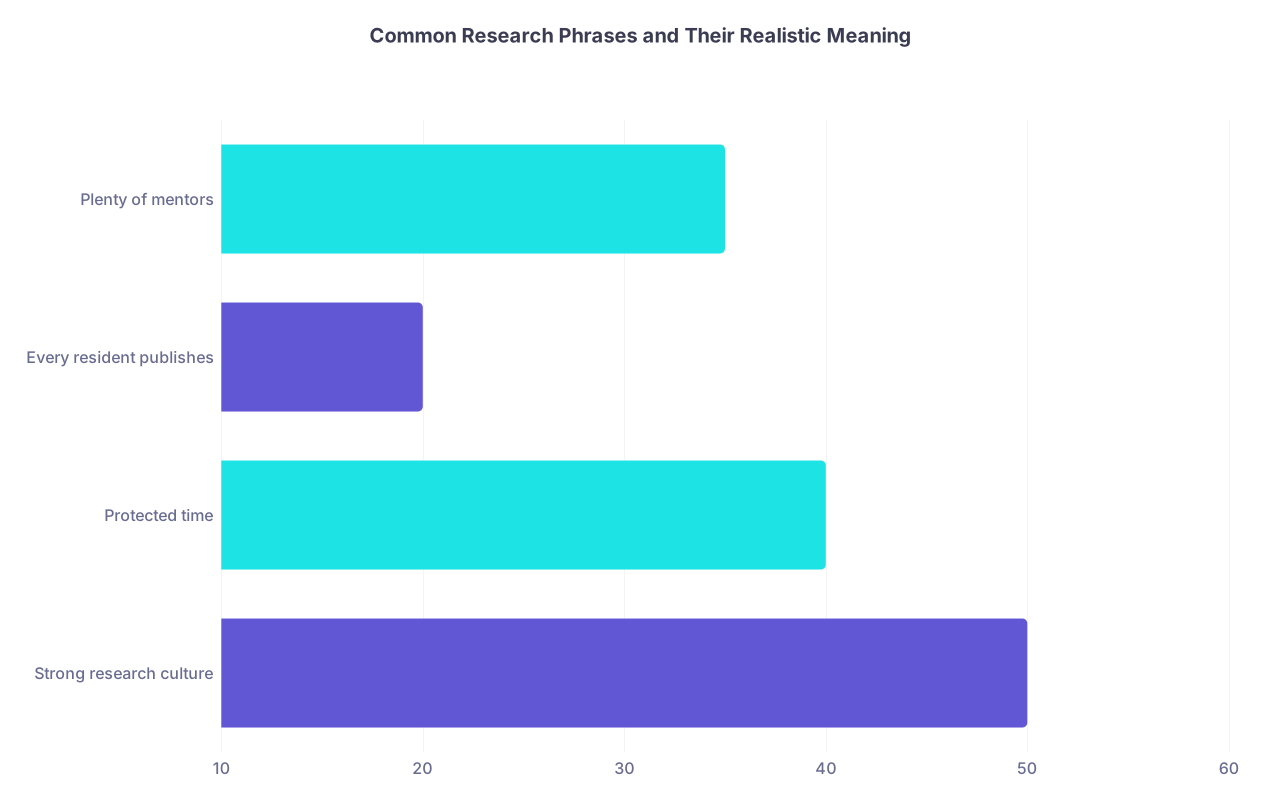
| Category | Value |
|---|---|
| Strong research culture | 50 |
| Protected time | 40 |
| Every resident publishes | 20 |
| Plenty of mentors | 35 |
A quick translation guide:
“Strong research culture”
Could mean three star residents publish like crazy while most do nothing. Ask: “How many publications/posters per graduating resident on average over the last 3 years?”“Protected time for research”
Could mean one elective block if your schedule and service coverage allow. Ask: “Is it guaranteed? How often does it get pulled for service?”“Every resident does scholarly activity”
Could mean: “Everyone has to present something at least once.” Ask: “What counts? QI, case report, local poster, or only national meetings/publications?”“Lots of research opportunities”
Could mean: “You can cold-email and hope.” Ask: “Do you maintain a centralized mentor list or ongoing project list for residents?”
Also: don’t buy the “you must have misheard” line from strangers on Reddit either. I’ve watched more than one PGY-1 post on r/Residency: “My program is suddenly requiring a first-author paper and says this was clear all along.” The replies are divided—some blame the program, some blame the resident. The truth is usually structural opacity plus leadership spin.
What To Do If You’re Already There
You’re in the program, expectations feel shifted or misrepresented, and you’re asking: is this a sign I should run, or just grind through?
A few practical moves that separate red flag from normal pain:
Get it in writing where you can
Email your APD:
“To make sure I’m aligned: my understanding is that [X] counts as sufficient scholarly activity for graduation. Is that accurate?”
If they’ll put a clear “yes” or “that’s acceptable” in writing, the culture might be sloppy but not predatory.Anchor to published policies
If the handbook or recruitment materials are more lenient than what you’re now being told, reference that gently:
“The handbook lists QI and case reports as acceptable forms. Has that changed recently?”Programs with integrity will either admit the bar is shifting or clarify nuance. Programs without integrity will insist “it was always this way.”
Watch how they treat struggling residents
If someone who isn’t research-inclined is supported to complete a modest QI or case report and not shamed, that’s one thing.
If they’re labeled “unmotivated” or “not engaged” because they’re not churning out abstracts, that’s a cultural red flag.Use the experience as data for your own career planning
Sometimes the answer is: this place is more research-driven than you wanted, and you’re stuck for now. That doesn’t mean your entire career has to follow that script. You can intentionally pick a less research-obsessed fellowship or job later. A lot of people quietly do exactly that.

The Real Question: Mismatch or Manipulation?
Here’s the core distinction:
Mismatch = You wanted low-research, you landed in moderate-research. They were somewhat vague, you didn’t ask enough specifics, and no one is actually punishing you as long as you complete some minimal project.
That’s frustrating. Painful sometimes. But it’s normal academic life.Manipulation = They sold you a light, flexible scholarly expectation, then escalated the bar after you matched, deny the change, and use vague “professionalism” language to pressure you into more output.
That’s not you misreading. That’s a legit program red flag.
And no, the solution is not “everyone should just be more excited about research.” The solution is honesty: clear expectations on the front end, realistic support on the back end, and no retroactive rewriting of what was promised.
You’re allowed to not want your residency to be a second PhD. You’re allowed to focus on being a good clinician and still be a serious, committed doctor.
Years from now, you won’t remember the exact number of posters with your name on them. You’ll remember whether you felt lied to—or treated like an adult who could handle the truth.


