The wrong subspecialty exposure in residency will quietly kill your fellowship options before you even start applying.
Let me be blunt: program leadership will tell you “you can do any fellowship from here.” That statement is often false. Not malicious, but still false. The patterns of exposure, case mix, and faculty around you during residency either expand or shrink your realistic fellowship choices. And by the time you realize it, you are PGY‑3 with half the relevant boxes unchecked.
I will walk through the specific exposure patterns that quietly limit future options, by specialty, and what you can still do if you are already in the “wrong” environment.
1. The Core Principle: Fellowships Follow Your Case Mix, Not Your Dreams
Fellowship selection committees care about three things, in this rough order:
- Evidence you understand the specialty’s day‑to‑day reality
- Meaningful performance in that environment (evaluations, letters, tangible work)
- Some combination of research, scholarly output, and “trajectory” in that field
All three are fundamentally constrained by what your residency program exposes you to.
You cannot become a competitive MICU fellow if:
- You never run an ICU service independently
- You rarely intubate, manage vents, or lead codes
- Your only pulmonary interaction is “please do a thoracentesis” on consults
You can write in your personal statement that you “love critical care,” but your application will scream: “this person has never lived it.”
This is why “subspecialty exposure patterns” matter. It is not about checkbox rotations. It is about:
- Volume
- Acuity
- Longitudinal mentorship
- Procedural or technical skill pathways
You want to match cards, GI, heme/onc, MICU, IR, EP, peds subspecialties, etc.? Then you need to know which exposure deficits quietly close those doors.
2. Internal Medicine: The Silent Fellowship Killers
Internal medicine is the most obvious arena where exposure patterns make or break future fellowship options. Let’s be very specific.
2.1 MICU / CCU–Light Programs
If your IM residency has:
- Minimal MICU time (e.g., 3–4 months total across 3 years)
- No real night MICU exposure (only daytime, with fellows running everything)
- A “step‑down ICU” that functions as the de facto unit
- Attending‑ or fellow‑driven procedures only
You are handicapping yourself for:
- Pulm/CC
- Pure CC
- To a lesser extent, cardiology (especially advanced HF, interventional, or CCU‑heavy academic cards)
Programs that select for critical care want to see:
- Substantial ICU exposure with primary responsibility
- Some procedural experience (airway, lines, vents, codes) or at least real decision‑making about them
- Letters from intensivists who have actually seen you manage sick patients
If your program’s model is “residents write notes, fellows run the unit,” your application will look soft, especially compared with residents from big tertiary academic centers where PGY‑2s are running overnight MICU with attending backup.
2.2 Weak Cardiology Exposure
Cardiology fellowship doors start closing when your residency:
- Has no cath lab exposure or only “tourist” days once a year
- Lacks a dedicated CCU service (or the CCU is basically telemetry with nice monitors)
- Has almost all advanced cases shifted to an affiliated tertiary center where residents rarely rotate
- Offers no formal echo exposure or TTE reading time
For cardiology, selection committees expect:
- Substantive time on CCU / cardiology consults
- Real management of decompensated HF, ACS, arrhythmias
- Some understanding of what EP, interventional, structural actually involve
- At least one strong letter from a cardiologist who has seen you work in their environment
If your residency is at a small community program where STEMIs go straight to a different hospital, where EP is “call the device rep,” and HF means “give more furosemide,” you are at a disadvantage.
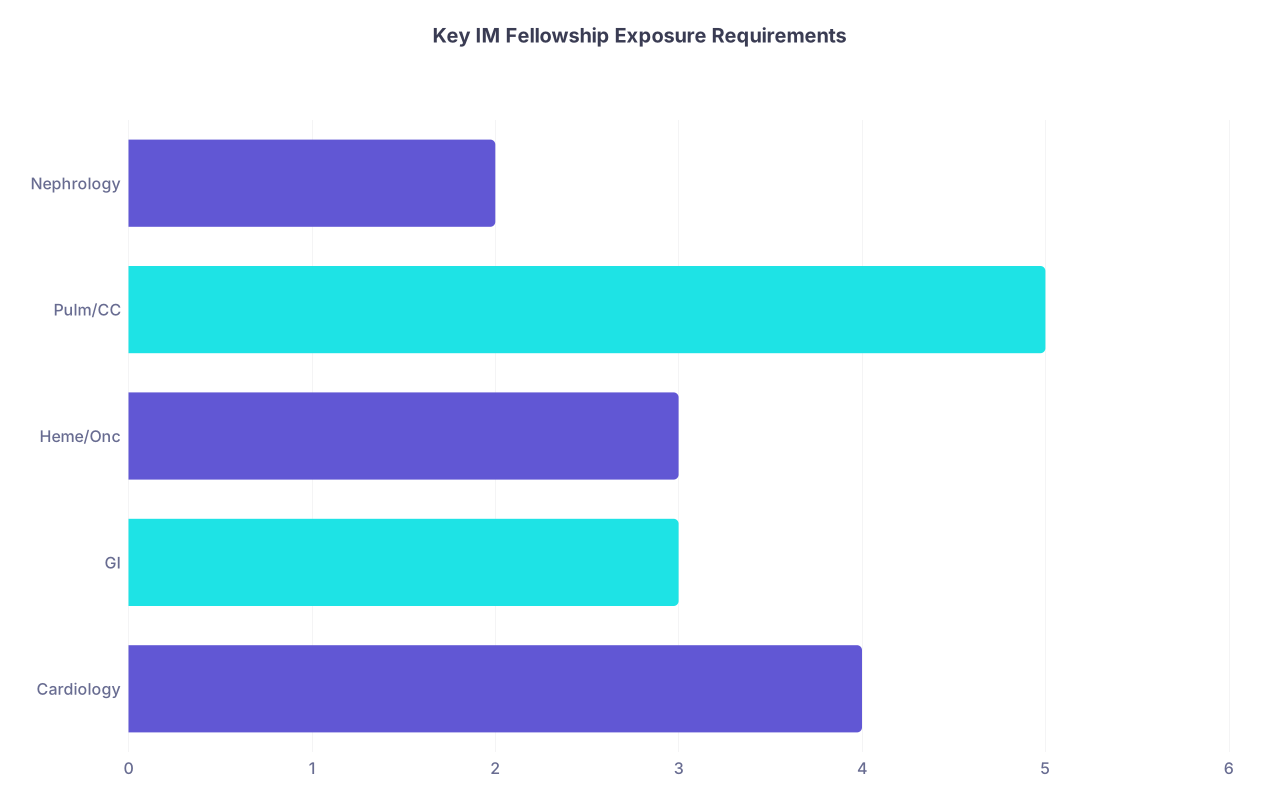
| Category | Value |
|---|---|
| Cardiology | 4 |
| GI | 3 |
| Heme/Onc | 3 |
| Pulm/CC | 5 |
| Nephrology | 2 |
(Scale 1–5: how critical high‑acuity exposure and subspecialty infrastructure are to a competitive application.)
2.3 GI and Heme/Onc Without Real Subspecialty Services
Another bad pattern: “consult‑only” subspecialties with no dedicated ward or continuity.
For GI, fellowship competitiveness suffers when:
- There is no true inpatient GI service—only scattered consults
- Residents never see advanced procedures: ERCP, EUS, EMR, complex bleeding cases
- Outpatient GI clinic is mainly reflux, IBS, constipation, with advanced cases off‑site or sent to another system
- Minimal direct time with GI attendings (fellows are the interface)
For heme/onc, red flags:
- Oncology “lives” in an outpatient infusion center where residents rarely go
- Hematology is a phone‑based consult service that writes brief notes; complex cases sent to tertiary center
- No bone marrow transplant unit, or residents do not rotate there
- Radiation oncology siloed away, zero cross-talk
Fellowship program directors want to see that you actually understand what GI or heme/onc days look like: inpatient complexity, chemo‑related complications, transplant or advanced endoscopy issues, real longitudinal cancer care. Without this, your “interest” reads superficial.
2.4 Research‑Sparse Environments
You do not need R01‑level research to match fellowship. But there is a threshold. Programs that hurt you here:
- Community hospitals with no meaningful IRB or research infrastructure
- Academic affiliates where all real projects go to fellows, not residents
- Attendings who “support research” but have zero time, zero ongoing projects
This matters disproportionately for:
- Cardiology
- GI
- Heme/onc
- Pulm/CC
- Renal and sometimes endo at highly academic places
If all you graduate with is “a QI poster on reducing order set clicks,” you are behind applicants with 2–4 subspecialty‑relevant abstracts, a manuscript, and a mentor who is actually known in the field.
3. Surgery: How Case Mix Locks or Unlocks Advanced Fellowships
Surgical residents feel this viscerally. You are only as strong as the cases you have actually done.
3.1 MIS/Bariatrics with Minimal Complex Lap Work
Programs that overpromise on Minimally Invasive Surgery (MIS) usually have this pattern:
- High volume of straightforward laparoscopic cholecystectomies and sleeve gastrectomies
- Very limited complex foregut, revisional bariatric, or advanced hernia work
- Attendings who keep the challenging MIS cases for themselves or fellows
If your logbook is:
- 200 lap choles
- 80 bariatric cases, mostly sleeves
- Minimal complex adhesiolysis, paraesophageal hernias, Heller myotomies, revisional work
…then top MIS fellowships will consider you under‑exposed, no matter how enthusiastic you are.
3.2 Weak Vascular or Transplant Programs
For vascular:
- If all endovascular work is done by interventional radiology or cardiology
- If open cases are rare and go to one “star” attending
- If there is no dedicated vascular service where residents are primary operators
You will struggle matching competitive vascular fellowships that expect:
- Robust experience with open aortic, carotid, peripheral bypass cases
- Real endovascular exposure, not just “I watched the stent go in”
For transplant:
- No liver transplant program
- Kidney transplant volume <30/year
- Residents not consistently scrubbed in or pushed to take primary roles
You simply will not be competitive for a major transplant fellowship. They have dozens of applicants who have been knee‑deep (literally) in transplant during residency.
3.3 Trauma/Critical Care–Light General Surgery Programs
Critical care or trauma fellowships will look skeptically at:
- Level III/IV trauma centers labeled as “busy” but with low penetrating trauma, limited massive transfusion
- ICUs run predominantly by anesthesiology or medicine critical care with surgery in a consultative role
- Trauma call that is mostly falls and ground‑level injuries in the elderly
You need substantial exposure to:
- High‑acuity trauma (blunt and penetrating)
- Real surgical control of bleeding, damage control, and post‑op ICU management
- Running the SICU or trauma ICU, not just being the “consult note” team
Without that, your application says “I have seen a few cases,” not “I am ready for this fellowship.”
4. Pediatrics: Subspecialty Options Tied to Tertiary Exposure
Pediatrics has its own version of this problem. The gulf between community‑based peds residencies and large quaternary children’s hospitals is enormous.
4.1 PICU and NICU Deficits
For PICU:
- Programs with no in‑house PICU (kids are transferred out)
- Residents who only do 1–2 months of PICU, often as “extra hands” under fellow control
- Minimal exposure to ECMO, CRRT, invasive ventilation strategies
For NICU:
- Level II nurseries rebranded as “NICU”
- Level III units with very limited extreme prematurity or surgical neonates
- Zero exposure to complex genetic/metabolic neonatal care
If you want PICU or NICU fellowship, but your logbook is light on critical cases, your letters will be weak. Program directors can tell who has actually managed a sick 24‑weeker on three pressors at 3 a.m. and who has not.
4.2 Subspecialties Without True In‑House Services
Look at these specifically:
- Peds cardiology
- Peds heme/onc
- Peds GI
- Peds nephrology
- Peds ID
If in your residency:
- Complex kids are sent to the big children’s hospital 90 miles away
- Residents never rotate there, or only for a 4‑week elective as PGY‑3
- There is no real continuity peds subspecialty clinic for residents
Then your fellowship application is built on sand. Committee members expect to see:
- Inpatient subspecialty rotations
- Substantial outpatient clinic in that field
- Letters from subspecialists who have watched you manage complex kids over time
5. Radiology, Anesthesia, EM: Under‑Discussed Exposure Traps
Not everything is IM and surgery. Let me hit a few other specialties.
5.1 Diagnostic Radiology
Fellowship choices in DR are shaped early:
- Programs with no real IR presence limit you for IR (obvious)
- Places where neuro is farmed out, or there is no major stroke center, weaken your neuro applications
- Programs that do not cover a cancer center or transplant center thin out your body/onc imaging portfolio
If you want IR but:
- Your program has 1–2 IR attendings doing mostly ports and nephrostomies
- Complex endovascular, Y‑90, TIPS, PAD, and embolization work goes to another service or hospital
You are going to be disadvantaged against residents from institutions where IR runs half the hospital.
5.2 Anesthesiology
Critical care, cardiac, and pain fellowships all demand specific exposure:
- Cardiac anesthesia: Without a major cardiothoracic program (CABG, valves, LVADs, transplant), your application looks thin.
- Critical care: If your residents do not meaningfully rotate through surgical ICUs as primary providers, it shows.
- Pain medicine: Programs with weak chronic pain clinics or where chronic pain is essentially outsourced will not support a strong pain application.
You need to count complex cases, not just “number of airways.”
5.3 Emergency Medicine
For EM, subspecialty options (toxicology, EMS, ultrasound, critical care) hinge on:
- Whether your ED sees real volume and acuity
- Whether there are dedicated academic tracks or faculty in those areas
- Whether ICU rotations are robust and not “scut months”
EM‑to‑critical care is a growing path. It is much harder from programs where EM residents barely touch ventilator management or long‑term ICU care.
6. Structural Patterns That Should Make You Nervous
This is where the “program red flag” part really lives. These are the systemic patterns that often cripple fellowship options.
6.1 Fellow‑Heavy, Resident‑Light Programs
If your hospital is saturated with subspecialty fellows in every high‑value area, residents get squeezed:
- Fellows take all the interesting consults, procedures, and advanced cases
- Attendings know fellows better, write stronger letters for them, and push their careers
- Residents become note writers, not decision‑makers
I have seen this repeatedly at big-name institutions. Residents graduate with a fancy hospital on their CV but far less autonomy and weaker letters than residents from mid‑tier academic programs without fellows.
6.2 The “Everything Is Transferred Out” Problem
Community programs tell residents: “You get great bread‑and‑butter exposure, and we transfer the rare zebras.”
Translation: you will be under‑exposed to the exact pathology that academic fellowships consider their core business.
Signs this will hurt you:
- STEMIs, strokes, massive GI bleeds frequently transferred rather than definitively managed
- Oncology or transplant cases shipped to “the mothership” with no meaningful resident involvement
- Pediatric complex cases sent elsewhere, leaving you with only mild bronchiolitis and routine asthma
If the cases that define your target fellowship are mostly transferred out, your fellowship options are already constrained.
6.3 “Shadow” Affiliation Without Real Integration
Another common trap: community hospitals “affiliated” with a big academic center, used as a recruitment talking point.
Look for:
- Are there integrated rotations at the main academic site, with defined resident roles?
- Or are you “allowed” to do 1–2 PGY‑3 electives there if you can find your own housing?
- Do faculty from the main site routinely mentor or write letters for your residents? Or are you essentially two separate worlds?
If the affiliation is mostly branding with minimal real subspecialty exposure, it will not rescue your fellowship prospects.
7. How to Assess a Program’s Fellowship‑Supportive Exposure Before You Sign
If you are still in the selection phase, you can avoid many of these traps. Ask targeted questions. Not “is your program supportive.” Everyone says yes. Drill down.
Here is how to structure it.
| Domain | Targeted Question |
|---|---|
| ICU | How many months of MICU / SICU do residents complete, and who runs the unit at night? |
| Procedures | Who does central lines, intubations, LPs, and advanced procedures—residents, fellows, or attendings? |
| Subspecialty Clinics | How many half‑days per month can a resident spend in a chosen subspecialty clinic longitudinally? |
| Transfers | Which high‑acuity or complex cases are usually transferred out rather than managed in‑house? |
| Research | How many residents in the last 3 years matched cards / GI / heme‑onc / CC, and what research did they have? |
The one question that never lies:
“Can you show me the last 3–5 years of where graduates matched for fellowship, by specialty?”
If a program says:
- “People can do anything from here, but we do not have that data compiled.”
That is a red flag.
If the data shows:
- Strong matches in primary care, hospital medicine, maybe a few nephro or endo fellows
- Very few (or zero) matches in cards, GI, heme/onc, MICU, competitive peds subspecialties
Believe the pattern, not the sales pitch.
8. You Are Already in a Limited-Exposure Program. Now What?
Let me shift from diagnosis to salvage. You may be PGY‑1 or PGY‑2, staring at this and realizing: “My program matches at least three of these red flags.”
You are not doomed, but you cannot coast. You will have to be deliberate and slightly aggressive—professionally.
8.1 Maximize Elective Time Where It Actually Counts
Stop wasting electives on “easy” rotations just to breathe.
If you want a specific fellowship:
- Load up on that subspecialty’s inpatient service and consult months
- Add outpatient clinic electives in the same field
- Consider one away elective at a place with a strong fellowship program in that area
You want cards from a community IM program? You probably need:
- Multiple CCU/cardiology months
- One advanced HF or advanced imaging elective if available
- An away rotation at a strong academic cards center as PGY‑2 or early PGY‑3
8.2 Build Real Mentorship Outside Your Home Institution (If Needed)
If your program has no serious researchers in your chosen field, you look outward:
- Cold email faculty at the academic partner hospital
- Ask specifically: “Do you have any ongoing projects that could involve a resident from our affiliate site?”
- Be prepared to do work remotely: chart reviews, data entry, manuscript drafting, virtual meetings
Not glamorous. But two decent abstracts and a paper with a known name in your subspecialty carry far more weight than complaining that your program has no research.
8.3 Get Letters That Prove You Can Do the Job
Fellowship directors will forgive weaker institutional pedigree or thin case exposure if:
- Your letters are powerful, specific, and clearly from people who know the field
- The letter writer can credibly say: “I have worked with many fellows; this resident performs at or above that level”
You may need to:
- Spend your elective glued to one attending who is nationally regarded
- Take ownership of a subset of their patients to demonstrate sustained performance
- Ask for feedback early and adjust how you work so that when you request a letter, it is not a surprise
Weak “resident worked hard and was punctual” letters from generic attendings will sink you.
8.4 Be Honest with Yourself About What Is Feasible
There are fantasies I see every year:
- PGY‑2 at a tiny community hospital with zero transplant program deciding they want abdominal transplant surgery at a top‑10 academic center
- Peds resident with no PICU exposure wanting to do PICU at an institution that only interviews residents from large freestanding children’s hospitals
- Anesthesia resident who has done 10 cardiac cases at a low‑volume center dreaming of the most competitive cardiac fellowships
Sometimes the exposure gap is simply too large. It is not a moral failing. It is structural.
You have options:
- Target less competitive programs in the same fellowship
- Consider a hospitalist or attending job at a more academic center, then reapply after 1–2 years of better exposure and scholarly work
- Recalibrate to a subspecialty that matches your actual training environment
What you should not do is cling to an unrealistic target while ignoring the signals.

| Step | Description |
|---|---|
| Step 1 | Assess Fellowship Interest |
| Step 2 | Review Program Exposure |
| Step 3 | Focus on Research and Letters |
| Step 4 | Plan Electives and Away Rotations |
| Step 5 | Consider Less Competitive Programs or Recalibrate Specialty |
| Step 6 | Apply Broadly with Strong Mentorship |
| Step 7 | Exposure Adequate? |
| Step 8 | Gap Still Large by PGY 3? |
9. The Future: Why This Will Matter Even More, Not Less
The direction of medicine is clear:
- Increasing subspecialization
- Growing emphasis on measurable “readiness” for fellowship (case logs, ICU months, scholarly output)
- More competition for lifestyle‑friendly or procedure‑heavy fellowships
Programs that cannot provide robust subspecialty exposure will bleed their most ambitious residents unless they adapt.
You will hear a lot about “competency‑based training,” “EPAs,” and “flexible pathways.” Behind the jargon, the real currency will remain:
- How many sick patients you actually managed
- How complex your cases were
- Who is willing to vouch for you based on seeing you do that work
Everything else is marketing.
FAQ (exactly 5 questions)
1. Can I still match a competitive fellowship from a small community residency?
Yes, but you start at a disadvantage. You will need to aggressively optimize electives, seek outside mentorship and research, and be realistic about program tiers. Plenty of people have done it—but they did not treat residency as a 9‑to‑5 job. They treated it like a three‑year campaign.
2. How early should I decide on a fellowship to shape my exposure?
By late PGY‑1 you should have a shortlist of 1–2 serious options. By mid‑PGY‑2 you need to commit enough to structure electives, research, and letters around that choice. Waiting until late PGY‑3 to decide you “love GI” when you have done almost no GI work is basically too late.
3. Does doing an away elective at a big academic center really help?
It can help a lot if you perform well and secure a strong letter from a respected subspecialist. It does not magically erase weak training, but it shows you can function in a higher‑acuity environment and gives a fellowship program director a concrete reference point outside your home institution.
4. Is research absolutely required for all fellowships?
No. Some fellowships (like nephrology at many institutions, or community‑oriented endo or rheum) are more forgiving. But for cards, GI, heme/onc, MICU, and competitive surgical or radiology fellowships, some scholarly work is effectively expected, especially at academic programs.
5. Should I switch residency programs if I realize my current one severely limits my goals?
If you are very early (intern year) and the gap between what you want and what the program can offer is extreme—no ICU, no subspecialties, no research—it is rational to explore transferring. Later in training, switching is harder and risky. At that point, it is often more realistic to either recalibrate your fellowship target or plan a staged approach: finish where you are, then move to a stronger institution as a hospitalist and build your fellowship application from there.
Key points: Your fellowship options are bounded by your residency’s case mix, subspecialty exposure, and mentorship structure. Fellow‑heavy, transfer‑happy, research‑sparse programs quietly close doors, especially for competitive fellowships. If you are in such an environment, you must deliberately engineer rotations, mentorship, and scholarship—or adjust your goals before the application cycle forces the issue.