The most dangerous feedback you’ll hear on interview day often comes from the happiest, loudest resident in the room.
If you’re not careful, you’ll build your entire rank list on that one voice—while the exhausted, burned‑out majority sit quietly in the background, saying nothing. And that silence is not neutral. It’s a red flag.
Let’s walk through why this trap is so common, how programs exploit it (yes, exploit), and how you protect yourself from being sold a fantasy by one cheerful PGY‑3 while the rest of the program is barely hanging on.
The Seductive Lie of the Single Happy Resident
You know the scene.
You’re at a pre‑interview dinner or post‑interview lunch. One resident is basically the emcee: cracking jokes, talking about how “supportive” the program is, how “chill” the attendings are, how “we’re like a family.” They have that weird boundless energy for someone supposedly working 70–80 hours a week.
You notice:
- They answer almost every question
- They interrupt quieter residents to speak for the group
- They keep steering the conversation to the “great culture” and “amazing leadership”
- They get oddly vague when you ask about call, weekends, or time off
The mistake is assuming this person = the program.
You’re tired, overextended, and under pressure to fall in love with someplace. It’s easy to latch onto the one clear, enthusiastic data point and ignore the fact that five other residents at the table looked at their shoes when someone mentioned “wellness.”
I’ve watched applicants rank a program highly because of one charismatic resident, then show up as interns and realize:
- That resident was a chief with protected time, not living the day‑to‑day grind
- They were a program favorite with privileges others didn’t get
- They had no kids, no commute, no major obligations and genuinely found the workload “fine”
- Or bluntly: they were drinking the Kool‑Aid and needed to believe the program was great
Your career is too long to be anchored to one outlier’s happiness. Outliers don’t represent the mean. They often mask it.
Silence Is Data. Treat It Like Data.
Here’s the big mistake people make: they listen only to what’s said and ignore what’s not said.
On your interview day, watch for:
- Residents at the same table who barely talk, even when directly asked
- Quick, rehearsed answers followed by awkward silence
- Residents glancing at each other before answering a tough question
- People physically shifting, sighing, or looking away when duty hours, fairness, or leadership come up
You’re not in a neutral setting. Residents know their careers depend on not angering the PD and not being labeled “negative” or “not a team player.” Gossip travels in hospitals faster than sepsis labs.
So silence is protective. It’s survival. And it’s incredibly revealing.
If you ask, “Do you feel supported when things go wrong?” and the loud resident says, “Oh totally, leadership’s great,” while three others suddenly find their salad very interesting—that’s not an endorsement. That’s fear or resignation.
I’ve seen residents later admit:
- “I didn’t feel safe saying anything with the chief there.”
- “We were warned not to badmouth the program to applicants.”
- “We were told to ‘focus on positives’ or it would reflect on us.”
If you ignore that silence and just cling to the single bright, shiny voice, you’re telling yourself a comforting story, not evaluating reality.
How Programs Engineer the Happy‑Resident Illusion
Do not be naïve: some programs carefully curate who you meet.
You think you’re randomly seeing “a sample of our wonderful residents.” You’re often seeing:
- The chief residents with the most PD‑aligned loyalty
- The wellness committee people who are heavily invested in optics
- The high‑energy social types who enjoy recruitment and are given protected time to be there
- The residents least likely to say anything controversial
Now add in programs that deliberately exclude:
- Known complainers (aka people who tell the truth)
- Burned‑out seniors who would say, “Run” if given 2 minutes alone with you
- Residents who have kids, chronic illness, or caregiving responsibilities (aka those stressed by schedules)
And then look at the schedule they invite you to:
- Recruitment dinners on nights when the call schedule is lighter
- Tours led only by upper‑levels who are out of the ICU or ED
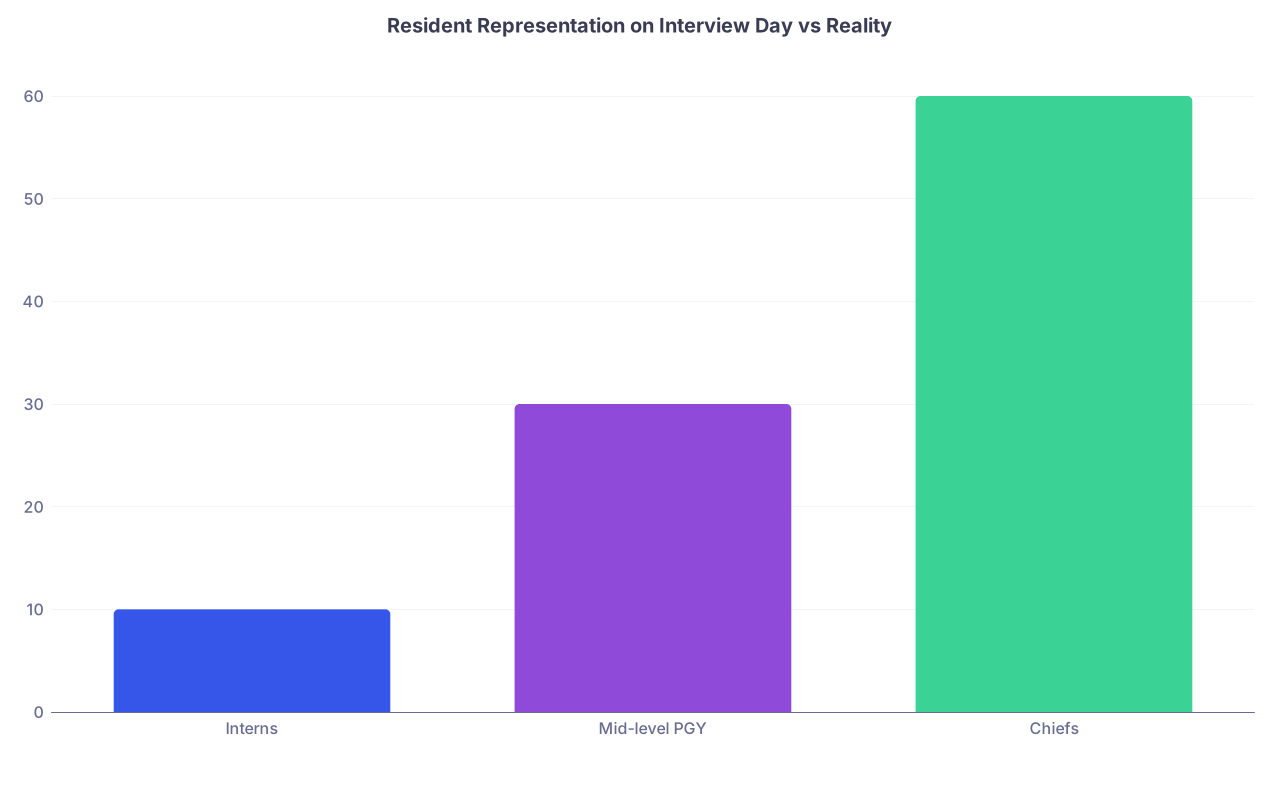
- Breakout rooms with zero interns or only one carefully selected PGY‑2
You end up with a fun, shiny, but deeply misleading view of the program.
| Category | Value |
|---|---|
| Interns | 10 |
| Mid-level PGY | 30 |
| Chiefs | 60 |
That’s not an exact dataset, obviously, but it’s the pattern: chiefs and “trusted” senior residents are overrepresented. Interns and the most overworked mids are underrepresented.
Your mistake would be assuming this biased sample equals the full picture. It doesn’t.
Common Scenarios Where Single Voices Mislead You
Let’s get concrete. Here are typical patterns I’ve seen play out.
1. The “Our Program Is So Supportive” Chief
A cheerful chief resident tells you:
“We have amazing support. I’ve never felt abandoned on a rough call. Attendings are super approachable.”
What they don’t mention:
- As a chief, they have lighter clinical duties and more control over schedules
- When they were PGY‑2, three residents quit after brutal ICU months
- That “support” = a wellness pizza party after 28‑hour shifts back‑to‑back
Watch the lower‑level residents when this is said. Are they nodding like they’ve experienced the same support? Or staring into space, dead‑eyed?
2. The “I Still Have a Life!” Outlier
A single resident describes their great lifestyle:
- “I still rock climb all the time.”
- “I coach soccer every weekend.”
- “I travel on my golden weekends.”
This can be true—for them. But they may be:
- Single, local, with no kids and strong family support
- Naturally high‑energy and low‑sleep folks
- On an easier elective month during recruitment season
- Someone who trades away miserable shifts to others or avoids certain rotations
You cannot project their experience onto your future self, especially if you have different responsibilities or personality.
The resident with two kids who commutes 40 minutes may have an entirely different story, and you never hear it. Or they’re at the same table, silently chewing between polite smiles.
3. The “Complaints Are Overblown” Loyalist
This one’s dangerous. You ask a slightly pointed question about workload or scut:
“I saw some things online about long hours. Has that improved?”
The loyalist laughs it off:
“People exaggerate. It’s residency, you expect it to be hard. I think some folks just weren’t a good fit.”
Translation in many programs: burnout is blamed on individual weakness, not structural problems.
The silent red flag: no one else at the table backs them up with specifics like, “Yeah, last year they cut our total ICU time” or “We now cap at X patients and it’s enforced.”
You get general reassurance, no concrete changes, and a room full of silence. That’s not “drama is overblown.” That’s unresolved dysfunction.
Red Flag Patterns in Resident Behavior You Should Not Ignore
You’re not a mind reader, but there are repeat patterns that should make you very cautious about trusting one happy voice.
Here are some resident‑side red flags during interview day:
- Only 1–2 residents do 90% of the talking, by choice, not by facilitation
- Residents avoid specifics about call frequency, caps, or weekend coverage
- Someone starts to answer honestly, then gets cut off or “reframed” by a more senior resident
- Jokes about “you survive somehow,” “just get through PGY‑2,” or “we don’t talk about that rotation” that no one actually clarifies
- Any mention of “we’re like a family” while multiple people look exhausted and dead behind the eyes
And program‑side red flags:
- You are never alone with residents without faculty present or within earshot
- Breakout rooms always include a chief or someone with a formal leadership role
- When you ask to talk to an intern, they’re “busy on a tough week” but no attempt is made to connect you later
- Residents appear on Zoom from workstations, hurried, and give short, guarded answers while attendings are “also joining to help answer questions”
If you see these patterns and still decide, “But that one PGY‑3 was so happy; I’ll be fine,” you’re choosing the exception over the rule. That’s a choice many later regret.
How to Actively Probe Beyond the One Happy Voice
You’re not powerless. There are ways to stress‑test the narrative without being confrontational or weird.
Ask the Same Question to Multiple People, Separately
Do this as much as possible:
- Ask a senior: “How have duty hours changed over your time here?”
- Ask an intern later: “How are duty hours actually tracked? Any pressure to under‑report?”
- Ask a mid‑level: “What rotation pushes people closest to burnout?”
Look for consistency, not perfect alignment. If three people independently admit the same tough rotation but frame it as “probably our hardest block,” that’s reality. If only one resident is positive and everyone else hedges or gets vague, assume the majority is closer to the truth.
Ask for Concrete Examples, Not Vibes
Vibes are easy to script. Details are harder to fake.
Bad question: “Do you feel supported?”
Better questions:
- “Can you describe a time a resident was truly overwhelmed and how the program responded?”
- “What’s one thing residents complain about the most—and has leadership actually changed it?”
- “How often are people staying past their shift end? Give me a typical week.”
Push (politely) for specifics. The more generic the answer, the more likely you’re being handled.
Watch Body Language Like a Hawk
You’re not just listening to words.
Look for:
- Micro‑expressions when a tough topic comes up: eye rolls, forced laughs, stiff shoulders
- Residents exchanging looks when someone gives an overly rosy answer
- A single resident consistently answering quickly, as if closing off the topic before others can speak
If the happiest resident always jumps in first and everyone else settles back, that’s not leadership—that’s control of the narrative.
Use Data and Structure, Not Just Stories
Stories are powerful. They stick in your mind. “That one resident who seemed so happy.” But you need structure to counterbalance anecdote.
Build a simple comparison system for your programs.
| Factor | Program A | Program B | Program C |
|---|---|---|---|
| % residents who spoke freely | |||
| Interns present and candid | Yes/No | Yes/No | Yes/No |
| Consistency in answers | Low/Med/High | ||
| Concrete examples given | Few/Some/Many | ||
| Visible burnout vibe | Low/Med/High |
Force yourself to score what you saw, not what you felt from one person.
You’ll be surprised how often:
- Your feeling about “they were so friendly” doesn’t match
- The actual number of residents who seemed guarded was high
- The only detailed answers came from one happy outlier
That mismatch is precisely where people later say, “I don’t know how I missed it.” You didn’t miss it. You ignored it.
Asynchronous Honesty: The Emails and DMs That Really Matter
Some of the most honest program intel doesn’t happen on interview day at all.
Programs rarely advertise this, but you’re allowed to:
- Get contact info from residents and email them later with more specific questions
- Ask for contact with a resident who has a similar background (kids, partner, visa, etc.)
- Reach out to alumni or current residents via LinkedIn or friends of friends
You’ll often get two very different tones:
- In‑person / on‑Zoom: “We work hard but it’s a great learning environment.”
- One‑on‑one via email/DM: “Look, here’s what’s actually rough and what’s tolerable.”
Red flag: a program blocks or discourages this. If they refuse to connect you with additional residents, insist everything go through the coordinator, or say “we don’t want to overwhelm residents with extra questions,” that’s suspicious. Good programs don’t fear more contact; they encourage it.
Future of Medicine: Why You Must Stop Excusing Structural Harm
Let me zoom out for a second.
Medicine is slowly, painfully waking up to the cost of ignoring resident well‑being. Burnout, depression, suicide—these aren’t abstract. They’re happening down the hall.
Every time applicants trust the one happy voice and ignore the silent, unhappy majority, a few things happen:
- Harmful programs stay full; match rates reward bad behavior
- Leadership tells themselves, “We’re competitive, so we must be doing fine”
- Residents suffering in silence watch another class come in, repeating the cycle
You are not just choosing your own fate. You’re quietly voting with your rank list for which systems get to keep doing what they’re doing.
Choosing programs with:
- Transparent residents
- Mixed feedback that’s honest instead of scripted
- Leadership that lets residents speak freely (even critically)
…isn’t just self‑preservation. It’s pressure on the system to modernize and stop hiding behind a single smiling PGY‑3 at interview dinners.

| Step | Description |
|---|---|
| Step 1 | Interview Day |
| Step 2 | High risk of misrepresentation |
| Step 3 | Better insight |
| Step 4 | Rank based on single voice |
| Step 5 | Rank with realistic expectations |
| Step 6 | Possible burnout and regret |
| Step 7 | Higher chance of fit |
| Step 8 | Resident voices mixed? |
How Not to Fall Into This Trap
Let me boil it down into practical guardrails.
Never let one resident’s enthusiasm outweigh the group’s vibe.
If one person is glowing and five look miserable, assume the five are your future, not the one.Treat silence, hesitation, and guardedness as data.
You are not paranoid for noticing it. You’re observant.Actively seek dissenting voices.
Talk to interns. Talk to mids. Email people later. Use your network. Push past the curated bubble.
If you remember nothing else, remember this: residency is too hard to gamble on a single happy story while everyone else in the room says nothing.
Listen to the loud one—but weigh the quiet many.