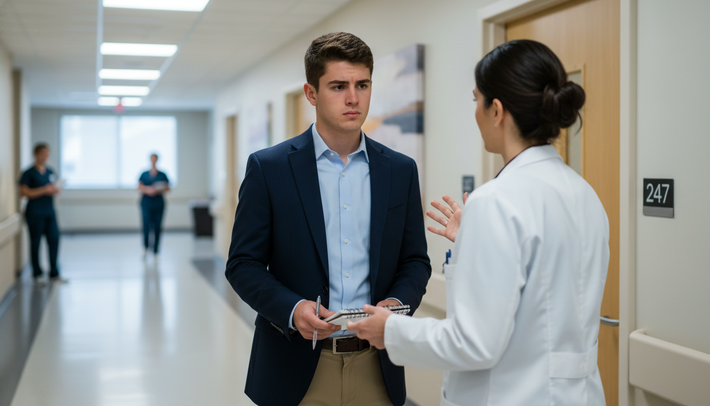
The obsession with shadowing surgeons is wildly overblown—and the data backs that up.
If you believe half the premed forums, you’d think that without 100+ hours of surgical shadowing, your application is dead on arrival. That is fiction. Competitive applicants get into excellent medical schools every year with little or no time spent watching someone else operate.
The problem isn’t shadowing itself. It’s the myth that surgical shadowing is some special golden ticket, especially if you’re considering a surgical specialty later. It is not.
Let’s sort out what actually matters—and what’s just anxious noise.
(See also: Shadowing vs Clinical Volunteering for more details.)
The Myth: “You Need Surgical Shadowing to Be Competitive”
This belief usually shows up in a few flavors:
- “Top schools expect OR shadowing.”
- “If you think you might want surgery, you have to shadow surgeons.”
- “Adcoms will question your interest if you haven’t observed an operation.”
None of these are consistently supported by actual admissions data or policies.
Look at what schools publicly say they require or strongly recommend. They almost never specify surgical shadowing. They talk about:
- Exposure to patient care
- Understanding of the medical profession
- Longitudinal involvement in clinical settings
Harvard, UCSF, Mayo, Penn, Michigan, Duke—pick your favorite “competitive” program. Their admissions pages emphasize clinical experience and understanding of medicine, not scrubbed‑in time watching laparoscopic cholecystectomies.
When they do mention shadowing explicitly, it’s nearly always in broad terms: physician shadowing, clinical observation, or exposure to multiple specialties. Not "must watch a Whipple."
What competitive applicants really share is not a specific type of shadowing, but a clear, credible story about:
- Why they want to be physicians
- How they’ve tested that interest in the real world
- What they learned from those experiences
You can build that story with zero surgical shadowing.
What Admissions Committees Actually Care About
Let’s stop guessing and look at what’s on the record.
The AAMC, medical schools’ own admission pages, and dean/interview webinars converge on a few core clinical themes:
Sustained clinical exposure
Schools want to see that you’ve spent serious, repeated time around patients and healthcare teams. That might be:- Hospital volunteering
- ED or inpatient clinical assistant roles
- Scribing (in any specialty)
- Hospice, free clinics, community health centers
- Longitudinal primary care or specialty clinic shadowing
They care that you showed up week after week, not that you stood in an OR for one intense week.
Active vs passive involvement
Passive observation (classic shadowing) is lower‑yield from an admissions standpoint than roles where you actually do things appropriate to your level—talking with patients, taking vitals, entering data, coordinating care, translating, etc.The OR is notoriously passive for premeds. You’re often at the back of the room, barely hearing anything under masks and suction noise, and certainly not touching the patient.
Breadth of understanding
Exposure to different clinical settings matters more than depth in a single narrow area. Seeing outpatient vs inpatient, acute vs chronic care, resource-rich vs resource-poor environments—these are higher‑value experiences than knowing how long a Whipple takes.Reflection and maturity
Adcoms repeatedly say they care less about what you did and more about what you learned and how you integrated it into your decision to pursue medicine. A small amount of shadowing plus deep reflection beats 200 hours logged and nothing insightful to say about any of it.
Notice what’s missing: “Requirement for surgical shadowing.”
The competitive part of a “competitive application” is not whether you watched an appendectomy. It’s whether you’ve demonstrated insight, commitment, reliability, and alignment with the profession.
Why Surgical Shadowing Is Overvalued (and Often Misunderstood)
There are three big reasons the surgeon‑shadowing myth persists.
1. The glamor distortion
Surgery looks dramatic. Lights. Instruments. High stakes. Shows like Grey’s Anatomy and The Resident heavily skew toward procedural medicine because it’s more visually compelling than adjusting insulin doses.
Premeds internalize this and assume: dramatic = important. That’s not how admissions works.
If anything, months of thoughtful involvement in a dull‑looking outpatient clinic where you’re helping manage hypertension and diabetes typically signal more understanding of real medicine than four days watching orthopedic cases.
Surgical practice is a small slice of what physicians do worldwide. Medical schools are not selecting “future surgeons only.” They’re selecting future physicians, the majority of whom won’t be in the OR.
2. Misreading surgeon stories
You’ll hear surgeons say, “I knew I wanted surgery when I shadowed Dr. X in the OR.” That’s their story, not a template.
They often compress years of exposure into one narrative moment. Beneath that soundbite, many:
- Had extensive non-surgical clinical experiences
- Explored internal medicine, pediatrics, or emergency medicine
- Only solidified their interest in surgery during clinical clerkships in medical school
By the time they’re telling their story on podcasts, the OR moment becomes the highlight reel. Premeds hear that and conclude, “I need that exact moment too.”
You do not.
3. Confusing residency competitiveness with premed expectations
Yes, surgical residencies can be highly competitive. That doesn’t retroactively impose a requirement on your premed record to have surgical shadowing.
Residency programs care about:
- Your performance in medical school
- Your evaluations on surgical rotations
- Your letters from surgical faculty
- Your research and scholarly work in surgery or related fields
- Your technical and cognitive abilities as demonstrated in clerkships
None of that depends on whether you stood in an OR at 19 staring over a drape, unable to identify what you were seeing.
Premeds routinely conflate “competitive specialty” with “must declare and prove devotion at age 20.” That’s not how training pathways are designed.
When Surgical Shadowing Does Help—and When It Doesn’t
Let’s be clear: shadowing surgeons is not useless. It’s just not mandatory, and it’s often misused.
High-yield uses of surgical shadowing
Surgical shadowing is helpful when:
- You’re genuinely considering a surgical or procedure-heavy career and want to sanity-check whether the environment—even in a superficial way—fits you.
- You already have solid, hands-on clinical experiences and want to supplement them with a window into a different side of medicine.
- You can pair the OR time with clinic time with the same surgeon, so you see pre-op decision making, informed consent, and post-op management—not just the cutting.
In these contexts, 10–20 hours can be enough to give you material to reflect on: the team dynamics, the pace, the hierarchy, the types of patients, how surgeons think through risk and benefits.
Low-yield or performative surgical shadowing
Surgical shadowing is much less helpful when:
- You’re doing it instead of hands-on clinical work because it “sounds more impressive.” Admissions committees can tell.
- You’re there once for a “surgery camp”–style experience you’ll never repeat. That reads as tourism.
- You can’t articulate anything meaningful you learned beyond “it was cool” and “I liked the teamwork in the OR.”
If your personal statement or interview answer leans heavily on one dramatic OR story but your application is otherwise light on real patient contact, that looks unbalanced.
There’s also a practical concern: OR access is often about connections and institutional policies, not merit. Some hospitals make it extremely hard for undergrads to be in the OR for infection control and liability reasons.
Adcoms know this. They’re not going to systematically penalize applicants who had no path into an OR, especially when there are far better, more accessible ways to demonstrate commitment to medicine.
What To Do Instead: Building a Competitive Clinical Profile Without Surgical Shadowing
If you’re not in the OR, where should you be?
You should be where patients are—and where you’re allowed to actually contribute within your scope.
Some of the highest-yield premed clinical experiences, from an admissions perspective, are:
- Long-term hospital volunteering where you interact with patients and families, not just carts and printers
- Medical scribing (ED, family medicine, cardiology clinic—does not matter)
- Certified roles like EMT, CNA, medical assistant, phlebotomist
- Hospice volunteering, where you learn more about mortality, communication, and family dynamics than any OR can teach
- Free clinic roles—especially if you’re doing translation, navigation, or health education
None of that requires a single moment in an operating room.
A common pattern among extremely strong applicants: 300–800 hours of substantive clinical involvement, spread across 1–3 settings, with increasing responsibility over time—and maybe zero surgical shadowing.
When they talk about these roles in essays or interviews, they can:
- Describe specific patients and ethical or emotional challenges
- Explain how their view of medicine evolved
- Reflect on limitations of the system they worked in
- Show they understand the boring, chronic, unglamorous tasks that make up most of patient care
That level of insight is what separates competitive from generic, not whether they’ve seen a laparoscopic tower.
“But I Might Want to Be a Surgeon—Isn’t It Risky Not to Shadow One?”
The short answer: no. The risk is vastly overstated.
Here’s the uncomfortable truth: you don’t know what any specialty is really like until clinical rotations in medical school. Watching surgeons as an undergrad gives you little operational understanding of:
- Overnight call realities
- Post-op complication management
- Clinic volume and paperwork
- Operating while sleep-deprived
- How reimbursement, hospital politics, and system constraints shape surgical practice
If you can shadow a surgeon and you’re curious, fine—do it. But do not treat undergraduate OR exposure as a prerequisite to “qualify” you for eventually choosing or matching into surgery.
Medical school is built specifically to expose you systematically to specialties so you can make informed decisions later. Programs are not expecting premeds to have done their specialty due diligence at 19.
A more realistic goal now: be sure you actually want to be a physician treating human beings, in any of many possible contexts. That can be tested very effectively outside the OR.
How to Talk About Not Having Surgical Shadowing
If an interviewer asks, “Have you shadowed any surgeons?” you do not need to panic or apologize.
A strong answer might sound like:
“I haven’t spent time in the OR specifically. My clinical experience has focused on outpatient internal medicine and hospice. That’s where I’ve had the most meaningful patient interaction and responsibility at my current training level. What I have seen is how complex chronic care and end-of-life decisions can be, and that’s been central for me in deciding I want to practice medicine. I do want to explore surgery and other procedural fields during medical school, once I can engage more meaningfully with the team.”
That answer shows prioritization, intentionality, and insight. It does not sound deficient.
If you do have small doses of surgical or procedural exposure but not much, you can position it as:
“I’ve had some limited exposure to surgery—about 10 hours shadowing in the OR—which helped me appreciate the teamwork and coordination involved. But in terms of depth, most of my learning has come from my longitudinal clinic role, where I could participate more directly in patient care.”
You’re not underselling the OR time; you’re accurately ranking its educational value compared to your other work. Adcoms will respect that judgment.
The Real Non-Negotiables—and Where Surgery Fits
Strip away the noise and premed mythology, and you’re left with a simpler framework.
Non-negotiables for a competitive application:
- Significant, longitudinal clinical exposure with real patient contact
- Evidence that you understand medicine as it is, not as TV portrays it
- Reflection, maturity, and clear reasoning for pursuing this path
- Reliability and staying power in challenging, often unglamorous roles
Nice-to-haves, but not mandatory:
- A sampling of specialties, including procedure-heavy and cognitive fields
- Some sense of how different clinical environments feel (outpatient, inpatient, ED, resource-limited)
- Brief exposure to surgery if easily available and aligned with your interests
What’s a complete myth:
- That top schools demand OR hours
- That aspiring surgeons must have premed surgical shadowing to be taken seriously
- That surgical shadowing is inherently more impressive than other clinical work
You’re not weaker because you haven’t stood in an OR. You’re weaker if you’ve built your application around what sounds impressive instead of what actually teaches you about patient care and your own fit for the profession.
Bottom line:
- Surgical shadowing is optional, not mandatory—even for a highly competitive medical school application.
- Sustained, hands-on clinical experience where you actually interact with patients is far more valuable than passively watching operations.
- Build your experiences around genuine learning and responsibility, not around chasing what looks glamorous on paper. Admissions committees know the difference.