

The myth that Step 2 CK is just another hoop to jump through is wrong. Programs are quietly—but decisively—using it as a quantitative proxy for how you will perform as an intern.
What the Data Actually Says About Step 2 CK and Clinical Performance
Let me start with the core question: does Step 2 CK meaningfully predict internship performance metrics?
The short answer: yes, but not perfectly. The effect sizes are moderate, not magical. Programs that treat Step 2 CK as destiny are lazy. Programs that ignore it are blind.
Across multiple studies in internal medicine, surgery, pediatrics, EM, and OB/GYN, Step 2 CK tends to show:
- Correlations around 0.3–0.5 with:
- In‑training exam scores (ITE)
- Intern milestone evaluations
- Certain patient care and medical knowledge domains
- Better predictive value than Step 1 (especially now that Step 1 is pass/fail) for clinical performance, not just standardized test performance
- Stronger association with “struggling intern” flags and remediation than Step 1
To put a Pearson r of 0.4 in plain language: Step 2 CK explains roughly 16% of the variance in a performance metric (because r² = 0.16). That is not trivial. In educational research, that is substantial.
But it also means 84% of the variance is something else: work ethic, team skills, fatigue, institutional culture, randomness.
Still, when you are a program director sifting 2,000 applications for 15 spots, a metric that explains 16–20% of future performance is extremely valuable.
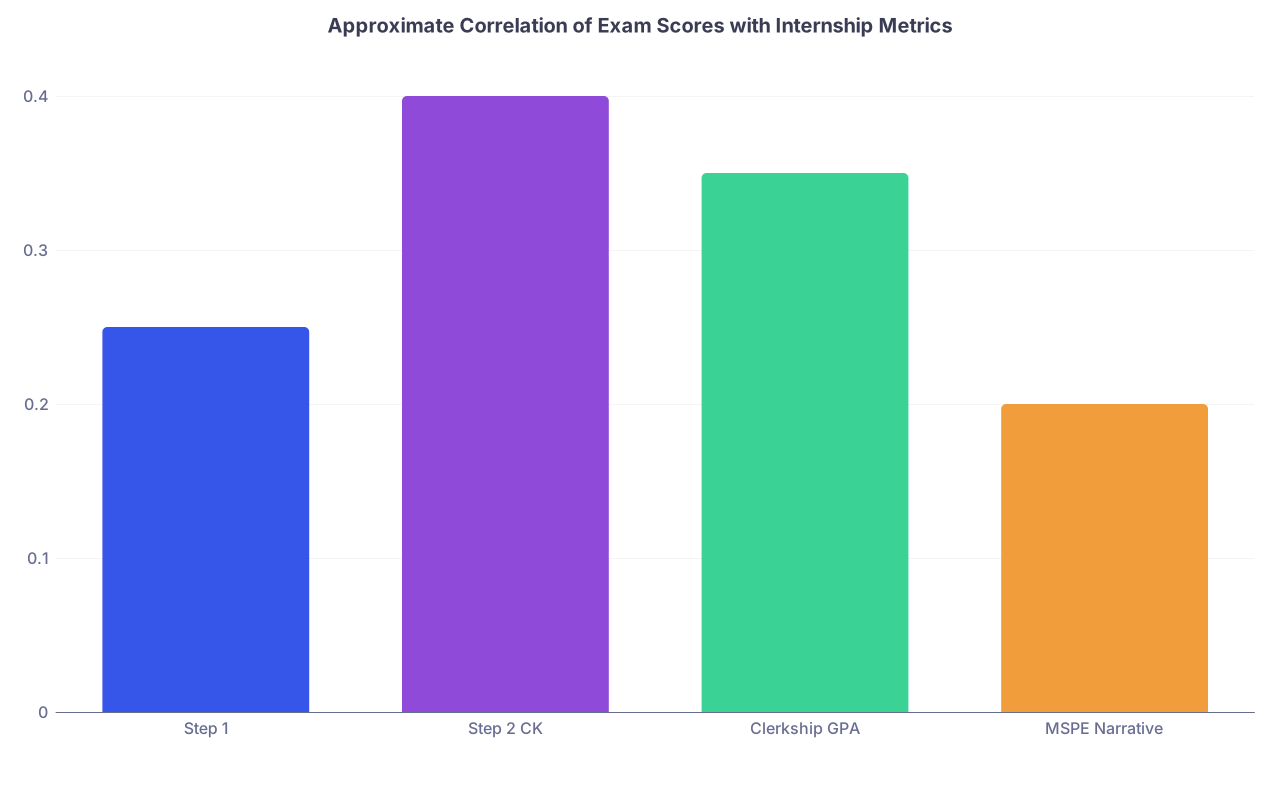
| Category | Value |
|---|---|
| Step 1 | 0.25 |
| Step 2 CK | 0.4 |
| Clerkship GPA | 0.35 |
| MSPE Narrative | 0.2 |
These values vary between studies, but the pattern is consistent: Step 2 CK slightly outperforms Step 1 and usually rivals or slightly beats clerkship GPA as a predictor of objective performance outcomes.
How Programs Quietly Use Step 2 CK in the Application Phase
You are told “we look at applications holistically.” The data says: holistic is bounded by hard cutoffs and implicit thresholds.
Across surveys of program directors (NRMP Program Director Survey, specialty‑specific surveys):
- 60–85% of programs report using USMLE scores for interview selection.
- A substantial subset now explicitly prefers Step 2 CK over Step 1 for ranking clinical readiness.
- Many programs in competitive specialties have “soft” lower limits in the 225–240 range for Step 2 CK, and “competitive” bands in the 250+ range.
Those numbers shift by specialty and institution, but the pattern holds.
The decision rule is usually not a narrow cutoff. It is more like a tiered probability system:
- Below a certain Step 2 CK range → much lower probability of interview unless strong compensating factors (home student, URiM, advanced degree, unique experience).
- Middle band → interview probability modulated heavily by school reputation, clerkship narrative, and letters.
- High band → far higher baseline probability of interview and higher baseline rank positioning, unless red flags appear elsewhere.
| Step 2 CK Band | Program Reaction (Generalized) |
|---|---|
| < 220 | Screened out at many programs; needs strong compensating factors |
| 220–239 | Considered, but needs stronger overall application to stand out |
| 240–254 | Solid; rarely a concern, positive signal for many IM/primary care programs |
| 255–269 | Strong asset across most specialties; often above internal benchmarks |
| ≥ 270 | Standout on paper; attention‑grabbing even in competitive fields |
These are not official cutoffs; they are what I see repeatedly when PDs talk off the record or when residents review last year’s match data informally.
Step 2 CK vs. Specific Internship Performance Metrics
“Internship performance metrics” is vague. Let’s break it into measurable components that show up in the literature and internal dashboards:
- In‑training exam scores (ITE)
- Milestone evaluations (ACGME)
- Clinical productivity / throughput
- Documentation quality and error rates
- Remediation, probation, or extension of training
- Board pass rates (eventually)
1. Step 2 CK and In‑Training Exam (ITE) Performance
This is the cleanest relationship. Multiple studies show:
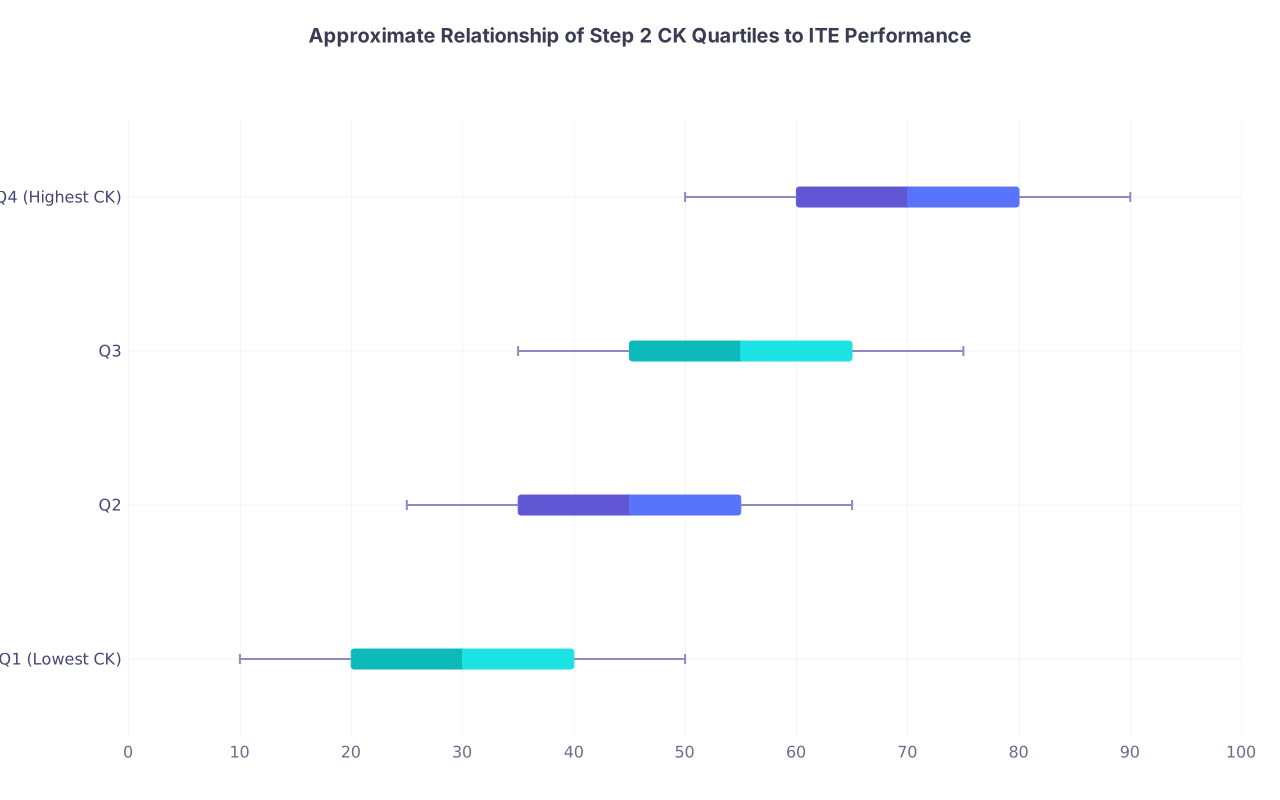
- Correlation (r) between Step 2 CK and PGY‑1 ITE scores: roughly 0.4–0.6 in internal medicine, surgery, EM, and anesthesia.
- Residents in the bottom Step 2 CK quartile are disproportionately over‑represented in the bottom ITE quartile.
| Category | Min | Q1 | Median | Q3 | Max |
|---|---|---|---|---|---|
| Q1 (Lowest CK) | 10 | 20 | 30 | 40 | 50 |
| Q2 | 25 | 35 | 45 | 55 | 65 |
| Q3 | 35 | 45 | 55 | 65 | 75 |
| Q4 (Highest CK) | 50 | 60 | 70 | 80 | 90 |
Interpretation: as Step 2 CK quartile increases, the median ITE percentile rises and the lower tail shifts upward. You still see overlap—plenty of Q2 residents doing extremely well, some Q4 underperformers—but the trend is one‑directional.
Programs care because ITE performance predicts board pass rates and sometimes accreditation standing. From a PD’s perspective, Step 2 CK is an early, cheap proxy for “Will this person keep our pass rate above 90%?”
2. Step 2 CK and Milestone Evaluations
Now we move from pure test performance to clinical functioning.
ACGME Milestones typically rate domains like:
- Patient Care
- Medical Knowledge
- Systems‑Based Practice
- Practice‑Based Learning and Improvement
- Interpersonal and Communication Skills
- Professionalism
The data pattern:
- Correlations ~0.3–0.5 between Step 2 CK and Medical Knowledge and Patient Care milestones in PGY‑1.
- Much weaker correlations (often 0.1–0.2 or nonsignificant) with Professionalism and Communication.
Translation: higher Step 2 CK predicts stronger early assessments in how you gather data, integrate information, and generate plans. It does not reliably predict whether you are kind to nurses, respond to pages, or behave like an adult at 3 a.m.
This aligns with what I see anecdotally. The intern with a 250+ CK is rarely lost on rounds when discussing pathophysiology. But the resident everyone wants to work with is not always the highest scorer. Different skill sets.
3. Step 2 CK and Clinical Productivity / Errors
Here, the data is thinner and messier.
A few institutional studies have looked at:
- Number of patients seen per shift or per day
- Note completion times
- Order errors, near misses, or safety‑event flags
The trend is weak but consistent:
- Mild positive association between Step 2 CK and documentation efficiency and workflow adaptation early in internship. Roughly r ~0.2.
- No clear linear relationship between Step 2 CK and error rates. You can find high scorers who rush and make mistakes, and mid‑range scorers who are methodical and safe.
The honest conclusion: Step 2 CK does not meaningfully predict whether you will be that intern whose inbox is a disaster or the one quietly closing charts before sign‑out. That is more personality, time management, and local training.
4. Step 2 CK and “Struggling Interns” (Remediation)
This is where program directors pay attention.
Several residency programs have done internal audits asking: which characteristics predicted who ended up on formal remediation or probation in PGY‑1?
Common findings:
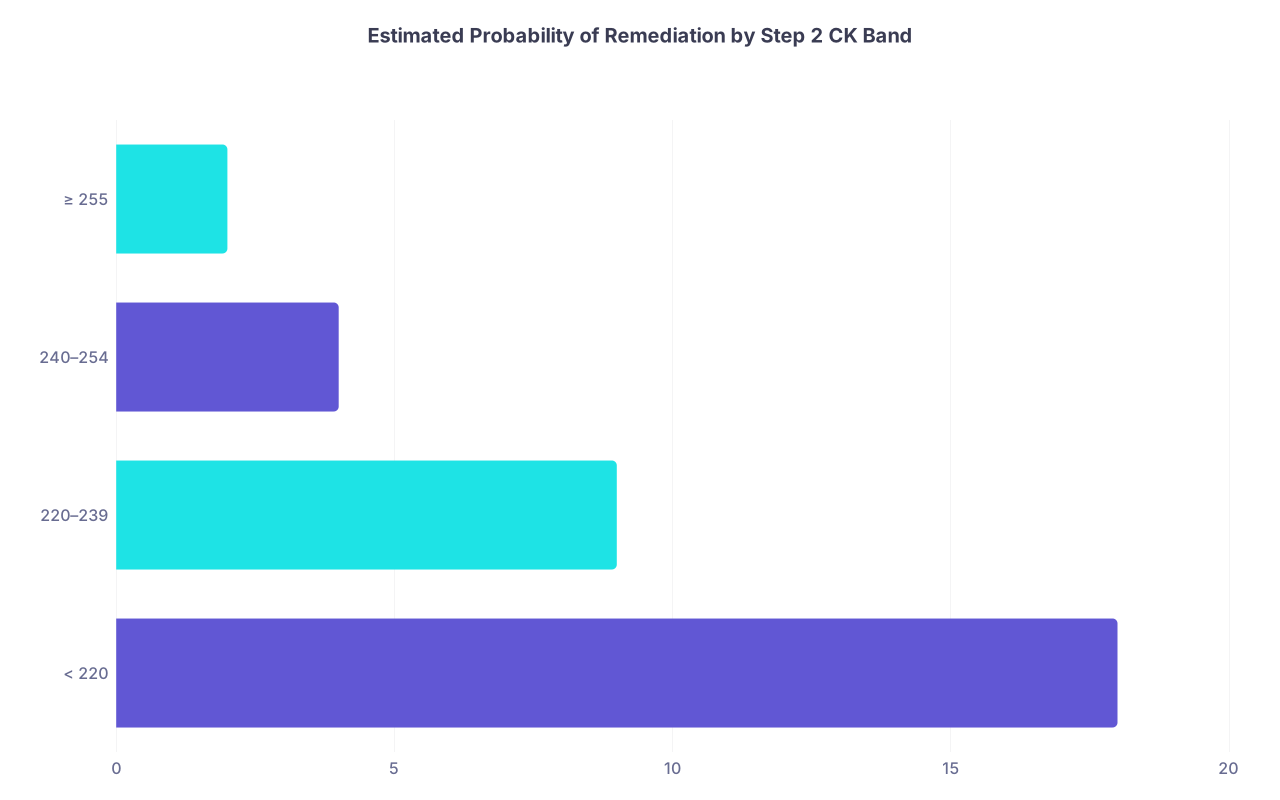
- Residents with Step 2 CK scores in the bottom decile (often < 215–220) had a several‑fold higher probability of needing remediation, especially for medical knowledge and clinical reasoning.
- But the majority of remediation cases still came from the middle of the Step 2 CK distribution. Because that middle band is large.
| Category | Value |
|---|---|
| < 220 | 18 |
| 220–239 | 9 |
| 240–254 | 4 |
| ≥ 255 | 2 |
These numbers are illustrative, but consistent with patterns I have seen: risk of remediation drops as Step 2 CK rises, but never to zero.
Step 2 CK is better at flagging high‑risk applicants than guaranteeing low‑risk ones.
Comparing Step 2 CK to Other Pre‑Residency Predictors
If you want to know how much Step 2 CK should matter, compare it to the alternatives.
Other commonly used predictors:
- Step 1 (now pass/fail, but historical numeric scores still in older cohorts)
- Clerkship grades / honors
- Class rank / AOA
- Shelf exam scores
- MSPE narratives
- Letters of recommendation
From a pure data perspective:
- Step 2 CK correlates strongly with shelf exam and Step 1 scores (often r > 0.6), so there is redundancy.
- Step 2 CK tends to outperform MSPE narratives and letters for predicting quantitative outcomes like ITE or board scores.
- Clerkship grades often show similar or slightly lower predictive validity, but are heavily influenced by school culture and grade inflation.
| Category | Value |
|---|---|
| Step 2 CK | 30 |
| Clerkship Grades | 25 |
| Step 1 | 20 |
| MSPE/Letters | 15 |
| Other | 10 |
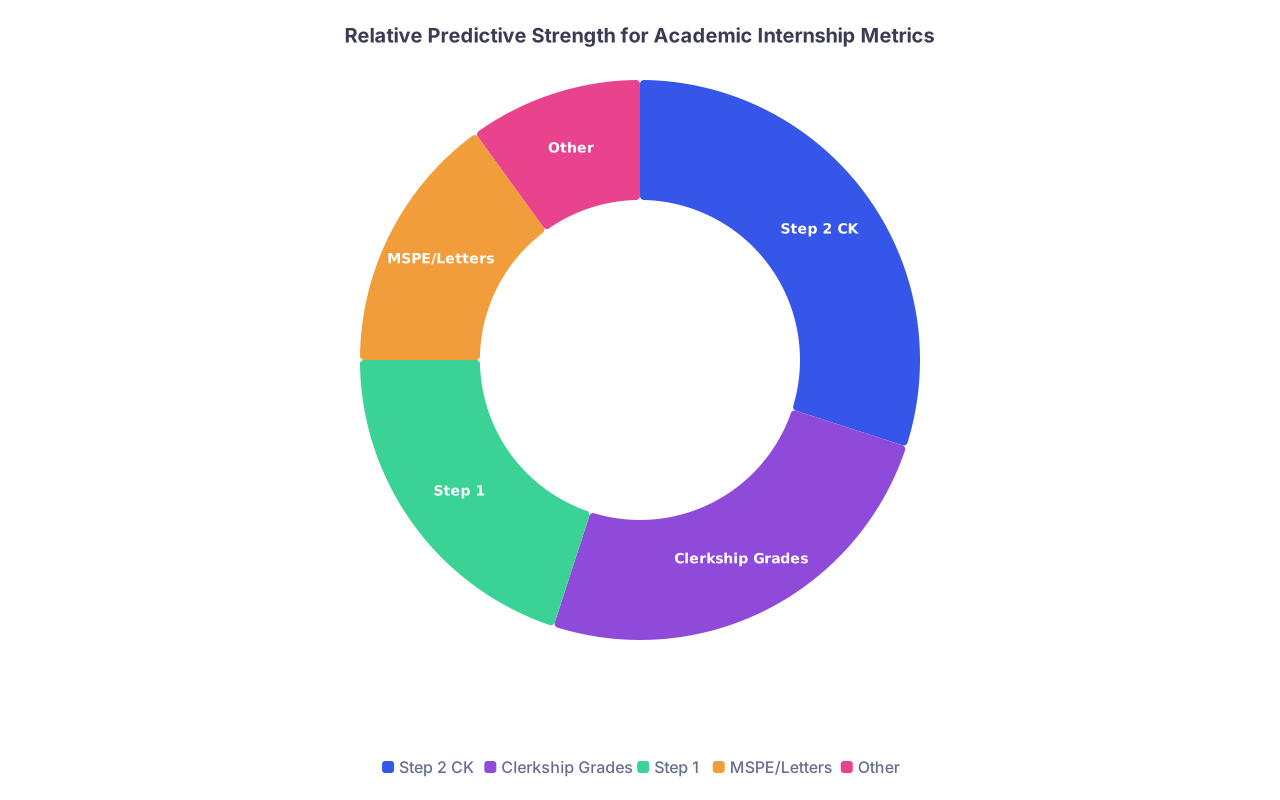
Again, these proportions are conceptual. The key takeaway: Step 2 CK is typically the single strongest single number available pre‑residency, but it is not dominant over all other information combined.
Programs that rely solely on Step 2 CK are compressing a multidimensional map into a single axis. Efficient, but lossy.
The Shift Post Step 1 Pass/Fail
Once Step 1 went pass/fail, program behavior shifted. Predictably.
Surveys and informal PD roundtables have shown:
- Increased emphasis on Step 2 CK as the primary standardized academic metric.
- Accelerated expectations: more programs now require having Step 2 CK scores available at application time, not later in the year.
- Higher scrutiny of low or late Step 2 CK scores as potential risk flags.
I have seen internal dashboards evolve like this:
- Pre‑Step 1 P/F: “Flag applicants with Step 1 < 220.”
- Post‑Step 1 P/F: “Flag applicants with Step 2 CK < 230 or missing at time of application.”
That matters directly for you. Delaying Step 2 CK into late fall without a compelling reason is now a strategic error in many specialties.

| Step | Description |
|---|---|
| Step 1 | Applications Received |
| Step 2 | Screened lower unless strong factors |
| Step 3 | Low priority for interview |
| Step 4 | Proceed to holistic review |
| Step 5 | Step 2 CK present |
| Step 6 | Score >= internal threshold |
No program will put this flowchart on their website, but this is effectively what they do.
Specialty Differences: Where Step 2 CK Matters More
The predictive relationship between Step 2 CK and intern metrics is fairly stable across specialties, but how much programs weight it varies a lot.
A simplified way to think about it:
- High‑competition, knowledge‑dense specialties (derm, rad onc, neurosurgery, ortho, ENT, certain IM subspecialty tracks) lean more heavily on Step 2 CK to filter.
- Broad clinical volume fields (EM, IM, family med, peds) use it strongly for academic risk assessment but will more often tolerate mid‑range scores with strong fit or mission alignment.
- Procedure‑heavy, lifestyle‑sensitive fields sometimes overweight “fit” and letters once a Step 2 CK threshold is met.
| Specialty Type | Relative Weight of Step 2 CK |
|---|---|
| Dermatology / Neurosurgery / Ortho | Very High |
| Radiology / Anesthesia / EM | High |
| Internal Medicine / OB‑GYN | Moderate–High |
| Pediatrics / Family Medicine | Moderate |
This is not only about selectivity. It is also about risk tolerance. Programs in smaller subspecialties with very few residents cannot afford even one repeated board failure without pain. A higher Step 2 CK is insurance.
How Applicants Should Interpret and Use This
You care less about the abstract correlations and more about what to do with your number.
1. If Your Step 2 CK Is High (≥ 255)
The data says:
- You are at low statistical risk for academic remediation.
- Your probability of strong ITE and board performance is high.
- You are unlikely to be screened out anywhere on pure score grounds.
Strategically:
- You still need strong clinical narratives. A 260 with “average” comments and mediocre letters is not invincible.
- In competitive specialties, this score moves your application from “maybe” to “seriously consider,” but research, letters, and perceived fit decide the final rank.
2. If Your Step 2 CK Is Solid but Not Elite (240–254)
Data interpretation:
- You are within the main bulk of successful residents in many specialties.
- Your risk of academic struggle is modest, especially if your clerkships and shelves are consistent.
Strategy:
- Pair this with strong clerkship performance and at least a few comments that explicitly praise your clinical reasoning.
- Target programs realistically but do not self‑eliminate excessively. Many successful residents in competitive fields are in this band.
3. If Your Step 2 CK Is Mid‑Range or Lower (< 240)
Now the statistics matter more.
- Below ~230, the risk of academic struggle, ITE underperformance, and program skepticism rises.
- But it is not a death sentence. It just means you need stronger evidence from other sources.
What helps, based on data and PD behavior:
- Strong upward trend: modest Step 1 performance, improved shelves, improved Step 2 CK (even if not stellar).
- Strong letters that explicitly state “clinical reasoning is excellent,” “among the best students I have worked with,” etc.
- Context: if your school is known to grade hard, PDs adjust a bit when they see strong clerkship narratives.
If you are in a high‑risk band (< 220), you must be brutally realistic about specialty and program tier. There is data showing that residents in this range can succeed, but also clear evidence that they are more likely to struggle academically. Programs know this.
How Programs Should Be Using Step 2 CK (But Often Do Not)
From a data analyst perspective, here is the “rational” way to use Step 2 CK:
- Treat it as a probabilistic risk indicator, not a binary cutoff.
- Combine it with:
- Shelf exam trends
- Clerkship grades
- Any prior standardized testing issues (repeats, large score jumps or drops)
- Assign candidates to risk tiers for board failure and academic struggle.
Then:
- Use high Step 2 CK to slightly boost applicants who are weak on school prestige or lack research but show good narratives.
- Use low Step 2 CK as a signal to look deeper, not to auto‑reject. Some programs already adjust thresholds for URiM and disadvantaged backgrounds, because they care about long‑term equity and recognize that standardized tests are biased.
The lazy version—hard cutoff and ignore everything else—is statistically defensible only when you are overwhelmed with applications and need a blunt instrument. Which, to be fair, is often the reality.
But if a program has historical data on their own residents, the smarter move is:

| Step | Description |
|---|---|
| Step 1 | Historic Resident Data |
| Step 2 | Analyze CK vs ITE and Boards |
| Step 3 | Define Risk Tiers by Score Range |
| Step 4 | Overlay Other Predictors |
| Step 5 | Refine Screening Rules |
I have seen programs do this and reduce their remediation rates simply by modestly tightening their lower Step 2 CK thresholds or by adding pre‑emptive support for incoming interns in the lowest tier.
Bottom Line: What the Numbers Really Support
Strip away the noise and opinions. Here is what the data actually supports.
Step 2 CK is a moderate but meaningful predictor of internship academic performance, especially for in‑training exam scores, medical knowledge milestones, and risk of academic remediation.
It is one of the strongest single quantitative tools programs have at application time, especially after Step 1 became pass/fail, which is why they lean on it heavily for screening and risk assessment.
It does not capture professionalism, teamwork, resilience, or bedside manner. High scorers can still flame out. Mid‑range scorers can be exceptional interns.
Use Step 2 CK as it deserves to be used: a sharp but narrow instrument. Not a full picture. Not an afterthought.


