
It's 7:30 p.m. the night before your residency interview. Your suit is hanging on the closet door, shoes are polished, folder is packed. But your brain? Still spinning. You’re not worried about “Why this program?” You’re worried about behavioral questions.
“Tell me about a conflict with a colleague.”
“Describe a time you made a mistake.”
“Give an example of when you had to advocate for a patient.”
At this point, you should stop cramming program websites and start mentally rehearsing. Behavior questions are pattern-based. If you walk in with 8–10 strong stories clearly in your head, you can handle 90% of what they throw at you.
Here’s your evening-before, hour-by-hour checklist of behavioral scenarios to rehearse—and how to do it without sounding robotic.
1. 6:00–6:30 p.m. – Set up your mental “story bank”
At this point you should stop multitasking. No more scrolling, no more email. You’re building your story bank for tomorrow.
You need 8–10 core stories that you can flex into different behavioral questions. Most people try to memorize answers. That backfires. Instead, know your stories cold and adapt them live.
Think in buckets:
| Category | Target # Stories |
|---|---|
| Conflict/Teamwork | 2 |
| Mistake/Failure | 2 |
| Ethics/Professionalism | 1–2 |
| Leadership/Initiative | 2 |
| Adaptability/Stress | 1–2 |
By 6:30 p.m., your goal is to have a rough list like:
- Conflict with nurse over discharge timing (MS3 IM)
- Wrong dose almost signed off on (MS4 sub-I)
- Stepping up as unofficial team lead on busy surgery rotation
- Patient refusing care due to mistrust; spent extra time building rapport
- Burnout moment on ICU month and how you adjusted
Do this fast. 10–15 minutes max. Do not wordsmith. Just get titles of events on paper.
Then pick a framework. Use STAR or CAR—and stick to it.
- STAR = Situation, Task, Action, Result
- CAR = Context, Action, Result
I don’t care which you use. I care that you commit to one, because flipping back and forth mid-interview makes your answers sound messy.
Now, for each story, jot 1 line for each piece:
- Context/Situation: 1 sentence
- Task/Problem: 1 short phrase
- Action: 2–3 key moves you took
- Result: 1–2 concrete outcomes + what you learned
That’s it. If your “notes” are more than half a page per story, you’re overdoing it.
2. 6:30–7:00 p.m. – Conflict & difficult personalities
At this point you should tackle the questions that make most applicants visibly tense: conflict.
Typical versions:
- “Tell me about a conflict with a colleague or supervisor.”
- “Describe a time you had to work with a difficult team member.”
- “How do you handle disagreements on the team?”
You need two ready-to-go conflict stories:
- Peer-level conflict (classmate, co-intern, nurse, resident)
- Power-gradient conflict (attending, senior resident, administrator)
Your rehearsal checklist (conflict)
For each of your two conflict stories, run this mental checklist:
- Did I:
- Avoid trashing the other person?
- Show that I tried to understand their perspective?
- Demonstrate calm communication, not passive aggression?
- End with a better relationship or at least a functional one?
If your story ends with “and then I avoided them the rest of the rotation,” toss it. That reads as immature.
Concrete behaviors to underline in your mental script:
- “I asked them privately if we could talk for a minute.”
- “I clarified what our shared goal was—safe patient care, timely discharges.”
- “I acknowledged their concern before offering my perspective.”
- “I suggested a specific plan moving forward.”
You don’t need fancy language. You need to sound like a normal adult who can disagree without imploding.
Now mentally rehearse answering:
- “Tell me about a conflict with a colleague.”
- “Tell me about a time you had to give someone difficult feedback.”
Use the exact same story for both. That’s the point of a story bank.
3. 7:00–7:30 p.m. – Mistakes, failures, and owning them
By this point in the evening, you should face the question everyone dreads:
- “Tell me about a time you made a mistake.”
- “Describe a clinical situation you wish you had handled differently.”
- “What’s a failure you’ve experienced, and what did you learn?”
Programs are not trying to catch you being unsafe. They’re trying to see if you can:
- Notice when you’re wrong
- Take responsibility
- Implement changes so it doesn’t happen again
The “bad” version that I hear way too often
“I care too much.”
“I work too hard.”
“I sometimes stay too late.”
Those are non-answers. They sound coached and insincere. Avoid them.
Your rehearsal checklist (mistake/failure)
Pick two stories:
- A real clinical or academic mistake (still safe, not catastrophic)
- A failure to meet your own standard (e.g., under-prepared for a shelf, delayed asking for help)
For each, mentally walk through:
- Context: What rotation, what level were you, who else was involved?
- Your mistake: Specific and owned.
- “I didn’t clarify the potassium level before signing the order.”
- “I waited too long to escalate concerns about a decompensating patient.”
- Immediate response:
- Who did you tell?
- How did you fix/mitigate it?
- What changed permanently in your practice:
- “Since then, I always…”
- “Now my default is to…”
You want to be able to say out loud, without flinching:
“I made this mistake. It shook me. Here’s exactly how I practice differently now.”
Practice this mentally in clean bullet points, not full sentences. If you script the exact words, you’ll sound stiff and panicked when you forget one phrase.
4. 7:30–8:00 p.m. – Ethics, professionalism, and speaking up
At this point you should shift to ethics/professionalism scenarios. These are common and they separate the mature from the naïve fast.
Common forms:
- “Tell me about a time you saw something that concerned you.”
- “Describe a situation where you had to advocate for a patient.”
- “Have you ever observed unprofessional behavior? What did you do?”
You need at least one strong ethics/professionalism story.
Examples that work:
- Resident making dismissive comments about a patient; you later debriefed with them or with your attending.
- Team ignoring a patient’s expressed concern; you brought it back up on rounds.
- Documentation that didn’t accurately reflect what happened; you asked for clarification before signing.
What programs want to hear:
- You notice red flags.
- You don’t ignore them out of fear.
- You’re smart about how you address them (chain of command, private conversation, not a public ambush).
Your rehearsal checklist (ethics/professionalism)
Ask yourself:
- Am I clearly describing:
- What felt wrong?
- Who I talked to (and why that person)?
- How I balanced hierarchy with patient safety?
- Do I:
- Avoid sounding self-righteous?
- Avoid sounding passive and helpless?
Aim for this tone: aware, thoughtful, not dramatic.
Now mentally rehearse for:
- “Tell me about a time you had to advocate for a patient.”
- “Tell me about a time your values were challenged.”
Same story. Slightly different framing up front.
5. 8:00–8:30 p.m. – Leadership, initiative, and follow-through
By 8 p.m., you should hit your leadership/initiative stories. Programs want residents who don’t just clock in and out. They want people who see a problem and do something.
You need two stories:
- Formal leadership or project (committee, QI, curriculum, free clinic role)
- Informal leadership (stepping up on a chaotic call night, reorganizing sign-out, coordinating with consultants)
Common questions:
- “Tell me about a time you led a team.”
- “Describe a situation where you took initiative to improve something.”
- “Give an example of a project you started and followed through.”
Your rehearsal checklist (leadership)
For each story, clarify in your own head:
- The specific problem:
- “Our sign-outs were inconsistent and unsafe.”
- “Clinic no-show rates were high; patients were confused about follow-up.”
- Your role:
- Don’t oversell. If you were one of three co-leads, say that.
- The concrete actions:
- New template, new protocol, new schedule, new teaching resource.
- The measurable or visible impact:
- “Fewer missed labs.”
- “Residents reported feeling more prepared.”
You’re not pitching a grant. You’re proving you can see a mess, organize people, and leave things better.
Now mentally answer:
- “Describe a time you made a system better.”
- “Tell me about something you’re proud of outside of grades and scores.”
Again, same stories. Different angle.
6. 8:30–9:00 p.m. – Stress, burnout, and how you actually cope
At this point in the night, your brain is getting tired. Good. That’s exactly how you’ll feel on some rotations. Programs want to know you won’t implode.
Common questions:
- “Tell me about a time you were under significant stress.”
- “How do you handle burnout?”
- “Describe a time you had too many responsibilities at once. What did you do?”
You need 1–2 stories that show:
- You’ve hit your limit before.
- You didn’t just “push harder.”
- You changed your system, not just your willpower.
Your rehearsal checklist (stress & resilience)
Pick situations like:
- ICU month plus research deadline plus family illness
- Two major exams + clinical duties + leadership responsibilities
- Being overwhelmed on nights and nearly missing important tasks
Then mentally walk it like this:
- What specifically was overwhelming? (Not just “it was a lot”)
- How did you recognize the problem?
- Who did you talk to? (Mentor, chief, advisor)
- What concrete changes did you make? (Time blocking, delegation, asking for coverage, therapy)
- What’s different about how you operate now?
Avoid the macho nonsense answer:
“I just power through and get it done.”
That reads as lacking insight and dangerous in residency.
7. 9:00–9:20 p.m. – Quick-fire rotation: adapt your stories
Now you should test-drive your story bank. This is the most important 20 minutes of the night.
Grab your list of 8–10 stories. For each one, ask:
“Besides the obvious question, what else could this answer?”
Example:
- Conflict with nurse over discharge
- Conflict question
- Teamwork question
- Communication breakdown question
- Near-miss medication error
- Mistake/failure question
- Patient safety question
- “Time you felt uncomfortable with an order” question
- ICU burnout story
- Stress/resilience question
- “Time you had competing priorities” question
- “What did you learn about yourself in med school?” question
You want each story to flex into 2–3 question types. That’s how you walk in feeling prepared instead of fragile.
To make this real, say (out loud, if you can):
- “If they ask me about teamwork, I’ll probably use [story A] or [story B].”
- “If they ask me about a challenge, I can use [story C] or [story D].”
You’re not locking yourself in. You’re just mapping territory.
8. 9:20–9:40 p.m. – Out loud reps (but short)
At this point you should do minimal out-loud practice. Not 2 hours. Not a full mock interview. That will just wind you up.
Pick 3 questions:
- “Tell me about yourself.” (Yes, behavioral-ish; it sets your tone.)
- “Tell me about a time you made a mistake.”
- “Tell me about a conflict with a colleague.”
Answer each once, out loud, using bullet-points in your head. 60–90 seconds per answer. That’s it.
While you speak, mentally check:
- Am I getting to the point quickly?
- Is there a clear beginning, middle, and end?
- Do I actually mention what I learned or what I do differently now?
If you ramble or lose track twice in a row, stop. Do not chase perfection. You’re going for clarity, not memorization.
9. 9:40–10:00 p.m. – Shut down and trust the prep
Your last 20 minutes are not for more scenarios. At this point you should:
- Glance once at your story list.
- Notice that you’ve got:
- 2 conflict stories
- 2 mistake/failure
- 1–2 ethics/professionalism
- 2 leadership/initiative
- 1–2 stress/resilience
- Accept that this is enough. Because it is.
Then actually shut it down:
- Put the notebook away (physically out of sight).
- Set your alarm.
- Prep your breakfast if you need to.
- Do something mindless for 20 minutes and go to bed.
No last-minute Googling of “top 50 behavioral interview questions.” That’s anxiety, not preparation.
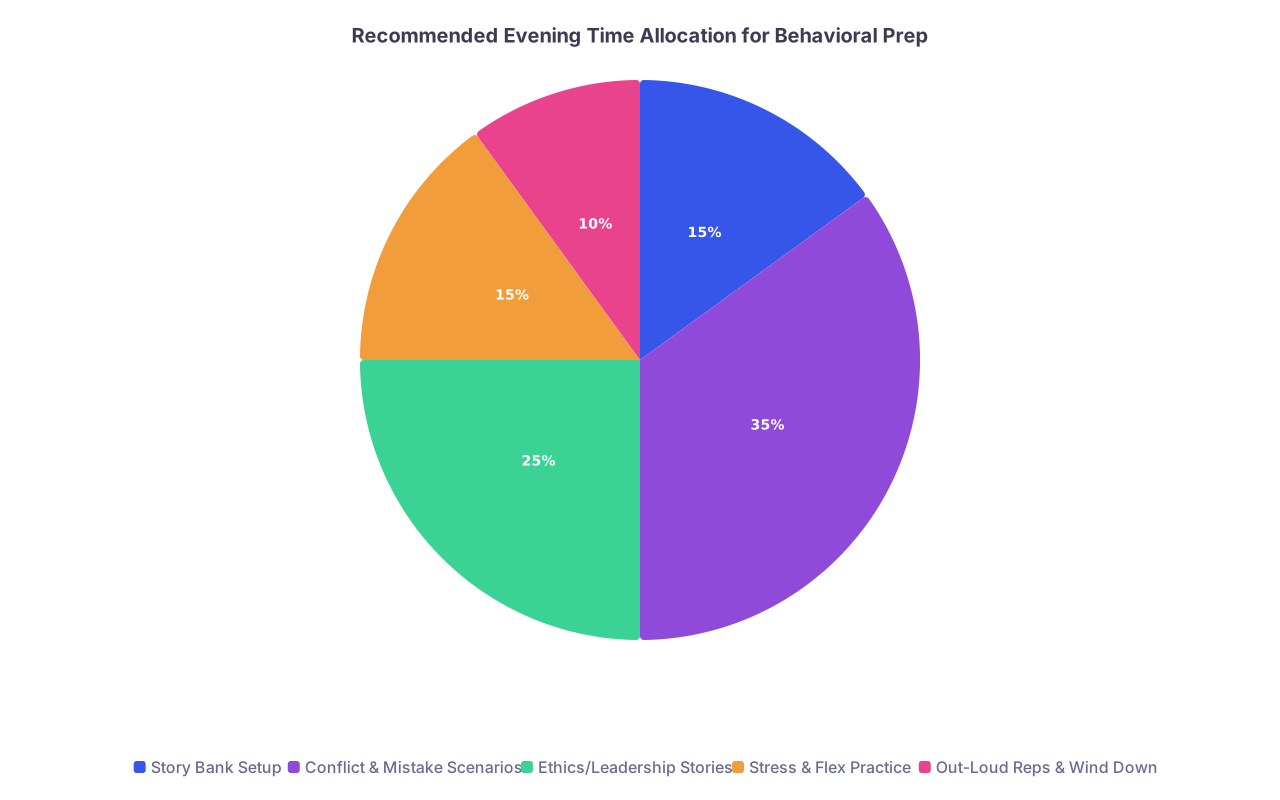
| Category | Value |
|---|---|
| Story Bank Setup | 15 |
| Conflict & Mistake Scenarios | 35 |
| Ethics/Leadership Stories | 25 |
| Stress & Flex Practice | 15 |
| Out-Loud Reps & Wind Down | 10 |
10. Morning-of: 10-minute mental warm-up
You’re not done forever. You’re done for tonight. But the morning-of, you should do a 10-minute warm-up:
- Skim your story titles only (not full details).
- Pick your “go-to” for:
- Conflict
- Mistake
- Leadership
- Stress
- Remind yourself: “I will answer in STAR/CAR; I will get to the point; I will not dodge hard questions.”
Then stop. The worst interview answers I hear come from people who over-scrambled their brain that morning.
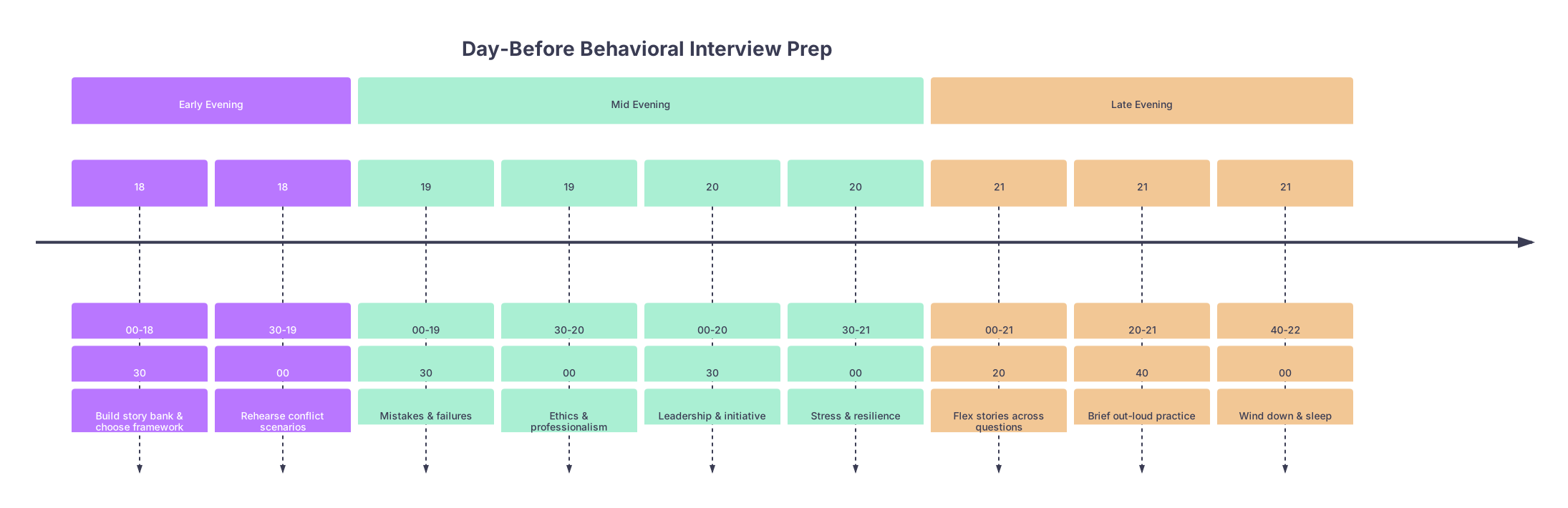
| Period | Event |
|---|---|
| Early Evening - 18 | 00-18 |
| Early Evening - 18 | 30-19 |
| Mid Evening - 19 | 00-19 |
| Mid Evening - 19 | 30-20 |
| Mid Evening - 20 | 00-20 |
| Mid Evening - 20 | 30-21 |
| Late Evening - 21 | 00-21 |
| Late Evening - 21 | 20-21 |
| Late Evening - 21 | 40-22 |

Quick Reference: Story Bank Snapshot
Here’s the structure you should be able to sketch from memory by bedtime:
| Slot | Story Title (Short) |
|---|---|
| Conflict (peer) | Nurse disagreed on discharge |
| Conflict (hierarchy) | Attending vs resident plan |
| Mistake #1 | Near-miss med order |
| Mistake #2 | Late to escalate decompensation |
| Ethics/Professionalism | Witnessed unprofessional remark |
| Leadership #1 | Revamped sign-out system |
| Leadership #2 | Free clinic initiative |
| Stress/Resilience | Overloaded ICU + exam week |
If you can fill a table like that in your head, you’re ready. The exact titles don’t matter. The structure does.

FAQ (Exactly 2 Questions)
1. What if I honestly can’t think of a “big” mistake or conflict?
Then stop searching for dramatic TV-level disasters. Most good behavioral answers come from ordinary days. A small documentation error you caught. Mild tension over task distribution on a rotation. The key is reflection, not drama. If you truly cannot find anything you’d do differently in medical school, that’s the real red flag—so push yourself to be honest about imperfect moments.
2. Should I tailor my stories differently for competitive vs less competitive programs?
No. You don’t need two different personalities. The same story bank works for community IM and MGH. The difference is emphasis. At highly academic places, you might lean a bit more on leadership/QI and how you think. At smaller programs, you might highlight teamwork and reliability. But the underlying stories stay the same. Edit the framing, not your history.
Do this next:
Right now, grab a sheet of paper and write eight short story titles—just the headlines. Conflict x2, Mistake x2, Ethics x1, Leadership x2, Stress x1. No details. Just titles. If you cannot fill that list in 10 minutes, that’s your homework for tonight.