
Most applicants start behavioral prep two weeks before interviews. That’s why they give the same boring answers and get the same silent rejections.
You’re smarter than that, or you wouldn’t be reading this.
Behavioral interviews are not “soft” or secondary. They’re where programs decide: Do I trust this person at 3 a.m. with my patients and my residents? The clinical stuff is assumed. Your stories, judgment, and professionalism are what move you up—or down—the rank list.
Let’s walk this chronologically, from the moment you get your first interview invite all the way to submitting your rank list. I’ll tell you exactly what you should be doing:
- Month-by-month early on
- Then week-by-week as invites hit
- Then day-by-day around interviews and rank list decisions
You’ll see the inflection points where strong candidates pull away from everyone else.
1. 1–2 Months Before Your First Interview: Foundation Phase
At this point you might not even have your first invite yet. This is when serious applicants quietly build the base that everyone else wishes they had later.
Week 1: Build Your Story Bank (No, Not In Your Head)
By end of this week, you should have a written “story bank.” Not vague ideas. Actual bullets.
Create 10–15 behavioral stories covering common themes:
- Conflict with a team member
- Difficult attending or resident
- Medical error / near miss
- Time you were overwhelmed
- Leadership and followership
- Working with a difficult patient or family
- Receiving tough feedback and changing your behavior
- Advocacy for a patient or system improvement
- Failure / setback (exam, rotation, research, personal)
- Ethical dilemma / professionalism issue
For each story, write 5 bullets:
- Context (1 line: where/when)
- The specific challenge
- What you did (not what “we” did)
- The outcome (be concrete)
- What you learned and how you changed going forward
If you do this properly once, later questions become plug-and-play.
| Theme | Minimum Stories |
|---|---|
| Conflict | 2 |
| Leadership | 2 |
| Failure/Setback | 2 |
| Ethics/Prof | 2 |
| Resilience | 2 |
At this point you should…
Have at least 10 stories written in bullet format and saved somewhere you can quickly review (Google Doc, Notion, OneNote—pick one and commit).
Week 2: Map Your Stories to Classic Questions
Now you turn raw stories into reusable weapons.
Make a simple 2-column table for yourself:
- Column 1: Common question stems
- Column 2: Which story (or stories) fit
Examples:
- “Tell me about a conflict with a colleague” → Story #3, #7
- “Tell me about a time you failed” → Story #4, #9
- “Tell me about a time you had to adapt quickly” → Story #2, #6
You should be able to answer 80% of behavioral questions with your existing story bank by slightly reframing details.
At this point you should…
Be able to look at any sample list of behavioral questions online and quickly point to which story you’d use. If you cannot, your story bank is either too thin or too generic.
Week 3–4: Program-Facing Preparation
Now we pivot to alignment.
- Pick 5–8 target programs (a mix: dream, realistic, backup).
- For each, quickly scan:
- Mission statement
- Focus areas (research/community, trauma, underserved, etc.)
- Any big initiatives (new residency tracks, wellness stuff, QI focus)
- Tag your stories:
- Which ones highlight what they care about?
- Which show you’ve worked with a similar patient population or system pressure?
This is where your “why this specialty” and “why our program” answers start to take shape. Behavioral interviews don’t exist in a vacuum—programs are always thinking: Will this person thrive here?
At this point you should…
Have 2–3 stories per target program that you know will resonate strongly with their values and population.
2. From First Interview Invite to 2 Weeks Before: System Phase
The email hits: “We are pleased to invite you…” Good. Now the clock starts.
The Day You Get Your First Invite
Do three things the same day:
Block time.
- Put every possible interview date/slot into your calendar.
- Protect at least 2–3 hours the day before and half a day after for prep and decompression.
Start your master spreadsheet. Columns:
- Program
- Interview date
- Format (MMI, panel, 1:1, half day/full day)
- Interviewers (fill in later)
- Key values/mission buzzwords
- Red flags/green flags
- Post-interview gut score (1–10)
- Follow-up notes
Pull program-specific data.
Quick 15–20 minute scan on each:- What they brag about repeatedly (trauma volume, community hospital, research power, etc.)
- Any behavioral buzzwords: “collegiality,” “ownership,” “autonomy,” “communication”
At this point you should…
Have a basic logistical and values map for every program that has invited you.
2–3 Weeks Before First Interview: Rehearsal, Not Memorization
This window is gold. Don’t waste it.
Week A: Out-Loud Reps
Goal: Every core story told cleanly in under 90 seconds.
- Use the STAR or PAR format, but don’t sound like a robot:
- Situation / Problem
- Task / Action
- Result / Reflection
Record yourself (phone is fine) telling:
- 5 “conflict/difficulty” stories
- 3 “leadership/initiative” stories
- 2 “failure/resilience” stories
Watch once and only fix two things per story:
- Rambling (cut details no one cares about)
- Vague outcomes (“it went well” is useless—give numbers, specific change, or concrete feedback)
At this point you should…
Be able to tell your top 8–10 stories without notes and without spiraling into a 5-minute monologue.
Week B: Mock Interview & Feedback
You need a real mock interview. Not your friend reading off a question list while you both laugh.
Options ranked:
- Faculty member or chief resident in your specialty
- Career advising office / dean’s office mock
- Alumni who recently matched into your specialty
- Peer who will actually be honest and critical
Ask explicitly for:
- “What 2–3 impressions do you take away from my stories?”
- “What feels rehearsed or fake?”
- “What would make you hesitate to rank me highly?”
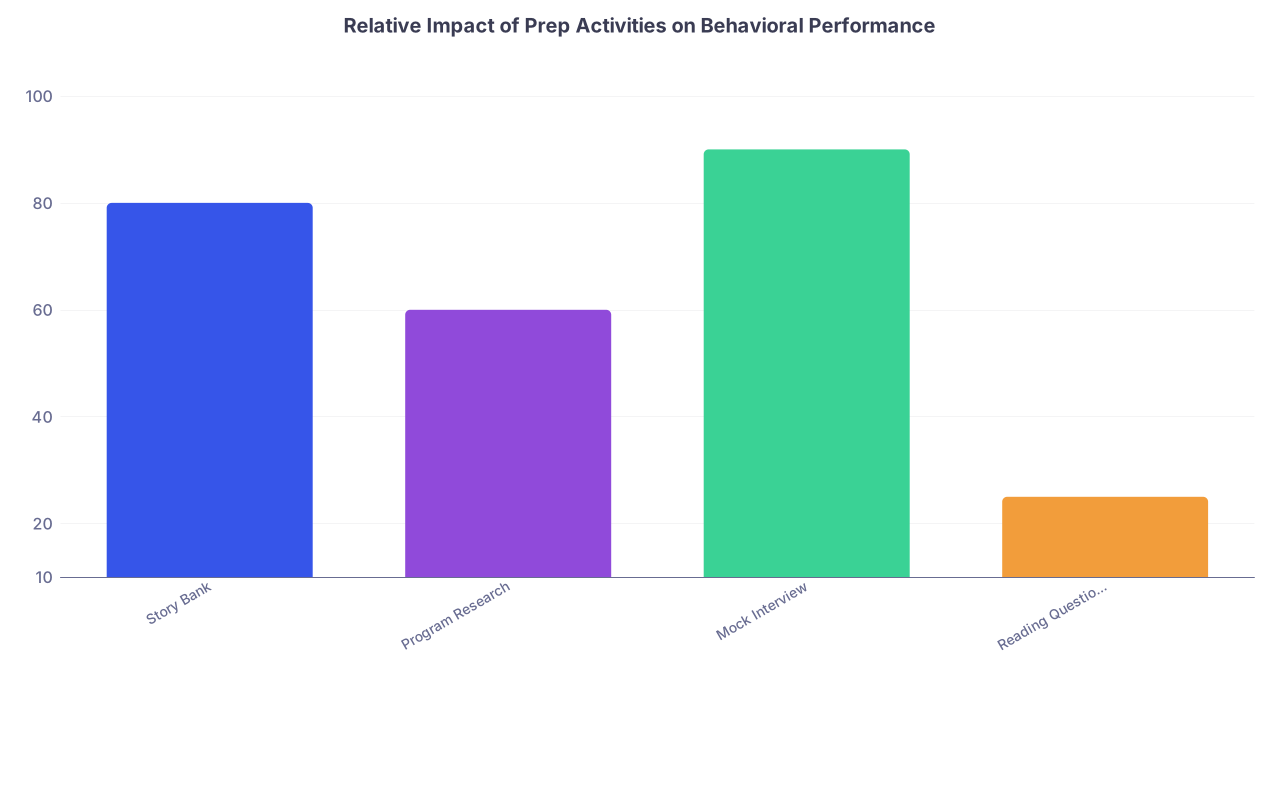
| Category | Value |
|---|---|
| Story Bank | 80 |
| Program Research | 60 |
| Mock Interview | 90 |
| Reading Question Lists | 25 |
At this point you should…
Have at least one mock interview under your belt and a short list of 3–4 specific behaviors to change (talk slower, give clearer outcomes, stop apologizing every third sentence, etc.).
3. One Week Before Each Interview: Program-Specific Tightening
Now we go granular—week-by-week for each scheduled interview.
7 Days Before: Deep Program Pass (45–60 minutes)
Do a focused, timed review:
- Website: residents’ page, curriculum, recent news
- Social: resident-run Instagram/Twitter if they have it
- Any recent scandals, expansions, or major changes (Google “[program name] hospital news”)
Then tailor:
- 2–3 stories that show you’d fit their clinical reality
- County vs private
- Academic vs community
- Big tertiary center vs smaller site
- 1–2 stories that show alignment with their stated values
- “Diverse and underserved community” → story involving language barriers, resource limitations
- “Strong research culture” → story about initiative in a project, or balancing research and clinical duties
At this point you should…
Have a mini one-page for the program: top 3 things that excite you, 1–2 minor concerns, and how your stories line up with who they say they are.
5–6 Days Before: Behavioral Edges
Now refine answers to high-yield behavioral questions that can sink you if you wing them:
- “Tell me about a time you had a conflict with a nurse/resident/attending.”
- “Tell me about a time you disagreed with a supervisor.”
- “Tell me about a time you made a mistake.”
- “Tell me about a time you were burned out.”
- “Tell me about your biggest weakness.”
The trick: no martyrdom and no self-destruction.
- Conflict stories: Must end in collaboration, not “I was right.”
- Mistake stories: Must end with concrete system or behavior changes.
- Burnout stories: Must show insight and ongoing coping, not “I powered through on caffeine.”
- Weakness: Must be real but containable (e.g., “I can be overly self-critical” → show how you’re managing it).
At this point you should…
Have rehearsed these “trap” questions enough that you don’t panic or over-share when they come up.
3–4 Days Before: Question Generation (The Subtle Behavioral Test)
The questions you ask them are themselves behavioral data.
Prepare 3–5 questions per program that show:
- You did your homework
- You care about culture and growth
- You’re thinking like a resident, not a tourist
Examples:
- “Can you tell me about a time residents gave feedback that led to a change in the program?”
- “How do you support residents when there’s conflict within the team?”
- “What qualities have you seen in residents who really thrive here?”
At this point you should…
Have your questions written down and tied to actual things you saw on their website or heard from residents.
4. 48 Hours to Interview Day: Micro-Prep Timeline
Now we get into the day-by-day details. This is where small choices add up.
48 Hours Before: Logistics Lockdown
- Confirm time zone (yes, people get this wrong constantly on virtual interviews).
- Test your tech if virtual:
- Camera, mic, background, lighting
- Update Zoom/Teams
- Choose outfit, try it on while sitting (creases, awkward buttons, etc.).
Create a 15-minute warm-up routine for interview morning:
- 2–3 stories aloud
- “Tell me about yourself” once
- One conflict story, one failure story
At this point you should…
Have zero logistical uncertainty and a set routine to start the day on rails.
24 Hours Before: Light Touch, Not Cramming
You are not learning new material today. You’re smoothing.
- Skim your story bank once.
- Skim your program one-pager.
- Review your questions for them.
- Sleep. Seriously.
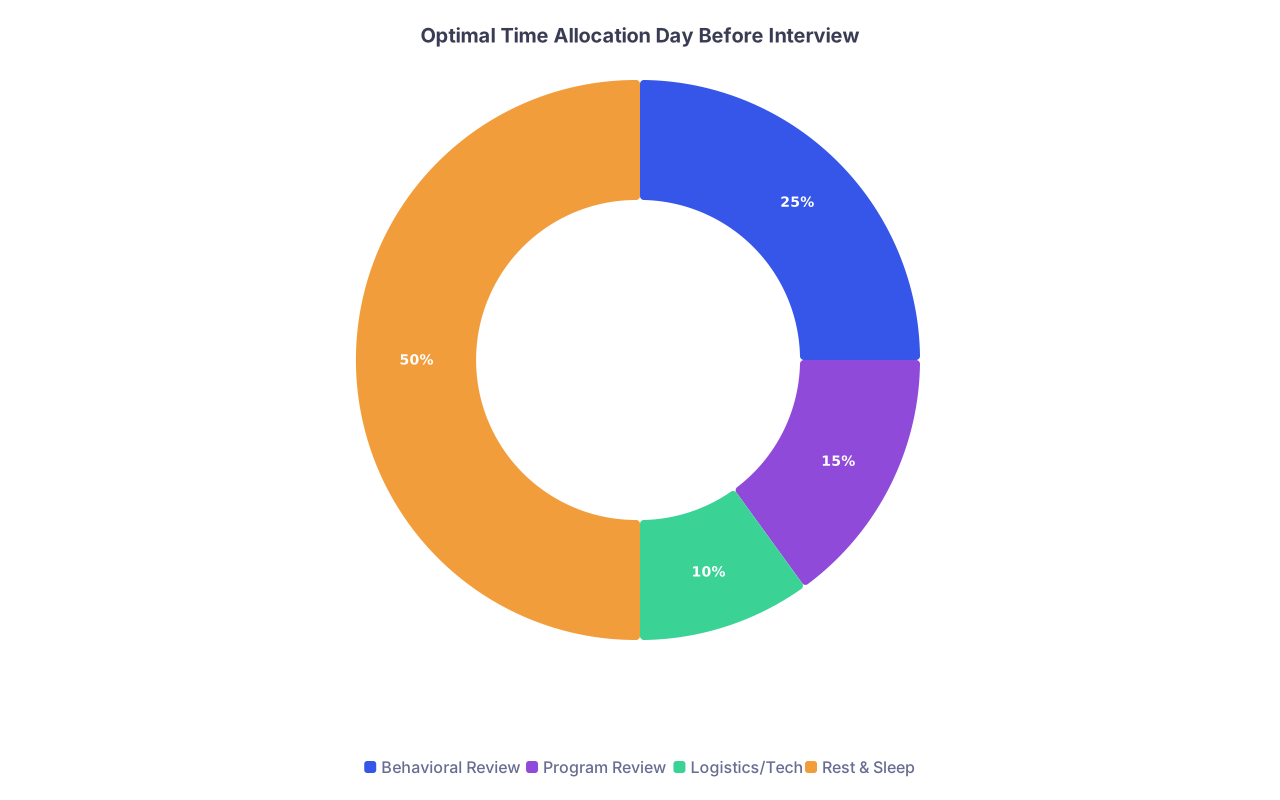
| Category | Value |
|---|---|
| Behavioral Review | 25 |
| Program Review | 15 |
| Logistics/Tech | 10 |
| Rest & Sleep | 50 |
At this point you should…
Be able to close your laptop by 9–10 pm without feeling the urge to rewrite your entire life story.
Interview Morning: 90-Minute Countdown
Here’s a tight schedule that actually works.
T-90 minutes:
- Light breakfast, hydrate.
- 5 minutes of movement (walk, stretching).
T-60 minutes:
- Put on outfit, final tech check (for virtual).
- Open your notes but keep them minimal: story titles only, not scripts.
T-30 minutes:
- Run your 15-minute warm-up:
- “Tell me about yourself”
- 2–3 key stories
- 1 tough behavioral (conflict/mistake)
T-10 minutes:
- Deep breaths, no new input. No more notes, no more Googling.
At this point you should…
Be calm enough to actually listen to questions instead of pre-loading answers in your head.
5. Interview Day: Real-Time Behavioral Performance
During the interview, you’re being evaluated on more than your stories. The way you respond is half the data.
During Each Behavioral Question
Think in this order:
- What theme is this actually testing?
- Conflict, resilience, maturity, self-awareness, integrity
- Which story best fits that theme?
- How do I keep this under 2 minutes with a clear ending?
Quick mental checklist while answering:
- 1–2 sentences of context
- What you actually did
- Concrete outcome
- One sentence of reflection or “how I use this now”
If you’re rambling, the interviewer’s eyes will drift. You’ll see it.
At this point you should…
Be consciously controlling length and clarity, not just reciting whatever pops into your head.
Between Interviews / Breaks
For multi-interviewer days, use 2-minute micro-resets:
- Jot quick notes: what they asked, your approximate answers, their names.
- Adjust if you’re repeating the same story too often.
- Reset posture and facial tension (jaw, shoulders).
6. 0–72 Hours After Each Interview: Rank List Data Collection
Behavioral prep doesn’t end when the Zoom window closes. This is now about feeding your future self when you’re building the rank list.
Within 2 Hours Post-Interview
While it’s fresh:
- Fill in your spreadsheet:
- Questions you were asked (especially behavioral)
- Which stories you used
- Any questions you stumbled on
- Overall vibe: 1–10
- Residents’ mood: seemed overworked? supportive? bitter? genuinely happy?
This is not busywork. It lets you:
- Improve before the next interview
- Remember real impressions months later when everything blurs
At this point you should…
Have concrete, written impressions for each program, not vague “I think I liked it” feelings.
Within 24 Hours: Thank-You Emails (Targeted, Not Spammy)
You do not have to write to every single person. But for 1–3 key faculty or residents:
- Reference a specific moment from your conversation
- Reaffirm one thing that excited you about the program
- Keep it to a short paragraph
This is soft behavioral data too: are you thoughtful and professional, or performing empty rituals?
7. Final 2–3 Weeks Before Rank List: Reflection Phase
Now we zoom out again, week-by-week, focused on how you felt and behaved across all these interactions.
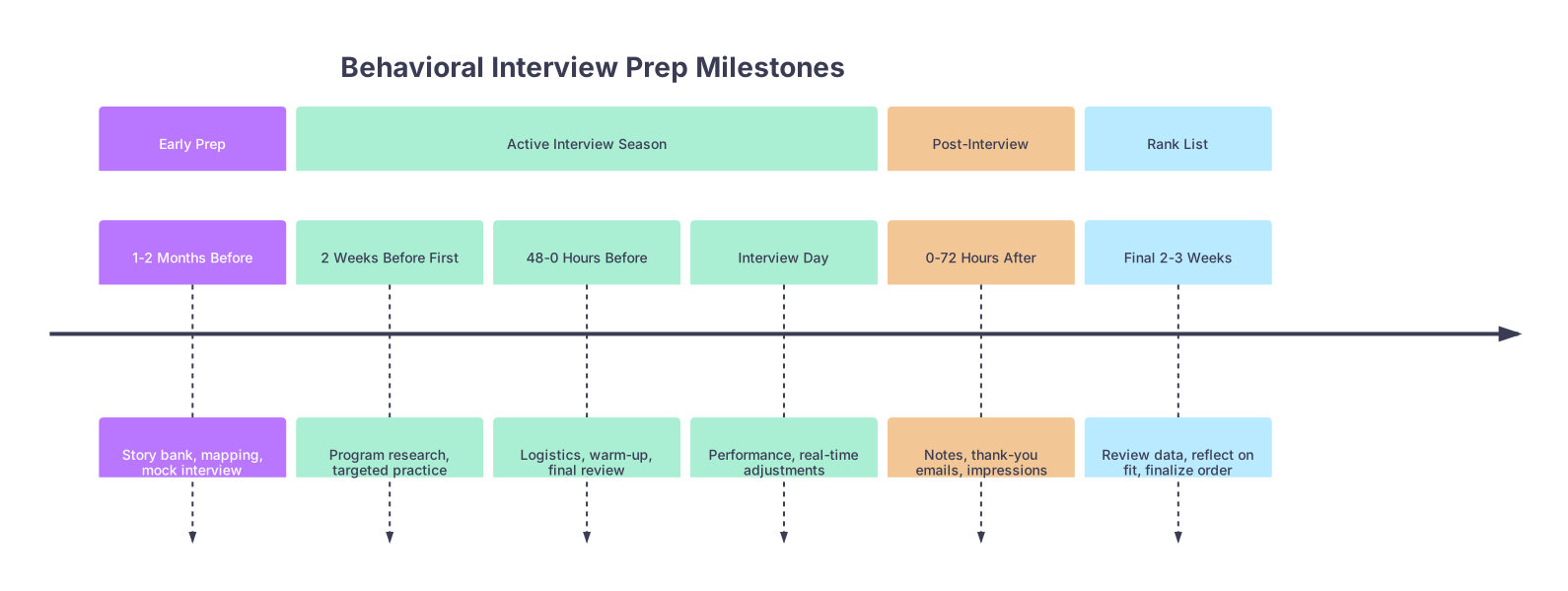
| Period | Event |
|---|---|
| Early Prep - 1-2 Months Before | Story bank, mapping, mock interview |
| Active Interview Season - 2 Weeks Before First | Program research, targeted practice |
| Active Interview Season - 48-0 Hours Before | Logistics, warm-up, final review |
| Active Interview Season - Interview Day | Performance, real-time adjustments |
| Post-Interview - 0-72 Hours After | Notes, thank-you emails, impressions |
| Rank List - Final 2-3 Weeks | Review data, reflect on fit, finalize order |
2–3 Weeks Before Rank List Deadline: Pattern Review
Go back through your spreadsheet:
- Sort programs by your post-interview gut score.
- Look at your notes on culture, resident happiness, and any red flags.
- Notice patterns:
- Where did you feel like your best self telling stories?
- Where did your behavioral answers feel naturally aligned vs. forced?
At this point you should…
Be able to answer: “Where did I feel like I could be me and still be successful?”
1 Week Before Rank List: Reality Check Conversations
Talk to:
- A mentor in your specialty
- A resident you trust
- Maybe one non-medical person who knows your personality well
Use concrete behavioral examples from interviews:
- “At Program A, I felt comfortable telling stories about X…”
- “At Program B, I felt like I had to sell a version of myself that isn’t real…”
This isn’t therapy. It’s scanning for mismatch between who you are and what programs reward.
At this point you should…
Have your top 3–5 programs fairly clear in your mind, based on both rational factors and your actual experience interacting with them.
48 Hours Before Rank List Submission: Final Alignment
Last pass:
- Re-read your notes for your top 5–7 programs.
- Ask yourself bluntly:
- “If I matched here, would I be proud to grow into the type of physician this program tends to produce?”
- “Did my behavioral interactions with them feel sustainable for 3+ years?”
Then lock the list.
FAQ (Exactly 4 Questions)
1. How many behavioral stories do I really need?
You can survive with 8–10 solid stories. You’ll thrive with 12–15 well-practiced ones that you can flex for different questions. Beyond that, you’re hoarding, not improving.
2. What if two interviewers at the same program ask very similar behavioral questions?
It’s fine to reuse a story, but tweak focus or level of detail. Or swap in a secondary story if you have one. The disaster move is telling the exact same story in the exact same way—sounds rehearsed and shallow.
3. How do I handle a behavioral question where I genuinely don’t have a perfect story?
Pick the closest relevant experience and be honest about the stretch. Then emphasize what you learned and how you’d handle a similar situation now. They’re testing how you think, not whether you’ve seen every scenario.
4. Do thank-you emails actually matter for behavioral impressions or rank lists?
They rarely move you from bottom to top, but they can tip “borderline” into “safe to rank.” A thoughtful, specific, concise thank-you reinforces that you’re professional, reflective, and not transactional. They matter more at smaller, more relational programs than at massive academic factories.
Key points to walk away with:
- The real work starts 1–2 months before your first interview, by building a reusable story bank.
- Every stage—from invite to thank-you email—is behavioral data; act like they’re always asking, “What would this person be like as a resident?”
- Your rank list should reflect where your authentic behavioral self fit best, not just where the name sounds shiny.