
What happens when an interviewer asks, “Tell me about a time you failed,” and the only story that comes to mind involves depression, a breakup, and you almost failing Step 1?
Here’s the line you’re trying to walk: be genuine, but not messy. Human, but not oversharing. Vulnerable, but still clearly functional and safe to work with.
Let’s break that down in a way you can actually use.
The Real Question Programs Are Asking
When a residency program asks behavioral questions—
“Tell me about a conflict with a team member”
“Tell me about a time you made a mistake”
“Tell me about a challenge you faced”
They are not secretly asking:
- “What is the worst thing that’s ever happened to you?”
- “Prove that your life is harder than other applicants’.”
- “Trauma dump so we can see your soul.”
They are asking three things:
- Can you reflect like a professional?
- Can you handle difficulty without falling apart or blaming everyone else?
- Are you safe to have in our hospital at 3 a.m.?
So how personal is too personal?
If your story makes them worry about #2 or #3, it’s too personal for this setting.
The Core Rule: Professional Relevance First, Personal Detail Second
Use this as your anchor rule:
If a detail doesn’t help show your judgment, professionalism, growth, or how you’ll function as a resident, it probably doesn’t belong.
Concrete examples.
Acceptable “personal” elements:
- You were overwhelmed balancing clerkships and a sick family member, and you learned how to set boundaries and prioritize patient care.
- You had impostor syndrome starting on ICU, sought feedback, adjusted, and ended up more confident and deliberate.
- You realized you were burned out, asked for help, and changed your approach to time management and self-care so your performance improved.
Too personal for residency interviews:
- Graphic details of self-harm, suicide attempts, or psychiatric hospitalization without framing, treatment, and stability.
- Explicit details about trauma (abuse, assault, family violence) beyond what’s necessary to set context.
- Ongoing, unresolved issues where you are clearly still unstable, angry, or dysregulated.
- Romantic relationship drama as the central story (messy breakups, infidelity, etc.).
Notice the pattern: the problem isn’t that you have mental health issues, grief, or trauma. The problem is when the story centers your pain instead of your professionalism and growth.
A Simple Test: The Three-Lens Filter
Before you use any behavioral story, run it through these three lenses:
Safety Lens
Would a reasonable PD or faculty member hearing this story think:- “Is this person stable enough for residency?”
- “Am I going to have to constantly worry about them?”
If yes, cut or significantly reframe the story.
Relevance Lens
Does this story directly show a competency they care about?- Teamwork
- Communication
- Adaptability
- Ethics
- Handling feedback
- Time management
- Resilience
If your story is 80% life drama and 20% vague lesson, find another story.
Control Lens
Can you tell this story:- Calmly
- Without tearing up
- Without sounding bitter, angry, or victimized
- With clear insight and specific growth
If you still feel raw or activated when describing it, it’s probably not ready for interview day.
If the story fails any of these lenses, it’s too personal for this context, even if it’s true and meaningful.
What You Can Safely Share (And How)
Let me walk through common “gray area” topics and how to present them without oversharing.
1. Mental Health Struggles
Yes, lots of med students struggle with anxiety, depression, burnout. Faculty know this. The key is framing.
Better version:
- “During my second year, I struggled with burnout and anxiety. I noticed my concentration slipping and my efficiency dropping. I reached out to student wellness, started structured counseling, and made concrete changes—blocking study time, building exercise into my week, and talking openly with my advisor about workload. Since then, my performance has improved and I’ve kept those habits during clinical rotations.”
Too personal / risky:
- “I had severe depression, I couldn’t get out of bed, I thought about ending my life, and I still have bad days.”
That second version might be true. It belongs with your therapist, not your interviewer. For residency, you’re showing that you recognized a problem, got appropriate help, and are now functioning well.

2. Family Illness or Death
Very common source of “challenge” stories. The trap is spending too long on the sad part and too little on what you did.
Strong version:
- One sentence of context: “During my surgery clerkship, my father was diagnosed with advanced cancer.”
- Then focus on actions and professionalism:
- How you communicated with your team
- How you protected patient care
- How you used support systems and institutional resources
- What you learned about boundaries, empathy, or teamwork
Weak/too personal version:
- Long, detailed account of his hospitalization, suffering, your grief, your family conflict, etc., with very little about your behavior and growth.
If the interviewer leaves the story mainly remembering your tragedy instead of your professionalism, you overshared.
3. Academic Struggles, Remediation, or Failures
These can actually be excellent behavioral stories if you own them.
Good:
- “I failed my first OSCE because I rushed and missed key history elements. I met with the course director, reviewed my tape, and realized I wasn’t structuring my encounters. I created a checklist, practiced with peers, and retook the OSCE, passing comfortably. Since then I use that structure on the wards and have gotten consistent positive feedback on my HPI presentations.”
Too personal:
- “I failed Step 1 because I was going through a terrible breakup and couldn’t focus, and then I spiraled.”
You can mention emotional context briefly, but blame should never be the main point. You want to look like someone who takes ownership and systematically improves.
Topics That Are Usually A Bad Idea
I’ll be blunt. These topics almost always cause more harm than good unless you are extremely careful and they are directly relevant.
Be very cautious with:
- Current or very recent substance misuse
- Ongoing legal issues
- Graphic descriptions of trauma or violence
- Stories that reveal others’ private information (e.g., “my co-resident has bipolar and…”)
- Romantic/sexual relationship conflicts
- Politics, unless it’s clearly relevant to patient care and delivered neutrally
If you’re debating whether to include graphic or intensely personal details, you almost certainly should not. You can nearly always zoom out:
Instead of:
- “I was sexually assaulted and couldn’t trust anyone…”
Use:
- “I went through a major personal trauma during my second year. I worked closely with mental health professionals to process it, and one thing I took from that experience is a deeper appreciation for trauma-informed care in my patients.”
Same story, appropriate level of detail for a professional interview.
The 40–50% Rule for Behavioral Stories
Here’s a simple structure that keeps you out of the “too personal” ditch.
Target:
- 30%: Brief context
- 40–50%: Your actions (what you did, said, decided)
- 20–30%: Outcome + reflection (what you learned, how you changed, how it applies to residency)
Where people blow it: they make 70% of the story about the backstory and emotions. That’s when stories start to feel like therapy sessions instead of professional reflections.
Let me show you what I mean.
Bad ratio:
- “My mom got sick. Then this happened. Then that happened. I cried a lot. I felt guilty. I felt alone. I felt overwhelmed…”
Better ratio:
- “During my OB rotation, my mom had an unexpected stroke. I let my team know early, arranged with my attending how to handle potential emergencies, and spoke with student affairs about possible schedule adjustments. I made sure patient care and my obligations were covered when I needed to step away. This forced me to confront my limits, communicate more transparently, and accept help—skills I know I’ll need in residency.”
Same event. Different focus.
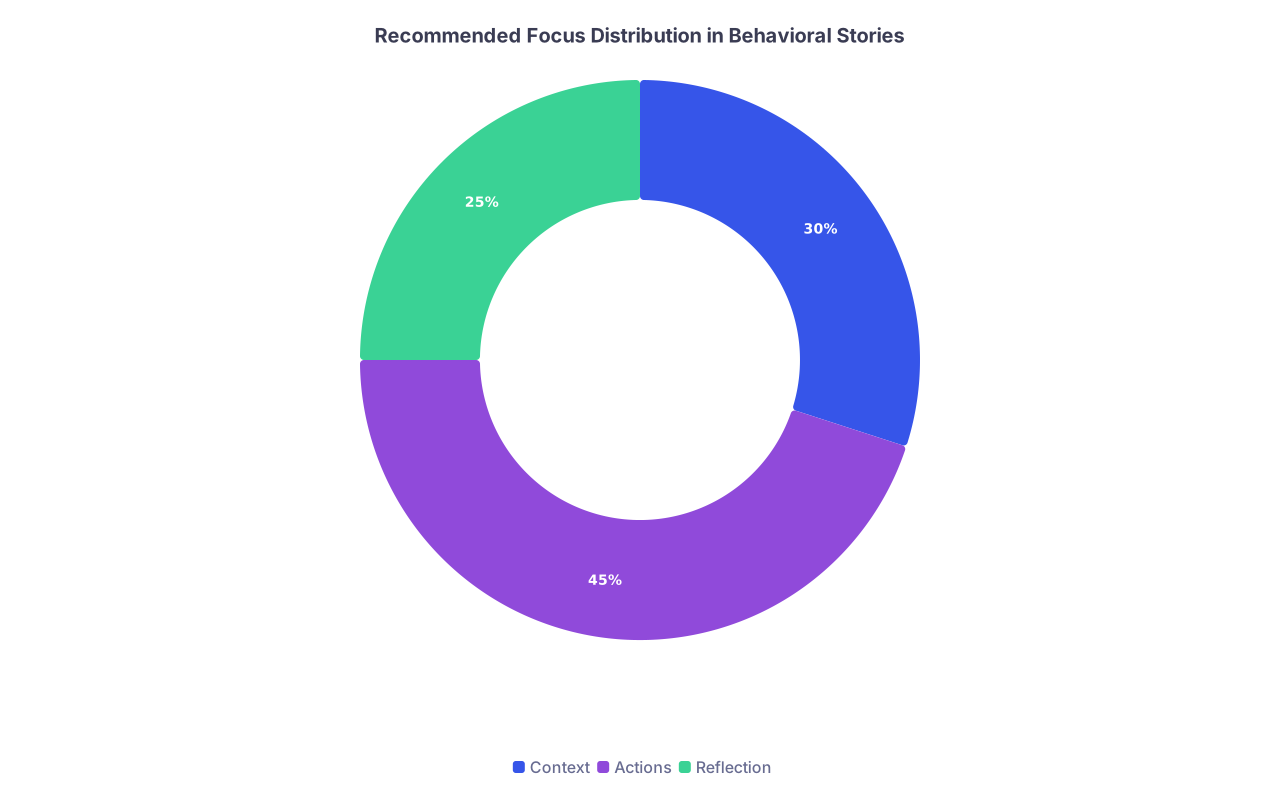
| Category | Value |
|---|---|
| Context | 30 |
| Actions | 45 |
| Reflection | 25 |
Quick Decision Framework: Use This Before Every Story
Use this 6-question checklist on any potential story that feels “personal”:
- Is there a clear, specific behavior or decision I can highlight?
- Does this show a competency programs care about?
- Can I tell this without graphic or unnecessary intimate detail?
- Do I sound stable, self-aware, and mature when I tell it?
- Would I be comfortable if this story was casually retold by the PD to another faculty member?
- Does the story end with me looking more capable, not more fragile?
If you can’t honestly say yes to at least 5/6, find a different story or reframe heavily.
Examples: Rewriting “Too Personal” Stories
Let’s fix a few common ones.
Example 1: Mental Health + Failure
Original (too personal): “I failed Step 1 because my depression got really bad. I was crying every day and honestly almost dropped out. It was the worst time of my life and I still feel ashamed.”
Reframed (appropriate): “I failed Step 1 the first time. Looking back, I underestimated how much my anxiety was affecting my focus and effectiveness. After that, I worked with a counselor, adjusted my study strategies, and built a more structured schedule with accountability from a study partner. I passed comfortably on my second attempt. It taught me to recognize earlier when I am not coping well and to use available resources quickly—something I’ve continued in my clinical years.”
Example 2: Family Trauma
Original: “My brother was addicted to opioids and went to jail. I spent months trying to help him and it really messed me up emotionally.”
Reframed: “A close family member had a severe opioid use disorder, which led to repeated crises during my third year. I had to learn how to separate what I could control from what I could not, and still show up fully for my patients. I used counseling and peer support, communicated with my clerkship directors when needed, and that experience has given me a deeper, more empathetic approach to patients with substance use disorders while still maintaining professional boundaries.”

What Interviewers Actually Remember
Here’s what sticks in their minds after a full interview day:
- “That student took responsibility for a mistake and clearly learned from it.”
- “She handled that family crisis without dropping the ball on patient care.”
- “He was reflective and calm talking about a hard situation.”
- “They’ve clearly thought about burnout and how they’ll manage it.”
They do not need (or frankly want) the screenplay version of your pain. They want the executive summary of your growth.
If you’re unsure, ask yourself:
“Would I tell this version of the story to a respected attending I’m working with on day one of residency?”
If not, it’s probably too personal for the interview.

| Step | Description |
|---|---|
| Step 1 | Choose Story |
| Step 2 | Pick Different Story |
| Step 3 | Remove or generalize details |
| Step 4 | Check 40-50% actions focus |
| Step 5 | Rewrite with more actions, less backstory |
| Step 6 | Use in interview |
| Step 7 | Relevant to competency? |
| Step 8 | Includes graphic or intimate details? |
| Step 9 | Shows stability and growth? |
Your Action Step for Today
Open a document and list 6–8 potential behavioral stories (failure, conflict, challenge, leadership, feedback, stress, ethical dilemma). For each one, write:
- 2 sentences of context
- 3–5 bullet points of what you actually did
- 2 sentences of what you learned and how it applies to residency
Then ruthlessly cut any detail you would not say in front of a respected attending on rounds.
That’s your “personal but professional” sweet spot.
FAQ: Residency Behavioral Interview Stories & How Personal To Be
1. Can I talk about therapy or counseling in my interview?
Yes, briefly and professionally. You can say you “worked with a counselor,” “used mental health resources,” or “engaged in therapy” as part of how you handled a challenge. Keep it focused on what you learned and how it improved your performance, not the blow-by-blow of your sessions.
2. Is it a bad idea to mention depression, anxiety, or burnout?
Not automatically. If it’s well-treated, stable, and you can clearly show how you function effectively now, it can demonstrate insight and maturity. But if the story makes it sound like you’re barely holding on, or it centers your suffering rather than your actions and growth, it’s going to hurt you.
3. What if my only real “challenge” stories are very personal or traumatic?
You probably have more usable stories than you think. Think smaller: a tough feedback moment, a conflict in a team, a time you had to advocate for a patient, a scheduling crunch. High-drama isn’t required. Pick stories where you can stay composed and highlight professional behavior, even if the underlying situation was intense.
4. Can I use romantic relationship issues as a challenge example?
I strongly recommend you don’t. Relationship drama almost never lands well as a primary interview story. If a breakup indirectly contributed to stress or performance issues, you can mention “a significant personal stressor” without making your love life the focus.
5. How do I know if I’m oversharing during practice?
Have someone brutally honest—advisor, resident, mentor—listen and tell you where they started to feel like they were in a therapy session instead of a professional conversation. Also watch yourself: if you feel your emotions ramping up or you’re tempted to give vivid detail about pain, that’s usually oversharing territory.
6. Should I avoid negative or painful stories altogether?
No. Some of your best behavioral examples will come from mistakes, conflicts, and hard times. Just remember: the point is not to prove you’ve suffered. The point is to show how you responded, what you learned, and how that makes you a better, more reliable resident.
7. What if an interviewer directly asks about something I’m not comfortable sharing?
You’re allowed to set boundaries. You can say something like, “That was a difficult period for me personally, but what I took from it professionally was…” and pivot to the lesson and your growth. You do not owe anyone your full trauma history to match into residency.
Now, open your interview prep doc and rewrite one “too personal” story into a tight, professional version using the 30/45/25 context-actions-reflection structure. Don’t wait—do that first one right now.