
The loudest, flashiest applicants do not automatically win residency spots.
If that sentence makes you exhale a tiny bit, good. Because I know exactly where your brain’s been spiraling: “I’m quiet. I hate small talk. Everyone else seems so smooth on interview day. How am I supposed to compete on behavioral interviews when I’m an introvert?”
Let me say this bluntly: programs don’t want a class of 20 Ted Talk speakers. They want people they can trust at 3 a.m. when a patient is crashing. And some of those people are quiet, observant, understated as hell.
But you and I both know there’s still a problem: behavioral interviews reward people who can talk about themselves. At length. With stories. On demand. That’s… not us.
So the question isn’t “Can introverts compete?”
It’s “How does an introvert compete without pretending to be someone else and mentally collapsing in the process?”
Let’s walk through it like two people sitting in an empty call room at 11 p.m., over-caffeinated and brutally honest.
What Programs Actually Care About (Not What You’re Afraid Of)
Your fear: “They’re judging me on how outgoing and charming I am in 20 minutes.”
Reality: They’re mostly screening for:
- Can I put this person in front of a patient/family without panicking?
- Will they talk to nurses and consultants like actual humans?
- Will they learn from feedback instead of imploding or arguing?
- When things get ugly (and they will), will they be safe and reliable?
None of that requires you to be the extrovert-in-chief. It requires three things: clarity, self-awareness, and some ability to tell a coherent story about what you did and what you learned.
Notice I didn’t say “charisma.”
Here’s the catch though: if you don’t show those things in your behavioral answers, they can’t just assume you have them. Behavioral interviews are “evidence only” territory: “Tell me about a time when…” means “Prove it. With a story.”
That’s uncomfortable for introverts because you’re used to doing the work quietly, not narrating it.
Fine. Then we weaponize preparation.
The Introvert Trap: Where We Quietly Self-Sabotage
There are a few predictable ways introverts tank behavioral interviews. I’ve watched this happen, and honestly, I’ve done some of it myself.
One-sentence answers to giant questions.
Q: “Tell me about a time you had a conflict with a colleague.”
You: “There was a disagreement on a team, but we worked it out and it went fine.”
That’s not an answer. That’s a trailer. They want the movie.Overthinking in real time.
You get a question → your brain starts building a perfect answer → you go silent for 6 seconds staring at the wall. Interviewer starts wondering if you understood the question.Downplaying everything.
You were literally running half the service as an MS3 because the resident was drowning, but you tell it like, “I just helped with some tasks and tried to support the team.”Monotone = perceived lack of interest.
You care deeply, but your energy reads as flat because you’re conserving social fuel. Half the time, you look like you’re bored when you’re actually just tired and introverting.Avoiding “bragging” so completely you vanish.
Extrovert: “I stepped up and led the team.”
You: “I helped a bit.”
Result: they can’t see you taking initiative, even when you actually did.
None of this is about your personality. It’s about skills that extroverts accidentally practice all the time just by talking more. You’re going to have to practice them deliberately.
The Behavioral Interview Framework That Saves Introverts
You’ve probably heard of STAR (Situation, Task, Action, Result). Basic, yes. Overused, yes. Still effective, also yes.
But introverts often do STAR like this:
“Situation… [over-describes hospital, every detail]. Task… [vague]. Action… [one sentence]. Result… [everyone lived happily ever after].”
We’re flipping that.
Use this slightly modified structure: S-T-A-R-L
- Situation – 1–2 sentences. Just enough to set the stage.
- Task – What you were responsible for.
- Action – What you actually did (this is the bulk).
- Result – What happened, including numbers or specifics if you have them.
- Learning – What you took away, what you’d do differently.
The “L” is where introverts shine. You’ve been reflecting your whole life. That’s value, not a bug.
Let me show you how this sounds.
Question: “Tell me about a time you had a conflict with a team member.”
Weak introvert answer:
“There was a disagreement on medicine between me and another student, but we talked about it and everything was okay in the end.”
S–T–A–R–L version:
“On my internal medicine rotation, there was a day when our team was really behind on discharges and notes. Another student and I disagreed about who should prioritize which tasks.
As the senior student, I was technically responsible for helping divide the work and keeping things moving for the intern.
I asked if we could step out of the workroom for five minutes. I told them I felt we were both getting frustrated and I didn’t want that to spill over in front of patients or nurses. I asked what felt most stressful to them. They said they were overwhelmed with notes and didn’t feel comfortable calling some of the consultants. I offered to take the calls and one admission, and asked if they could focus on finishing the notes and discharge summaries, since they knew those patients better. We agreed, told the intern our plan, and checked in again at noon.
We ended up finishing everything on time, and the intern actually thanked us for sorting it out without making it their problem.
What I learned was that if I catch conflict early and create space to talk about it directly, it doesn’t have to become dramatic. I also realized not everyone is comfortable with the same tasks, so dividing work by comfort level, not just ‘fairness,’ actually helped us move faster.”
That answer doesn’t require you to be loud. It requires structure and detail. That’s trainable.
Building Your Introvert-Friendly Story Bank
Here’s the part no one tells you: top interviewers are not “thinking on their feet.” They’re pulling from memorized stories and flexing them to fit the question.
You need a story bank. Not 50 stories. Around 8–12 good ones that you know cold and can adapt.
Aim for stories that cover:
- A time you made a mistake / failed
- A time you had conflict with a colleague or nurse
- A time you had a difficult patient or family
- A time you went above and beyond
- A time you worked in a team under pressure
- A time you showed leadership (formal or informal)
- A time you received tough feedback and changed
- A time you advocated for a patient or for safety

Here’s how you build this without melting down:
Take one evening.
Open a blank doc. Brain-dump every memorable situation from clinical years. Good, bad, awkward, whatever.Tag them.
Next to each, write a word: conflict, leadership, failure, teamwork, communication, ethics, etc. Many stories will hit multiple tags.Pick your 8–12 best.
Not the most heroic. The ones where:- You had a clear role
- You can explain your thought process
- Something actually changed because of what you did (even small)
Write them out in S–T–A–R–L format.
Literally type the story. Full sentences. Then condense it so it can be told in about 90–150 seconds.
Is that overkill? Maybe. But here’s the thing: introverts don’t wing social performance well when they’re stressed. This is your armor.
Rehearsal That Doesn’t Feel Fake (Or Kill Your Soul)
Your other fear: “If I rehearse too much, I’ll sound robotic and scripted.”
The goal is not memorizing exact sentences. It’s memorizing beats.
Think about each story like this:
- Opening line (Situation + Task) = 1–2 sentences you basically memorize
- 3–4 key “Action” beats you make sure you hit
- Result and Learning in your own words, naturally
You want it to feel like: “I’ve told this story before, and I know where it’s going,” not “I’m reciting line 3 of paragraph 2.”
Practical ways to rehearse that don’t feel awful:
Record yourself on your phone answering 3–4 behavioral questions. Watch it back once. Notice:
- Are you rushing?
- Are you trailing off?
- Are your stories missing a clear result?
Practice with one safe person who actually gets you. Tell them: “I’m not trying to become extroverted. I just need to make sure my stories are clear.” Let them point out where they got lost or wanted more detail.
Use bullet prompts, not full scripts.
Under each story in your document, write:- “Family yelling at team”
- “I took them to conference room”
- “Reflected their concerns, clarified goals”
- “They apologized later”
- “Learned: people yell when scared, not because they hate us”
Those bullets are your beats. You talk around them in real time.
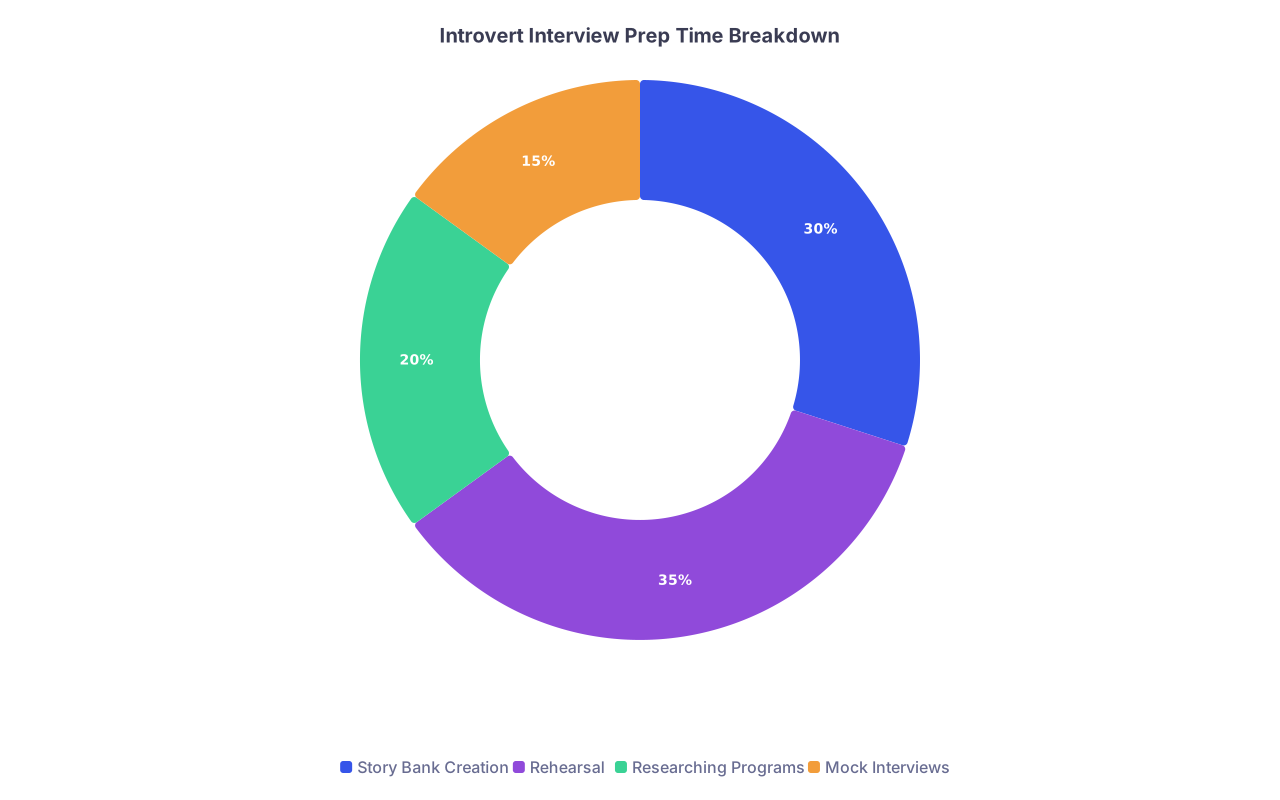
| Category | Value |
|---|---|
| Story Bank Creation | 30 |
| Rehearsal | 35 |
| Researching Programs | 20 |
| Mock Interviews | 15 |
Handling the “Personality Show” Parts of Interview Day
Behavioral questions are one thing. But what about the rest of the circus?
- Pre-interview dinners.
- Social hours.
- Awkward Zoom breakout rooms.
- “Any questions for us?” when your brain is blank.
Here’s how to survive without pretending to be someone else.
Pre-interview socials
You don’t have to be “on” the whole time. At all.
Strategy that works for introverts:
- Show up on time.
- Aim for two or three real conversations of 5–10 minutes each.
- Ask residents questions you actually care about:
- “What’s a hard day here look like?”
- “What surprised you once you started internship?”
- “What do people quietly complain about that doesn’t make the brochure?”
- When your social battery hits red, step away:
- Bathroom break.
- Get water.
- Stand at the edge and just observe for a bit.
No one is scoring your “percentage of time spent talking.” That’s an anxiety myth.
In the actual interview
You are being judged more directly here, but again—they’re not looking for the loudest voice. They’re looking for comfort, clarity, and being present.
For introverts, a few micro-skills matter a lot:
Take a beat before answering.
You’re allowed to pause. Try: “That’s a good question, let me think for a second.” Then breathe once, pick a story, and commit.Signal engagement with your face.
This feels dumb, but it matters:- Nod when they’re speaking.
- Slightly raise your eyebrows when they say something surprising/interesting.
- Allow yourself small smiles.
You’re probably under-expressing compared to how engaged you feel inside.
Don’t bury the lead.
Start answers with the key point, not a story that wanders for 90 seconds and finally gets interesting at the end.
Q: “Tell me about a time you made a mistake.”
Start with:
“I missed a lab abnormality on night float that delayed care by about 12 hours, and it taught me a lot about how I review data.”
Then go into S–T–A–R–L.

| Step | Description |
|---|---|
| Step 1 | Behavioral Question Asked |
| Step 2 | Pause & Breathe |
| Step 3 | Use S-T-A-R-L |
| Step 4 | Pick Closest & Adapt |
| Step 5 | End with What You Learned |
| Step 6 | Choose Story from Bank |
What If I Just Don’t Come Off as “Likeable” Enough?
There’s a quiet terror here no one admits out loud: “What if they just don’t like me? What if I’m forgettable?”
Some truth: yes, “fit” and “vibe” matter. Some attendings absolutely gravitate toward high-energy, extroverted people. Some don’t. You can’t control their personality. At all.
You can control:
Whether you seem genuinely interested in being there
(Ask real questions. Reference something specific about their program.)Whether you seem safe to put on a team
(Show you handle conflict, feedback, and stress in your stories.)Whether you seem authentic
(Don’t fake extroversion. Modulate your energy a bit, but stay you.)
Quiet, thoughtful, steady is a very attractive personality type in residency. Especially in the middle of the night. Especially with anxious patients. Especially with burned-out nurses.
Your goal isn’t to be unforgettable. It’s to be clearly reliable and someone they’d be fine sharing a long call night with. That bar is reachable.

Reality Check: How Much Does Behavioral Performance Actually Matter?
You’re probably also wondering, “If I bomb one question, am I done?” or “Can a good interview compensate for average stats?”
Roughly, this is the weight interview performance carries once you’ve been offered interviews at all:
| Factor | Relative Impact |
|---|---|
| Interview & 'Fit' | High |
| Letters of Recommendation | High |
| Clinical Performance (MS3) | High |
| Personal Statement | Medium |
| Research / CV Activities | Medium |
Once you’re in that interview chair, your scores and grades got you in the door. They still matter, but now they’re background.
Does that mean one awkward answer kills your chances? No. Committees hear hundreds of interviews. Everyone has clunky moments. What they remember is the overall pattern: Did you have insightful stories? Did you take responsibility for mistakes? Did you sound like the same human across interviewers?
A calm, slightly reserved applicant with clear stories and thoughtful reflections will beat the charming but shallow talker more often than your anxiety wants to admit.
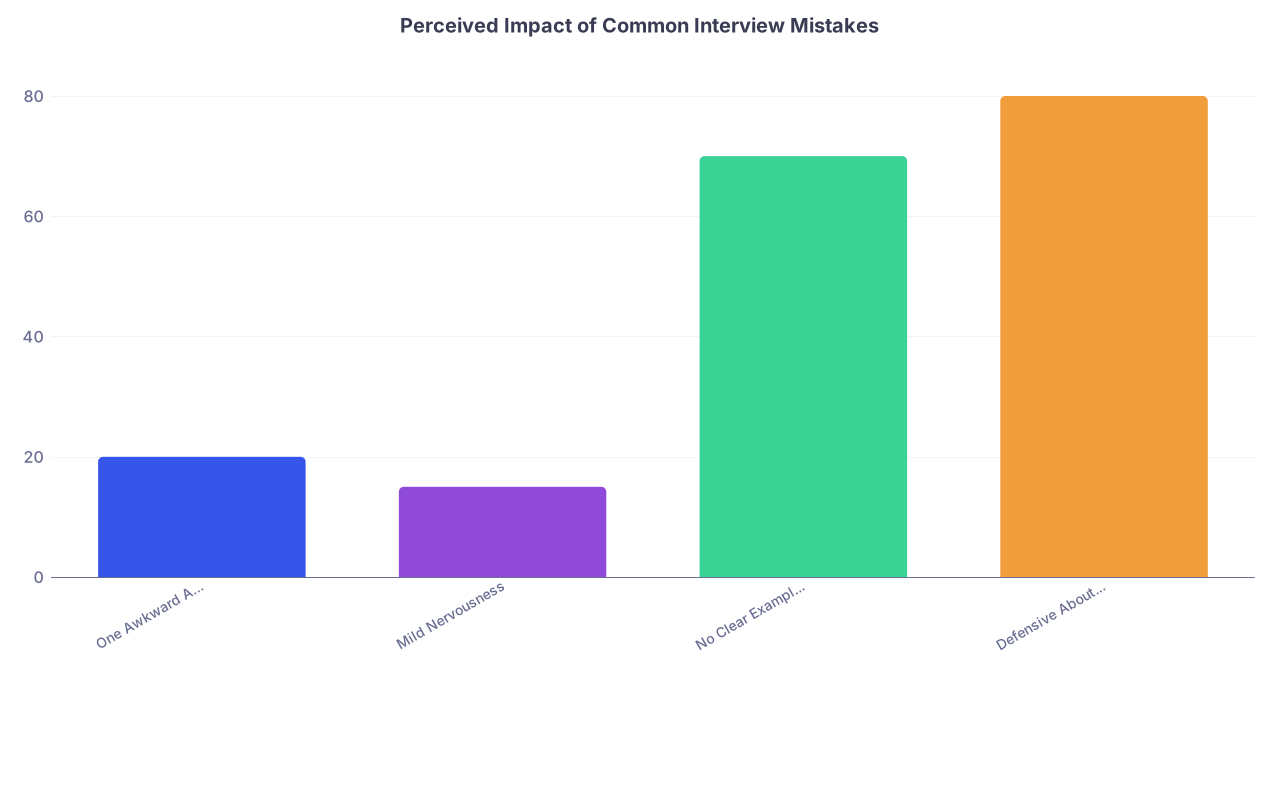
| Category | Value |
|---|---|
| One Awkward Answer | 20 |
| Mild Nervousness | 15 |
| No Clear Examples | 70 |
| Defensive About Feedback | 80 |
A Simple 2-Week Plan for Introvert Interview Prep
Just so this isn’t all theory, here’s a realistic, non-insane prep plan.
Week 1:
- Day 1–2: Build your story bank (8–12 stories, rough S–T–A–R–L outlines).
- Day 3–4: Refine 4–5 of them and say them out loud once each.
- Day 5: Record yourself answering 5 behavioral questions. Watch back once.
- Day 6–7: Fix the biggest issues (rambling, no clear result, no learning point).
Week 2:
- Do 2 short mock interviews (30 minutes each) with someone you trust or your school’s advising.
- Before each scheduled interview: 10-minute warm-up where you answer 2–3 behavioral questions out loud, alone.
- After each real interview: jot down which questions you got. Add them to your doc. You’ll start seeing patterns.
You don’t need daily 3-hour rehearsals. You need targeted practice that builds familiarity. Introverts thrive on familiarity.

FAQ: Introvert Panic Edition
1. What if I blank on a behavioral question and my mind goes totally empty?
It happens. To extroverts too. Say something like, “I’m trying to think of the best example,” breathe once, then grab any decent story, not the perfect one. Commit to S–T–A–R–L. Interviewers care more that you recover than that you nail the ideal example. A 6/10 answer is infinitely better than 5 seconds of silent panic followed by a mumble.
2. Is it bad if I pause before answering? I’m scared they’ll think I’m slow or unprepared.
Pauses of 1–3 seconds actually read as thoughtful, not clueless. The trick is to name the pause: “Let me think for a second,” then hold eye contact and breathe. What feels like 10 seconds in your body is usually 2–3 seconds in real life. Long, blank stares with no signal are what feel weird, not intentional pauses.
3. I’m terrified of coming across as braggy. How do I talk about my accomplishments without sounding arrogant?
Describe what you did and what you learned, not how amazing you are. Example:
Instead of “I’m a strong leader,” say, “On surgery, the intern was overwhelmed, so I started pre-rounding earlier and organizing sign-out for our patients. That helped us catch up and I realized I like quietly coordinating things behind the scenes.” That’s confident, not arrogant.
4. What if my personality just doesn’t match the program culture?
Then that program is probably not your place, and that’s not a failure. Some programs are loud, high-energy, very “rah-rah.” Some are quiet, cerebral, more contained. If you’re forcing a personality all day on interview day, imagine doing that for four years. The Match is a two-way filter, not a one-sided judgment of your worth.
5. I’m an introvert and English isn’t my first language. Am I basically doomed for behavioral interviews?
No. You’re playing on “hard mode,” but not impossible mode. Focus on clarity over fancy phrasing. Practice your stories out loud more times than you think you need, especially the openings and the “what I learned” lines. Programs are generally much more forgiving about accent and minor grammar issues than they are about vagueness, defensiveness, or zero insight.
One day, you’ll be the resident showing a terrified MS4 where to put their bag on interview day, and you’ll see someone quiet on the edge of the group, clutching a folder way too hard.
You won’t remember your own word-for-word answers from your interviews.
You’ll remember that you walked into them introverted, anxious, and still chose to show who you were anyway.