
What if you pick a residency that basically makes having a kid impossible for 3–7 years—and you don’t realize it until you’re already there?
Because that’s the thing no one really says out loud on interview day: some programs are survivable with a family, and some will quietly wreck any plan you have for kids, relationships, or even seeing daylight.
Let’s talk about that. Honestly. From the place in your brain that’s thinking:
“Am I screwing over my future self if I choose the ‘best’ program and ignore childcare and family planning now?”
You’re not the only one thinking this. You’re just one of the few brave (or anxious) enough to say it.
The Fears You’re Probably Not Saying Out Loud
Let’s name the monsters so they stop hiding under the bed.
You might be thinking:
- “If I have a baby in residency, will my co-residents hate me for taking leave?”
- “Are program directors judging me if I ask about maternity/paternity leave?”
- “What if I match far from family and then can’t afford childcare on a resident salary?”
- “What if my biological clock and residency timeline just… don’t line up?”
- “What if I wait, and then it’s too late?”
And then the worst one:
“What if there was a program where I could’ve made this work—and I didn’t match there because I was too scared to factor family into my rank list?”
I’ve watched applicants laser-focus on prestige, fellowship match, research output… and then, midway through intern year, they’re sobbing in a call room because pregnancy is complicated, or childcare fell through, or their spouse is burned out and threatening to leave.
Not because they’re weak. Because nobody told them to interrogate programs about this stuff up front.
So you are already doing something right by worrying about it now.
The Hard Truth: Not All “Family Friendly” Programs Actually Are
Almost every program will say, “We’re very supportive of residents with families.”
That sentence is basically copy-pasted into every recruitment talk. It means nothing by itself.
You have to look under the hood. Programs differ a lot on this. Let me be blunt:
Some programs:
- Will rearrange schedules to accommodate maternity/paternity leave
- Have co-residents who trade call without drama
- Have PDs who say things like, “Family comes first, we’ll figure it out”
- Actually know their own parental leave policy without having to “get back to you”
Other programs:
- Will “support” you by making you use all your vacation as maternity leave
- Will subtly punish pregnant residents with crammed rotations before/after leave
- Have a culture where everyone pretends they don’t have lives outside the hospital
- Feature senior residents bragging about “never taking a sick day” like it’s a medal
You’re not crazy for wanting to figure out which is which before you commit your 20s or 30s to a place.
What You NEED to Ask (Even If It Feels Awkward)
You’re probably worried you’ll look “less committed” if you ask about kids, leave, or childcare.
Here’s the reality: any program that penalizes you for asking is not a place you want to be. Full stop.
You don’t have to stand up and say, “Hi, I’d like to be pregnant PGY2.” You can ask questions in a neutral, policy-focused way.
Use this mental checklist on interviews or second looks.
| Factor | Green Flag | Red Flag |
|---|---|---|
| Parental leave | Clear, specific, matches or exceeds GME policy | Vague, inconsistent answers |
| Coverage during leave | Equitably redistributed, PD involved | “We just figure it out” |
| Schedule flexibility | Examples of swaps/accommodations | “We treat everyone exactly the same” |
| Childcare options | On-site or reliable referrals | “Some people find sitters on Facebook” |
| Culture | Residents openly mention kids | Awkward silence when family is brought up |
Specific Questions You Can Actually Use
Ask these to residents (not just faculty) in breakout rooms or emails:
- “Do you have co-residents with kids? How has it actually worked out for them?”
- “Have any residents taken maternity or paternity leave in the last few years? How did the program handle scheduling?”
- “What’s the real parental leave here—how many weeks do people actually take, and is it paid?”
- “Does anyone use local daycare or nannies you’d recommend? Is the schedule compatible with your call schedules?”
- “If a kid is sick unexpectedly, how hard is it to find someone to cover, realistically?”
If they say, “Um, I don’t think anyone here has kids” — that’s information. Not necessarily a dealbreaker, but definitely a warning light if family planning is very high on your priority list.
And watch people’s faces when they answer. A resident saying, “Yeah, it’s fine!” with haunted eyes is not reassuring.
The Financial Side Nobody Walks You Through
Let’s be real: resident salary + childcare = pain.
Most people underestimate this. Badly.
You need to at least sketch out what life looks like with a kid in a given city.
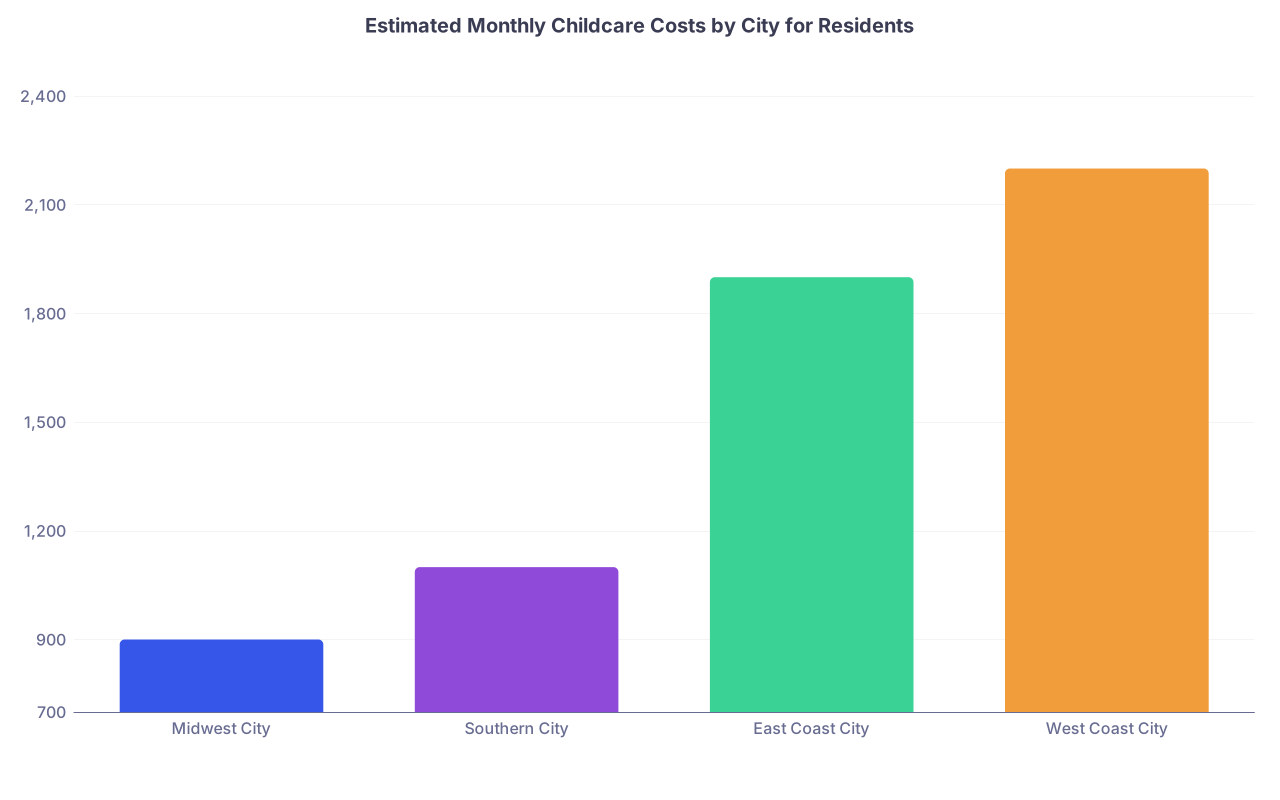
| Category | Value |
|---|---|
| Midwest City | 900 |
| Southern City | 1100 |
| East Coast City | 1900 |
| West Coast City | 2200 |
These are rough ballparks for full-time daycare. Some places are worse.
Now imagine you’re bringing home $3,500–$4,200 a month after taxes as a PGY-1. And call schedules that force you to pay for full-time coverage even when you’re not home to see your kid.
You don’t have to be a financial planner to ask:
- What’s the resident salary and cost of living really like here?
- How many co-residents have kids on this salary? Are their partners also working?
- Is there on-site hospital daycare with reduced rates or flexible hours?
- Does the program or GME offer any childcare subsidies?
- Are schedules mostly days, or is there a lot of nights & 24-hour call?
Programs that understand this problem often partner with nearby childcare centers, offer backup care, or at least have a culture of sharing resources. Programs that don’t… leave you scrambling and broke.
Leave, Pregnancy, and the Ugly Logistics
Here’s where your anxiety probably spikes: “What if I get pregnant in residency and everything blows up?”
You deserve straight answers, not vibes.
Every program has to follow ACGME, ABMS board, and institutional GME policies about leave and minimum weeks on service. But how they apply it can vary a lot.
You want clarity on 3 things:
Duration of leave
- Is there a standard maternity leave? Paternity leave?
- Is any of it paid beyond what FMLA/GME requires?
- Do people actually take the full amount, or is there pressure to come back early?
Impact on graduation
- Has anyone needed to extend residency because of parental leave?
- If yes, how was that handled financially and emotionally?
- Are they flexible about adjusting rotations so you still meet board requirements?
Culture of backup and coverage
- Do co-residents resent covering for people on leave?
- Does the PD step in to help distribute workload?
- Are there float residents or jeopardy systems built in?
Programs that are truly family-friendly can tell you, without hesitation: “Yes, in the last few years we’ve had X residents take parental leave. We did A, B, C to help. Nobody was punished for it.”
Programs that dodge: “We haven’t really had to deal with that; we’d cross that bridge when we come to it.” Translation: you’d be the guinea pig.
Signals a Program Might Actually Be Family-Friendly
Look past the brochure. Look at patterns.
Good signs:
- You see residents with kids at the pre-interview dinner or Q&A. They’re not hidden.
- Nobody flinches when you mention “my partner” or “my kids” or “eventually having a family.”
- The PD knows the parental leave policy cold and speaks about it like a normal part of residency, not a rare catastrophe.
- Residents can rattle off actual names: “Yeah, last year Sarah took 8 weeks, and they rearranged her ICU month.”
- Someone mentions flexible vacation scheduling for daycare starts, school, or family needs.
- There are part-time or research blocks people have used during pregnancy/postpartum.
Red flags:
- A weird silence when family or kids come up.
- Jokes like, “You won’t have time for kids here, haha.” They think it’s funny. It’s not.
- Residents say, “I mean, it’s technically possible… but no one does it.”
- You hear about people banking all their vacation and sick days just to patch together a barely-adequate leave.
- PD or chiefs make comments about “commitment” and “priorities” when family planning is mentioned.
You are not overreacting if these comments bother you. Those attitudes show up hard when you actually need support.
How Much Should Family Planning Really Affect Your Rank List?
This is the part that keeps people up at night: “Am I allowed to rank a ‘less prestigious’ place higher because it’s more livable for my future family?”
Yes. Yes you are. Prestige does not raise your kids. Prestige does not do 3 a.m. feeds. Prestige does not show up when daycare closes early and your co-resident takes your pager.
I’ve seen people who:
- Chose the big-name, malignant-adjacent program, delayed kids, and ended up doing fertility treatments as attendings.
- Chose the solid but not top-10 program with sane schedules and supportive leadership, had a kid PGY-2, and still matched competitive fellowships.
If having kids during residency is a likely scenario for you, that is not a “nice to consider” factor. It’s core. It should absolutely move programs up or down your list.
Ask yourself:
- Do I want kids during residency, or am I okay waiting until fellowship/attending?
- How old will I be by the end of residency/fellowship? Does that timeline stress me out?
- Is my partner’s situation (career, health, age) adding pressure to that timeline?
- Would I regret going to a hyper-intense prestige program if it basically forced me to put kids on hold?
None of these answers are wrong. But pretending they’re not there is how people end up miserable.
Long-Distance, Partners, and Support Systems
Let’s not ignore the other piece: who’s helping you?
If you’re single, out-of-state, no family nearby, and planning to have a baby in a city you’ve never lived in… that’s a different level of logistical chaos than staying near your parents who can do daycare pickup.
Not impossible. Just harder. You have to plan for it.
- What’s their work schedule like? Are they in training too?
- Are they okay being the primary parent during call months? Have you actually talked about that?
- Are you relying psychologically on “My parents will help” — even though they live three flights away?
Programs rarely ask you this, but you should:
“Will I have at least one stable adult in this city I can call when my kid is sick and I’m scrubbed in?”
If the answer is no, the burden on the program’s culture and flexibility becomes even more critical.
You’re Not Selfish for Caring About This
There’s this toxic undercurrent in medicine that if you’re truly “dedicated,” you’ll:
- Delay kids indefinitely
- Be fine missing milestones
- Never ask for accommodations
- Treat your personal life as optional side-quest content
That mindset burns people out and breaks families. You’re not dramatic or “less committed” for wanting to be both a decent physician and a present parent.
You’re actually being responsible by thinking about this now, instead of blowing up later and quitting, resenting your program, or resenting your kid. Or yourself.
Concrete Next Step (Do This Today)
Open a blank document or notes app right now.
Make two short lists:
Non-negotiables about family/childcare for residency
(Examples: “Program must have clear parental leave policy.” “At least one co-resident currently has kids.” “City where childcare is even remotely affordable.”)Nice-to-haves
(Examples: “On-site daycare.” “Nearby family support.” “Less than 1 hour commute so I can actually see my kid on non-call days.”)
Then, pull up the top 5–10 programs on your current rank list. For each one, write down what you actually know about those items versus what you’re assuming.
If there are big question marks, email a current resident or the coordinator this week and ask. You don’t need permission. You’re allowed to get the data you need to protect your future.
Because the real nightmare scenario isn’t “They think I’m weird for asking about kids.”
It’s waking up PGY-2 in a program that makes starting a family feel impossible—and realizing you could have known that before you ranked it.