Boost Your Board Exam Scores with These Top-Rated Q-Banks
Board exams are one of the highest‑stakes milestones in Medical Education. Whether you are preparing for the USMLE, COMLEX, or other licensing exams, your performance will heavily influence residency opportunities and long‑term career paths. Amid the pressure, one set of tools consistently stands out as essential for effective Board Exam Preparation: high‑quality question banks, or Q-Banks.
Strategic use of Q-Banks does far more than just test your recall. When used correctly, they become an integrated system for active learning, test strategies, and evidence‑based study techniques that sharpen your clinical reasoning and exam performance.
This guide breaks down:
- Why Q-Banks are uniquely powerful
- Key features to look for when selecting one
- A detailed review of top-rated Q-Banks
- Practical strategies to maximize your score gains
- Common FAQs from medical students and residents
Why Q-Banks Are Essential for Board Exam Preparation
Q-Banks are not just “extra practice questions.” They are designed to replicate board-level difficulty, style, and structure. Used effectively, they serve as both a diagnostic tool and a learning platform.
Active Learning vs Passive Studying
Traditional methods—reading textbooks, annotating class notes, or watching videos—tend to be passive. In contrast, Q-Banks force you into active recall and application:
- You must retrieve information (not just recognize it).
- You are compelled to apply concepts to new, sometimes unfamiliar, clinical scenarios.
- You repeatedly practice critical thinking under time pressure.
This aligns with cognitive science principles:
- Active recall strengthens memory traces.
- Retrieval practice improves long-term retention more than re-reading.
- Application of knowledge enhances transfer to new contexts—exactly what board exams require.
Familiarizing Yourself with the Testing Environment
Modern Board Exam Preparation is not only about what you know, but how you perform under exam conditions. High-quality Q-Banks simulate:
- Exam format (single-best-answer multiple choice, long clinical vignettes)
- Question difficulty and distractor quality
- Time constraints (e.g., 40 questions in 1 hour)
- Interface style (navigation, flagging questions, review modes)
This repeated exposure helps you:
- Reduce test anxiety by normalizing the experience
- Learn pacing: how long to spend per question and when to move on
- Develop a sense of “exam intuition” for common patterns and pitfalls
Self-Assessment and Targeted Remediation
An effective Q-Bank doubles as a diagnostic assessment:
- You quickly identify weak content areas (e.g., cardiology, biostatistics, pharmacology).
- Performance trends reveal whether your study techniques are working.
- Detailed analytics help you refine your study plan rather than guessing.
Example:
- If you consistently miss renal questions, you can:
- Revisit a renal physiology chapter
- Watch a short review video
- Return to the Q-Bank and retest those topics in a customizable block
Building Test-Taking Strategies and Clinical Reasoning
Beyond knowledge gaps, Q-Banks reveal strategic and cognitive patterns:
- Do you change correct answers to incorrect ones?
- Do you get questions wrong because of misreading, not knowledge?
- Do you miss multi-step reasoning, such as diagnosis → next best step → contraindications?
Over time, you learn to:
- Parse long question stems efficiently (ignoring distractor details)
- Identify key phrases and red flags
- Eliminate obviously wrong options quickly
- Choose the most appropriate answer when several seem “right”
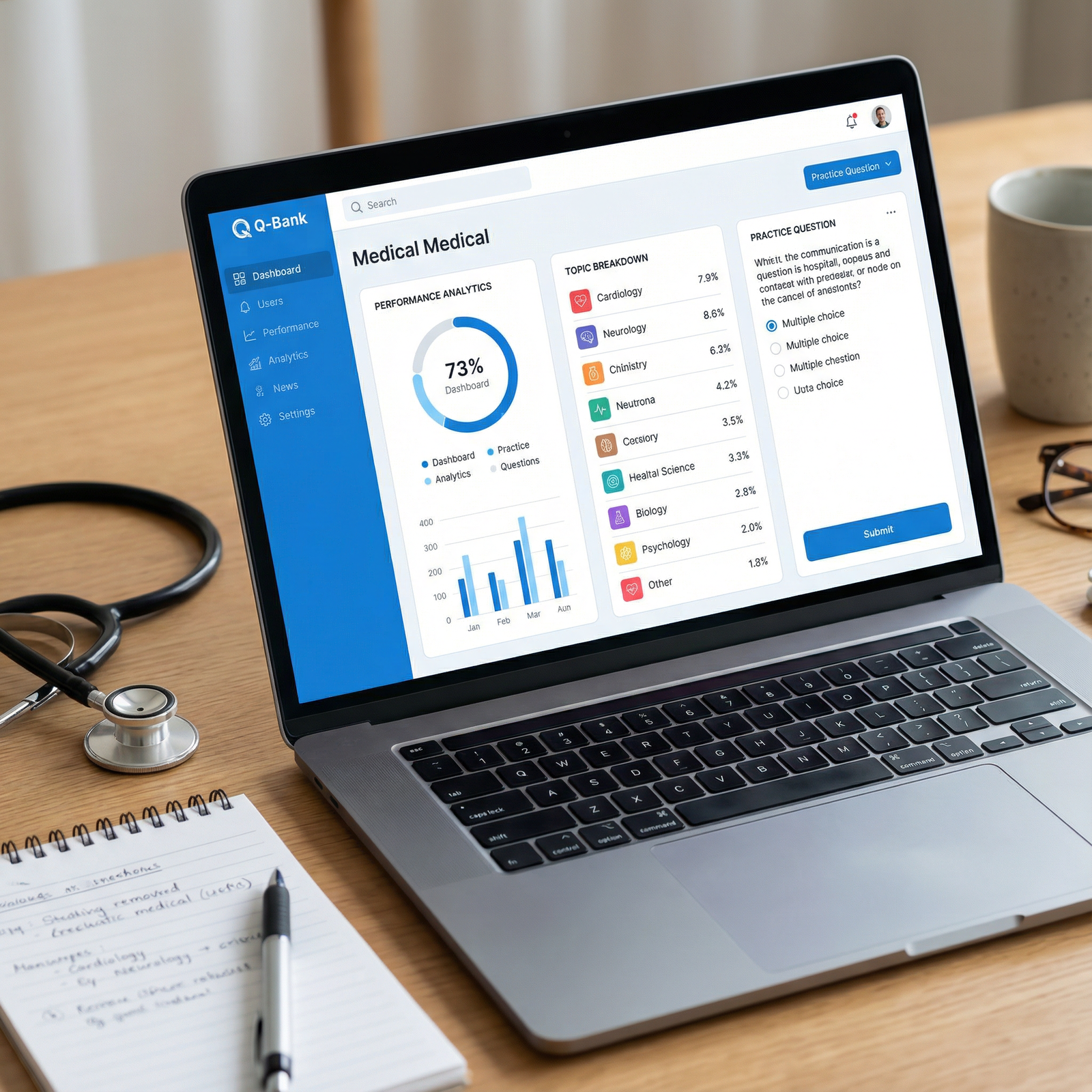
What to Look for in a High-Quality Q-Bank
Not all Q-Banks are created equal. When choosing tools for Board Exam Preparation, focus on features that amplify both your learning and your test strategies.
1. Depth and Breadth of Questions
- Look for large, well-curated question pools that cover:
- All major organ systems
- Core basic sciences (for preclinical exams)
- High-yield clinical topics and guidelines (for clinical exams)
- Diversity in question style:
- Long clinical vignettes
- Short conceptual questions
- Multi-step reasoning (diagnosis → management → complication)
A larger question pool matters, but quality, relevance, and up-to-date content are equally critical.
2. High-Yield, Detailed Explanations
The explanations are arguably more valuable than the questions themselves. Strong Q-Banks provide:
- Clear rationale for the correct answer
- Why each incorrect option is wrong (differential diagnosis thinking)
- High-yield charts, tables, or images
- Pathophysiologic reasoning, not just “because the exam says so”
- Links to guidelines or evidence when relevant
You should walk away from each question feeling like you:
- Understood the concept deeper than before
- Could teach it to someone else
- Can apply it to a slightly different scenario
3. Robust Performance Analytics
An effective Q-Bank should track:
- Overall score and trends over time
- Performance by:
- System (e.g., cardio, GI, neuro)
- Discipline (e.g., pathology, pharmacology, biostatistics)
- Question difficulty levels
- Comparison to peers or percentiles (helpful, but don’t obsess)
Use these analytics to:
- Prioritize weak subjects first
- Decide what content to review from textbooks or videos
- Adjust your study schedule objectively, not by “feeling behind”
4. Customization and Study Modes
Customization is key to efficient Study Techniques:
- Build blocks by:
- System (e.g., endocrine questions only)
- Discipline (e.g., micro/pharm)
- Difficulty
- Question status (new, incorrect, marked, etc.)
- Choose testing modes:
- Tutor Mode: See explanations immediately after each question (great for learning).
- Timed Exam Mode: Simulate test conditions (essential in the final weeks).
This flexibility allows you to shift from learning mode early in prep to assessment mode as your exam approaches.
5. Interface, Accessibility, and Mobile Learning
For busy medical students and residents, practical factors matter:
- Intuitive, clean user interface
- Reliable, fast loading questions
- High-quality images and diagrams
- Mobile app support for:
- Commuting
- Down time during rotations
- Short focused bursts of practice
A good mobile experience allows you to convert “dead time” into high-yield micro-sessions.
Top-Rated Q-Banks for Medical Students and Residents
Below is an overview of some of the most trusted and widely used Q-Banks in contemporary Medical Education. Many students combine two or more, depending on their timeline and goals.
1. UWorld: The Gold Standard for Many Exams
Best for: Core USMLE/COMLEX prep, first primary Q-Bank
UWorld’s reputation among medical students is almost universal—it is considered by many as the central pillar of Board Exam Preparation.
Key Features
- Thousands of questions (varies by exam), heavily board-style and updated regularly
- Extremely detailed explanations, often including:
- Mini-lectures
- Pathway diagrams
- Illustrated charts and tables
- Comprehensive performance tracking and subject breakdown
- Self-assessment exams that approximate your predicted score range
- Interface and style that closely mimic actual exam software
Why It’s Effective
- Emphasis on clinical reasoning rather than rote memorization
- Questions are often more challenging than the real exam—building a margin of safety
- Many students use UWorld as their primary learning tool, especially for Step 1 and Step 2 CK
Tips for Using UWorld
- Treat every explanation like a mini-chapter—annotate into your primary notes or review resource.
- Aim to complete the entire Q-Bank at least once; if time allows, a second pass focused on incorrects and marked questions is highly beneficial.
- Use the self-assessments to time your dedicated period and adjust your strategy.
2. AMBOSS: Integrated Q-Bank and Medical Library
Best for: Integrated studying (questions + content), quick reference while on rotations
AMBOSS combines a robust Q-Bank with an in-depth, easily searchable medical library, which many students use as a one-stop reference for both board studying and clinical work.
Key Features
- Thousands of exam-style questions for USMLE/COMLEX and international exams
- “Study Mode”:
- Highlighting tools
- Immediate access to articles related to the question stem
- “Exam Mode”:
- Stricter interface that mimics the testing environment
- Powerful search engine within the medical library
- Performance stats and customizable question sessions
Why It’s Effective
- Promotes contextual learning: when you miss a question, you can immediately read a focused, clinically relevant article.
- Bridges the gap between basic science and clinical application.
- Excellent for both preclinical review and clerkship-level reinforcement.
Practical Use Case
- After finishing a cardiology block in school, use AMBOSS to:
- Do cardio-focused questions
- Read articles linked from missed questions
- Build a concise cardio “cheat sheet” using notes from explanations
3. Kaplan Q-Bank: Comprehensive and Content-Rich
Best for: Students who prefer structured courses plus a Q-Bank
Kaplan has long been a staple in test prep, and its Q-Banks remain a solid choice, especially when paired with their video lectures and textbooks.
Key Features
- Extensive question pool with board-relevant, concept-tested style
- Detailed, textbook-like explanations with diagrams
- Integrated access to certain video or review materials (depending on your package)
- Customizable test creation by topic, system, and difficulty
- Analytics that show performance over time and by subject
Why It’s Effective
- Particularly helpful if you like to learn from long-form explanations with foundational review.
- Pairing the Kaplan Q-Bank with their course structure provides a unified path from content learning to practice.
How to Integrate Kaplan Effectively
- Use Kaplan Q-Bank earlier in your prep for learning and reinforcement.
- Transition to UWorld or AMBOSS as your primary tool closer to the exam for more challenging practice and exam-style refinement.
4. BoardVitals: Flexible, Exam-Specific Options
Best for: Variety of exams (USMLE, COMLEX, shelf exams, specialty boards)
BoardVitals is known for providing tailored Q-Banks across a wide spectrum of medical and subspecialty exams.
Key Features
- Large question banks across multiple exam types and specialties
- Detailed rationales and references
- Custom test modes by subject, difficulty, and question type
- Regular content updates aligned with current exam trends
- Mobile-friendly platform
Why It’s Effective
- Excellent if you are:
- Preparing for COMLEX in addition to or instead of USMLE
- Studying for shelf exams or later sub-specialty boards
- Flexibility allows you to plug specific gaps (e.g., an OMM-heavy COMLEX block or a neuro shelf exam).
Example Use Case
- A DO student uses UWorld for general board prep, and BoardVitals’ COMLEX-specific Q-Bank to:
- Reinforce OMM
- Target COMLEX-style question framing and content
5. TrueLearn: Data-Driven and Adaptive Learning
Best for: Learners who value analytics, spaced repetition, and adaptive strategies
TrueLearn emphasizes a learning science–based approach with adaptive features and detailed performance metrics.
Key Features
- Large banks covering COMLEX, USMLE, NBME subject exams, and residency board exams
- “SmartBank” technology that integrates:
- Spaced repetition
- Cognitive science principles
- Percentile-based analytics that benchmark your performance
- Tools to build personalized quizzes and track weaknesses
Why It’s Effective
- Focus on retention over time, not just brute-force question volume
- Especially popular among osteopathic students and residents preparing for in-training or specialty board exams
Suggested Strategy
- Use TrueLearn throughout the year (not only during “dedicated”), doing:
- 10–20 questions per day
- Focused review of weak areas highlighted by performance analytics
- This builds a strong foundation that pays off when you enter a dedicated study period.
Strategies for Using Q-Banks for Maximum Score Gains
Q-Banks are only as powerful as your approach to them. Thoughtful use can transform them from a passive checklist into a high-yield, targeted learning engine.
1. Integrate Q-Banks into a Structured Study Plan
- Treat Q-Bank use as a core component, not an afterthought.
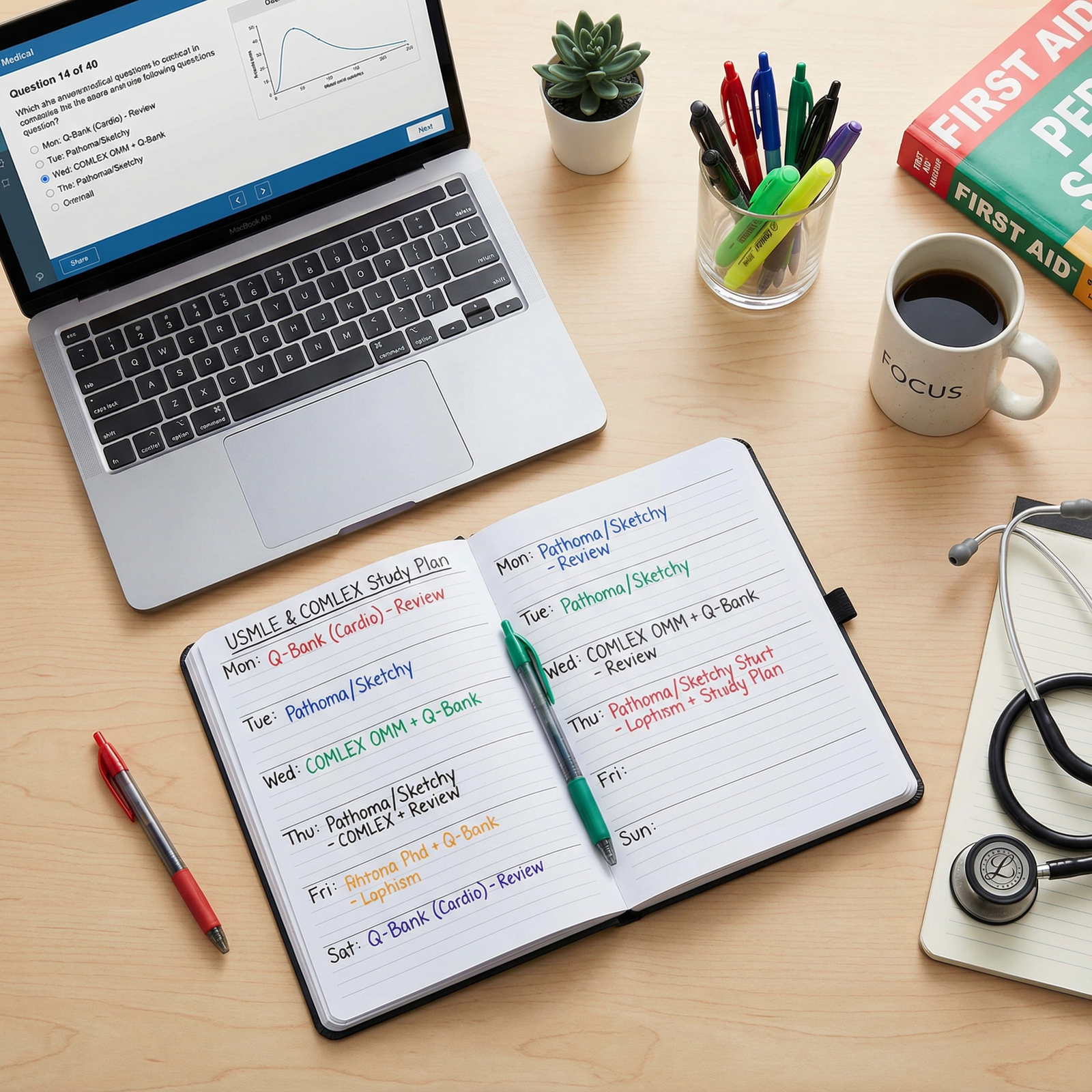
- Example weekly plan (during dedicated Step 1/COMLEX Level 1 prep):
- 40–80 Q-Bank questions daily (in 2–4 blocks)
- 50–60% of your time on reviewing explanations
- Remaining time on content review (Anki, notes, videos) driven by Q-Bank weaknesses
2. Start Early and Ramp Up Over Time
- Preclinical years:
- Use a Q-Bank lightly during organ systems blocks (10–20 questions a few times per week).
- Aim to build familiarity with question style early.
- Dedicated prep:
- Intensify to daily blocks with exam-like timing.
- Shift from content-heavy learning to question-driven learning.
3. Focus on Quality of Review, Not Just Quantity of Questions
Avoid the trap of chasing a “questions completed” number. Instead:
- After each block, thoroughly review:
- Every incorrect question
- Every correct question you guessed or were unsure about
- During review:
- Ask yourself: “Why did I miss this? Knowledge gap, misread question, or reasoning error?”
- Write brief summary notes or add concepts to flashcards (e.g., Anki).
4. Use Performance Analytics to Drive Targeted Study Techniques
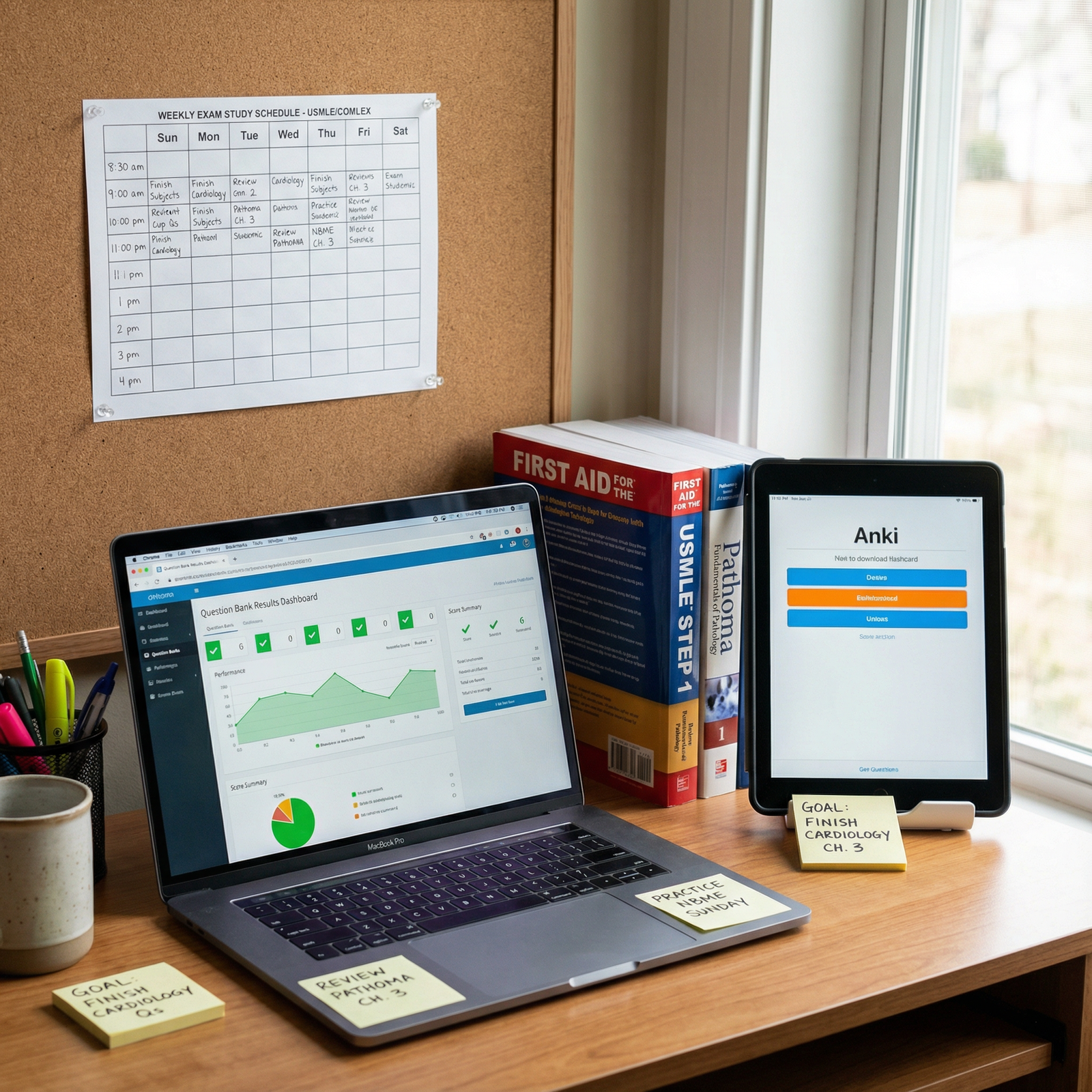
- Every few days, analyze your dashboard:
- What systems are consistently low?
- Are you repeatedly missing certain question types (e.g., biostats, ethics, ECG interpretation)?
- Translate this into action:
- Schedule dedicated blocks to review those weak topics.
- Use a mix of videos, concise notes, and targeted Q-Bank blocks.
5. Regularly Simulate Full Exam Conditions
In the final 4–6 weeks:
- Do periodic full-length simulation days:
- Multiple 40-question blocks back-to-back with short breaks
- Strict timing (just like the real exam)
- This builds:
- Mental stamina
- Time management
- Confidence under realistic pressure
6. Leverage Spaced Repetition and Re-Exposing Missed Questions
- Re-do incorrect questions after some time has passed.
- Many Q-Banks allow:
- “Incorrects-only” blocks
- “Marked questions” blocks
- Combine this with spaced repetition flashcards to:
- Solidify high-yield, previously missed concepts
- Avoid re-making the same errors on test day

FAQs About Q-Banks and Board Exam Preparation
1. Are Q-Banks alone enough to prepare for board exams?
Q-Banks are a critical component of Board Exam Preparation, but they are rarely sufficient as a sole resource. The most effective approach combines:
- Q-Banks for:
- Active practice
- Assessment and test strategies
- Clinical reasoning
- Content resources for:
- Filling in knowledge gaps (textbooks, review books, video series)
- Building foundational understanding
- Spaced repetition (e.g., flashcards) for:
- High-yield facts
- Hard-to-remember details (e.g., bug–drug pairs, metabolic pathways)
Use Q-Banks as the engine that reveals what you need to study, then reinforce that material through targeted review.
2. How many Q-Bank questions should I aim to do each day?
There is no universal number, but common effective ranges:
- During dedicated prep:
- 40–80 questions per day is typical
- Some high-intensity schedules go up to 120/day, but only if:
- You have enough time to review explanations thoroughly
- You are not sacrificing sleep or comprehension
- During preclinical or clerkship periods:
- 10–40 questions a few times per week can be sufficient to build familiarity
Quality of review matters more than raw quantity. If you are rushing through explanations, consider reducing your daily question load.
3. When should I start using Q-Banks in medical school?
Earlier than many students think:
- Preclinical years (M1–M2):
- Start integrating organ-system-relevant questions as you go.
- This introduces board-style thinking early without overwhelming you.
- About 6–12 months before your exam:
- Begin using a major Q-Bank (e.g., UWorld, AMBOSS) more consistently.
- Dedicated study period:
- Q-Banks become your central study tool, guiding what you review each day.
The earlier you are comfortable with the question format, the more you can focus on content and strategy during dedicated time.
4. Should I do questions in Tutor Mode or Timed Exam Mode?
Use both, but at different phases:
- Early/learning phase:
- Tutor Mode is highly useful.
- You see explanations right away and can connect concepts immediately.
- Intermediate to late phase:
- Gradually shift to Timed Exam Mode, full blocks:
- Simulate exam pacing
- Work on stamina and decision-making under pressure
- Gradually shift to Timed Exam Mode, full blocks:
- Final weeks:
- Primarily practice in exam-like conditions with full-length timed blocks and self-assessments.
A hybrid approach can also work (e.g., timed blocks followed by very slow, detailed review afterward).
5. Can using Q-Banks help reduce test anxiety?
Yes, when used strategically, Q-Banks can significantly reduce test anxiety:
- Familiarity with the format, timing, and difficulty reduces the “fear of the unknown.”
- Repeated exposure under timed conditions builds confidence in your pacing and reasoning.
- Performance analytics can reassure you that you are improving, even if progress feels slow day to day.
However, over-focusing on percentages or comparing yourself excessively to peers can increase anxiety. Use analytics as a tool, not a judgment.
By integrating high-quality Q-Banks like UWorld, AMBOSS, Kaplan, BoardVitals, and TrueLearn into a structured, data-driven study plan, you transform Board Exam Preparation from a vague, overwhelming task into a clear, targeted process. Combine active question practice with smart Study Techniques, evidence-based Test Strategies, and consistent review, and you will be well-positioned to achieve the board scores that open doors in residency and beyond.