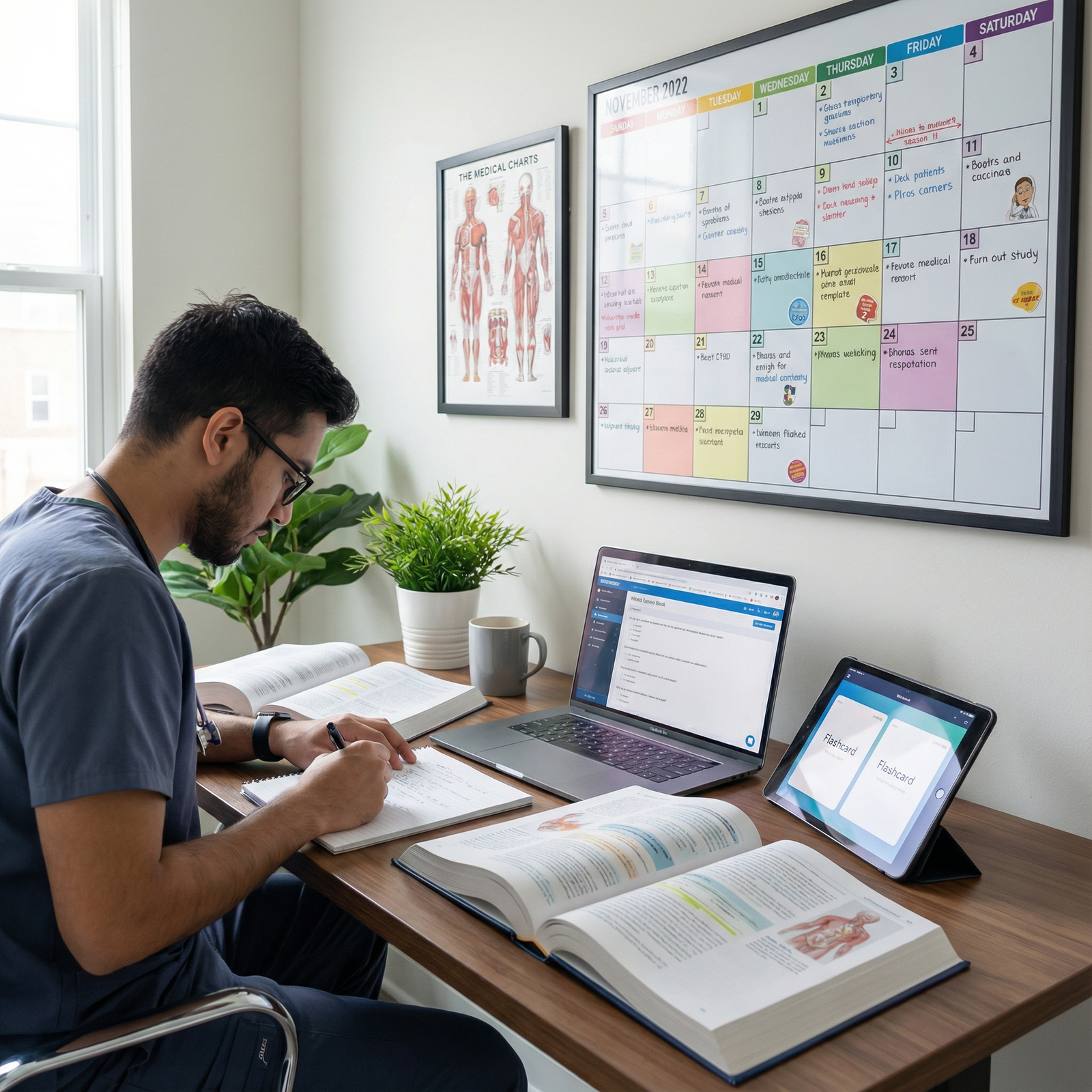
Designing Your Ultimate Medical Study Plan with High‑Yield Resources
Creating an effective Medical Study Plan is one of the most powerful things you can do to succeed in medical school and on high‑stakes exams like the MCAT, USMLE Step 1/2/3, COMLEX, or shelf exams. With endless Study Resources available—books, question banks, apps, videos, podcasts—it’s easy to feel overwhelmed and unsure where to start.
This guide walks you step‑by‑step through building your own ultimate, realistic, and sustainable exam preparation plan, using top medical resources and evidence-based Active Learning strategies. You’ll learn how to choose the right tools, structure your time, and maintain your health while studying at a high level.
Understanding Your Exam Goals and Starting Point
Before buying another book or opening another question bank, you need clarity. A strong Medical Study Plan is built around your specific exam, your timeline, and your current level.
1. Define Your Primary Exam and Timeline
Start by being brutally specific:
- Which exam?
- MCAT, USMLE Step 1, Step 2 CK, Step 3, COMLEX, shelf exams, or in‑course block exams.
- When is your test date?
- Count how many weeks and days you have.
- What are your constraints?
- Are you in full‑time classes or on clinical rotations?
- Do you work, have family responsibilities, or research commitments?
Create a simple snapshot:
- Exam: USMLE Step 1
- Test date: August 15
- Today: May 1
- Time until exam: ~15 weeks
- Other obligations: 4 weeks of rotations + 11 weeks dedicated
This snapshot will guide how aggressive or conservative your plan should be.
2. Set SMART Performance and Process Goals
Your goals should not only be “get a good score.” Break them down:
Performance goals (outcome-focused):
- “Reach a 515+ on full-length MCAT practice tests by test week.”
- “Score at or above my target percentile on two NBMEs before Step 1.”
- “Average ≥70% on UWorld blocks by week 8 of dedicated.”
Process goals (daily/weekly behaviors):
- “Complete two 40-question timed UWorld blocks daily, with full review.”
- “Add 30–40 new Anki cards per day and review all due cards.”
- “Finish one Pathoma chapter plus notes three days per week.”
SMART goals are:
- Specific – “Do 80 questions/day” instead of “Do questions.”
- Measurable – You can track completion.
- Achievable – Fits your energy and time.
- Relevant – Directly supports your exam.
- Time-bound – Tied to a date or timeframe.
3. Honestly Assess Your Strengths and Weaknesses
Your Medical Study Plan should be personalized, not generic.
Use:
- Previous exams: NBME, UWorld self-assessments, COMSAEs, MCAT FLs.
- In‑course performance: Past block exams, clerkship evaluations.
- Self-reflection: Which subjects or question types make you anxious?
Categorize major subjects into three buckets:
- Strong: You consistently score well; require maintenance review.
- Moderate: You understand basics but miss details or integrations.
- Weak: You avoid these topics or consistently miss related questions.
Example:
- Strong: Biochemistry, Behavioral Science
- Moderate: Pharmacology, Physiology
- Weak: Renal Physiology, Biostatistics, ECG interpretation
Your schedule should prioritize weak and moderate areas early, while still cycling through strong areas regularly.
Step 1: Select High‑Yield Medical Study Resources Intentionally
There are more Study Resources than any one person can use effectively. Your job is to curate, not collect. Too many materials dilutes your focus and wastes time.
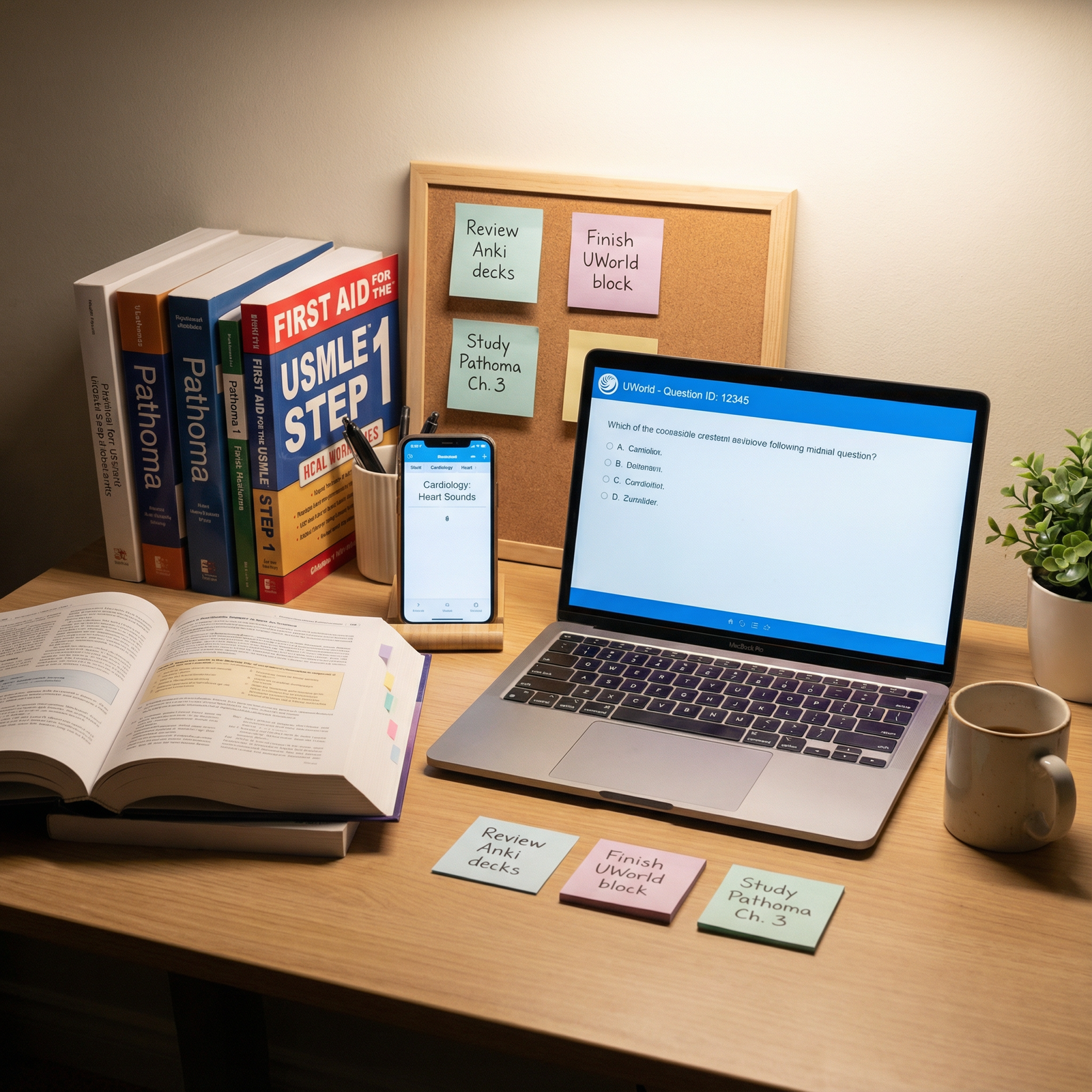
Core Text and Reference Resources
These are your content backbone—they give you structured explanations and outlines:
First Aid for the USMLE (Step 1 / Step 2 CK versions)
- Ideal as a framework, not your only source.
- Use it as a checklist of what you must know and as a quick reference during question review.
Pathoma (Text + Videos)
- High-yield for pathology; straightforward explanations.
- Strategy: Watch a video, annotate directly into First Aid or Pathoma book, then reinforce with questions.
Clinical Microbiology Made Ridiculously Simple
- Great for rapid review and mnemonic-based learning in microbiology.
- Pair with question banks or Sketchy-type visual resources.
Organ-system or block-specific texts
- Netter’s Atlas for Anatomy
- BRS Physiology or similar for physiology review
- Use selectively for topics you find conceptually difficult.
Question Banks and Online Platforms
For exam preparation, questions are non-negotiable. They’re the single most powerful learning and assessment tool.
UWorld
- Industry standard for USMLE and many other exams.
- Use it as a learning tool, not just assessment:
- Do questions in tutor or timed mode, depending on phase.
- Carefully review explanations, all answer choices, and make Anki cards or notes from missed questions.
AMBOSS
- Combines a comprehensive medical library with an excellent question bank.
- Strengths: In-depth explanations, “Attending tips”, and quick articles for on-the-fly clarification.
- Great supplement to UWorld early in prep or during clerkships.
Khan Academy (especially for MCAT)
- Free, structured content for foundational sciences and reasoning skills.
- Use targeted videos to patch conceptual gaps.
Flashcard and Spaced Repetition Apps
To manage the sheer volume of facts in medicine, you need spaced repetition.
Anki
- Gold standard for long-term retention.
- Use:
- Pre-made decks (e.g., AnKing for USMLE) as a base,
- Plus custom cards from your own question bank mistakes and lecture notes.
- Focus on active recall and keep cards concise.
Quizlet
- Useful for quick sets on memorization-heavy topics (e.g., antibiotics, bugs and drugs).
- Great for group collaboration if your team builds decks together.
Audio, Video, and Microlearning Resources
These support Active Learning during lower-energy times (commute, gym, chores) or when you need another explanation style.
MedCram
- Clear, concise explanations of complex topics (e.g., acid-base, COVID, cardiology).
- Excellent for visual learners and concept-heavy topics.
The Medical School HQ Podcast and similar shows
- Particularly helpful for premeds and early medical students.
- Use for strategy, mindset, and career guidance—not as primary exam content.
The key: Select one primary resource for each function (main text, main Qbank, flashcards) and only a few secondary supplements. Depth beats breadth.
Step 2: Build a Realistic and Efficient Study Schedule
A strong Medical Study Plan combines your timeline, energy patterns, resources, and goals into a schedule you can actually follow.
1. Choose Your Overall Study Framework
Two broad phases often work well:
Foundation Phase (Early / Pre-dedicated):
- Focus: Understanding core content + starting questions.
- Time: Weeks to months before dedicated or exam.
- Structure:
- 50–70% time on content (lectures, books, videos)
- 30–50% time on questions and review
Dedicated / Intensive Phase (Closer to exam):
- Focus: Questions, practice exams, and targeted review.
- Structure:
- 60–80% time on question banks and full-lengths
- 20–40% time on reviewing weak areas and flashcards
2. Design Your Weekly and Daily Routine
Anchor your schedule around non-negotiable elements:
- Question blocks
- Anki / flashcard review
- Content review (videos or reading)
- Practice exams (weekly or biweekly in later phases)
- Rest and exercise
Sample Weekly Structure (for Step 1 / Step 2 CK style exam):
Monday–Friday
- Morning:
- 1–2 timed 40-question Qbank blocks
- Detailed review of all questions (often takes 2–3x the time to answer them)
- Afternoon:
- System/topic-specific review (e.g., Pathoma + First Aid + AMBOSS articles)
- Anki reviews (new + due cards)
- Evening:
- Light review, Anki, or short videos if energy allows.
- Morning:
Saturday
- Every 1–2 weeks: Full-length NBME / UWorld self-assessment or long practice block.
- Remaining time: Review the practice test in detail.
Sunday
- Lighter day:
- Weekly reflection and planning (see later section).
- Targeted review of weak topics.
- Non-medical time to prevent burnout.
- Lighter day:
3. Use Time-Blocking and Break Strategies
To maintain focus and avoid fatigue:
Pomodoro or modified Pomodoro:
- 25–50 minutes of focused work + 5–10 minute break.
- After 3–4 cycles, take a longer 20–30 minute break.
Match task difficulty to energy:
- High-energy times: Timed question blocks, new or hard content.
- Low-energy times: Anki reviews, rewatching difficult videos, highlighting First Aid, audio learning.
4. Integrate Practice Questions Intentionally
Avoid “saving” questions for later. They’re a learning tool, not just an assessment.
You can structure them:
- By system (e.g., cardio, GI, neuro) early on, aligned with what you’re studying that week.
- By mixed blocks later on, to simulate actual exam conditions and integration.
When reviewing:
- For each missed or guessed question, identify:
- Knowledge gap: What concept did you not understand?
- Process gap: Did you misread, rush, or misinterpret the stem?
- Pattern gap: Are you missing similar questions repeatedly?
Convert key takeaways into:
- An Anki card,
- A brief note on a “high-yield mistakes” document, or
- A margin note in First Aid / your primary text.
5. Example Weekly Plan (Expanded)
| Day | Topic Focus | Primary Resources | Questions & Tasks |
|---|---|---|---|
| Monday | Biochemistry, Molecular Biology | First Aid, BRS, related Pathoma sections | 2x 40-question blocks (biochem-heavy), Anki |
| Tuesday | Anatomy, Neuroanatomy | Netter’s, AMBOSS library, board review videos | 1–2 blocks, targeted Anki, short review videos |
| Wednesday | Pharmacology | Sketchy/visual pharm resource, First Aid | 2x blocks (pharm-heavy), build drug Anki cards |
| Thursday | Pathology (e.g., Cardio + Pulm) | Pathoma + First Aid integrated | 2x blocks (cardio/pulm), review Pathoma notes |
| Friday | Microbiology & Immunology | Clinical Microbiology MRS, First Aid, Sketchy | 2x blocks (micro/immuno), Anki bug–drug decks |
| Saturday | Full-length practice / Mixed review | NBME/UWorld SA or 3–4 consecutive mixed blocks | Full review of exam, identify weak topics |
| Sunday | Targeted review + Recovery | AMBOSS articles, notes, light content review | Reattempt missed questions, planning + rest |
Adapt this template to your exam, rotation schedule, and life circumstances.
Step 3: Maximize Active Learning for Deep Retention
Active Learning is more than just “studying harder.” It’s about engaging your brain in retrieval, application, and explanation, which are essential for exam and clinical performance.
1. Study Groups and Peer Learning (Used Wisely)
Group study can be powerful if:
- The group is small (2–4 people)
- Everyone is committed and prepared
- Sessions have a clear goal and end time
Effective group activities:
- Rapid‑fire quizzing on high-yield facts or concepts
- Explaining challenging topics to each other (e.g., cardiac cycles, acid-base)
- Working through tough questions together and discussing reasoning
Avoid:
- Letting sessions become social hangouts
- Spending most of the time passively listening instead of participating
2. The Teach-Back Method
One of the strongest Medical School Tips: Teach everything you want to master.
Techniques:
- After studying a topic, close your book and explain it out loud:
- As if you’re teaching a junior student
- To an imaginary patient or study partner
- Use a whiteboard to draw mechanisms or pathways from memory.
- Once you’re done, check back with your source to fill in missing details.
If you can accurately teach the renin-angiotensin system or nephron physiology from memory, you are exam-ready for that topic.
3. Effective Note-Taking and Concept Organization
Move away from passive transcription toward structured, reviewable notes:
Cornell Method:
- Notes section: Main content during lecture or reading.
- Cues: Key terms, questions, or prompts in the side margin.
- Summary: Brief synthesis at the bottom after you finish.
Mind Mapping:
- Create visual diagrams linking concepts (e.g., types of shock, heart murmurs, hypersensitivity types).
- Especially useful for visual learners and integration-heavy topics.
Concept tables and comparison charts:
- Compare diseases with similar presentations (e.g., nephritic vs nephrotic, Crohn vs UC).
- Compare drug classes (e.g., beta-blockers, diuretics, antibiotics).
Embed these into your review: turn them into Anki image occlusion cards or quiz yourself off them regularly.
Step 4: Continuous Assessment, Feedback, and Adjustment
A strong Medical Study Plan is dynamic. You should constantly use data from your performance to adjust your strategy.

1. Schedule Regular Practice Exams
Simulated exams help you:
- Gauge progress over time
- Build test-day stamina and timing
- Practice working under pressure with mixed question sets
Plan:
- Early: 1 practice exam to establish a baseline.
- Mid: Every 2–3 weeks to monitor trajectory.
- Late: Every 1–2 weeks to fine-tune and assess readiness.
Treat these like real exams:
- Same start time as planned test day
- Timed blocks, minimal distractions
- No looking up answers during the exam
2. Analyze Your Results Systematically
Use each exam as data, not a verdict on your worth.
Look at:
- Overall score and trend: Are you stable, improving, or dropping?
- Subject breakdown: Are certain systems consistently low?
- Question types: Do you struggle more with pattern recognition, multi-step reasoning, or calculations?
- Behavioral patterns: Rushing at the end of blocks, second-guessing, misreading stems.
Create a running document or spreadsheet with:
- Top 3 weak content areas from each exam
- Top 2–3 test-taking errors (e.g., changed right answers to wrong, misread “except,” time management issues)
- A brief action plan for the next 1–2 weeks
3. Weekly Reflection and Plan Adjustment
Build a 20–30 minute Weekly Review Ritual:
Ask yourself:
- What went well this week?
- What did I struggle with repeatedly?
- Which Study Resources were most helpful or least helpful?
- Was my schedule realistic, or did I consistently fall behind? Why?
Based on this, adjust:
- Number of questions per day
- Time allocated to your top 2–3 weak systems
- Use of certain resources (e.g., less passive video, more questions; or more AMBOSS articles for specific topics)
This feedback loop keeps your Medical Study Plan responsive instead of rigid.
Step 5: Protecting Your Physical and Mental Health During Exam Preparation
High-level exam performance is physiology-dependent. Cognitive function, memory, and decision-making all suffer when you ignore your health.
1. Physical Health Essentials
Sleep:
- Aim for 7–9 hours per night consistently.
- Protect the 3–4 nights before your exam—no all-nighters; do lighter review instead.
Exercise:
- Even 20–30 minutes of walking, jogging, or lifting 3–5 times per week improves mood, focus, and resilience.
- Put your workouts in your calendar like any other appointment.
Nutrition and hydration:
- Stable blood sugar and hydration matter.
- Focus on whole foods, regular meals, and water.
- Avoid relying solely on caffeine and snacks to get through long days.
2. Mental Health and Burnout Prevention
Signs you may be burning out:
- Constant exhaustion or dread before studying
- Emotional numbness or irritability
- Frequent procrastination despite knowing the stakes
- Feeling hopeless or excessively self-critical
Protective strategies:
- Mindfulness, meditation, or prayer for 5–10 minutes daily.
- Micro-breaks between Pomodoro cycles to move, stretch, breathe.
- Scheduling guilt-free personal time each week (friends, hobbies, nature).
- Reaching out earlier rather than later—to mentors, mental health services, or trusted peers.
If you notice significant depression, anxiety, or thoughts of self-harm, seek professional help immediately. No exam score is more important than your safety and health.
3. Social Support and Accountability
Maintain connections:
- Study with peers occasionally for variety and mutual support.
- Share your goals with a friend or family member who can check in with you.
- Consider a mentor (senior student, resident, faculty) who has recently taken your exam and can help you calibrate expectations.
Frequently Asked Questions About Building a Medical Study Plan
1. How many hours per day should I study for major medical exams?
There’s no universal number, but many students preparing for high‑stakes exams aim for 6–10 focused hours per day during dedicated periods and 3–5 hours per day during pre-dedicated or busy rotation periods. Focus on quality over raw hours: structured question sessions, active recall, and targeted review are far more productive than 12 hours of passive reading.
2. How do I balance lecture material with board prep resources like First Aid and UWorld?
In preclinical years, prioritize passing and understanding your curriculum, because it often lays the foundation tested on boards. A common structure is:
- During the semester:
- 60–70% time on lecture/required coursework
- 30–40% time on board-aligned resources (e.g., UWorld, Anki, Pathoma)
- Closer to exams or during dedicated:
- Shift heavily toward board-style questions and condensed review resources (First Aid, Pathoma, AMBOSS).
Try to align your board prep with your current block (e.g., renal questions during your renal block) to double-count your studying.
3. Are free resources enough for exam preparation, or do I need all the paid platforms?
You can build a strong plan using mostly free Study Resources—especially for MCAT and early basic science prep—by combining:
- Khan Academy videos
- Open-access lecture series and notes
- Free Anki decks
- Practice questions from reputable free sources
However, for USMLE/COMLEX and many medical school exams, paid question banks (e.g., UWorld, AMBOSS) are extremely valuable and often worth prioritizing in your budget. A practical compromise is: choose one primary premium Qbank and use free content for supplemental explanation and review.
4. Should I do all questions in tutor mode or timed mode?
It depends on your phase and goals:
- Early phase (learning focus):
- Mix of tutor and timed blocks, often system-based.
- Emphasize understanding explanations and concepts thoroughly.
- Later phase (testing focus):
- Shift toward mostly timed, mixed blocks to simulate exam conditions.
- Practice pacing, endurance, and decision-making under pressure.
By your last several weeks, you should feel comfortable doing almost all blocks in timed mode.
5. What if I’m consistently behind my schedule or not hitting my target scores?
First, normalize this—many strong students find their initial plan too ambitious. Then:
- Audit your schedule: Were your daily goals realistic? Are you underestimating review time?
- Prioritize ruthlessly:
- Keep: Qbank use, Anki/spaced repetition, practice exams.
- Reduce: Excessive note rewriting, too many videos, multiple overlapping textbooks.
- Narrow your focus to your highest-yield weak areas:
- Identify the top 2–3 systems or skills dragging your score down.
- Allocate extra focused time there for 1–2 weeks, then reassess.
- Seek feedback: Show your plan and score trajectory to a mentor, advisor, or peer who has done well on your exam.
Adjusting your plan isn’t failure—it’s exactly how a good Medical Study Plan should function.
By combining high-quality Study Resources, structured time management, deliberate Active Learning, and realistic self-care, you can build an exam preparation plan that is not only effective but sustainable. With intention and consistency, your study plan becomes a roadmap—not just to a strong score, but to being a thoughtful, prepared future physician.