Introduction: Why Your Q-Bank Choice Really Matters
For most medical students, board exams (USMLE, COMLEX, MCCQE, etc.) are some of the highest-stakes tests they will ever face. You already juggle lectures, clerkships, research, and life outside of medicine; optimizing your Medical Exam Prep strategy is non-negotiable.
Among all available study tools, question banks—commonly called Q-banks—stand out as one of the most powerful. They don’t just test what you know; when used correctly, they actively teach, reinforce, and shape how you think like a clinician. That said, not all Q-banks are created equal, and not every Q-bank is right for every student or every phase of training.
With dozens of products on the market, Q-Bank Selection can feel overwhelming. This guide will walk you step by step through:
- What a Q-bank actually is and how it works
- Why Q-banks are essential to modern Medical Exam Prep
- Key features to compare when choosing between platforms
- Examples of leading Q-banks and who they are best for
- How to integrate your Q-bank into an efficient, evidence-based study plan
The goal is not to tell you there is “one best Q-bank,” but to help you identify the right Q-bank for you, based on your goals, timeline, and learning style.
What Is a Q-Bank and How Does It Work?
A Q-bank (question bank) is a digital collection of practice questions, typically multiple-choice, designed to mirror real exam formats. Modern Q-banks are more than just PDFs or simple quizzes; they are full platforms built around Active Learning and Performance Tracking.
Core Components of a Modern Q-Bank
Most reputable Q-banks share several key features:
Large, exam-style question pool
Thousands of vetted, NBME- or COMLEX-style questions that closely resemble what you’ll see on your actual exam, often written by experienced physicians or medical educators.Immediate feedback with explanations
After answering, you get instant grading plus detailed rationales explaining:- Why the correct answer is correct
- Why each incorrect option is wrong
- Key concepts, mnemonics, high-yield images, or tables
Question organization by subject and system
Content is usually sortable by:- Organ system (e.g., cardiology, GI, renal)
- Discipline (e.g., pathology, pharmacology, ethics)
- Exam-type (Step 1 vs Step 2 CK, Level 1 vs Level 2-CE)
Performance Tracking and analytics
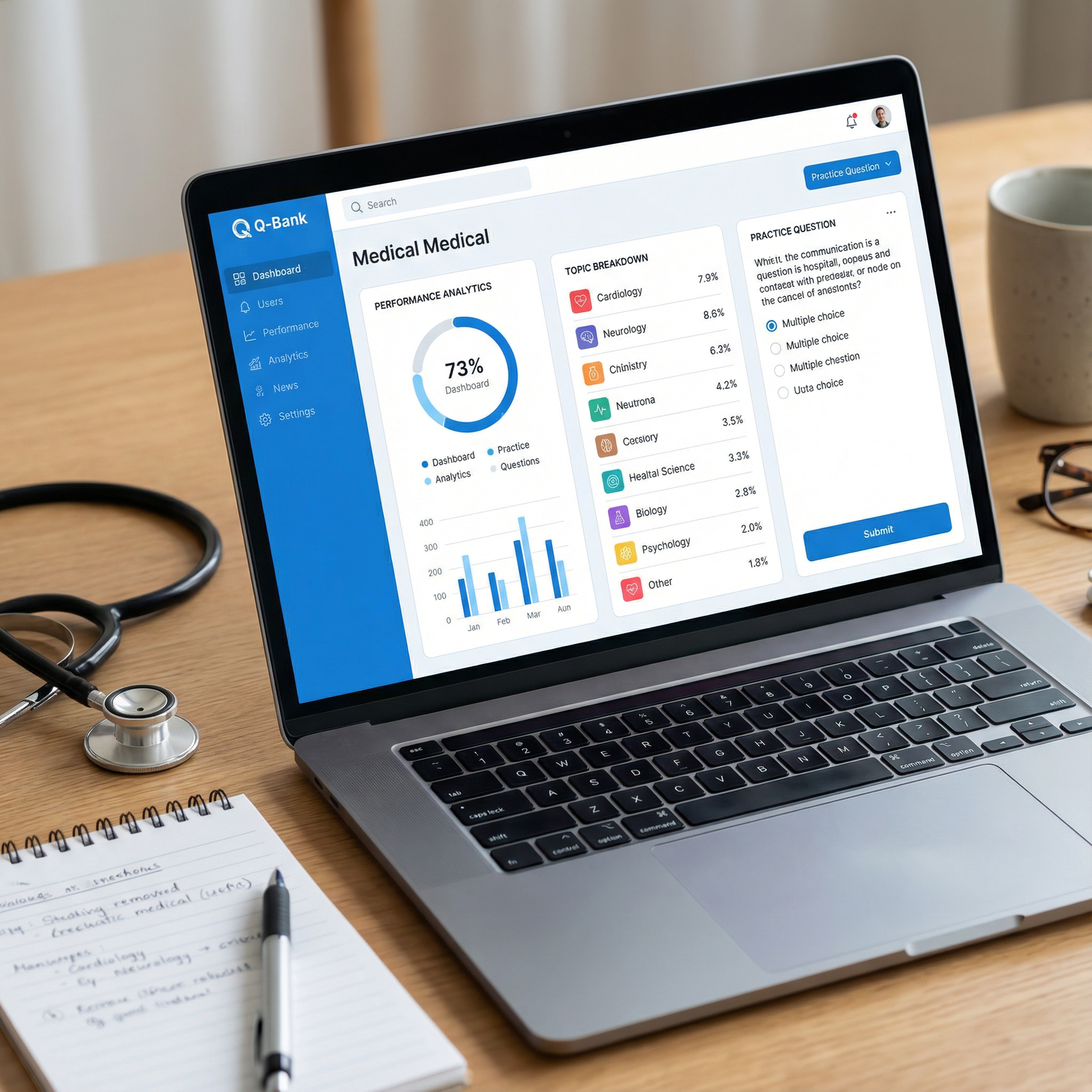
Dashboards allow you to monitor:- Overall percentage correct
- Strengths and weaknesses by topic
- Timing per question
- Progress over time or compared with peers
Customizable test modes
You can typically choose:- Timed vs tutor mode
- Random vs subject-specific blocks
- Difficulty level (if offered)
- Exam-length simulations (e.g., full-length practice exams)
Why Q-Banks Are Different from Textbooks
Textbooks and lectures give you information. Q-banks force you to use that information under exam-like conditions. This is a very different cognitive process and is much closer to what you’ll experience on test day and in clinical practice.
In other words, textbooks are the “what,” Q-banks are the “how” and “when to apply it.”
Why Q-Banks Are Essential for Effective Medical Exam Prep
Q-banks have become a central pillar of modern board prep because they align with well-studied learning principles and directly mirror exam experience.
1. Test Familiarization: Reducing Exam-Day Surprises
Board exams have a specific style: long clinical vignettes, distractors that sound plausible, time pressure, and multi-step reasoning. Medical Exam Prep that ignores this reality is incomplete.
A good Q-bank helps you:
- Get used to the length and complexity of stems
- Learn how to parse relevant vs irrelevant clinical details
- Develop pacing—knowing when to move on from a difficult question
- Recognize “classic” presentations of high-yield diseases
When exam day arrives, you want the interface, timing, and question style to feel familiar, not foreign.
2. Active Recall and Retrieval Practice
Decades of educational research show that Active Learning strategies—especially active recall and retrieval practice—are far more effective than passive review.
Q-banks excel at this by:
- Forcing you to pull information from memory, not just reread it
- Highlighting what you actually don’t know (not what you think you know)
- Reinforcing long-term retention when questions are revisited over time
Pairing Q-banks with spaced repetition tools (e.g., Anki) is an especially powerful combination for long-term knowledge retention.
3. Focused Study and Targeted Remediation
Good Q-banks allow you to drill down on:
- Specific organ systems (e.g., cardiology if your weakest NBME area)
- Disciplines (e.g., microbiology, biostatistics, pharmacology)
- Competency domains (e.g., ethics, professionalism, patient safety)
Instead of reading entire chapters again, you can:
- Do a block of targeted questions
- Review explanations
- Identify exactly which subtopic is causing difficulty
- Direct your reading or videos to that specific gap
4. Benchmarking and Performance Tracking Over Time
One of the most underrated benefits of Q-banks is Performance Tracking:
- You can see if you’re trending upward over weeks/months
- You can monitor your performance against peers using the same platform
- You can connect Q-bank percentages with NBME/UWorld self-assessment scores to estimate exam readiness (with caution)
This data informs key decisions:
- When to schedule your exam
- Whether you need more content review vs more question practice
- Which subjects require extra attention in the final weeks
Key Factors to Consider in Q-Bank Selection
Choosing the right Q-bank isn’t about brand loyalty; it’s about fit. Below are the most important criteria to use when comparing options for your Medical Exam Prep.
1. Content Quality, Accuracy, and Relevance
This is non-negotiable. Access to sleek features means little if the content itself is mediocre.
Look for:
Expert authorship and editorial oversight
Are questions written and reviewed by board-certified physicians or experienced medical educators? Is there a clear editorial process?Regular updates and alignment with current exams
Exams evolve—pass/fail shifts, new guidelines, and changing emphasis (e.g., more management and communication skills for clinical exams). You want a Q-bank that:- Updates questions regularly
- Retires outdated or low-yield content
- Adjusts explanations to reflect current guidelines and best practices
Curriculum and exam fit
Ensure the Q-bank matches:- Your specific exam (USMLE vs COMLEX vs MCCQE vs international equivalents)
- Your current phase (pre-clinical vs clinical, Step 1 vs Step 2 CK, etc.)
Actionable tip:
Before purchasing, explore sample questions or a free trial. Ask:
- Do the stems feel like NBME/COMLEX style?
- Are explanations clear, concise, and clinically oriented?
- Are there too many trivial “factoid” questions or mostly concept-based scenarios?
2. Question Diversity and Depth
A strong Q-bank reflects the breadth and nuance of the exam:
Case-based clinical vignettes
Especially crucial for Step 2/3 and COMLEX Level 2/3. You want multi-step reasoning:- Diagnosis → next best step → management → complications
Conceptual and mechanism-based questions
For earlier exams like Step 1 or Level 1, questions should test:- Pathophysiology
- Drug mechanisms and side effects
- Interpretation of labs and imaging
Varied formats (where applicable)
While most board exams are still MCQ-focused, many Q-banks now include:- Multimedia (images, heart sounds, radiology)
- Tables or charts to interpret
- Short-answer or “select all that apply” for non-USMLE exams
Red flags:
- Questions feel “tricksy” rather than educational
- Explanations simply restate the question without teaching
- Excessive emphasis on outdated minutiae rather than high-yield concepts
3. User Interface, Experience, and Accessibility
You will spend hundreds of hours inside your Q-bank; friction adds up.
Consider:
Interface design
- Is the layout clean and uncluttered?
- Are fonts, highlighting, and navigation easy on the eyes for long sessions?
- Can you easily flag questions, add notes, or review incorrects?
Mobile compatibility and offline access
A quality mobile app lets you:- Do questions between cases on clerkship
- Study on commutes or during small windows of downtime
- Sometimes download questions for offline use
Customizability
Can you:- Build custom blocks by subject/system/difficulty?
- Switch between timed mode and tutor mode easily?
- Filter only “unseen,” “incorrect,” or “marked” questions?
4. Performance Tracking and Analytics
Effective Performance Tracking is central to strategic board prep.
Look for:
High-level dashboards showing:
- Overall percent correct
- Progress over time
- Time per question
Granular analytics breaking down:
- Performance by organ system
- Performance by discipline (pharm, path, biostatistics, etc.)
- Comparison to peers (percentiles)
Integration with study planning
Some platforms allow you to:- Auto-generate weak-area question blocks
- Receive recommendations based on your performance
- Align with your test date to suggest how many questions/day you need
Actionable strategy:
Use your Q-bank analytics weekly to adapt your plan:
- Underperforming in cardio and renal? Shift 2–3 days that week to targeted blocks + supplemental review of those systems.
- Over time, your study plan becomes data-driven, not guess-based.
5. Cost, Subscription Models, and Value for Money
Q-banks are a significant financial investment; value matters more than absolute price.
Compare:
Length of access
Options may include:- 30-day “crunch time” passes
- 3–6 month standard subscriptions
- 12+ month comprehensive access
Bundle offerings
Some platforms include:- Self-assessments
- Video libraries
- Flashcards or question-linked notes
- “Step 1 + Step 2” or “Level 1 + Level 2” bundles at a discount
Trial periods and refund policies
- Free trials are invaluable for testing interface and content quality
- Check small print on refunds or extensions, especially around exam delays
Actionable tip:
Before buying:
- Make a realistic timeline for your study period.
- Estimate how many questions/day you can complete.
- Choose a subscription length that fits that pacing with some buffer.
6. Community, Support, and Educational Ecosystem
A Q-bank doesn’t exist in isolation; it’s part of a broader study ecosystem.
Look for:
Community and discussion forums
- Some platforms (or their associated social media groups) host peer discussions and explanations.
- Just be cautious to avoid misinformation—prioritize official explanations.
Faculty or expert support
- Webinars, live sessions, or “ask an expert” options can clarify difficult concepts.
- Some Q-banks are integrated with coaching/tutoring services.
Integration with other study tools
- Is there linkage to a medical library (e.g., AMBOSS)?
- Can you export concepts to flashcards (e.g., Anki decks, in-platform cards)?
- Are there references to standard texts for deeper reading?
Leading Q-Banks on the Market: Strengths, Use Cases, and Considerations
While availability and popularity can vary by country and exam, below are several widely known platforms and what they are generally known for. Always verify current features and pricing, as these change frequently.
1. UWorld
Best known for: Gold-standard USMLE-style questions and explanations.
- Content quality
- Highly exam-representative questions with detailed, pedagogy-focused explanations.
- Emphasis on clinical reasoning and integration of basic and clinical sciences.
- User experience
- Clean, exam-like interface.
- Robust highlighting, note-taking, and question-flagging tools.
- Performance Tracking
- Strong analytics, including performance by subject/system and global percentile comparisons.
- Ideal for:
- Dedicated exam prep phases (e.g., final months before Step 1/2, COMLEX Level 1/2).
- Students who want their primary Q-bank to mimic the exam very closely.
2. AMBOSS
Best known for: Integrated medical library + Q-bank ecosystem.
- Content ecosystem
- Q-bank is directly linked to a comprehensive, searchable medical library.
- One-click access to concise, high-yield explanations, tables, and images.
- Interactive features
- “Attending tips,” highlighting of key phrases, and context explanations.
- Nice for just-in-time learning during clerkships and ward questions.
- Smart study tools
- Adaptive Q-Bank Selection based on performance and topic weaknesses.
- Stepwise difficulty adjustment and study recommendations.
- Ideal for:
- Ongoing learning throughout pre-clinicals and clerkships.
- Students who like to read concise references and answer questions in one place.
3. Kaplan (Qbank / Kaplan Medical)
Best known for: Extensive question volume and multi-format educational resources.
- Question variety and volume
- Large library with detailed explanations and frequently included videos.
- Strong emphasis on foundational science concepts and exam strategies.
- Focused learning tools
- Structured dashboards and integrated study plans.
- Additional resources
- Live and on-demand courses, textbooks, and video lecture series.
- Ideal for:
- Students who prefer structured courses plus Q-bank.
- Those wanting extra content review alongside question practice.
4. Osmosis
Best known for: Visual and integrated multimedia learning.
- Integrated learning
- Q-banks combined with animated videos, flashcards, and memory tools.
- Visual learning tools
- Particularly useful for visual learners who benefit from diagrams and animations.
- Retention-focused resources
- Emphasis on spaced repetition and concept reinforcement.
- Ideal for:
- Early-phase students building conceptual foundations.
- Those who learn best with visual aids and integrated explanations.
Note: There are many other Q-banks (e.g., BoardVitals, Rosh Review, question banks specific to international exams). Always look for reviews from recent test-takers in your exam region.

How to Integrate a Q-Bank Into Your Study Plan
Even the best Q-bank will underperform if used haphazardly. Success comes from embedding it into a thoughtful strategy.
1. Early vs Dedicated Phase Use
Pre-clinical / early clinical years:
- Use a Q-bank with strong teaching explanations (e.g., AMBOSS, Osmosis, Kaplan) alongside your classes.
- Do small blocks (10–20 questions) after learning each topic.
- Focus on tutor mode to maximize learning, not speed.
Dedicated exam prep period:
- Shift toward your primary exam-style Q-bank (e.g., UWorld, AMBOSS).
- Aim for 40–80 questions/day, depending on your schedule and stamina.
- Use a mix of timed (to practice pacing) and tutor (to deepen understanding).
2. Active Review of Explanations
Don’t just check the correct answer and move on. For each question:
- Read the full explanation, including why each distractor is wrong.
- Jot down 1–2 key takeaways (e.g., in a notebook, digital notes, or flashcards).
- For particularly tricky or frequently tested concepts, create:
- An Anki card
- A one-page “high-yield” summary
- A quick sketch or flowchart
This transforms Q-banks from assessment tools into powerful teaching tools.
3. Using Performance Tracking to Guide Study
Once you’ve done several hundred questions, patterns will emerge in your analytics:
- Consistently low performance in one organ system → schedule a focused week on that system (videos + reading + targeted question blocks).
- Time per question high but accuracy good → practice timed blocks to improve speed.
- Strong basic science but weak clinical management → spend more time on clinical vignettes and guidelines.
Re-check your analytics weekly and adjust your plan. This is how you convert Performance Tracking into targeted action.
4. Avoiding Common Q-Bank Mistakes
Doing questions passively
Skimming stems, guessing, then clicking through explanations without truly engaging.Saving “the good Q-bank” for the end
This common myth leads to wasted potential. High-quality questions teach the most; use them strategically throughout your prep, not only in the last weeks.Over-focusing on percentage correct
Early scores are often low. Focus on:- Trends over time
- Weakest areas
- Whether you are understanding underlying concepts better
Not resetting or spaced reviewing incorrects
Revisit “incorrect” and “marked” questions periodically. Learning from your mistakes is one of the highest-yield components of Q-bank use.
FAQs: Choosing and Using the Right Q-Bank
1. How many Q-banks do I actually need?
Most students do best with one primary Q-bank that they complete thoroughly, plus optionally one secondary Q-bank for extra questions or a different style.
If time and budget are limited, prioritizing deep engagement with a single high-quality Q-bank is usually more effective than shallow use of multiple platforms.
2. When should I start using a Q-bank in medical school?
You can start early:
- Pre-clinical: 5–10 questions after each major topic helps reinforce concepts and get used to board-style thinking.
- Clerkships: Use clerkship- or shelf-specific blocks to prepare for rotations and NBME shelves.
- Dedicated study: Transition to more intensive use (40–80 questions/day) during your final 6–12 weeks before the exam.
Starting early builds comfort and reduces the learning curve during your high-pressure dedicated period.
3. Are Q-banks enough on their own to pass board exams?
Q-banks are essential but usually not sufficient alone, especially for content-heavy exams like Step 1 or COMLEX Level 1. You typically need:
- A primary content resource (e.g., Pathoma, First Aid, Boards & Beyond, AMBOSS library)
- A Q-bank for application and reinforcement
- Optional: flashcards/spaced repetition for memorization
Think of Q-banks as the backbone of your Medical Exam Prep, supported by textbooks, lectures, and summary resources.
4. Should I do questions in tutor mode or timed mode?
Both have a role:
- Tutor mode
Best for learning phases and early prep:- Immediately see explanations
- Take notes while concepts are fresh
- Timed mode
Essential in the weeks before your exam:- Mimics actual test conditions
- Builds pacing and endurance
A common approach:
- Early: 70–80% tutor mode, 20–30% timed
- Final 3–4 weeks: flip this ratio to prioritize timed, exam-length blocks
5. What if I find a Q-bank confusing or not aligned with my needs?
If a Q-bank feels confusing, non-intuitive, or poorly aligned with your exam style:
- Explore its help center, tutorials, or guided tours—many platforms offer onboarding resources.
- Give it at least a few sessions to adapt—every interface has a learning curve.
- If it still feels like a poor fit and you’re early in your subscription:
- Check refund or exchange policies.
- Consider switching to a platform that better matches your exam and learning style.
Your time and mental energy are valuable. A Q-bank should support, not hinder, your workflow.
Selecting the right Q-bank is one of the most impactful decisions you’ll make in your exam preparation. By focusing on content quality, question diversity, user experience, Performance Tracking, and overall value, you can choose a platform that genuinely supports your learning and boosts your confidence on exam day.
Use your Q-bank not just as a test, but as a teacher—and integrate it thoughtfully into a structured, data-informed study plan.