
Don’t Overlook These 7 Crucial Study Materials for Exam Day Excellence
Preparing for major exams in medical school or allied health programs is one of the most demanding parts of your training. Between dense content, long exam days, and high stakes, it’s easy to feel overwhelmed—and even easier to waste time on low‑yield resources.
A smart exam preparation plan is not about using every resource; it’s about using the right study materials in the right way. The seven categories below form a high‑yield core toolkit that supports knowledge acquisition, retention, and test success. Whether you’re studying for the USMLE, COMLEX, shelf exams, or other board and in‑training exams, these resources will help you prepare systematically and efficiently.
1. Comprehensive Review Books: Your High‑Yield Foundation
Comprehensive review books are the backbone of exam preparation in medical education. They condense huge amounts of material into structured, exam‑focused summaries, helping you see the “big picture” while still covering crucial details.
Why Comprehensive Review Books Matter
A well‑chosen review book helps you:
Organize your studying
It gives you a roadmap of what is considered “testable” and what can be safely deprioritized.See connections between systems
Good review books integrate physiology, pathology, and pharmacology rather than treating them as isolated subjects.Build a rapid‑review resource
In the final weeks before your exam, having a single book to flip through is far more efficient than reviewing full textbooks or scattered notes.
Key Features to Look For
When choosing review books for exam preparation, prioritize:
Concise, high‑yield summaries
Bullet points, tables, and key concept callouts that highlight what’s most likely to be tested.Integrated mnemonics and memory aids
Especially for pharm, micro, and biochemistry where recall-heavy content can be difficult.Strong visual aids
Flowcharts for pathways, tables comparing similar diseases, radiology images, and pathology photos that mirror real exam visuals.
Popular Review Book Examples
For USMLE Step 1:
“First Aid for the USMLE Step 1” is a gold‑standard starting point. Many students use it as a central “hub” and annotate it with notes from lectures, question banks, and pathology texts.For system‑based or shelf exams:
Titles like “Step‑Up to Medicine,” “BRS Physiology,” “Rapid Review Pathology,” or specialty‑specific review books (e.g., pediatrics, surgery) can be used in conjunction with your core resource.
Action Step: Choose one primary review book per major exam (or two at most). Commit to completing it at least twice before test day—once early for exposure, and once closer to the exam as a high‑yield review.
2. High‑Yield Question Banks: Turn Knowledge into Test Success
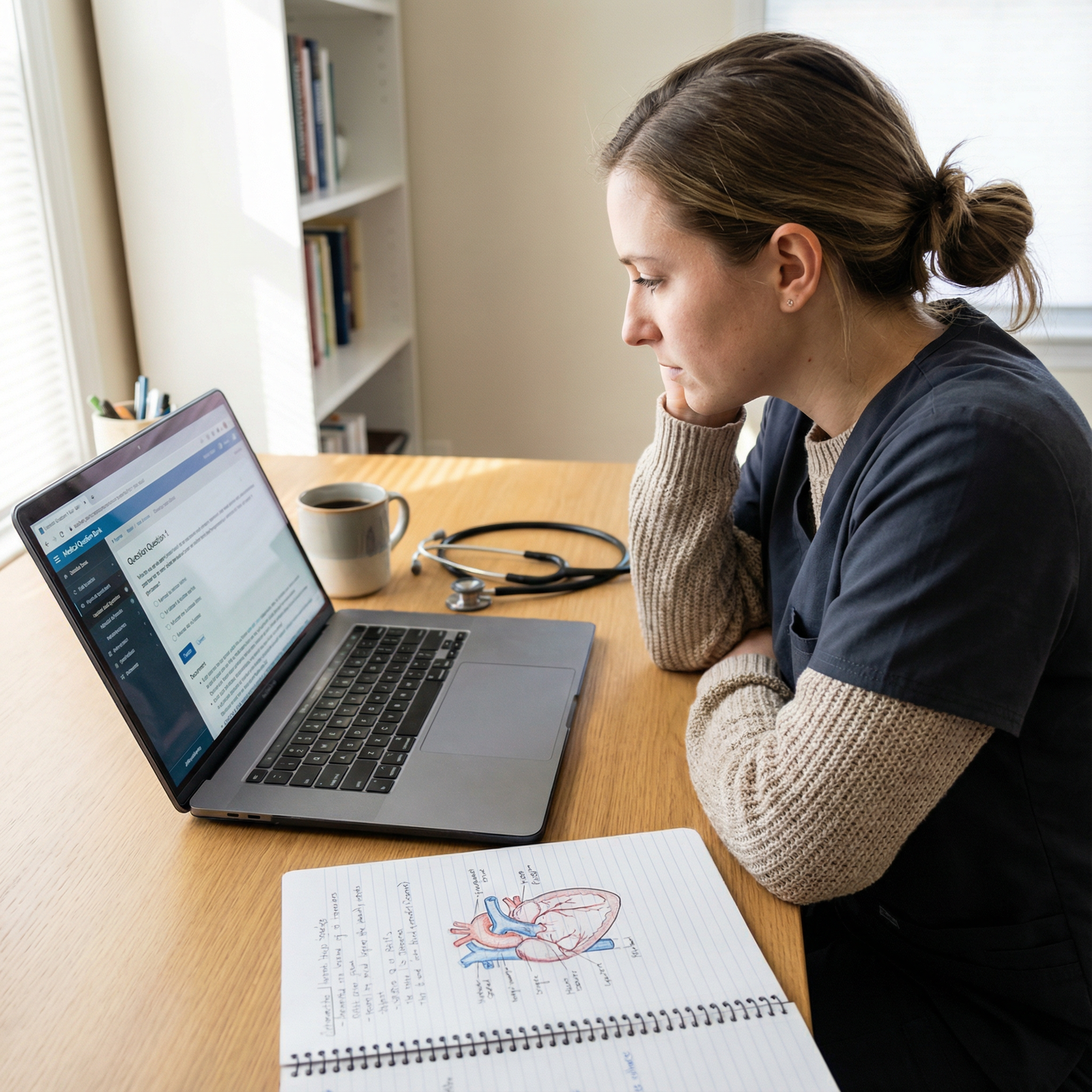
Question banks (Qbanks) are arguably the most critical resource in your exam preparation toolkit. They don’t just test your knowledge—they train the way you think on exams, from pattern recognition to clinical reasoning.
How Question Banks Support Learning
Active recall under exam‑like pressure
Retrieving answers from memory in a timed, multiple‑choice format mirrors real test conditions and strengthens retention.Application over memorization
Vignette‑style questions force you to interpret data, recognize key findings, and synthesize information for diagnosis and management.Continuous feedback and performance tracking
Detailed explanations and performance analytics help you pinpoint weaknesses early and adjust your study plan.
Choosing the Right Qbanks
Commonly used medical question banks include:
- UWorld – Known for challenging questions and high‑quality explanations. Its interface and style closely simulate many major board exams.
- AMBOSS – Integrates a Qbank with an extensive medical library, quick fact panels, and helpful overlays like “Attending Tips.”
- Kaplan, BoardVitals, and others – Often used as supplementary banks for additional question exposure.
Most students find it effective to:
- Choose one primary Qbank and aim to complete 100% of questions.
- Use a second, smaller bank only if time and energy allow, typically later in the study period.
Best Practices for Using Question Banks
- Start early – Don’t wait until you “finish content.” Begin mixed or system‑based question sets early to keep your studying clinically focused.
- Do timed blocks – At least some of your sets should mimic real test timing (e.g., 40 questions in 1 hour) to build pacing and stamina.
- Review explanations thoroughly – Learn why each answer choice is right or wrong. Capture key points in a notebook, anki deck, or margin notes in your review book.
- Track your data – Note recurring weak topics (e.g., renal physiology, acid‑base, EKGs) and schedule targeted review sessions.
Action Step: Aim for a realistic daily question goal (e.g., 40–80 questions per day during dedicated prep) and schedule dedicated time to review every block.
3. Flashcards and Spaced Repetition: Locking in Long‑Term Memory
Some exam content—especially pharmacology, microbiology, biostatistics formulas, and diagnostic criteria—requires rapid recall of specific facts. Flashcards, particularly when paired with spaced repetition algorithms, remain one of the most effective tools for this.
Why Flashcards Work So Well
Spaced repetition
By revisiting information at scientifically determined intervals, you reinforce fading memories right before you would naturally forget them.Active recall
Forcing yourself to retrieve the answer (rather than just re‑reading notes) significantly strengthens memory.Customizability
You can design cards for what you find difficult—lab value ranges, side effect profiles, diagnostic criteria, etc.
Digital vs. Physical Flashcards
Digital flashcards (e.g., Anki, Quizlet):
- Automatically implement spaced repetition
- Sync across devices
- Often shareable or pre‑made (e.g., popular Anki decks for USMLE/COMLEX)
Physical flashcards:
- Helpful for kinesthetic learners
- Can be used for quick in‑person drills with study partners
- Good for diagram drawing or image‑based recall
Many students combine both: digital cards for large decks; paper cards or whiteboards for visual pathways.
High‑Yield Flashcard Strategies
- Keep cards simple and focused – One fact or concept per card. Avoid essay‑style cards.
- Use images and mnemonics – For example, add an EKG strip to arrhythmia cards, or a pathology slide for characteristic findings.
- Tag by topic – Organize decks by system (cardio, GI, neuro) or exam (Step 1, shelf, OSCE).
- Build from your mistakes – Turn missed Qbank questions and practice exam errors into new flashcards the same day.
Action Step: Dedicate 20–40 minutes per day exclusively to flashcard review. Protect this time—it pays off hugely in long‑term retention.
4. Practice Exams and Mock Tests: Simulate Exam Day Before It Counts
You cannot truly be ready for a major exam until you’ve practiced under realistic conditions. Full‑length practice exams and mock tests are essential for refining time management, test‑taking strategy, and mental endurance.
Benefits of Full‑Length Practice Exams
Pacing and time management
Learn how long you can spend per question and still complete a block comfortably.Endurance training
Board exams are marathons. Simulating a full test day reduces the shock of sustained focus and decision‑making.Score benchmarking
Practice test scores help you assess your readiness, adjust your timeline, and identify content areas that need urgent attention.
Where to Find High‑Quality Practice Exams
NBME (National Board of Medical Examiners):
Offers official practice exams for USMLE steps and some subject exams. These are often the closest approximation in style and difficulty.COMSAE / COMAT exams:
For osteopathic students, these mirror COMLEX and COMAT format and content.Within Qbanks (e.g., UWorld Self‑Assessments):
Many question banks include self‑assessment exams that provide scaled scores and predictive data.
How to Use Practice Exams Strategically
Take them at realistic intervals
For a major board exam, many students take a practice exam every 2–3 weeks during dedicated studying, increasing frequency as test day nears.Simulate the real environment
- Start at the same time your real exam will begin
- Follow scheduled breaks
- Use only permitted items (earplugs, snacks, water)
Analyze results methodically
- Review every missed and guessed question
- Categorize errors (knowledge gap vs. misreading vs. rushing)
- Update your study plan to target repeated weak topics
Action Step: Put your practice exam dates on your calendar before you start dedicated studying. Treat these exam days as non‑negotiable appointments with your future self.
5. Clinical Cases and Vignettes: Bridging Textbook Knowledge to Real Patients
Modern medical exams heavily emphasize clinical reasoning. It’s not enough to memorize facts; you must apply them to realistic patient scenarios. Clinical cases and vignettes train you to think like a clinician under exam conditions.
Why Clinical Vignettes Are Essential
Integrate multiple disciplines
A single case can test anatomy, pathophysiology, pharmacology, ethics, and biostats in one scenario.Develop diagnostic reasoning
Vignettes teach you to prioritize differential diagnoses based on key clues in the history, exam, and lab data.Mirror clinical practice
This style of learning makes your studying more meaningful and prepares you not just for exams, but for clerkships and residency.
Useful Case‑Based Resources
- Case Files series (e.g., Case Files Internal Medicine, Surgery, Pediatrics) – Brief, high‑yield clinical cases with questions and explanations.
- Blueprints and NMS series – Often include case‑based questions and clinical reasoning discussions.
- Specialty‑specific case books – For OSCEs, oral boards, or clerkship exams.
How to Study with Clinical Cases
Actively work through cases
Before reading the explanation, pause to write down: likely diagnosis, next best step in management, and any key findings that clinched your decision.Use them alongside Qbanks
When a Qbank highlights a weak topic (e.g., heart failure), review a few relevant cases from your case book to deepen understanding.Practice articulating your reasoning
Say your thought process out loud or explain it to a study partner—as you would to an attending on rounds.
Action Step: Add a short “case block” to your daily study plan (e.g., 2–4 cases per day), especially during clerkships and before subject exams.
6. Study Groups and Peer Resources: Learn Faster by Teaching and Discussing
Well‑run study groups can dramatically accelerate your learning, clarify confusing concepts, and keep you accountable. Poorly run groups, on the other hand, can become social hour disguised as studying. The difference is structure.
Benefits of Collaborative Exam Preparation
Active teaching
Explaining a topic to others is one of the most powerful learning tools—if you can teach it clearly, you truly understand it.Exposure to different perspectives
Peers may have mnemonics, diagrams, or intuitive explanations that resonate better than your usual resources.Accountability and motivation
Scheduled group sessions make it harder to procrastinate or silently fall behind.
How to Structure Effective Study Groups
- Keep them small – 3–5 students is usually optimal.
- Set a clear agenda – E.g., “Today: cardiology murmurs, arrhythmias, and heart failure Qbank review.”
- Time‑box activities – 20–30 minutes per topic, followed by a short recap.
- Assign roles – Rotate who leads the session, who keeps time, and who summarizes high‑yield points.
- Limit distractions – No social media, side conversations, or unrelated tasks during group time.
Additional Peer and Institutional Resources
- Upper‑class mentors or residents – Ask which resources and strategies worked best for them for the same exam you’re preparing for.
- School‑provided materials – Some institutions offer curated Qbanks, faculty review sessions, or official study guides.
- Online communities – Forums and social platforms can offer support and tips, but be mindful of misinformation and avoid endless “resource shopping.”
Action Step: If you choose to have a study group, define shared goals together (e.g., “Finish X Qbank by Y date”) and review progress at each meeting.
7. Digital Study Aids and Apps: Optimize Your Time, Health, and Focus
Beyond content‑heavy resources, digital tools can transform how you study—helping you manage time, track habits, and protect your well‑being. Effective exam preparation isn’t just about grinding longer; it’s about studying smarter.
Types of Digital Study Tools to Consider
Productivity and planning apps
- Notion, Evernote, or OneNote for organizing notes, schedules, and resources
- Google Calendar or Todoist for mapping study blocks and deadlines
Flashcard platforms
- Anki, Quizlet, Brainscape for spaced repetition and mobile review
Focus and habit‑tracking apps
- Forest, Focus To‑Do, or Pomodoro timers to structure focused study intervals
- Habit trackers to monitor daily goals (questions completed, flashcards reviewed)
Wellness and sleep apps
- Sleep Cycle, Calm, Headspace to support sleep hygiene and stress management, which are essential for memory consolidation and test performance.
Building a Digital Study Workflow
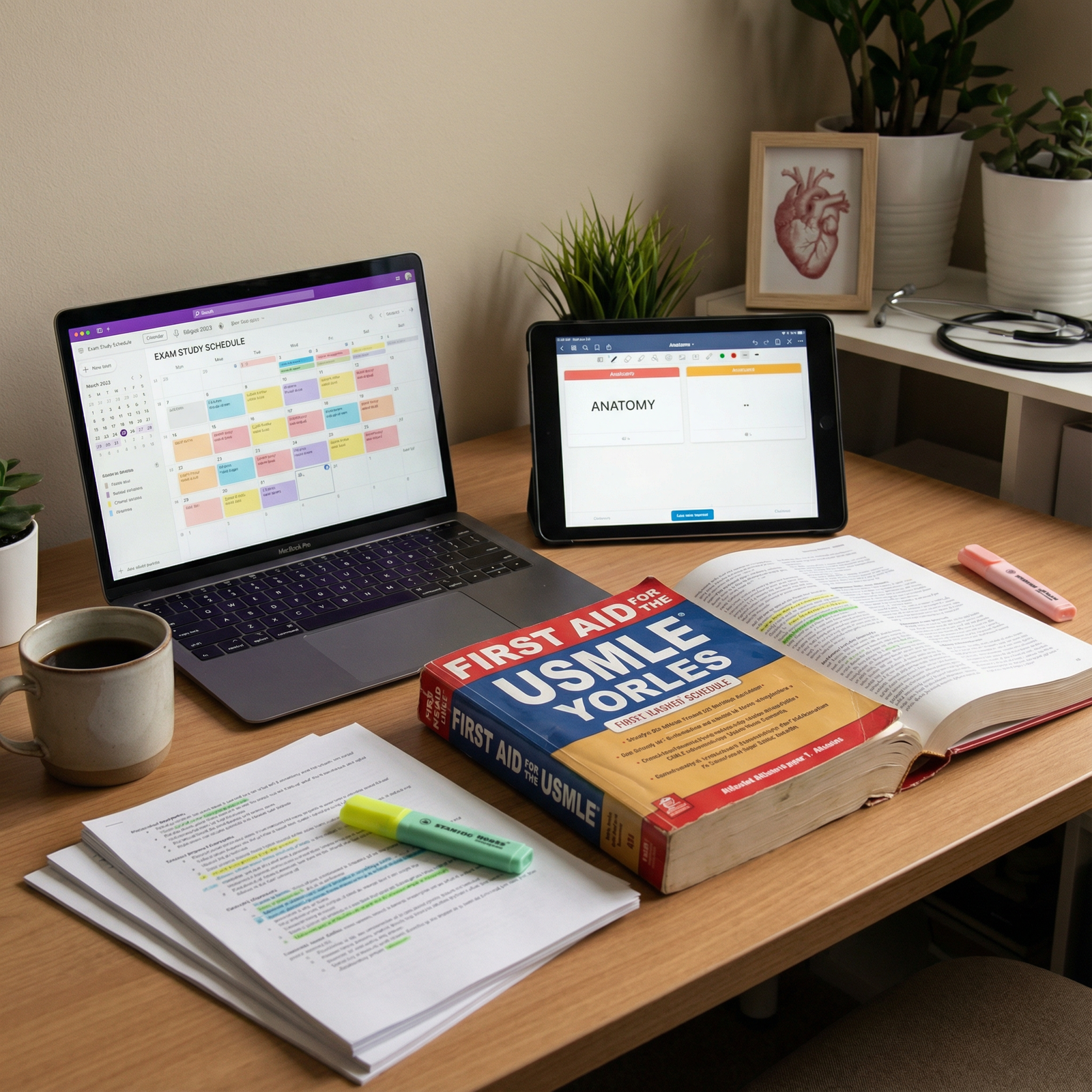
Create a master exam timeline
Include practice exam dates, content milestones, and days reserved for rest or light review.Time‑block your day
For example:- Morning: Qbank blocks (timed)
- Afternoon: Review explanations + related review book chapters
- Evening: Flashcards + short case practice
Use Pomodoro‑style intervals
Alternate 25–50 minutes of focused studying with 5–10 minute breaks to prevent burnout and maintain concentration.
Avoiding Digital Pitfalls
- Limit app overload – Too many tools can become a distraction instead of support. Start with just a calendar, one note‑taking app, and your flashcard platform.
- Control notifications – Disable nonessential alerts during study blocks to maintain deep focus.
- Use tech intentionally – If a tool doesn’t clearly improve your efficiency or understanding after a trial period, drop it.
Action Step: Design a simple, repeatable daily digital study routine and stick to it for at least 2 weeks before making major changes.
Putting It All Together: A Cohesive Exam Preparation Strategy
These seven categories of study materials—comprehensive review books, high‑yield question banks, flashcards, practice exams, clinical cases, study groups, and digital aids—work best when they’re integrated into a coherent plan rather than used in isolation.
Example Weekly Study Framework
Early Phase (content‑heavy):
- Review book: 2–3 chapters per day
- Qbank: 20–40 questions/day (untimed, tutor mode acceptable)
- Flashcards: 20–30 minutes/day
- Cases: 1–2 clinical vignettes/day
- Group: 1–2 structured sessions/week
Dedicated Phase (exam‑heavy):
- Qbank: 40–80 questions/day (timed blocks)
- Review book: Rapid review sections tied to missed questions
- Flashcards: 30–45 minutes/day
- Practice exams: Every 1–3 weeks
- Cases: 2–4 clinical vignettes/day (focused on weak systems)
- Group: Brief, high‑yield review and Q&A, if helpful
The exact numbers can be adjusted to your pace and schedule, but the principle is the same: combine multiple complementary study materials and study tips in a focused, intentional way aimed at test success.
FAQ: Exam Preparation and Study Materials in Medical Education
1. When should I start using question banks in my exam preparation?
Start earlier than you think. You don’t need to “finish all content” first. During pre‑dedicated time, you can do system‑based or subject‑specific blocks (e.g., only cardio questions when you’re in a cardio block). As you approach your exam, gradually transition to mixed, timed blocks to more closely mimic test conditions.
2. How many times should I go through my main review book?
Aim for at least two complete passes:
- Pass 1: Slower, building foundational understanding and annotating with notes from lectures and Qbanks.
- Pass 2: Faster, focused on consolidation and high‑yield details.
If time permits, a quick third skim in the final week (especially summary tables, algorithms, and mnemonics) can be very helpful.
3. What if I feel overwhelmed by too many study resources?
This is common. Simplify by:
- Choosing one primary review book
- Selecting one main Qbank
- Using one flashcard system (e.g., Anki)
Optional resources (extra cases, second Qbank, additional books) should be added only if you have time and they clearly meet a need, such as reinforcing a persistent weak area. Depth with a few high‑quality resources beats shallow exposure to many.
4. How often should I take full‑length practice exams?
For major exams like USMLE or COMLEX:
- During early dedicated: about every 2–3 weeks
- In the last month: potentially every 1–2 weeks, depending on your stamina and stress level
Avoid taking a full‑length exam in the last 48 hours before your real test. Use that time for light review, sleep optimization, and mental reset.
5. Are digital resources better than traditional books for medical exam prep?
Neither is inherently better; it depends on your learning style and environment:
- Digital strengths: portability, searchability, integrated spaced repetition, analytics, and multimedia.
- Physical strengths: reduced screen fatigue, easier annotation and big‑picture page view, fewer digital distractions.
Many students benefit from a hybrid approach: a physical or PDF review book as a central anchor, digital Qbank and flashcards, and a digital planner or calendar to coordinate it all.
By intentionally combining these seven crucial study materials and tailoring them to your own strengths, weaknesses, and schedule, you’ll build a powerful, efficient exam preparation strategy. That deliberate structure—rather than sheer hours alone—is what positions you for exam day excellence in medical education.