
It is June 10th after your M1 year. Finals are done. Your classmates are either vanishing to the beach, starting research, or pretending UWorld does not exist. You are sitting with a blank “summer plan” document wondering:
What should I actually read now that will actually help me crush Step later—without ruining my summer?
This is that plan. Month-by-month, then week-by-week, then down to “today, read this chapter.”
I will walk you through:
- M0 (spring, before summer starts): set up and triage
- M1→M2 summer: core reading list and how to pace it
- Short M2→Step study gap: what to skim, what to ignore
- How to adjust if you are ahead, behind, or burned out
You do not need to study like you are 6 weeks out from Step. That would be dumb and counterproductive. You do need to make smart, light-contact passes through the right books so that when dedicated hits, nothing feels brand new.
Big Picture Timeline: Where Each Summer Fits
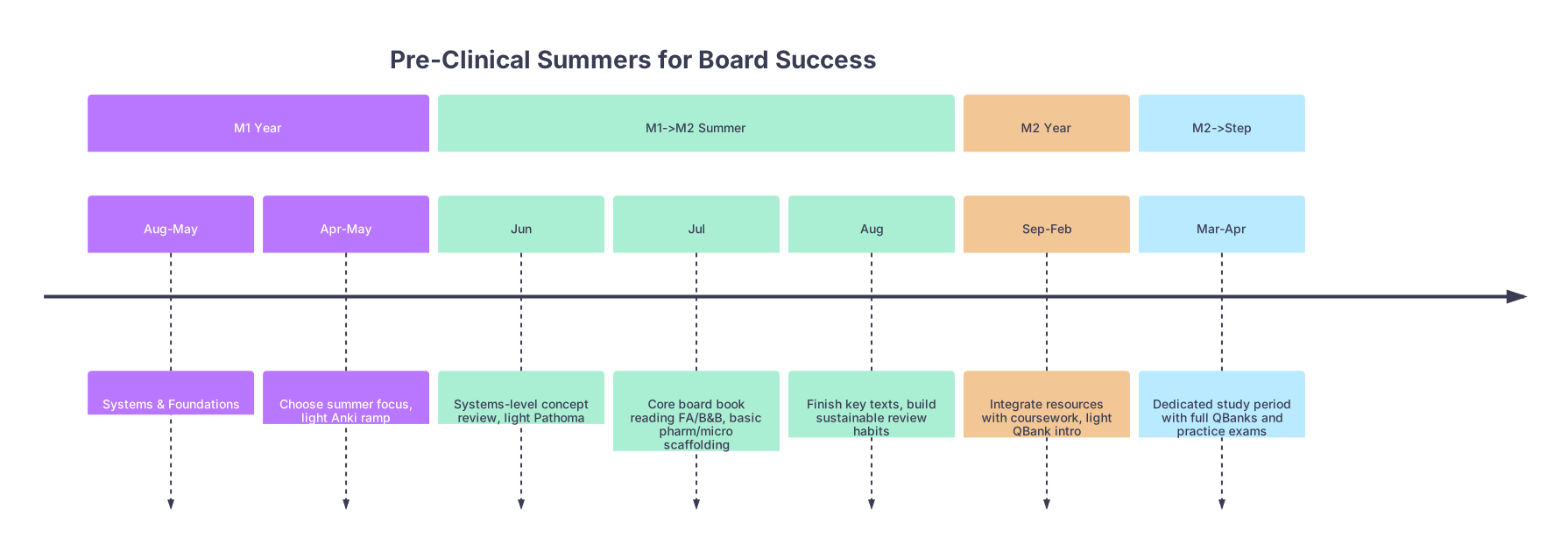
| Period | Event |
|---|---|
| M1 Year - Aug-May | Systems & Foundations |
| M1 Year - Apr-May | Choose summer focus, light Anki ramp |
| M1->M2 Summer - Jun | Systems-level concept review, light Pathoma |
| M1->M2 Summer - Jul | Core board book reading FA/B&B, basic pharm/micro scaffolding |
| M1->M2 Summer - Aug | Finish key texts, build sustainable review habits |
| M2 Year - Sep-Feb | Integrate resources with coursework, light QBank intro |
| M2->Step - Mar-Apr | Dedicated study period with full QBanks and practice exams |
Here is the principle:
- M1→M2 summer = Lay wiring. Concepts, frameworks, light exposure.
- M2 year = Tie these frameworks to your actual classes with more depth.
- Dedicated = Heavy question-based application on top of already-familiar patterns.
If you flip this and do nothing then try to brute-force everything in 6–8 weeks, you suffer. I see it every year.
Before Summer Starts (Late April–May M1): Set Up, Do Not Overdo
At this point you should be finishing spring exams and getting your clinical skills OSCE out of the way.
Your goals between now and June 1:
Decide your primary summer identity
- Research-heavy with light reading
- Clinical volunteer with moderate reading
- Pure rest with minimal “maintenance” reading
Lock in your core resources (no hopping all summer)
| Resource | Use For | Priority |
|---|---|---|
| First Aid (USMLE or COMLEX) | High-yield boards outline | Essential |
| Pathoma | Pathology framework | Essential |
| Sketchy (or similar) | Micro + Pharm memory | High |
| Boards & Beyond / equivalent | Systems explanations | High |
| Anki (premade deck like AnKing) | Long-term retention | High |
Do not start “reading everything” now. In these 2–3 weeks:
Weekly Micro-Plan (Pre-Summer)
Week 1 (late April):
- Skim First Aid’s front matter: exam overview, study strategies (30–45 minutes).
- Browse the pathology table of contents in Pathoma. Watch 1–2 intro videos:
- “Cell injury”
- “Inflammation”
- That is it. This is reconnaissance, not battle.
Week 2 (early May):
- Pick one system you already finished in M1 (e.g., cardio).
- Open First Aid to that system and spend:
- 1–2 evenings: Read cardio in FA side-by-side with your class notes.
- 1 evening: Watch the matching Pathoma cardio sections.
- Flag sections that felt completely foreign. You will loop back in summer.
Week 3 (mid–late May):
- Install a mature Anki deck (e.g., AnKing).
- Learn the addon basics (hierarchical tags, filtered decks).
- Do a test run:
- 50–100 new cards from one system you just reviewed.
- Daily reviews for 5–7 days to see what cadence feels tolerable.
- The point: set up tools before summer so time is not wasted later.
Then stop. Finish your exams, decompress for at least 1 full week. No “just one more chapter.”
M1→M2 Summer: Month-by-Month Structure
Now the real reading list.
I will lay this out assuming a 10-week summer (June–mid-August). If you have 6 or 12 weeks, I’ll show how to compress or stretch later.
Overall Summer Goals
By the end of this summer, you should:
- Have read all of Pathoma at least once.
- Have skimmed all systems in First Aid (lightly, not memorized).
- Have started a sustainable Anki habit (100–150 reviews/day feels routine).
- Have built basic familiarity with:
- Microbiology (at least high-yield organisms)
- Pharmacology (major drug classes and prototypes)
Month 1 (June): Path & Systems Skeleton
At this point you should focus on understanding what the exam is really about: pathology and pathophysiology.
Weekly Breakdown – June
Week 1 (Re-entry + General Principles)
- Pathoma
- Chapters 1–3 (general pathology: cell injury, inflammation, neoplasia).
- Target: 1 chapter every 2–3 days with the videos.
- First Aid
- Skim the “General Principles” sections:
- Biochemistry, immunology, general pharm intro.
- Do not try to memorize every enzyme. Read for flavor and structure.
- Skim the “General Principles” sections:
- Anki
- 50–100 new cards/day (only from material you just saw in Pathoma / FA).
- Pathoma
Week 2 (Heme + Cardio)
- Pathoma
- Chapters 4–5 (hemodynamics, RBC/WBC disorders).
- First Aid
- Hematology/Oncology chapter: read once over 2–3 days.
- Cardiovascular physiology + pathology sections.
- Optional video (Boards & Beyond / equivalent)
- 1–2 cardio physiology videos if that system felt weak during M1.
- Anki
- Total: ~80–120 reviews/day (keep it light but daily).
- Pathoma
Week 3 (Resp + GI)
- Pathoma
- Chapters 6–7 (cardio, resp, GI pathology; some of this you may save if not covered yet—fine).
- Watch only the systems your school already taught. Mark the rest “for fall.”
- First Aid
- Respiratory and GI chapters: 3–4 short reading sessions.
- Add Micro Starter
- Pick 5–10 high-yield bugs:
- Staph aureus, Strep pneumo, E. coli, Pseudomonas, TB, Influenza, HIV.
- Use Sketchy or similar for those images and add a few cards.
- Pick 5–10 high-yield bugs:
- Anki
- Keep new cards mostly pathology- and bug-focused.
- Pathoma
Week 4 (Renal + Endocrine + Catch-up)
- Pathoma
- Chapter 8–10 (if your school did those systems; if not, flag them for during M2).
- First Aid
- Renal and endocrine chapters.
- Cleanup
- Revisit any Pathoma chapters you rushed.
- Anki
- Stabilize review load. You should be around 100–150 reviews/day now.
- If reviews get >200/day and feel oppressive, stop adding for a week.
- Pathoma
By end of June you should have:
- Gone through Pathoma 1–10 at least once for covered systems.
- Lightly read corresponding sections in First Aid.
- Started micro exposure via a few representative organisms.
Month 2 (July): Pharmacology + Micro Foundations
Now that the “what goes wrong” pathology scaffold is there, you layer in how we treat and what causes it.
At this point you should:
- Commit to daily work, 5 days per week.
- Keep weekends flexible: 1 day off, 1 light review day.
Weekly Breakdown – July
Week 5 (Pharm Overview + Autonomics)
- First Aid Pharm
- Read the general principles section (pharmacokinetics/dynamics).
- Read autonomic pharmacology (sympathetic/parasympathetic drugs).
- Video resource (Boards & Beyond or similar)
- Watch 2–3 autonomic pharmacology videos.
- Sketchy Pharm (or similar)
- Hit 3–4 foundational sketches: beta-blockers, ACE inhibitors, diuretics.
- Anki
- Add 20–40 new pharm cards/day.
- Maintain pathology reviews but do not add more path for now.
- First Aid Pharm
Week 6 (Cardio/Renal Pharm + Bugs 101)
- First Aid Pharm
- Cardio drugs (antiarrhythmics, antihypertensives) and renal drugs (diuretics).
- Microbiology
- Read the first 10–12 pages of the micro section:
- Gram-positive vs gram-negative.
- Cocci vs bacilli.
- Basic staining and virulence concepts.
- Read the first 10–12 pages of the micro section:
- Sketchy Micro
- Gram-positive cocci and rods (e.g., Staph, Strep, Clostridium).
- Anki
- Start micro cards gently (10–20/day).
- First Aid Pharm
Week 7 (Antibiotics + High-Yield Bugs)
- First Aid Pharm
- Antibiotics overview: penicillins, cephalosporins, carbapenems, macrolides, fluoroquinolones.
- Micro
- Organize bugs by system:
- Respiratory: Strep pneumo, H. flu, Mycoplasma.
- GI: Salmonella, Shigella, Campylobacter, C. diff.
- Organize bugs by system:
- Sketchy
- At least 4–5 antibiotic scenes and the associated pathogens.
- Integration
- For every major bug you read:
- Bug → disease → treatment (antibiotic class) → key side effect.
- For every major bug you read:
- Anki
- Increase micro cards if your retention feels decent.
- First Aid Pharm
Week 8 (Virology + High-Yield Pharm Wrap)
- First Aid
- Virology overview (DNA vs RNA, enveloped vs non-enveloped).
- HIV and hepatitis sections.
- Remaining big-ticket drugs: chemo classes, endocrinology medications, insulin/oral hypoglycemics.
- Sketchy
- 3–4 viral sketches (HIV, influenza, hepatitis).
- Review
- Loop back to Pathoma Chapters 1–3. You will see how much more sticks now with pharm/micro context.
- Anki
- At this point, your daily reviews might hit 150–200. That is fine as long as it is sustainable.
- First Aid
You are not trying to finish every micro and pharm detail in July. You are giving your brain a scaffold so that during M2 these topics feel like old acquaintances instead of strangers.
Month 3 (Early August): Integration + Light Question Exposure
Now you consolidate. No need for 8-hour days.
At this point you should be:
- Done or nearly done with Pathoma once.
- Familiar with the layout of First Aid.
- Grounded in the basics of micro and pharm.
Weekly Breakdown – Early August
Week 9 (Systems Integration Review)
- Pick 3–4 systems you will hit early in M2 (e.g., cardio, pulm, renal).
- For each system spend 1 day with:
- Pathoma chapter (re-watch key videos at 2x).
- First Aid system chapter: read fully once.
- Brief look at the main drugs + bugs associated with that system.
- Optional: 5–10 UWorld or AMBOSS questions untimed per system just to see style. Do not obsess over percentages.
Week 10 (Wrap-Up + Plan for Fall)
- Make a resource map for M2:
- For each system: Pathoma chapters, FA pages, Boards & Beyond playlist, Sketchy scenes.
- Decide your Anki rules:
- Max new cards/day.
- What to do on busy exam weeks (e.g., no new, reviews only).
- Leave the last 3–4 days relatively open.
- Keep Anki reviews.
- Skim a few tricky Pathoma sections one last time.
- Then step away before M2 starts.
- Make a resource map for M2:
Short M2→Step Gap: What to Read, What to Ignore
Now you are M2, approaching dedicated. This is not a full summer, but students treat small gaps like mini-summers, so let us make them useful.
4–6 Weeks Before Dedicated
At this point you should:
- Have finished most of your systems coursework.
- Already be deep into question banks, not raw reading.
Reading priorities now:
First Aid – Targeted Second Pass
- Use your QBank performance to choose chapters.
- Example: if cardio questions are good but renal is weak:
- Re-read renal FA in 2 days.
- Rewatch 1–2 key Pathoma sections on glomerular diseases.
Pathoma – High-Yield Rewatch
- Focus on:
- Hematology, neoplasia.
- Renal, GI, endocrine.
- Skip lengthy normal physiology explanations unless they are clearly weak spots.
- Focus on:
Micro/Pharm – Tables Only
- No more first-pass Sketchy now.
- Repeatedly read FA tables:
- Antibiotics + bugs.
- Autonomic drugs.
- Cardio drugs (especially side effects and contraindications).
Light Qbank Every Day
- Reading at this stage without questions is a waste.
- 20–40 questions/day while still in classes is solid.
Different Scenarios: How to Adjust the Timeline
If You Are Burned Out After M1
Then the priority is sustainability, not heroics.
- Take 2 full weeks completely off after M1. Not negotiable.
- Cut the timelines above in half:
- Pathoma: 1 full pass of Chapters 1–6 only.
- First Aid: Skim only the systems you have already seen in class.
- Micro/Pharm: Reserve most of it for during M2.
A smaller, realistic plan executed is better than grand delusions you abandon in July.
If Your M1 Curriculum Was Weak
For example, mostly PBL with light lectures.
- You rely more on Pathoma + Boards & Beyond as your “real” coursework.
- Increase video time in June:
- For each Pathoma chapter, pair with 1–2 complementary B&B videos.
- Use First Aid almost like a syllabus:
- If a topic is in FA and you never saw it in school, assume you are responsible for it.
If You Are Already Scoring High on Practice
You still benefit from early passes.
- Spend more time on:
- Question banks earlier (e.g., USMLE-Rx or AMBOSS in late M1/M2).
- Conceptual understanding: physiology, mechanisms, integrations.
- Spend less time on:
- Blind memorization of FA tables during M1 summer.
Visual: How Your Study Time Should Shift Over the Pre-Clinical Years
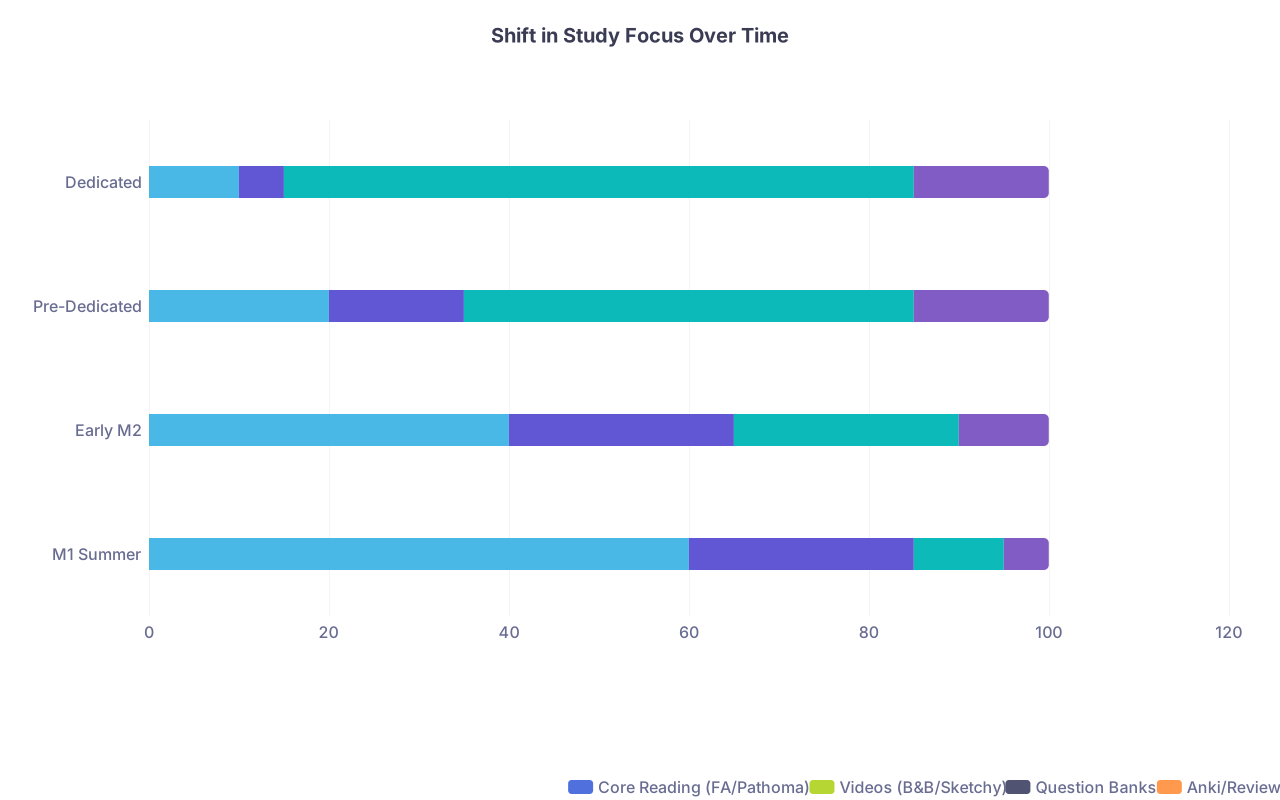
| Category | Core Reading (FA/Pathoma) | Videos (B&B/Sketchy) | Question Banks | Anki/Review |
|---|---|---|---|---|
| M1 Summer | 60 | 25 | 10 | 5 |
| Early M2 | 40 | 25 | 25 | 10 |
| Pre-Dedicated | 20 | 15 | 50 | 15 |
| Dedicated | 10 | 5 | 70 | 15 |
Daily Sample Schedules (Realistic, Not Monastic)
To make this concrete, here is a typical June weekday for a student also doing part-time research:

08:00–10:00 – Research / lab work
10:00–10:30 – Coffee + Pathoma video (1 short section)
10:30–11:15 – Read corresponding Pathoma pages + quick look at FA
11:15–11:45 – Anki reviews (path + a bit of pharm)
Afternoon – Life, exercise, friends, or more research
20:00–20:45 – Light FA reading (1 system section) or Sketchy
20:45–21:00 – Add a few new Anki cards from what you just saw
Total academic time: ~2.5–3 hours/day. That is enough to make a real dent over 8–10 weeks.
FAQ (Exactly 3 Questions)
1. Do I really need to start board resources in M1 summer, or can I wait until M2?
You can wait, but you will feel it. Students who meet Pathoma and First Aid for the first time in M2 are constantly behind. Using M1 summer for a low-stress, first-pass exposure turns M2 from “firehose” to “heavy drizzle.” You are not memorizing; you are building familiarity so nothing feels completely new later.
2. How much Anki is “enough” during pre-clinical summers without burning out?
For most people, 80–150 reviews/day with 20–40 new cards/day is the sweet spot. If your reviews spike above 200 consistently and you dread opening the app, you are doing too much. Summer Anki is for building a habit and laying down durable memories, not for maxing your heat map.
3. If I have only a 6-week summer, what should I cut from this reading list first?
Keep all of Pathoma (even if faster) and at least one full skim of First Aid systems you already covered. Then trim back micro and pharm depth: focus on the highest-yield bugs and drug classes only. You can always expand micro/pharm during M2. Protect the big frameworks first; details stick better when the scaffolding is already in place.
Key points to walk away with:
- Use M1→M2 summer for first-pass frameworks (Pathoma + FA) and light micro/pharm, not brute-force memorization.
- Keep a consistent, modest daily habit (2–3 hours) so that M2 and dedicated feel like step-ups, not complete resets.
- Commit early to a small set of resources and stick with them; constant switching wastes far more time than any single “imperfect” book ever will.