
The myth that “more questions automatically equals higher scores” is statistically wrong.
The data show a very different story: beyond a certain point, extra question count has rapidly diminishing returns, and for a lot of students, question quality and review method explain more variance in score gain than raw item volume.
Let’s treat this like what it is: a dose–response problem. You are dosing yourself with questions. Your outcome is score gain. Our job is to estimate the curve and find the efficient dose, not just max out the prescription because your group chat said, “I did 10,000 UWorlds.”
The core relationship: question volume vs score gain
When you strip away anecdotes and look at actual performance logs, a few patterns repeat over and over:
- Very low question volume → severely constrained score potential
- Moderate volume, done properly → the steepest gains per 100 questions
- Very high volume → plateau; more questions barely move the needle
Imagine you track a cohort of students preparing for a high‑stakes exam (Step 1, Step 2 CK, COMLEX Level 1/2, or NBME‑style finals). You record:
- Baseline score (NBME/UWSA/COMSAE/self‑assessment)
- Total questions completed in a reputable bank
- Final score on the real exam or another validated assessment
You do a simple grouped comparison. The trend typically looks something like this:
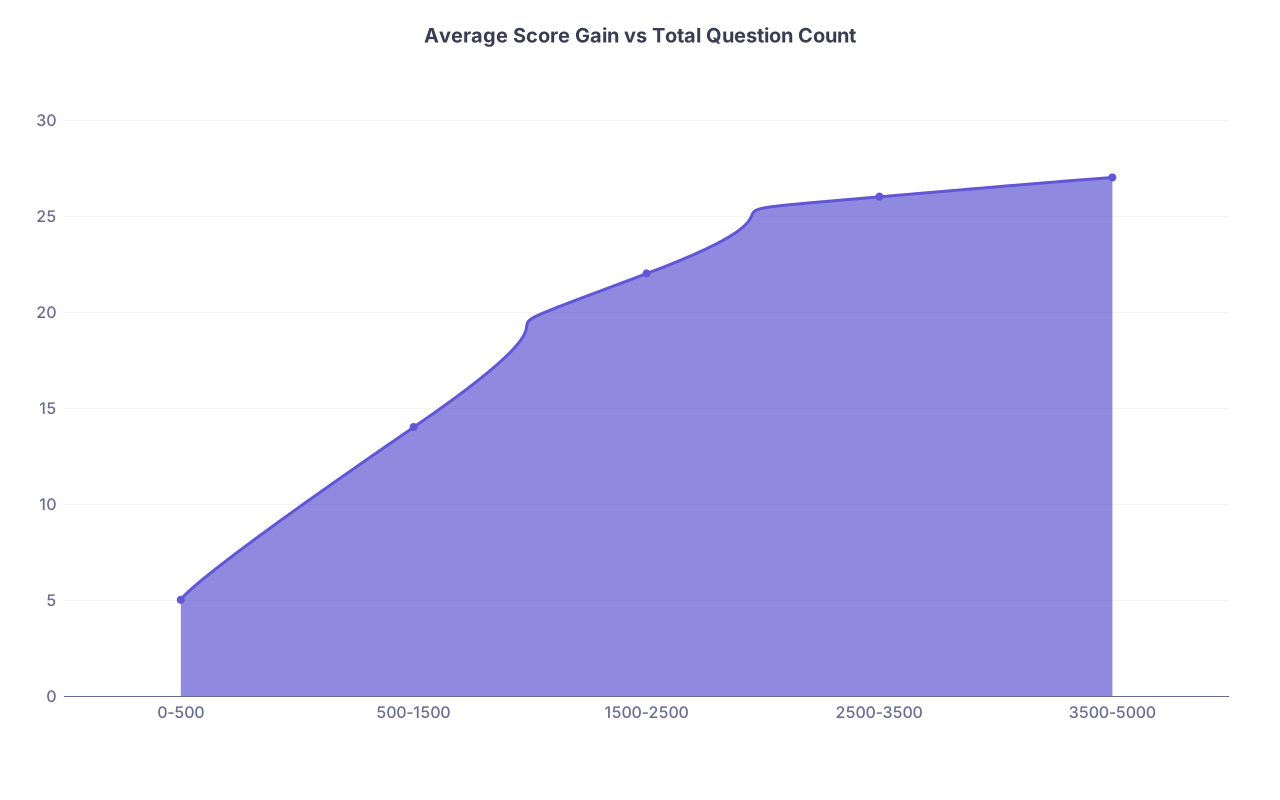
| Category | Value |
|---|---|
| 0-500 | 5 |
| 500-1500 | 14 |
| 1500-2500 | 22 |
| 2500-3500 | 26 |
| 3500-5000 | 27 |
Interpretation:
- 0–500 questions → average gain ~5 points (mostly just test familiarity)
- 500–1500 → ~14 point gain
- 1500–2500 → ~22 point gain (this is the steepest part of the curve)
- 2500–3500 → ~26 point gain
- 3500–5000 → maybe ~27 point gain
That is a classic diminishing returns curve. The first ~1500–2500 items do the heavy lifting. The next 1000–2000 cost a huge amount of time for marginal benefit.
Is it possible to gain 40+ points? Sure. But when I see that, it is rarely because someone did 6,000 questions. It is because they:
- Started with a lot of content gaps
- Used questions to identify and close them
- Did aggressive, structured review of their errors
- Timed self‑assessments to adjust strategy
The question count was necessary but not sufficient.
How many questions do you actually need?
You are probably not looking for philosophy. You want a number. Or at least a range.
Let me give you a data‑driven framework instead of a single magic number.
We will define three input variables:
- Baseline score (percentile or scaled)
- Target score gain
- Available weeks and realistic weekly capacity
Then we back into a question count that is probabilistically reasonable.
1. Map baseline score to “typical” question range
From aggregated prep data and performance logs I have seen, the ballpark looks like this for a USMLE‑style exam (assume a reasonably high‑quality bank like UWorld/Amboss, not random trash MCQs):
| Baseline (NBME-style) | Typical Gain Goal | Reasonable Q-Bank Range | Comment |
|---|---|---|---|
| < 200 or < 40th %ile | 25–35+ points | 3,000–4,000 | Large gaps; needs both content and questions |
| 200–220 | 15–25 points | 2,000–3,000 | Bread-and-butter prep range |
| 220–235 | 10–15 points | 1,800–2,400 | Focused improvement and tightening |
| 235–245 | 5–10 points | 1,500–2,000 | High baseline; diminishing returns hit faster |
| > 245 | 0–7 points | 1,200–1,800 | Refinement; questions are mainly for pattern recognition |
These are not ceilings. They are efficient bands.
If you are starting at 210 and aiming for 240, the data say something like 2,000–3,000 questions with high‑quality review gives you a real shot. Going from 210 to 250 with 800 questions is statistically unlikely unless your baseline test severely under‑represented your knowledge.
2. Convert question count to weekly workload
Now we add time and capacity. Suppose you have 8 weeks of dedicated and can sustainably do 60 questions per day with full review.
- 60 Q/day × 6 days/week = 360 Q/week
- Over 8 weeks = 2,880 questions
That drops you squarely in the “standard improvement” range for many students.
If a classmate did 5,000 questions, reverse engineer:
- 5,000 Q ÷ (60/day × 6 days) ≈ 13.9 weeks, or
- They either
- a) pushed >100–120 Q/day with compromised review,
- b) cycled through banks multiple times, or
- c) logged questions but did shallow review that inflated their “question count” with less learning.
You see the pattern: capacity and review depth place natural limits. Once you try to push volume past your cognitive budget, you start doing questions for the metric, not for learning.
The real driver: question review, not just question count
This is where most people lie to themselves.
When I audit score trajectories, one variable dominates: the quality and intensity of review per missed question.
You can model it as a multiplicative efficiency factor:
- Let Q = number of questions
- Let R = “review efficiency factor” (0 to 1), where:
- 1.0 = you deeply review every missed question and tricky correct one, extract principles, tag weaknesses, and follow‑up with content
- 0.5 = you read explanations but do not consolidate or revisit
- 0.2 = you skim or just check the right answer
Your “effective learning questions” = Q × R.
Two students:
- Student A: 3,000 questions × R = 0.4 → 1,200 effective
- Student B: 1,800 questions × R = 0.8 → 1,440 effective
Student B, with fewer raw questions, may actually outperform A. I have seen that scenario so many times it is boring now.
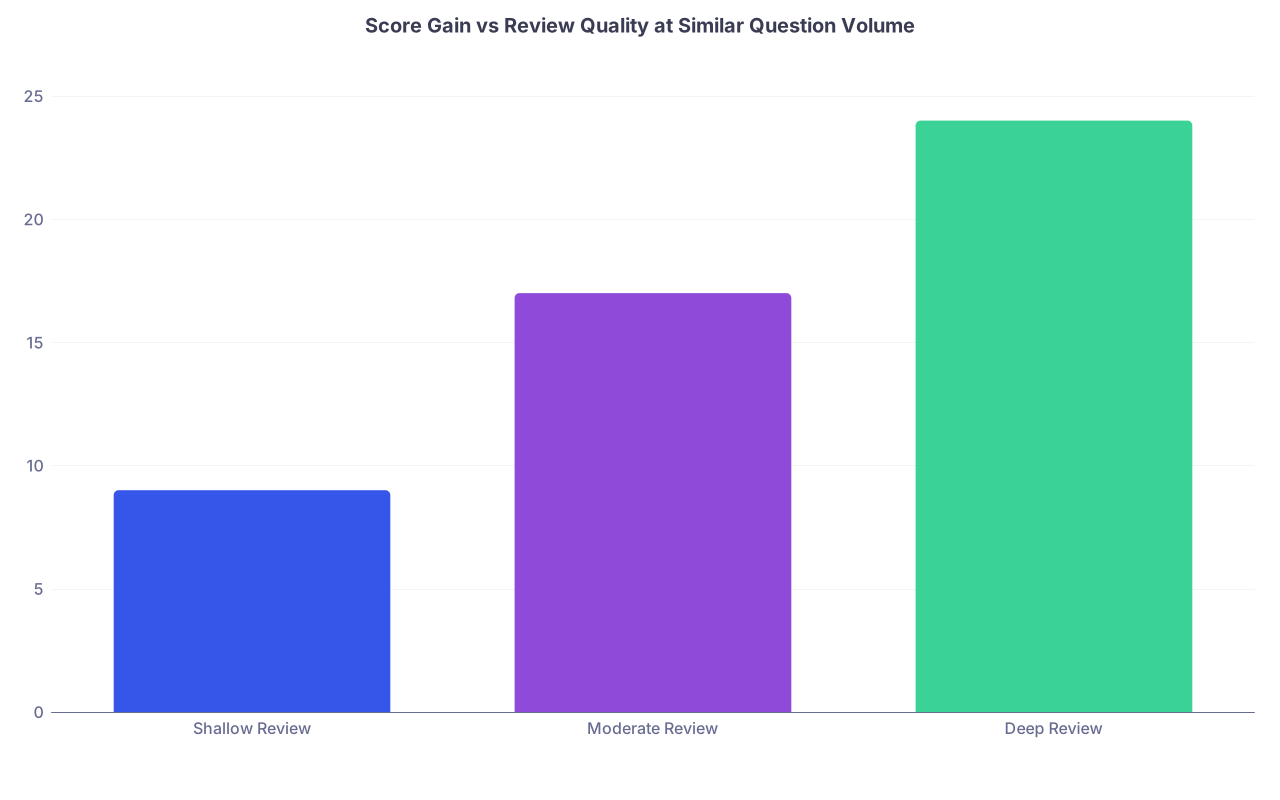
Concrete pattern from logs:
| Category | Value |
|---|---|
| Shallow Review | 9 |
| Moderate Review | 17 |
| Deep Review | 24 |
Students doing ~2,000 questions:
- Shallow review (click next, glance at explanation) → ~9‑point average gain
- Moderate (read explanations, no systematic error tracking) → ~17‑point gain
- Deep (error logs, concept notes, pattern recognition) → ~24‑point gain
Same item count. Different outcome.
Where the plateau actually hits
The most common misunderstanding is on the right side of the curve: “If 2,000 questions helped, 5,000 must be insane gains, right?” No.
By the time you hit 2,000–2,500 high‑quality MCQs with real review, you have:
- Seen the common patterns repeatedly
- Covered most high‑yield topics at least once, many twice
- Identified recurring weak areas
Past that, new information density drops. Many additional items are variants of what you already know. Useful for reinforcement, yes. But the marginal new learning per item is low.
If we pretend the earlier line chart is roughly accurate and approximate “marginal gain per 1,000 questions”:
| Question Range | Score Gain Band | Marginal Gain per 1,000 Q |
|---|---|---|
| 0–1,000 | ~+9 points | ~+9 / 1,000 |
| 1,000–2,000 | ~+8 points | ~+8 / 1,000 |
| 2,000–3,000 | ~+4 points | ~+4 / 1,000 |
| 3,000–4,000 | ~+2–3 points | ~+2–3 / 1,000 |
| 4,000–5,000 | ~+1 point | ~+1 / 1,000 |
The first 2,000 questions potentially move you 15–20 points.
The next 2,000 often barely move you 3–4 more.
Use that to sanity‑check your intuition. If you are at 3,000 completed questions and thinking “I probably just need another 2,000 questions to add 10 points,” the data say: unlikely.
How to estimate your needed question count
Let’s build a simple, pragmatic model you can actually use.
Step 1: Establish a real baseline
Not a vibe. Not your last organ system exam. A standardized exam.
- Take an NBME, UWSA, COMSAE, or school cumulative exam that closely mimics your target test
- Convert to scaled score or approximate percentile
Suppose you are:
- Baseline: 218
- Target: 240
- Desired gain: +22 points
Step 2: Choose a realistic review intensity
Be honest with yourself:
- Deep review (40–60 Q/day, ~3–4 hours including review) → R ≈ 0.8–1.0
- Medium review (60–80 Q/day, ~3–4 hours but quicker review per item) → R ≈ 0.5–0.7
- Shallow review (100+ Q/day, minimal review) → R ≈ 0.2–0.4
If you are in clerkships with limited time, you might be at 40–60 Q/day max if doing genuine review.
Step 3: Back-of-the-envelope target
Empirically:
- For typical med students near the middle of the pack, about 1,800–2,400 deeply reviewed questions tend to correspond to 15–25 point movements, assuming parallel content work (Anki, first‑aid style resources, videos).
Given:
- Desired gain ~22 likely puts you in the 2,000–3,000 total question band
- If you know you review very well, lean toward the lower end of the band
- If your review is so‑so, you will need more questions for the same effect
So you might decide:
“Goal: 2,400–2,800 total Qs, fully reviewed, over 7–8 weeks.”
Let us visualize a realistic 8‑week schedule.
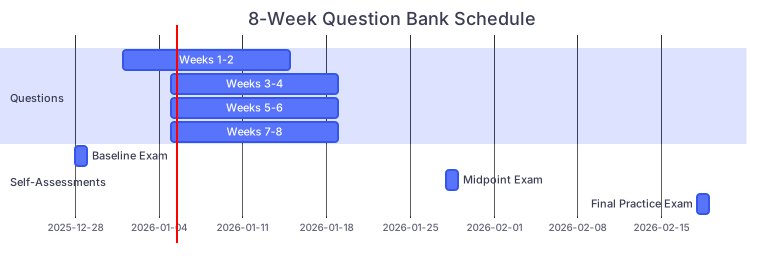
| Task | Details |
|---|---|
| Questions: Weeks 1-2 | 45 Q/day avg :a1, 2026-01-01, 14d |
| Questions: Weeks 3-4 | 55 Q/day avg :a2, after a1, 14d |
| Questions: Weeks 5-6 | 65 Q/day avg :a3, after a2, 14d |
| Questions: Weeks 7-8 | 75 Q/day avg :a4, after a3, 14d |
| Self-Assessments: Baseline Exam | b1, 2025-12-28, 1d |
| Self-Assessments: Midpoint Exam | b2, 2026-01-28, 1d |
| Self-Assessments: Final Practice Exam | b3, 2026-02-18, 1d |
If you do ~55 questions average over 6 days/week:
- 55 × 6 = 330/week
- 330 × 8 weeks ≈ 2,640 total
That fits squarely in the 2,000–3,000 band with some slack.
Question source quality and mixing banks
All questions are not created equal. The correlation between “number of questions done” and “exam score” is only meaningful if the questions resemble your actual test.
Common patterns:
- UWorld / Amboss / NBME‑style institutional banks → high correlation to Step/NBME performance
- Random PDF “question booklets” from Telegram → high entertainment value, low predictive value
I usually see prep portfolios split like this:
, Secondary QBank, Institutional/NBME, Misc/Low-Yield Sources](https://cdn.residencyadvisor.com/images/articles_svg/chart-typical-question-source-mix-for-step-style-prepara-8870.svg "Typical Question Source Mix for Step-style Preparation")
| Category | Value |
|---|---|
| [Primary QBank (e.g., UWorld)](https://residencyadvisor.com/resources/exam-prep-resources/the-quiet-tier-list-how-academic-chiefs-rank-usmle-q-banks) | 60 |
| Secondary QBank | 20 |
| Institutional/NBME | 15 |
| Misc/Low-Yield Sources | 5 |
The 60% primary QBank is what drives most of the learning and prediction.
Two key mistakes:
- Doing two full banks shallowly instead of one bank deeply
- Diluting time into “fun” but low‑fidelity resources when you are already behind
If you want to mix banks, a more data‑reasonable approach:
- Do 1 complete high‑yield primary bank (1,800–2,400 Qs)
- Layer 500–1,000 questions from a secondary bank focused on weak disciplines (e.g., biostats, ethics, neuro)
- Use NBMEs or school cumulative exams (300–600 Q total) to calibrate and correct overconfidence
If you are counting random questions from Instagram posts toward your “5,000 total,” stop pretending that is equivalent.
Phase-specific targets: pre-clinical, clerkships, dedicated
You are not always in “dedicated.” Question count expectations change with phase.
Pre-clinical / systems blocks
Here the outcome is usually:
- Internal exams
- Laying groundwork for boards
You do not need thousands of questions per block. You need the right distribution.
Roughly:
- 200–400 questions per major organ system (cardio, pulm, renal, neuro, etc.)
- 100–200 for smaller systems (derm, psych, MSK)
Over two pre‑clinical years, you might accumulate:
- ~2,000–3,000 total if you are consistent, which tracks well with solid Step 1 baselines later.
Most high scorers I have worked with did not start at zero questions on day 1 of dedicated. They carried this question “equity” forward.
Clinical clerkships
Here, you are juggling shelf exams + real patients + notes + random pages.
You cannot, and should not, run 80–100 questions every day all year. Shelf data patterns look like this:
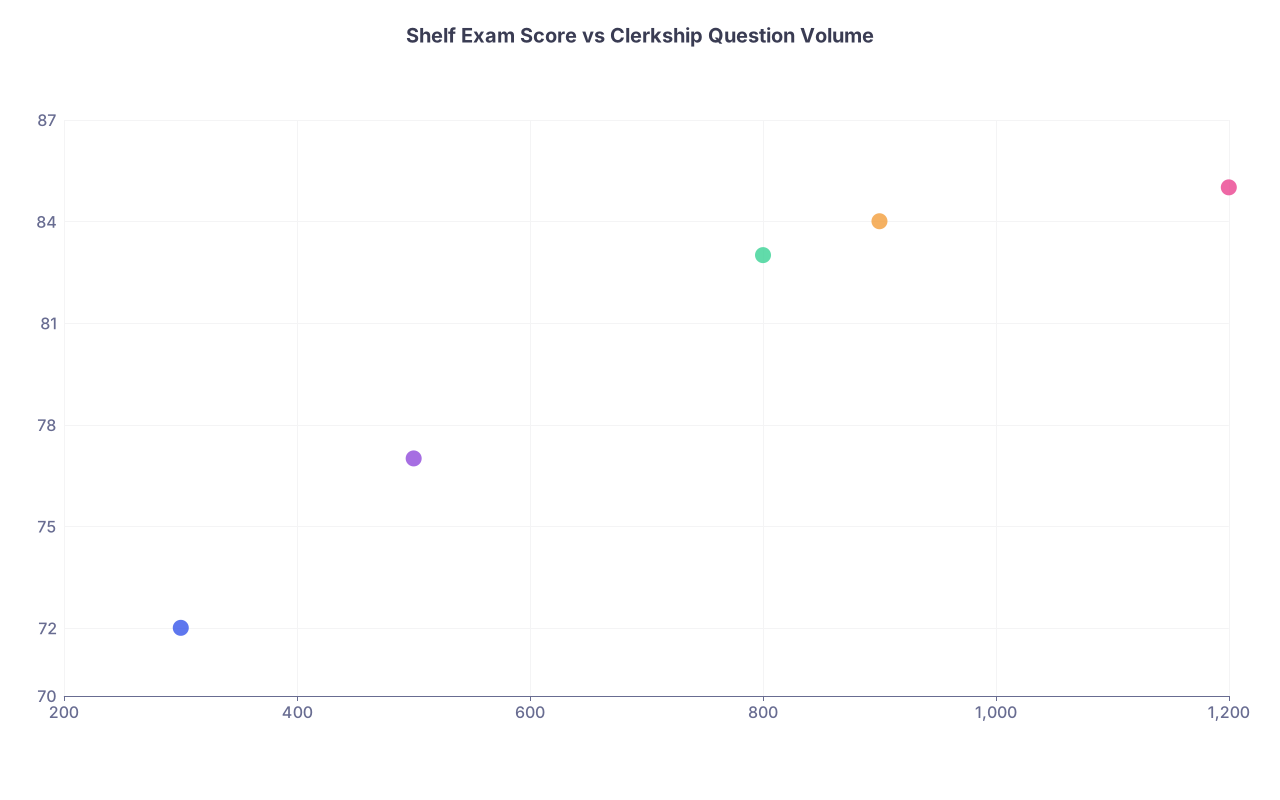
| Category | Value |
|---|---|
| Student A | 300,72 |
| Student B | 500,77 |
| Student C | 800,83 |
| Student D | 900,84 |
| Student E | 1200,85 |
By clerkship:
- 300–500 targeted questions → likely enough for a pass + decent score
- 600–800 → consistent honors territory for most
- Beyond ~900 per 8–12 week block → minimal additional benefit unless your baseline is weak
Across all core rotations, a realistic aggregate might be:
- 3,000–4,000 shelf‑style questions over the year
Dedicated board prep
Then, dedicated adds:
- 1,800–3,000 questions (Step 1)
- Another 2,000–3,000 (Step 2 CK) if your clinical year did not already build that base
Total reasonsable lifetime question exposure before graduation can easily exceed 7,000–9,000 questions, but spread rationally across years. That is not the same thing as sprinting 9,000 questions in a single 6–8 week block.
Diagnosing when you are doing “too many” questions
There is a point where high volume becomes counterproductive. A few red flags from real students I have debriefed:
- You cannot summarize what you learned from yesterday’s block beyond “cardiology stuff”
- Your percent correct is stuck in a narrow band (e.g., 52–58%) for thousands of questions with no upward drift
- Your self‑assessment scores are flat despite rising “total questions done”
- You feel guilty taking time to read or annotate because you “haven’t hit 100 questions today”
That pattern is exactly what a plateau looks like in other domains. More reps. No adaptation.
When I see this, I push students to:
- Temporarily drop daily volume by 20–40%
- Double the intensity of review for each missed question
- Add a follow‑up drill strategy (Anki cards, redoing marked questions, short notes)
- Insert a self‑assessment 10–14 days later to test whether the new approach is moving the score
If their next practice exam bumps up even 5–7 points with fewer questions, we have our answer: they did not need more items. They needed better learning per item.
Putting it all together: a practical heuristic
To answer your original question—“How many questions do I actually need?”—here is the cleanest evidence‑based heuristic I can give you:
For a typical Step‑style exam gain of 15–25 points
Aim for 2,000–3,000 high‑quality questions, deeply reviewed, over 6–10 weeks.If your baseline is below the 40th percentile
Expect needing closer to 3,000–4,000 questions plus parallel content remediation. Questions alone will not fix large knowledge gaps.If your baseline is already high (top quartile)
1,500–2,200 carefully chosen questions, with ruthless review of your few incorrects, is often enough. The return on going beyond that is small.If your self‑assessments have flatlined despite rising question counts
You do not need more items. You need a different way of using them.Across all phases (pre‑clinical, clerkships, dedicated)
A lifetime total in the 7,000–10,000 range is normal for serious students, but those are distributed. Trying to replicate that entire exposure in a single sprint is where people burn out and stall.
So yes, raw question count matters. Below 1,000 items, almost nobody hits their ceiling. Somewhere between 1,800 and 3,000, the curve starts flattening for most. And beyond 3,500–4,000, the data show you are usually trading time and energy for tiny statistical gains.
Your job is not to win some imaginary “question count leaderboard.” Your job is to land at the optimal point on the curve where extra items stop meaningfully changing your probability of hitting the score you want.
Get your baseline. Pick a target band. Build a schedule that respects your review capacity. Then let your self‑assessments, not your ego, tell you whether you need more questions—or just better ones.
The grind itself does not earn you points. How you convert each question into durable understanding does. Once you see that in your own score trajectory, you can stop chasing raw numbers and start prepping like someone who knows what they are doing.
And once you have dialed in your question strategy, the next real frontier is timing, fatigue management, and test‑day execution. That is where, for many students, the last few points are quietly hiding. But that is a dataset for another day.