Medical board exams are among the highest-stakes milestones in medical education. Whether you are preparing for the USMLE or COMLEX, success depends on a strong understanding of core concepts and strategic use of the best study resources. While question banks and videos are crucial, carefully chosen books remain the backbone of efficient, high-yield preparation.
Below is an expanded, in-depth guide to the top 10 essential books for mastering medical board exams, with practical tips on how to integrate each into your study plan.
The Role of Books in USMLE and COMLEX Board Exam Success
Medical school life can feel saturated with digital tools—videos, apps, and online question banks. Yet, for most students and residents, books remain the most reliable anchor in their exam strategy.
Why Books Still Matter in the Era of Question Banks
High-quality board review books are invaluable because they provide:
Structured concept clarity
Books like First Aid and BRS Physiology distill enormous curricula into logical, integrated outlines. When you’re overwhelmed, these texts help you create a mental map of what truly matters for USMLE and COMLEX.Context for practice questions
Question banks are excellent for application, but books ensure you actually understand the underlying physiology, pathology, and mechanisms rather than just memorizing patterns.Reliable, quickly searchable references
During dedicated study or clinical rotations, flipping to a concise explanation in a trusted book can save time versus hunting online through variable-quality sources.Integrated learning with other resources
Many of these books are designed to pair with:- Video lecture series (e.g., Pathoma)
- Question banks (e.g., UWorld, COMBANK, AMBOSS)
- Anki flashcards and spaced repetition tools
Used well, this creates an integrated, multi-modal board prep system.
1. First Aid for the USMLE Step 1: The Core Blueprint
Best for: USMLE Step 1, foundational basic science review; also helpful for COMLEX Level 1 when supplemented with OMM content.
Overview
First Aid for the USMLE Step 1 is often considered the “Step 1 Bible.” It doesn’t teach everything from scratch, but it maps out the universe of testable content in a way that’s uniquely exam-focused. Its high-yield summaries help you consolidate and organize months of material into something you can realistically review multiple times.
Why It’s Essential
Comprehensive high-yield coverage
Covers biochemistry, physiology, pathology, microbiology, pharmacology, immunology, and systems-based content—prioritizing what’s most likely to appear on medical board exams.Annually updated for changing exams
As USMLE Step 1 moved to pass/fail and the exam blueprint evolved, newer editions have shifted emphasis towards mechanisms, integration, and clinical relevance.Visual organization that supports rapid review
- Tables and charts for comparison (e.g., bugs and drugs, hypersensitivity types)
- Mnemonics and illustrations to boost recall
- Margin notes, annotations, and space for your own additions
How to Use It Effectively
- Early phase (M1–M2): Use it as a compass, not a textbook. Skim chapters to see what’s high-yield, then learn those topics from lectures or videos.
- Dedicated period:
- Aim for 2–3 passes of First Aid
- Integrate with a major QBank (e.g., UWorld) and Pathoma
- Annotate explanations from practice questions into First Aid
- Active learning: Turn key facts into Anki cards to ensure long-term retention.
2. Pathoma: Fundamentals of Pathology – Mastering Pathology for Boards
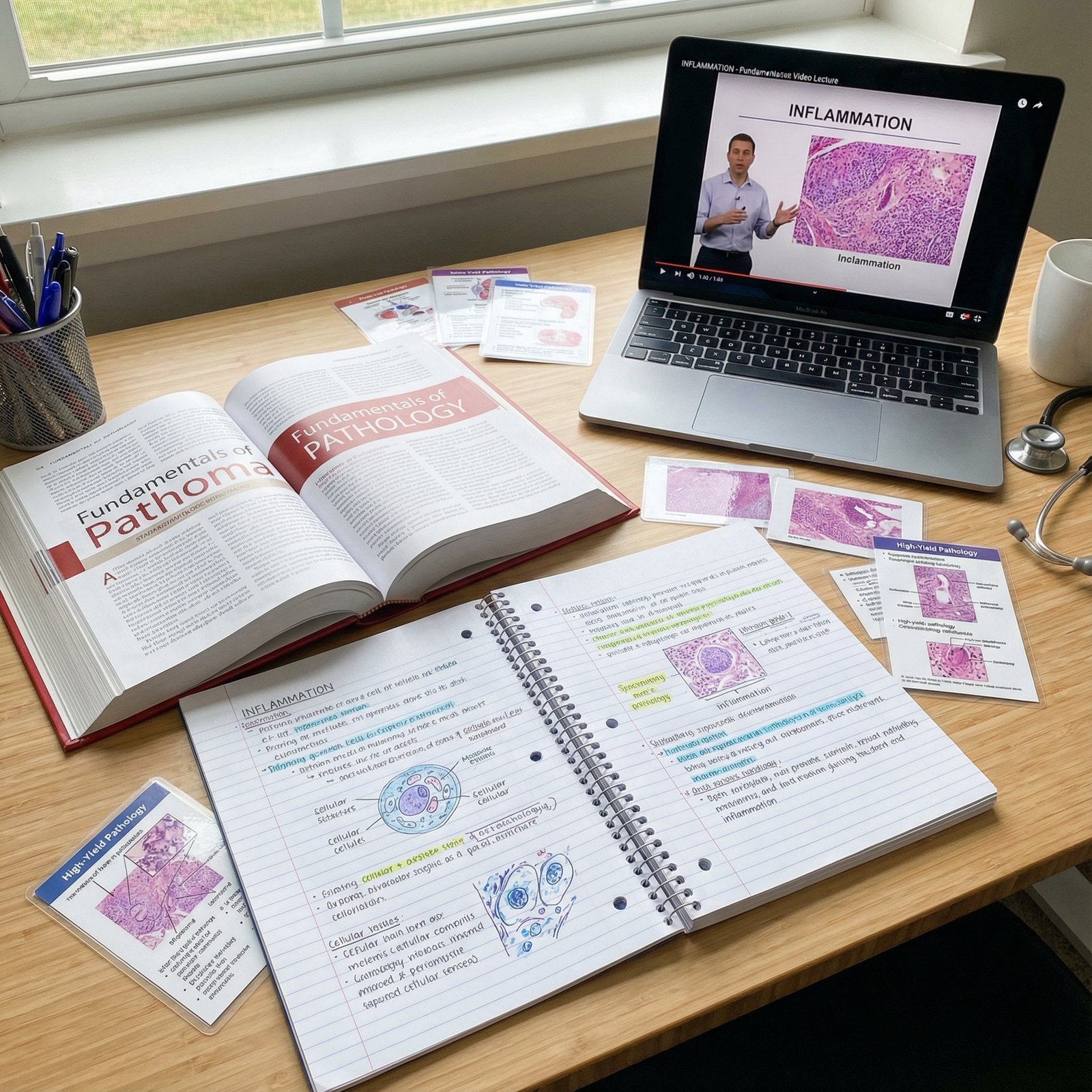
Best for: USMLE Step 1, COMLEX Level 1, and early clinical reasoning based on pathophysiology.
Overview
Pathoma: Fundamentals of Pathology by Dr. Husain Sattar is widely praised for transforming a traditionally dense subject into something logical, comprehensible, and memorable. The concise text pairs with a high-yield video series that many students use repeatedly.
Why It’s Essential
Clear explanations of difficult concepts
Pathophysiology is the foundation of modern exam questions. Pathoma bridges the gap from basic science to clinical reasoning by showing how diseases develop and present.Focused, high-yield organization
Chapters prioritize the pathology that board exams love to test—hematologic malignancies, renal disease, autoimmune conditions, neoplasia, and more.Excellent integration with visuals
- Simplified histology images
- Schematic diagrams
- Stepwise explanations (e.g., atherosclerosis development, cirrhosis progression)
How to Use It Effectively
- During systems courses:
- Watch the relevant videos as you go through organ blocks.
- Read the corresponding chapters to anchor concepts.
- During dedicated Step/COMLEX prep:
- Do a fast Pathoma pass early in your dedicated period to re-solidify pathology.
- Revisit key chapters (e.g., neoplasia, heme/onc, renal, immunology) right before practice exams.
- Combine with QBank questions:
Use wrong answers to identify weak pathology topics and rewatch the matching Pathoma videos.
3. USMLE Step 2 Secrets – High-Yield Clinical Pearls
Best for: USMLE Step 2 CK, COMLEX Level 2-CE, and clinical rotations.
Overview
USMLE Step 2 Secrets is a concise, question-and-answer formatted review book that distills high-yield clinical facts, diagnostic algorithms, and management strategies into digestible chunks. It’s especially useful when your schedule is packed with clinical duties.
Why It’s Essential
High-yield, exam-style organization
Instead of long paragraphs, you get rapid-fire Q&A content like:- “What is the best initial test for suspected PE?”
- “What is the next best step in management for unstable angina?”
Strong emphasis on clinical reasoning
The book helps develop the pattern recognition skills you need for NBME-style questions and COMLEX-style vignettes.Portable and quick to read
Ideal for:- Commuting
- Downtime on wards
- The final 2–4 weeks before your exam
How to Use It Effectively
- Read a section or two daily during clerkships to reinforce key differentials and management steps.
- Pair it with a QBank (e.g., UWorld Step 2, COMQUEST) and use it to clarify recurring weak spots like:
- Chest pain workup
- Anticoagulation decisions
- Obstetric emergencies
4. The Washington Manual of Medical Therapeutics – Clinical Management Mastery
Best for: USMLE Step 2/3, COMLEX Level 2/3, and inpatient/internal medicine rotations.
Overview
The Washington Manual of Medical Therapeutics is a compact, clinically oriented reference that focuses on the management of real inpatient problems—exactly the kind of context you’ll see in advanced exams and on the wards.
Why It’s Essential
Evidence-based treatment guidelines
Presents up-to-date management plans for common conditions such as:- Heart failure
- COPD exacerbations
- Sepsis
- Acute kidney injury
Organized for fast access
Structured by system so you can quickly find:- Diagnostic criteria
- First-line treatments
- Dosages and monitoring considerations
Bridges exam prep and clinical practice
Reading this while you’re on rotations allows you to:- Understand why certain orders are written
- Link exam management algorithms to real patients
How to Use It Effectively
- Keep it in your white coat or on your device during medicine rotations.
- When you see a new diagnosis on the wards, read the relevant section that day.
- Before Step 2/COMLEX Level 2, skim high-yield inpatient conditions and compare them to QBank approaches.
5. Goljan’s Rapid Review Pathology – Deep-Dive Pathology Reinforcement
Best for: Students wanting a deeper pathological foundation than Pathoma alone; high-performers aiming for strong Step 1/Level 1 scores.
Overview
Goljan’s Rapid Review Pathology is a more detailed pathology review text that includes robust explanations, summary tables, and an integrated question bank. Many students use it as a second-layer resource after Pathoma.
Why It’s Essential
In-depth explanations
Especially beneficial if:- You struggled in pathology during pre-clinicals
- You want a richer understanding of mechanisms and correlations
Chapter-end questions and explanations
These help you test whether you’ve really mastered each topic, beyond simple recognition.Integrates pathology, lab findings, and clinical presentation
Excellent for building the pattern recognition needed for vignettes that test subtle differences between diseases.
How to Use It Effectively
- Don’t try to read it cover to cover during busy coursework; instead:
- Use it selectively for topics you find challenging (e.g., glomerulonephritis, anemias, vasculitides).
- During dedicated, choose key systems to deepen only if time permits.
6. First Aid for the COMLEX Level 1 – Tailored Osteopathic Board Prep
Best for: DO students prepping for COMLEX Level 1; also helpful as a structured checklist for aligning USMLE-focused prep with COMLEX-specific needs.
Overview
First Aid for the COMLEX Level 1 mirrors the style of the USMLE First Aid but adapts content for the unique structure and emphasis of COMLEX, especially osteopathic principles and practice (OPP) and OMT.
Why It’s Essential
COMLEX-specific focus
Includes:- Osteopathic philosophy and principles
- Somatic dysfunction
- High-yield OMT techniques and clinical applications
- COMLEX-style question emphasis (e.g., more ethics, public health)
Prevents gaps for DO students using USMLE-focused resources
Many DO students rely heavily on USMLE-focused tools like UWorld and Step 1 First Aid. This book ensures:- You don’t neglect OMM
- You’re aware of COMLEX exam style differences
How to Use It Effectively
- Combine with:
- Your main basic science resources (Pathoma, BRS Physiology, First Aid Step 1)
- A dedicated OMM resource or videos
- Create a COMLEX-only checklist:
- OMM techniques
- Special testing styles (e.g., extended stems, more ethics/public health)
- Review these repeatedly in the final month.
7. Case Files Series – Clinical Vignettes and Application
Best for: Clerkships, USMLE Step 2 CK, COMLEX Level 2-CE, and early Step 3/Level 3 prep.
Overview
The Case Files series (e.g., Case Files: Internal Medicine, Surgery, Pediatrics, OB/GYN, Psychiatry) presents realistic clinical cases followed by discussion, key concepts, and questions.
Why It’s Essential
Exam-style case-based learning
Mirrors the format of clinical board exams, which increasingly rely on:- Long vignettes
- Integration of labs, imaging, and physical exam findings
Reinforces differential diagnosis and management
Each case walks through:- How to approach a symptom or chief complaint
- What to rule out
- First-line workup and treatment
Great for clerkship shelf exams and COMATs
Helps you translate what you see on the wards into the frameworks tested on exams.
How to Use It Effectively
- Read several cases per week in the specialty you’re rotating in.
- Before each shelf exam, prioritize cases covering core topics (e.g., chest pain, abdominal pain, shortness of breath, fever).
- Use the “Clinical Pearls” at the end of each chapter as rapid review material.
8. BRS Physiology – Solidifying the Foundation
Best for: Pre-clinical courses, USMLE Step 1, COMLEX Level 1, and anyone who feels their physiology is shaky.
Overview
BRS (Board Review Series) Physiology remains one of the most highly recommended resources for mastering physiology for Medical Board Exams. It clarifies mechanisms that underpin pathology and pharmacology questions.
Why It’s Essential
Concise but conceptually rich
Explains:- Cardiac physiology and pressure-volume loops
- Pulmonary mechanics and gas exchange
- Renal handling of electrolytes
- Endocrine feedback loops
End-of-chapter questions
These board-style items reinforce concepts and reveal weak areas early.Perfect complement to pathology resources
When a path question stumps you, it’s often a missing physiology link. BRS fills that gap.
How to Use It Effectively
- During M1/M2:
- Use alongside lecture notes during systems blocks.
- Do the chapter questions as formative assessments.
- Before Step/COMLEX:
- Rapidly review high-yield systems (cardio, renal, pulmonary, endocrine).
- Focus on equations and graphs that commonly appear on exams.
9. Clinical Microbiology Made Ridiculously Simple – Micro Made Memorable
Best for: Pre-clinical microbiology, Step 1, COMLEX Level 1, and students who benefit from mnemonics and visual memory aids.
Overview
Clinical Microbiology Made Ridiculously Simple is a uniquely engaging resource that converts the dense field of microbiology into manageable stories, cartoons, and memory hooks.
Why It’s Essential
Highly memorable mnemonics
Converts dry lists (e.g., gram-positive rods, RNA viruses) into:- Cartoons
- Visual metaphors
- Short, humorous narratives
Focus on clinically relevant details
Emphasizes:- Modes of transmission
- Classic presentations
- Treatment of key infections
Effective for long-term recall
Particularly useful when combined with Anki or other flashcard systems.
How to Use It Effectively
- Skim early in your microbiology course to build a conceptual framework.
- Revisit relevant sections before you take Step 1/Level 1, focusing on:
- Bacteria and viruses that frequently appear in vignettes
- Opportunistic infections
- Antimicrobials
10. The Essential Guide to Clinical Medicine: A Medical Student’s Handbook
Best for: Early clinical exposure, clerkships, OSCEs, Step 2/3 and COMLEX Level 2/3 foundation.
Overview
The Essential Guide to Clinical Medicine serves as a practical, pocket-style reference for the core skills and knowledge you need at the bedside and on exams.
Why It’s Essential
Practical approach to clinical medicine
Often includes:- History-taking templates
- Physical exam checklists
- Summaries of common clinical presentations and workups
Board-relevant clinical overviews
Provides concise refreshers on:- Cardiovascular, pulmonary, GI, neuro, and other system exams
- Interpreting basic labs and imaging
User-friendly layout
Makes it easy to:- Look up a topic before seeing a patient
- Review core concepts quickly before OSCEs or practical exams
How to Use It Effectively
- Before starting new rotations, read the chapters on that specialty’s common complaints and exams.
- Use it to structure your clinical presentations and SOAP notes.
- Pair with Case Files and Step 2 Secrets to bridge practical skills with exam-style reasoning.
Putting It All Together: Building a Cohesive Board Exam Study Strategy
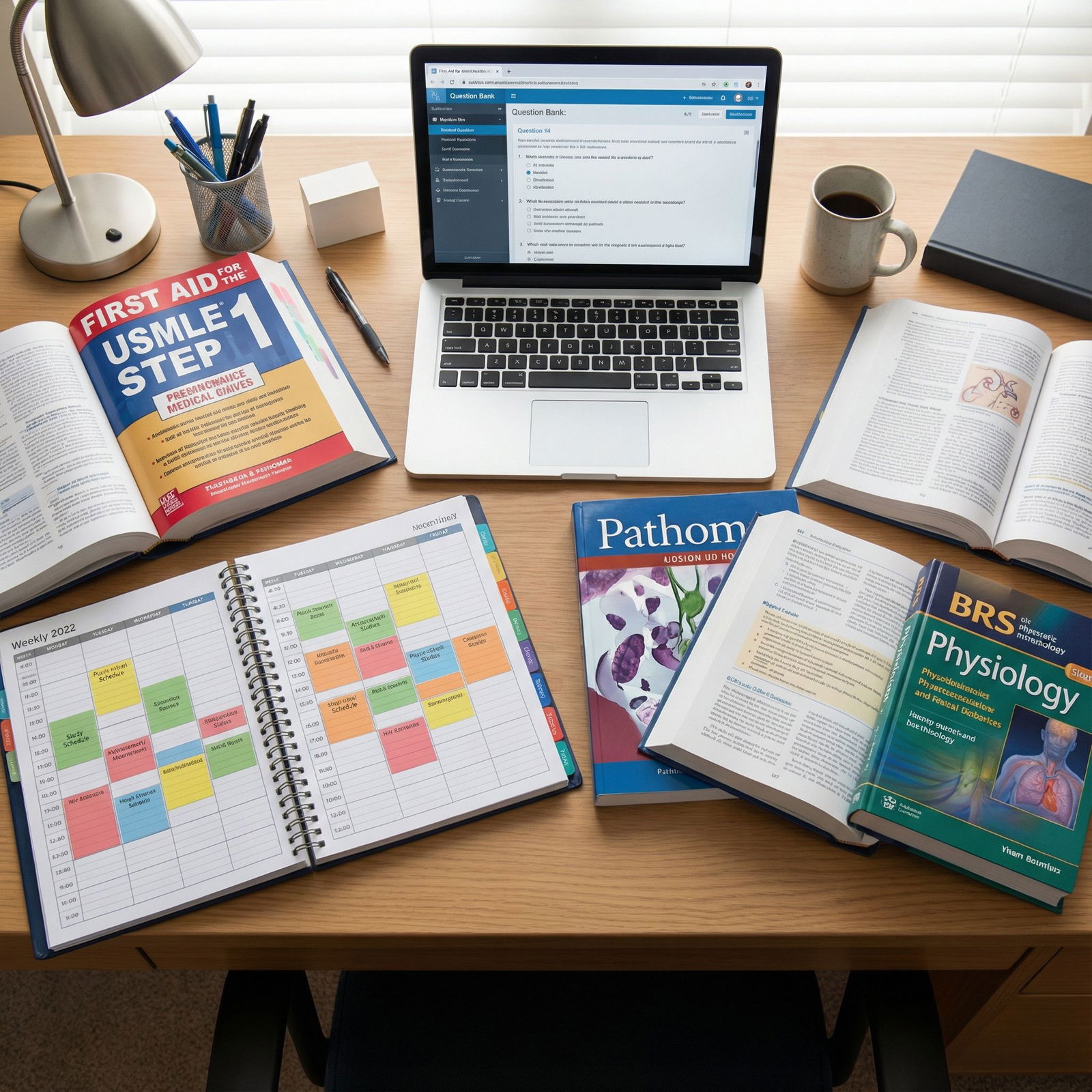
Choosing the right books is only half the battle; how you use them determines your success on USMLE, COMLEX, and other Medical Board Exams.
Stepwise Strategy for Pre-Clinical Years (USMLE Step 1 / COMLEX Level 1)
Foundation Phase (M1/M2)
- Use BRS Physiology and Clinical Microbiology Made Ridiculously Simple alongside coursework.
- Skim First Aid Step 1 to understand what’s high yield.
- Start Pathoma early and align it with your organ systems.
Integration and Review Phase
- As exams approach, shift emphasis to:
- First Aid Step 1
- Pathoma
- Selective use of Goljan’s Rapid Review Pathology
- DO students: Integrate First Aid for COMLEX Level 1 and an OMM resource.
- As exams approach, shift emphasis to:
Dedicated Study Period
- Daily routine might include:
- 1–2 hours of reading (First Aid, Pathoma)
- 40–80 QBank questions with review
- Targeted review of weak topics using the relevant book
- Daily routine might include:
Strategy for Clinical Years (Step 2/3 and COMLEX Level 2/3)
During Clerkships
- Use the Case Files series for each rotation.
- Carry The Essential Guide to Clinical Medicine for quick reference.
- Read USMLE Step 2 Secrets intermittently to build clinical reasoning.
Before Exams (Step 2 CK, Level 2-CE)
- Focus on:
- Step 2 Secrets
- Case Files for your weakest clerkships
- The Washington Manual for inpatient management topics
- Combine with high-quality question banks and NBME practice exams.
- Focus on:
FAQs: Medical Board Exam Books, Study Resources, and Strategy
1. Do I really need all 10 of these books to succeed on USMLE or COMLEX?
No. You do not need every single one of these to pass or even to score highly. These are the most consistently recommended, high-yield books across many students and institutions. A typical minimal but strong setup might be:
For Step 1 / Level 1:
- First Aid for the USMLE Step 1
- Pathoma
- BRS Physiology
- First Aid for COMLEX Level 1 (for DO students)
For Step 2 / Level 2:
- USMLE Step 2 Secrets
- Case Files for each core rotation
Adjust based on your weaknesses, learning style, and time available.
2. How should I balance books with question banks and videos?
Aim for an integrated approach:
- Use books to build a conceptual framework and quick references.
- Use videos (e.g., comprehensive lectures, Pathoma, OMM tutorials) to clarify complex or visual topics.
- Use question banks as your primary tool for:
- Application
- Assessment
- Identifying weak areas
A balanced daily schedule might look like:
- 40–80 QBank questions with review
- 1–2 chapters or sections from a key book
- 30–60 minutes of targeted video review for tricky topics
3. Should I buy physical copies or rely on ebooks and online access?
Either format can work; choose what supports your productivity best:
Physical books are great if:
- You retain better when annotating margins and using sticky notes.
- You find screens fatiguing.
Ebooks/PDFs are ideal if:
- You like searchable text.
- You study on multiple devices.
- You need to travel light across rotations.
Whichever you choose, stay consistent and avoid frequently switching formats mid-prep.
4. When should I start using these board prep books during medical school?
M1/M2:
- Start early with foundational resources (BRS Physiology, Micro Made Ridiculously Simple, Pathoma).
- Introduce First Aid in a light, “big-picture” way.
6–9 months before Step 1/Level 1:
- Gradually transition to more intensive use of First Aid, Pathoma, and relevant review texts.
Clerkship years:
- Use Case Files and The Essential Guide to Clinical Medicine from day one of rotations.
- Begin Step 2 Secrets several months before your exam.
5. How can I personalize this list to my learning style?
Reflect on:
Do you learn best visually?
- Prioritize Pathoma, Micro Made Ridiculously Simple, and visually rich resources.
Do you prefer concise bullet points and outlines?
- Lean on First Aid, BRS Physiology, and Step 2 Secrets.
Do you like deeper reading and understanding?
- Supplement with Goljan’s Rapid Review Pathology and The Washington Manual.
You don’t need to follow someone else’s exact resource list. The best Medical Board Exam strategy is the one you can sustain consistently while balancing medical school life, clinical responsibilities, and your well-being.
By choosing your core resources wisely—then using them deliberately and consistently—you can transform an overwhelming USMLE or COMLEX journey into a structured, manageable process. These essential books, paired with active practice and thoughtful planning, will position you to perform at your best on your Medical Board Exams and beyond.