
Introduction: Why Q-Banks Matter for Board Exam Success
For modern board exam prep, Q-Banks are no longer optional “extras”—they are core Study Resources for serious test preparation. Whether you are preparing for the USMLE, COMLEX, shelf exams, or other Medical Licensing exams, high‑quality practice questions are one of the most powerful tools you can use.
Q-Banks (question banks) let you:
- Practice exam-style questions under realistic conditions
- Identify knowledge gaps early and systematically
- Build test-taking stamina and timing
- Learn actively from explanations instead of passively rereading notes
However, the explosion of commercial and free Q-Banks has created a new problem: choosing the right ones. With so many options, features, and price points, it’s easy to feel overwhelmed or to invest in tools that don’t match your exam phase or learning style.
This guide walks you through:
- What Q-Banks are (and what they are not)
- Key factors to consider when choosing a Q-Bank
- How major Q-Banks compare and when each shines
- Practical strategies for integrating Q-Banks into your Board Exam Prep
- Common pitfalls to avoid, plus answers to frequently asked questions
By the end, you’ll be able to choose Q-Banks confidently and use them strategically throughout medical school life and exams.
What Exactly Is a Q-Bank—and How Does It Fit Into Board Exam Prep?
A Q-Bank is a digital collection of exam‑style practice questions, usually aligned with a specific standardized test or set of exams:
- USMLE Step 1, Step 2 CK, Step 3
- COMLEX Level 1, Level 2‑CE, Level 3
- Shelf exams (NBME subject exams)
- Other Medical Licensing or specialty board exams (e.g., NAPLEX, ANCC, ABIM, ABSITE)
Each question typically includes:
- A clinical vignette or stem mimicking real exam style
- Single-best-answer multiple-choice options
- A detailed explanation, often with rationales for both correct and incorrect options
- References to guidelines, key review books, or primary literature (in higher-end Q-Banks)
Used correctly, Q-Banks are not just “tests.” They are active learning tools that help:
- Consolidate core concepts over time
- Expose you to high-yield patterns and “classic” test presentations
- Teach you how exam writers think and how distractors are constructed
- Reveal recurring weak areas that need deeper review
What Q-Banks Are Not
It’s equally important to understand what Q-Banks cannot replace:
- They are not a full curriculum—you still need foundational resources (textbooks, videos, classes).
- They are not magic score boosters if you only skim explanations or use them passively.
- They are not identical to the real exam—but the best ones come very close in style and cognitive difficulty.
When integrated thoughtfully into your study plan, Q-Banks become the backbone of your Test Preparation strategy, especially in the months leading up to your exam date.
Key Factors to Consider When Choosing a Q-Bank
Picking the “best” Q-Bank is less about popularity and more about fit—for your exam, timeline, learning style, and budget. Below are the essential criteria you should evaluate before subscribing.
1. Content Quality and Exam Realism
Content quality is the single most important factor. A great user interface cannot compensate for poor questions.
Look for Q-Banks that:
- Are written and peer‑reviewed by physicians and experienced medical educators
- Reflect the current blueprint and style of your exam (e.g., integrated vignettes, multi-step reasoning)
- Match the difficulty level you expect:
- For Step 1/Level 1: strong emphasis on mechanisms, pathology, pathophysiology
- For Step 2 CK/Level 2: management, next best step, risk stratification
- Avoid excessively “zebra” or trivial questions unrelated to actual board trends
Actionable tip:
Always do the free trial (or sample questions) and ask yourself:
- Do these questions feel like NBME/COMLEX style?
- Are the distractors plausible, or are they obviously wrong?
- Does the clinical reasoning feel realistic?
If the questions seem either much easier or much harder than other credible practice exams (NBME, COMSAE, etc.), that’s a red flag.
2. Coverage and Completeness for Your Exam
Comprehensive coverage is crucial for robust Board Exam Prep. A Q-Bank should align with:
- The official exam content outline (e.g., USMLE Content Outline, COMLEX Blueprint)
- High‑yield organ systems and disciplines (e.g., cardiology, respiratory, biostatistics)
- Nonclinical but heavily tested areas (ethics, patient safety, communications, health systems)
Questions to ask:
- Does the Q-Bank specify the number of questions per organ system or discipline?
- Can you filter by system, subject, and difficulty to target specific gaps?
- Does it include enough biostatistics, ethics, and communication questions—areas many students underpractice?
Actionable tip:
Pull up your exam’s official content outline and compare it side by side with the Q-Bank’s topic list. Any major mismatch should make you cautious.
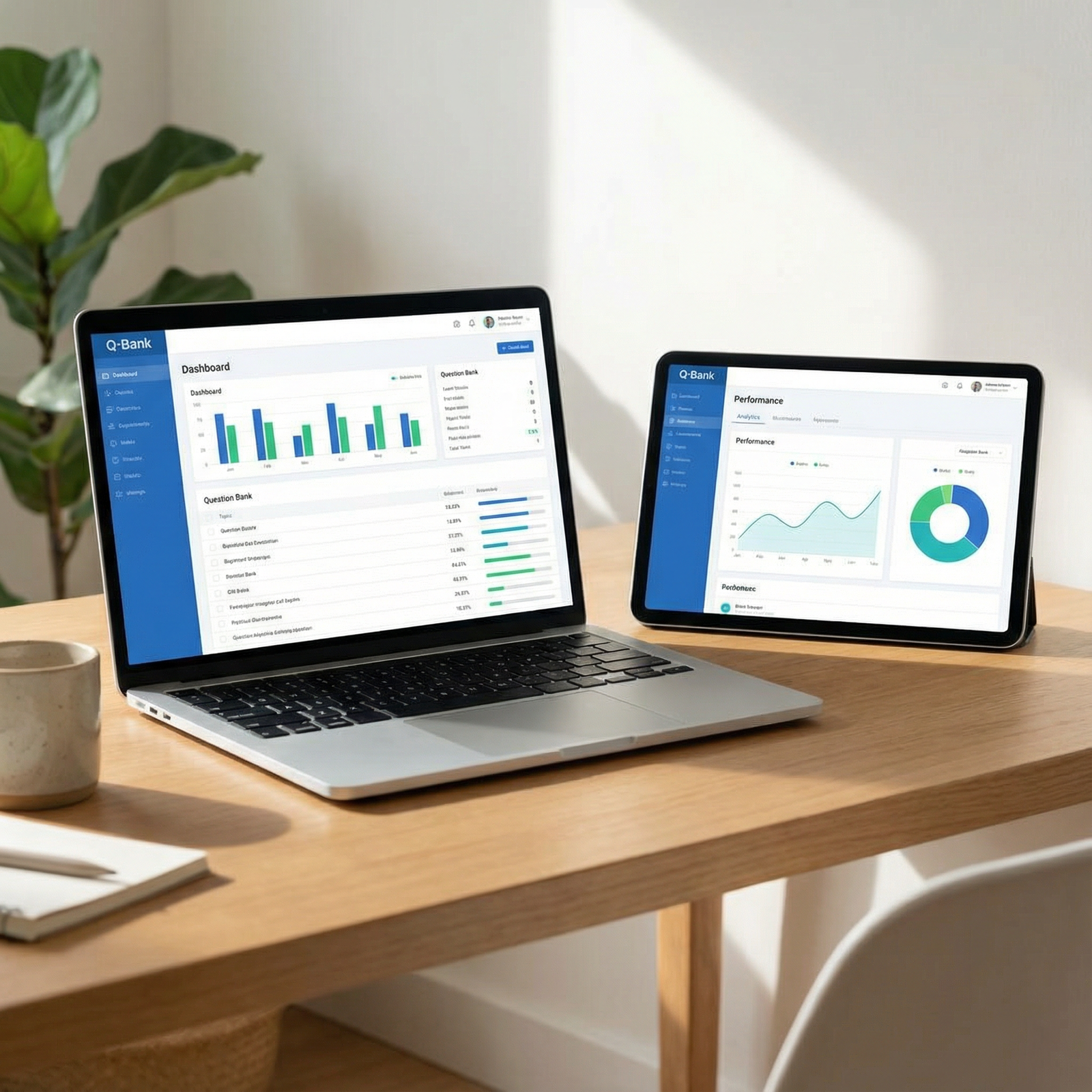
3. User Interface and Overall Study Experience
Your Q-Bank will be your daily companion during intense study blocks. A clunky interface wastes time and adds cognitive friction.
A strong user experience should include:
- Exam-style testing mode: realistic timer, block sizes matching the real exam, and similar navigation
- Tutor mode: see explanations immediately after each question for learning sessions
- Responsive web platform and mobile apps for on‑the‑go practice
- Easy question filters (organ system, subject, unused/incorrect/marked)
- Searchable explanations and keyword highlighting
Actionable tip:
During trial access, simulate your real usage:
- Create a 40–60 question timed block
- See how easy it is to review, annotate, and flag questions
- Test the mobile app on a commute or short break
The smoother the experience, the easier it is to stay consistent.
4. Explanation Depth and Teaching Quality
The explanation is arguably the most valuable part of a question. Even a perfectly written item is wasted if you don’t fully understand why every option is right or wrong.
High‑quality explanations should:
- Clearly articulate the key teaching point for each question
- Explain why the correct answer is correct
- Walk through why each wrong answer is wrong (not just “incorrect”)
- Use diagrams, tables, or flowcharts where helpful
- Reference standard texts or guidelines when appropriate
Some Q-Banks also hyperlink explanations to an integrated library or external resources, allowing you to immediately deepen your understanding.
Actionable tip:
During your trial, pay attention to how you feel after reading an explanation:
- Do you feel like you could teach the concept to a peer?
- Are “near-miss” options meaningfully discussed?
- Are there concise takeaway points or “Pearls” you can add to Anki or notes?
If the explanations feel thin or repetitive, consider another resource.
5. Adaptive Learning and Personalization Features
Adaptive learning can dramatically improve efficiency by focusing your time on the areas where you’re struggling most.
Key adaptive features to look for:
- Algorithms that serve more questions from weaker topics
- Personalized recommendations like “You are below average in cardiology” or “Focus on endocrine next”
- Smart question repetition (surfacing topics you consistently miss over time)
Some platforms integrate spaced repetition or make it easy to convert missed questions into flashcards.
Actionable tip:
Ask: Does this Q-Bank help me decide what to do next each week, or does it leave all planning to me? If you struggle with planning, adaptive features can be a major asset.
6. Performance Analytics and Progress Tracking
You can only fix what you can see. Strong analytics are critical for strategic Test Preparation.
Look for dashboards that allow you to:
- Track overall percentile compared with peers
- View performance by system, subject, and question type
- See trends over time (are you improving, plateauing, or declining?)
- Identify high-yield weaknesses to review more deeply
Actionable use:
Use your performance data to:
- Plan your weekly review topics
- Decide when to switch from content-heavy study to predominantly Q-Bank practice
- Inform when you might be ready to schedule the exam or take another NBME/COMSAE
7. Flexible Study Modes and Customization
The best Q-Banks let you study in ways that match your phase of preparation:
Common study modes:
- Tutor mode: immediate feedback for early learning phases
- Timed mode: simulating real test blocks in the dedicated period
- Random mode: integrated, unpredictable questions similar to the real exam
- Subject- or system-specific mode: shelf exam prep or targeted review
Additional helpful features:
- Option to exclude previously seen or correct questions
- Ability to create custom blocks (e.g., 20 cardiology questions, intermediate difficulty)
- Features for marked/flagged questions and incorrect questions review
Actionable tip:
Match mode to phase:
- Early phase: more tutor mode, system-specific blocks
- Mid phase: mix of random and targeted blocks, tutor mode gradually shifting toward timed
- Final phase: mostly timed, random blocks to simulate real exam pressure
8. Additional Resources, Integration, and Support
Many Q-Banks now exist within larger ecosystems of Study Resources. This can be helpful if you prefer an integrated approach.
Potential add‑ons:
- Video lectures linked directly to questions
- Interactive articles and a searchable clinical library
- Flashcards or spaced-repetition tools embedded in the platform
- Forums or discussion boards for complex questions
- Responsive customer support and tutorials on how to use the product effectively
Actionable tip:
If you already use a particular review course (e.g., Kaplan, AMBOSS, Boards & Beyond, First Aid-based products), consider Q-Banks that integrate tightly with these to streamline your workflow.
9. Subscription Flexibility and Cost Considerations
Q-Banks are a major financial investment during medical school. Balance quality with realistic budget planning.
Key questions:
- Are there monthly, 3‑month, 6‑month, and 12‑month options?
- Are there bundle discounts with other resources you already use?
- Do they offer student discounts, group discounts, or institutional access?
- Can you extend access at a reduced rate if your exam date changes?
Think carefully about when you want access to start. Wasted months on an unused subscription are a common and avoidable issue.
10. Trial Options, Refunds, and Risk Management
You shouldn’t need to gamble hundreds of dollars on an untested platform.
Look for:
- Free trial periods (even limited)
- Sample questions and explanation previews
- Clear refund or money-back policies, especially if the platform is new or unfamiliar
Actionable tip:
Use trials strategically: stack them during a lighter week, test 2–3 platforms side by side, and make a deliberate choice based on how well each matches your goals.
Comparing Top Q-Banks for Medical Board Exam Preparation
Below is an expanded overview of several widely used Q-Banks, their strengths, and ideal use cases. These are not endorsements but starting points for your own evaluation.
1. UWorld
Best known for:
Exceptionally realistic USMLE and COMLEX-style questions, gold-standard explanations.
Strengths:
- Very close to NBME-style vignettes and difficulty for Step 1 and Step 2 CK
- Highly detailed explanations with diagrams, tables, and “educational objective” summaries
- Strong analytics and a clean, exam-like interface
- Excellent for both content learning and last-phase Test Preparation
Ideal for:
- Primary Q-Bank for USMLE/COMLEX (especially in dedicated study period)
- Students who learn best from detailed, structured explanations
- Those seeking a single, high-yield core Q-Bank
Considerations:
- Can feel “heavy” or time-consuming if you read every explanation in depth
- Higher cost compared with some competitors
- Some students prefer to use another Q-Bank early in medical school and save UWorld for their final push
2. Kaplan Q-Bank
Best known for:
Long-standing test prep brand with comprehensive coverage and integrated courses.
Strengths:
- Broad topic coverage and large question volume
- Well-developed analytics and strong test simulation features
- Integration with Kaplan’s video lectures and review courses
- Good for building foundational test-taking skills early in prep
Ideal for:
- Students who are already using Kaplan courses or videos
- Early-phase Board Exam Prep before switching to UWorld or other Q-Banks
- Learners who want structured, curriculum-style Study Resources plus questions in the same ecosystem
Considerations:
- Some users feel question style is slightly more “old school” compared to newer platforms
- May not be as closely aligned with the latest NBME/USMLE trends as UWorld or NBME practice forms
3. AMBOSS
Best known for:
Powerful combination of Q-Bank and integrated medical library.
Strengths:
- High-quality questions with concise, efficient explanations
- Every explanation is linked to an in-depth article in the AMBOSS library
- “Attending tips” and highlight tools help focus attention on key clues
- Strong for both shelf exams and Step 2 CK / Level 2-CE
- Offline apps and quick search make it useful during clinical rotations
Ideal for:
- Clerkship students preparing for NBME subject (shelf) exams
- Integrated learning across topics using a single platform
- Those who like to quickly look up details without leaving their Q-Bank
Considerations:
- Some find the explanations a bit more concise compared to UWorld’s depth
- Best when actively combined with reading the linked library content
4. BoardVitals
Best known for:
Wide exam coverage beyond USMLE—specialty boards, nursing, pharmacy, etc.
Strengths:
- Large question banks across many Medical Licensing and specialty exams
- Cost-effective with frequent discounts
- Customizable practice tests and performance tracking
- Especially useful for niche or subspecialty board exam prep (e.g., anesthesiology, psychiatry)
Ideal for:
- Students or residents preparing for non-USMLE exams (NAPLEX, ANCC, specialty boards)
- Those who want an additional Q-Bank after primary ones are exhausted
- Test takers with budget constraints needing more volume
Considerations:
- Exam realism varies more across specialties; always check trial questions for your specific exam
- For USMLE primary prep, most students still prioritize UWorld or AMBOSS first
5. USMLE‑Rx
Best known for:
Integration with First Aid for the USMLE Step 1 and associated resources.
Strengths:
- Questions closely mapped to First Aid pages and high-yield facts
- Good for reinforcing memorization-heavy content
- Integrates with videos and flashcards in the Rx ecosystem
- Useful during preclinical years as you build toward Step 1
Ideal for:
- Students who study primarily from First Aid and want synced practice
- Early-phase learners needing more recall-level and basic conceptual questions
- Those who want to “warm up” before tackling UWorld
Considerations:
- Generally regarded as less challenging and less exam-realistic than UWorld
- Best used as a supplement rather than your only Q-Bank, especially near exam time
6. Zanki (Anki) and Other Flashcard Decks
While not traditional Q-Banks, large Anki decks like Zanki, AnKing, and others function as spaced-repetition question systems.
Strengths:
- Massive coverage of high-yield facts
- Spaced repetition optimizes long-term retention
- Many cards are mini‑questions testing rapid recall
- Free or low-cost and customizable
Ideal for:
- Daily maintenance of knowledge over months to years
- Supplementing Q-Banks to ensure high-yield facts stick
- Filling small time blocks (bus rides, quick breaks, etc.)
Considerations:
- Not a substitute for exam-style vignette practice
- Can become overwhelming without strict scheduling and discipline
- Best used alongside, not instead of, full Q-Banks
Real-World Use Cases: How Students Successfully Use Q-Banks
Case Study 1: From Average Scores to Step 1 Breakthrough with UWorld
A second-year student consistently scored in the mid‑50th percentile on early NBME practice exams. She switched her strategy:
- Completed one 40‑question timed UWorld block daily
- Spent 2–3 hours deeply reviewing explanations and making Anki cards from missed concepts
- Used performance analytics to target weak systems on weekends
Over three months, her NBME practice scores rose into the 80th percentile range, and she exceeded her Step 1 target score. The key was not just doing questions but systematically learning from mistakes.
Case Study 2: Integrated Shelf + Step 2 CK Prep with AMBOSS
A third-year student aimed to streamline shelf exam prep while also building toward Step 2 CK:
- Before each rotation: skimmed the AMBOSS article set for that specialty
- During the rotation: did 10–20 AMBOSS questions daily in tutor mode, reading linked articles for missed questions
- Last 4 weeks before Step 2 CK: switched to mixed, timed blocks combining AMBOSS and another Q-Bank
By the time he entered his dedicated period, he had already built strong pattern recognition and familiarity with NBME-style question structure, making the final push far less stressful.
Practical Strategies for Maximizing Q-Bank Effectiveness
To get the most out of any Q-Bank:
Start early, but be intentional.
- Integrate Q-Banks during systems blocks, not just in the final dedicated period.
Treat review as learning, not punishment.
- Spend more time on explanations than on the questions themselves.
Create a consistent schedule.
- Example: 2 blocks/day (80 questions) with structured review; adjust based on your capacity and exam timeline.
Log your weak points.
- Use a notebook or digital document to track recurring problem areas (e.g., acid-base disorders, renal pathology, biostatistics).
Mix Q-Bank practice with content review.
- When you identify a weak topic from analytics, go back to videos, textbooks, or the Q-Bank’s library to reinforce that area.
Simulate the real exam multiple times.
- Full-length practice days using timed mode to train endurance, pacing, and break strategy.

FAQ: Choosing and Using Q-Banks for Board Exam Prep
1. What is a Q-Bank, in simple terms?
A Q-Bank is an organized collection of practice questions designed to mirror the style, difficulty, and blueprint of a specific exam (e.g., USMLE, COMLEX, NAPLEX). Each question comes with explanations that help you understand not only the correct answer but also why other options are wrong. Q-Banks are central Test Preparation tools for Medical Licensing exams.
2. How many Q-Banks should I use—one or multiple?
For most students:
- At least one high-quality primary Q-Bank (e.g., UWorld, AMBOSS) is essential.
- A second Q-Bank can be helpful if:
- You start early and have time for more volume
- Your first Q-Bank doesn’t match your learning style
- You want additional exposure to weaker areas or niche content
However, spreading yourself across too many Q-Banks can be counterproductive. It’s usually better to master one fully (including reviewing all incorrect questions) than lightly touch several.
3. When should I start using Q-Banks during medical school?
A practical timeline:
Preclinical years:
- Start with a smaller or integrated Q-Bank (e.g., USMLE‑Rx, AMBOSS) aligned with your courses.
- Aim for low daily volume (10–20 questions) in tutor mode.
During clerkships:
- Use shelf‑focused Q-Banks (AMBOSS, UWorld Step 2 CK-style questions) throughout rotations.
Dedicated study period (6–12 weeks pre‑exam):
- Make your primary Q-Bank (often UWorld) the center of your day, shifting to more timed, random blocks.
The earlier you develop consistent Q-Bank habits, the smoother your dedicated period will be.
4. How can I maximize learning from each Q-Bank session?
To get the most out of your Q-Bank practice:
- Do questions in realistic blocks (e.g., 40 questions) rather than one-by-one.
- Simulate exam conditions: timed mode, quiet environment, minimal interruptions.
- Review every question, even the ones you got right. You might have guessed correctly for the wrong reason.
- Write down or create flashcards for concepts you missed or found tricky.
- Revisit incorrect and marked questions periodically to ensure you’re actually improving.
5. Are Q-Banks really necessary for passing my boards?
While it’s possible to pass with minimal Q-Bank use, there’s a clear pattern among high‑scoring students:
- Extensive, deliberate practice with high-quality Q-Banks is strongly associated with higher scores.
- Q-Banks help you internalize exam logic, timing, and the “language” of test writers—things textbooks alone cannot provide.
For most students aiming not only to pass but to perform competitively for residency, Q-Banks are essential components of an effective Board Exam Prep strategy.
By understanding what makes a Q-Bank effective, carefully comparing your options, and using them intentionally throughout medical school life and exams, you can turn practice questions into one of your highest-yield Study Resources—and walk into your Medical Licensing exams with confidence.