
You’re both sitting on a worn couch at 11:45 p.m., laptops open, 20 browser tabs each. Your partner has a spreadsheet labeled “Couples Match – Plan A/B/C.” You’ve got a tab open to yet another program’s “IMG policy” page that says absolutely nothing helpful.
You’re both IMGs. Both physicians. Both trying to match.
And the question hanging in the air is ugly and simple:
“Are we actually going to end up in the same city… or do we have to choose between our careers and each other?”
This is where most dual-IMG couples screw up: they focus on “romantic geography” (where they want to end up) instead of “policy geography” (where they’re actually welcome, as IMGs and as a couple).
Let me walk you through this like I would with a real couple on a Zoom advising call. I’ll assume:
- Both of you are IMGs (non-US graduates)
- You’re planning to use the NRMP Couples Match
- You’re worried about competitiveness + visas + getting support as IMGs
- You’d prefer not to live 2 flights apart for 3–7 years
We’re going to tackle three things:
- Where dual-IMG couples realistically get support
- How to build a couples strategy that programs actually can work with
- How to talk to programs and structure your rank list so you do not blow this up
1. First Truth: Not Every “IMG-Friendly” Program Is Couple-Friendly
You need to stop thinking in binaries like: “This program takes IMGs, so we’ll be fine.”
You’re not solo applicants. You’re a package deal with constraints.
Some programs are:
- IMG-friendly but tiny (few spots, not flexible)
- Couple-friendly but not great with visas
- Great with visas but barely touch IMGs
- Totally supportive in theory but chronically disorganized in practice
You care about overlap: places that can handle IMGs, visas, and couples.
Let’s define that.
What actually makes a site “supportive” for dual-physician IMG couples?
Look for real evidence in three buckets:
Track record with IMGs
- IMGs in current residents on their website (not one token person from 2015)
- Alumni list showing multiple IMGs over several years
- PD or coordinator openly saying “We routinely sponsor J-1/H-1B”
Track record with couples
- Website explicitly mentions “We support couples match”
- Chief/resident bios showing spouses/partners in other programs at same hospital or city
- You hear things like, “We’ve had multiple couples match here and at nearby programs”
Operational flexibility
- Medium–large program (so they can shuffle spots if needed)
- Multiple related residencies at the same institution (IM, FM, peds, psych, neurology, etc.)
- Affiliation with a big academic center or system that can coordinate across programs
If you do not see at least the first bucket plus one of the others, downgrade that program from “anchor” to “bonus.”
2. Pick the Right Kinds of Programs for a Dual-IMG Couple
Before you start blasting out 150 applications each, you need a targeting strategy.
You two are not typical applicants. You have constraints, so your geography and program type choices matter more.
Where dual-IMG couples have the best odds
I’ve seen dual-IMG couples succeed most reliably in:
Mid-sized cities with multiple residencies but less name-brand hype
Think:- Toledo, Dayton, Akron
- Reading, Scranton, Allentown
- Wichita, Omaha, Des Moines
- Macon, Savannah, Shreveport
These places have: - Multiple hospitals
- Several residencies
- A real need for physicians
- Less “Step 260 or bust” energy
Community/university-affiliated programs with strong IMG pipelines
Not the top 10 brand-name places. Mid-tier university affiliates that have:- IM + FM + peds + psych + anesthesia + maybe neuro
- Visible IMGs in several departments
- PDs who respond to emails
States with historically high IMG percentages
States with Historically Higher IMG Presence State Why Helpful for IMGs/Couples New York Many programs, high IMG density New Jersey Lots of community/university affiliates Pennsylvania Mix of academic and community sites Michigan Established IMG-friendly programs Ohio Multiple mid-sized cities, less hype
Are there exceptions? Sure. But if you build your core strategy around these kinds of places, you give yourselves actual oxygen.
Program features that should light up your radar
When you’re scanning program websites, prioritize places that check several of these:
- 8+ categorical spots per year (for IM/FM) or 6+ (for peds/psych/neurology)
- 20–40% of residents are IMGs
- Explicit mention of J-1 or H-1B sponsorship
- “We welcome couples match applicants” on the site or confirmed in an email
- Same institution hosts at least 3 residencies in the “primary care / core” family:
- Internal Medicine
- Family Medicine
- Pediatrics
- Psychiatry
- Neurology
- OB/GYN (harder as an IMG, but still)
If you see only US grads, zero visa info, and a vague “diverse residents” statement with no actual international names or faces? Move on. Do not build your plan around wishful thinking.
3. Synced Strategy: You Two Cannot Apply Like Solos
Here’s the mistake I see constantly:
Both people apply like solo applicants. Then in January, they panic and try to “Couples Match-engineer” their rank list without enough overlap.
That is how couples end up 900 miles apart.
You have to coordinate from the beginning: applications, communication, and rank strategy.
Step 1: Get brutally clear on competitiveness
You need numbers on the table. No ego.
- Your Step 1/2 scores or pass status and Step 2 score
- Attempts or gaps
- US clinical experience amount and quality
- Visa needs (both J-1? One green card? One US citizen?)
- Specialty competitiveness: IM/FM vs neuro/psych vs rads/anesthesia vs surgical
If one of you is aiming for a much more competitive specialty (e.g., neurology, psych, anesthesia) and the other is in IM/FM, that’s doable. Two couples both chasing competitive specialties as IMGs? Much harder.
You might need to make a call like:
- Person A targets IM at good IMG-friendly sites
- Person B flexes to FM/Peds/Psych at the same or nearby institutions/cities
Not romantic. Very effective.
Step 2: Build three tiers of locations
You’re going to build your plan around cities/regions, not single programs.
Tier your cities:
Tier 1 – Anchor cities
Cities with:- 2+ programs for each of you
- Clear IMG friendliness
- Reasonable visa comfort
This is where you want to stack your couples options.
Tier 2 – Single-program or lopsided cities
Maybe city has great IM but only one weak FM program, or vice versa. Or one of you has more realistic options there than the other.Tier 3 – Solo-save cities
Places where only one of you is reasonably competitive or visa-safe. These are your “we’d rather be apart than unmatched” backups.
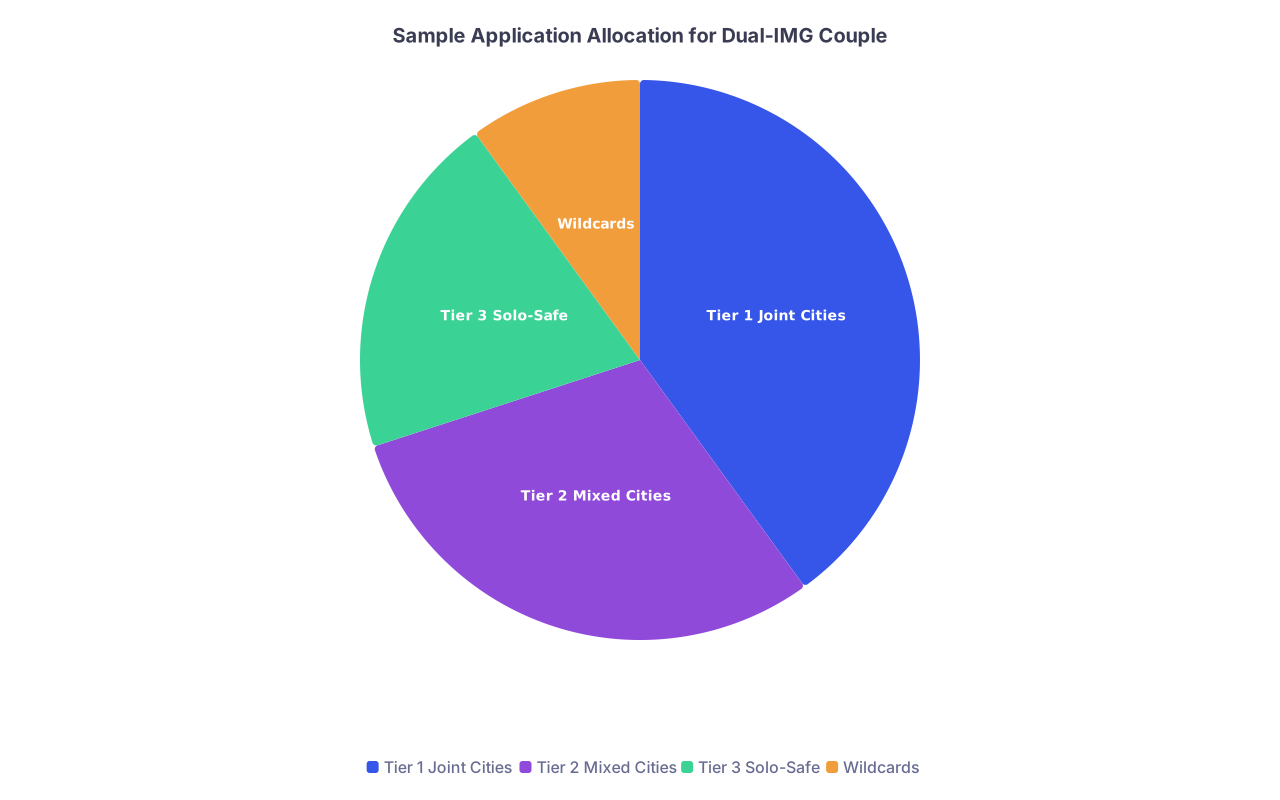
| Category | Value |
|---|---|
| Tier 1 Joint Cities | 40 |
| Tier 2 Mixed Cities | 30 |
| Tier 3 Solo-Safe | 20 |
| Wildcards | 10 |
You’re aiming for a structure something like:
- 35–45% of applications: both of you apply to programs in the same Tier 1 cities
- 25–35%: overlapping Tier 2 cities where one has stronger chances
- Remaining: Tier 3 backups for each of you individually
Step 3: Overlap aggressively where you are both viable
You do not need both of you to be competitive for the same program.
You do need both of you to be competitive for the same city or system.
Example:
- City A:
- Person A: decent shot at IM at University Hospital A, Community IM B
- Person B: solid shot at FM at Community FM A, Peds at Children’s A
This is good. You both apply to all relevant programs in that city.
Your couples rank later will include combinations like:
- A-IM University / B-FM Community
- A-IM Community / B-FM Community
- A-IM University / B-Peds Children’s
- etc.
You want multiple Cartesian pairs in the same city or hospital system.
4. Communicating with Programs Without Being Annoying
A lot of couples either say nothing (bad) or overshare in a chaotic way (also bad).
Here’s the principle: Programs can’t help you if they don’t know you’re a couple.
But they also do not want 9-page essays about your love story.
You need short, targeted, professional communication.
When to tell programs you’re a dual-IMG couple
Three main moments:
ERAS application itself
- Use the NRMP Couples Match designation
- Use the “Signaling” or specific question boxes if available
- In your personal statement:
- One of you can include a short line like:
“My partner and I are participating in the NRMP Couples Match and are both particularly interested in training in [Region/City].”
- One of you can include a short line like:
Post-interview thank-you / interest emails
Keep it something like:“I also wanted to share that my partner and I are participating in the Couples Match. They are applying in [specialty] and have applied to [Programs X/Y in your city]. We are both highly motivated to train in [City/Hospital System] together.”
If you get real traction at a site
If Program A interviews both of you or clearly likes one of you, it’s reasonable to send a short clarifying email to the PD or coordinator:“Thank you again for the opportunity to interview. I wanted to mention that my partner is also an IMG applying in [specialty] and has applied to [related program] at your institution. We are couples matching and would be thrilled to stay in the same hospital system if possible.”
Do not ask them to guarantee anything. You’re informing, not demanding.
How PDs actually think about IMG couples
Here’s the unvarnished version from conversations I’ve seen:
Positives:
- Couples are often more stable long-term. They don’t bail after PGY-1.
- Happy spouse/partner = fewer drama issues.
- If both are solid candidates, they can fill two needs at once.
Negatives:
- If one is strong and one is borderline, they feel pressured or guilty.
- Small programs have less room to maneuver if they agree to help.
- Visa complexity x 2 can scare them.
Your job is to make their decision as low-friction as possible:
- Both of you should look professional, reliable, and normal.
- Do not sound entitled or emotionally loaded (“It would destroy us if…”).
- Make it clear you understand there are no guarantees; you’re just sharing information.
5. Building a Couples Rank List That Doesn’t Sabotage You
The rank list is where couples quietly destroy their chances without realizing it.
You want three things simultaneously:
- Maximize chances to be in same program/hospital/city
- Maintain a safety net where at least one of you matches
- Avoid insane combinations you say you’ll never accept
Let’s walk it out.
Understand how the Couples Match algorithm sees you
NRMP treats you as one “unit” with many possible combinations. Examples:
- Entry 1: A – Program 1 / B – Program 1
- Entry 2: A – Program 1 / B – Program 2
- Entry 3: A – Program 2 / B – Program 1
- Entry 4: A – Program 2 / B – Program 2
- Entry 5: A – Program 3 / B – No match (this is allowed, by the way)
- Entry 6: A – No match / B – Program 3
You rank pairs, not individual programs.

| Step | Description |
|---|---|
| Step 1 | Start Ranking |
| Step 2 | Same Program Same City |
| Step 3 | Same City Different Programs |
| Step 4 | Nearby Cities Acceptable Drive |
| Step 5 | One Matched One Unmatched Safety |
| Step 6 | Both No Match |
How to structure your list in practice
In most dual-IMG couples I’ve helped, the structure roughly goes:
Top block: same-program or same-hospital combinations
Example:- A-IM at University / B-FM at University
- A-IM at University / B-Peds at Children’s in same system
Next block: same-city different-institution combinations
Example:- A-IM at Community A / B-FM at Community B in same city
- A-IM at University / B-Psych at Community in same metro
Third block: “commutable distance” combinations
Define this firmly between you. 45–60 minutes drive? 90 minutes?Fourth block: asymmetric safety pairs
Where one matches and the other is unmatched or in a less preferred city but still acceptable.Final: both unmatched
NRMP requires a terminating state. That’s the bottom.
The hard part: asymmetric sacrifice
You’ll likely face this decision:
Would you rather:
- Both match separately in strong, IMG-supportive programs 1000 miles apart
or - One of you match in a solid program while the other goes unmatched this year, to reapply next cycle with US LORs and an observer/research role in the same city?
There’s no one right answer. But you need to decide before you build your list.
If one of you has significantly stronger chances, it can be rational to:
- Prioritize combinations where the stronger candidate matches even if the other doesn’t
- Accept that the unmatched partner will spend a year in the same city building a better application (observerships, research, MPH, etc.)
What’s stupid is pretending you’ll accept being apart “if we have to,” then ranking no such combinations. The algorithm does what you rank, not what you imagine you’ll tolerate.
6. Visa Realities for Dual-IMG Couples
You cannot ignore visas as a couple. Visa misalignment will sink plans faster than anything.
Common real-world patterns
Both J-1
Very common. Easier for many community/university-affiliate programs.
Downsides: the two-year home rule later. But for matching together? Often simplest.One H-1B possible, one J-1 only
Some specialties/programs might sponsor H-1B; others won’t touch it.
You might need to:- Have the stronger candidate chase H-1B at a program used to it
- Let the other accept J-1 at a nearby institution
If you try to make both H-1B as borderline IMGs, you can squeeze out most of your options.
One US citizen/green card, one requiring J-1/H-1B
The US person has more geographic flexibility. It may make strategic sense for them to target any solid program in anchor cities where the visa-needing partner has options.
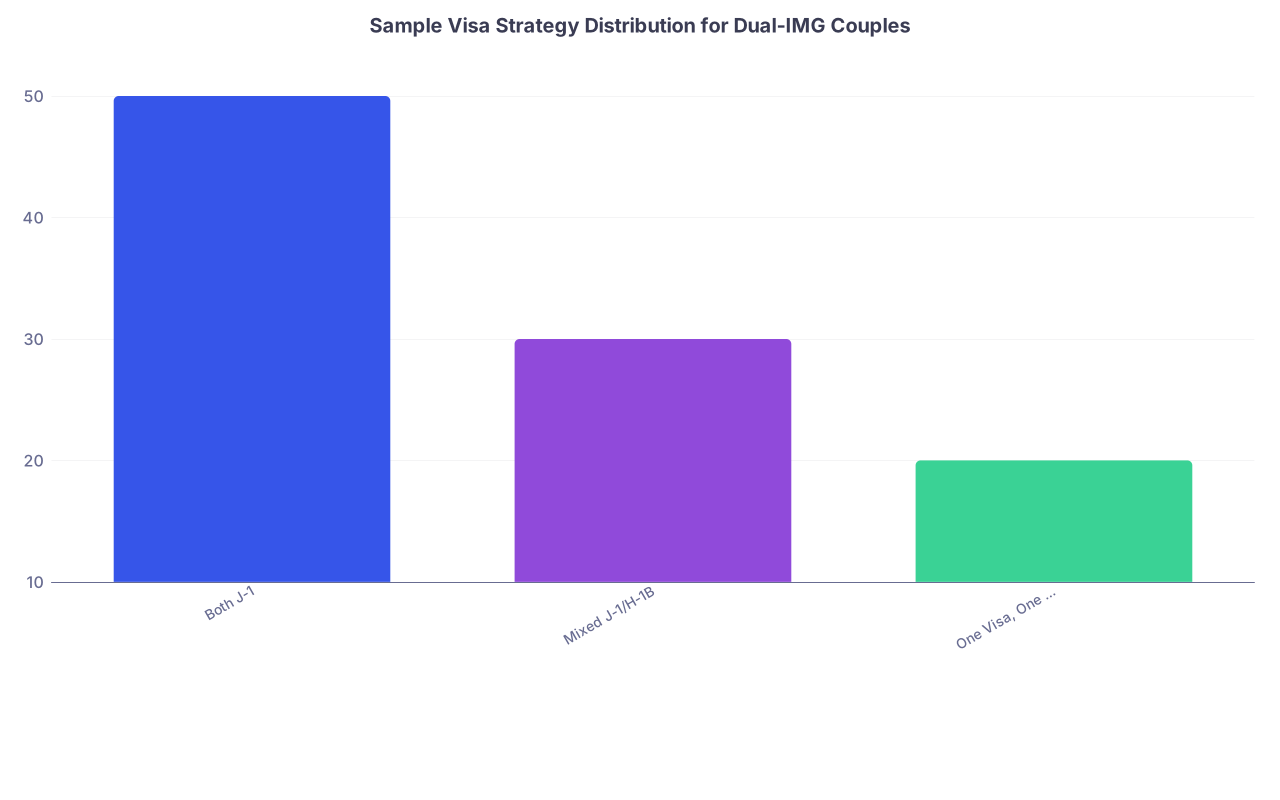
| Category | Value |
|---|---|
| Both J-1 | 50 |
| Mixed J-1/H-1B | 30 |
| One Visa, One US-PR | 20 |
Do not hide visa status. Programs hate surprises. Clear, early, and consistent.
7. Day-to-Day Tactics While Applications Are Live
Let’s bring this down from strategy-level to what you actually do week to week.
During application and interview season
Shared tracking document
Build one Google Sheet you both update, with columns:- Program name, city, state
- Specialty (IM/FM/etc.)
- IMG % and visa type
- Did A apply? Did B apply?
- Did A get invite? Did B get invite?
- Interview dates offered
- Notes on couples-friendliness
Coordinate interview dates early
If both of you get IVs in same city/system, try to cluster dates:- Same day if possible
- Consecutive days if not
Programs often will accommodate this if you ask early and politely and mention you’re a couples match pair.
Be consistent in messaging
When you talk about future plans on interviews:- Both of you should reference the same rough geographic priorities
- Both should mention being in the Couples Match when asked about family/location
Check reality every 2–3 weeks
If by late November:- One of you has 12 IVs and the other has 3
You need to be honest about how that will affect the rank list and Plan B.
- One of you has 12 IVs and the other has 3
8. Specific Sites and Systems That Tend to Be More Supportive
I’m not going to drop a magic list of “Top 10 Programs for Dual-IMG Couples” because that doesn’t exist and changes every year.
But I’ll tell you what types of systems I repeatedly see dual-IMG couples land in together:
Multi-hospital systems in mid-sized cities:
- Example patterns (not guarantees):
- Large Catholic or non-profit health systems (Trinity, Mercy, Ascension, etc.)
- County + university combinations in less flashy metros
- Example patterns (not guarantees):
University affiliates where:
- The main academic program is semi-competitive
- The community affiliates are more IMG-heavy
Couples will sometimes land one at the academic site, one at the affiliate.
Statewide systems:
- States where a single university or health system runs IM, FM, peds, psych, etc. in several cities.
You then aim for “same system, different city pairs” if same-city fails.
- States where a single university or health system runs IM, FM, peds, psych, etc. in several cities.

The point is: look for systems and clusters, not isolated stand-alone programs.
9. The Emotional Side: Don’t Let Panic Make Your Decisions
You’re going to hit a point – usually mid-January – where you’re exhausted and paranoid.
This is when couples do dumb things:
- Completely drop good, realistic joint options because one person fell in love with a shiny name-brand place they have a 5% chance at
- Refuse to rank any separate-city combinations even as safety, then act shocked if they go unmatched
- Or the opposite: overreact to interview asymmetry and essentially give up on coupling in their rank
Here's what you should do instead:
Sit down together with your spreadsheet.
Mark:
- Realistic joint city matches (same program / same city)
- Acceptable but not ideal commutable-area matches
- Solo-safe options where one of you is okay going alone
Write down, physically, in one sentence:
- “As a couple, we are willing to live apart if and only if: ___”
or - “We prefer to risk one of us being unmatched rather than live apart.”
- “As a couple, we are willing to live apart if and only if: ___”
That sentence controls the bottom 30% of your rank list.

| Step | Description |
|---|---|
| Step 1 | Define Priorities |
| Step 2 | Prioritize joint city pairs |
| Step 3 | Include solo-safe options |
| Step 4 | Anchor Tier 1 cities |
| Step 5 | Build rank list in logical blocks |
| Step 6 | Same city more important than both matched? |
10. What You Should Do Today
You do not need another abstract pep talk. You need concrete moves.
So here’s your next step, right now:
- Open a blank Google Sheet.
- Create columns: City, Program, Specialty, IMG %, Visa, A applied?, B applied?, Couples-friendly?, Notes.
- List 10 cities where you both already applied to at least one program.
- For each city, look up:
- How many total programs for each of your specialties exist there
- How IMG-heavy each seems
- Highlight 3–5 cities that could realistically be your “anchor” couples locations.
Do that today. Not this weekend. Today.
Because once those anchors are clear, every other decision—where to send late applications, how to word your emails, how to build your rank list—gets easier and less emotional.
You’re not just “hoping it works out.” You’re running a plan that gives two international physicians an actual shot at training together in a place that wants you there.