You’re sitting on the couch with your spouse. One of you has a spreadsheet of programs. The other has Zillow open and a cost-of-living calculator. You’re an IMG trying to match. They’re not in medicine at all—and they need a real job, a community, and some kind of life that is not just “supporting your residency.”
You’re not just asking: “Where can I match?”
You’re asking: “Where can we both build something that doesn’t suck for three+ years?”
This is where picking “IMG-friendly” isn’t enough. You need “IMG-and-spouse friendly.”
Let’s walk through how to do that, step by step, like an adult who has another adult’s life attached to yours.
1. Get brutally clear on your actual constraints
Before you hunt for specific programs, you need to know your non‑negotiables as a couple. Otherwise you’ll spin your wheels.
There are 4 main buckets you have to define together:
- Visa and immigration
- Spouse’s job reality
- Lifestyle (kids, family support, religious/cultural needs)
- Your competitiveness as an IMG
Do this on paper. Not in your head.
Visa / immigration reality
If you’re an IMG, visa is often the first domino.
Ask yourself:
- Are you needing J‑1, H‑1B, or do you already have a green card / EAD?
- Is your spouse a U.S. citizen / permanent resident or also on a dependent visa?
Visa consequences with a non-physician spouse:
- J‑1: Your spouse gets J‑2 and can apply for an EAD. They can work, but:
- There’s processing time (2–5 months commonly)
- Some employers are nervous about “temporary” work authorization
- H‑1B: Spouse gets H‑4. Unless they independently qualify (H‑1B, green card, etc.), they generally can’t work. That’s a big deal.
- Green card / EAD: You have maximum flexibility; focus can shift to jobs and lifestyle.
Be honest:
If your spouse absolutely must work for financial or sanity reasons, you should be very cautious about chasing H‑1B at all costs.
Spouse’s job reality
This is the part programs never talk about but absolutely dictates how miserable or stable your life will be.
You two need to answer:
- What does your spouse actually do?
- Accountant? Teacher? IT? Hospitality? Lab tech? Retail? Remote-friendly corporate job?
- Do they already have a portable job (remote, freelance, consulting)?
- Do they need a license in each state (teacher, nurse, psychologist, therapist, lawyer, etc.)?
- How quickly do they realistically find work in a new city? 1 month? 6 months?
For example:
- Spouse is a software engineer with remote options: huge geographical flexibility. You can consider smaller cities and more rural IMG-heavy programs.
- Spouse is a teacher: they’ll need state certification. Moving to a random state with poor teacher hiring is dumb.
- Spouse works in hospitality, retail, service: they need a city with actual businesses, tourists, or at least a functioning economy. Small college towns can work. Isolated rural areas? Often terrible.
Kids, extended family, and cultural needs
If you have kids, or your spouse expects to see their parents more than once every two years, geography matters harder.
Clarify:
- Do you need:
- An airport with real flights (hub or at least regional with good connections)?
- A religious community (mosque, temple, specific denomination, etc.)?
- Access to language communities (Spanish-speaking, Arabic-speaking, South Asian, etc.)?
That immediately knocks out a chunk of ultra-rural IMG-heavy places. Which might be good—no point matching in the middle of nowhere if your spouse disintegrates emotionally.
Your competitiveness as an IMG
You can’t pick locations like a Harvard grad with a 260.
Look at:
- USMLE scores
- Number of attempts
- U.S. clinical experience
- Gap years
- Specialty (FM and IM are not the same as Derm, obviously)
Be real: if you’re mid-tier competitive as an IMG, you’ll probably be choosing among community programs, mid-sized cities, and some rural-ish locations. Your spouse has to be on board with that kind of geography.
2. Understand what “IMG-friendly” actually looks like
You’re not looking for marketing language on the website (“We value diversity”). You’re looking at the numbers and patterns.
Here’s what I tell couples to focus on.
Read the tea leaves: how IMG-heavy is the program?
You can usually check each program’s resident roster. You’re looking for:
- Strong IMG presence (multiple per year, consistently)
- Diversity of schools, not just one pipeline school
If 50–80% of residents are IMGs in IM/FM/Peds, that’s truly IMG-friendly. If they have “one brave IMG” every 3 years, that’s tokenism, not a pattern.
Check visa behavior
You need to know not just “do they sponsor?” but “how do they behave?”
Look for:
- Do they sponsor J‑1 only, or J‑1 and H‑1B?
- Do upper-year residents list their visas on LinkedIn (clue: H‑1B presence)?
- Are there IMGs who progressed to fellowships from there? That often implies stable visa situations.
If your spouse must work, I generally advise:
- Lean J‑1: spouse usually can get J‑2 EAD and work.
- Treat H‑1B-only programs as dangerous for a single-income family unless your spouse has independent immigration status.
3. Regions and city types that work well for IMG + non-physician spouse
Now let’s talk geography. There are patterns.
You’re usually choosing among these buckets:
- Big metros with many hospitals
- Mid-sized “quiet but functional” cities
- Small towns / rural community programs
I’ll give you a blunt take.
Big metros: good for spouse, tougher for matching
Think: NYC, Chicago, Houston, Philadelphia, Miami, Los Angeles.
Pros for your spouse:
- Tons of job options across many industries
- Public transport (critical if you’re on one car or they don’t drive)
- Established immigrant communities, places of worship, ethnic markets, etc.
- Networking, social life, opportunities beyond “hospital friends”
Cons for you as IMG:
- More competition
- Some academic centers barely consider IMGs unless you’re top-tier
- Higher cost of living—one PGY-1 salary plus jobless spouse can be rough early on
Where this works best:
When your spouse is primary breadwinner or in a field that needs industry concentration (marketing, design, tech, some business roles). Also when you’re relatively competitive and can realistically land a city program.
Mid-sized “second-tier” cities: often the sweet spot
Think:
Buffalo, Rochester, Toledo, Dayton, Grand Rapids, Des Moines, Scranton, Reading, Greenville (SC), Winston-Salem, Oklahoma City, Tulsa, Albany, Spokane.
This is where a lot of IMG couples do well.
Pros:
- Many community or university-affiliated community programs that are actually IMG-friendly
- Lower cost of living
- Decent job markets in:
- education
- healthcare support
- retail
- small business
- some corporate back-office / finance / IT
- Often have at least one decent airport and some immigrant communities
Cons:
- Your spouse may still need to hustle for a job; things are slower than in huge metros
- Social life can be quieter; this hits some spouses hard, especially if they leave a big city lifestyle behind
This is my default recommendation zone for IMG + non-physician spouse who needs to work but doesn’t need to be in Manhattan or LA.
Rural towns and “middle of nowhere” programs: proceed carefully
There are many IM/FM programs in places that are basically:
- One hospital
- One Walmart
- A couple of chain restaurants
- Nearest real city = 1–3 hours away
These can be very IMG-friendly.
They can also be absolute hell for a non-physician spouse.
Spouse risks:
- Very few job opportunities outside the hospital system or local school district
- Minimal public transport
- Isolation, especially if:
- you don’t drive yet
- you’re a racial/ethnic/religious minority with no local community
- Limited childcare options, limited mental health support, limited everything
These can work if:
- Spouse is remote / online employed
- You both are genuinely okay with a quiet, low-stimulation environment for 3 years
- You aggressively plan social outlets (church, community center, hobbies, etc.)
4. Program-filtering strategy when you have a spouse
Here’s how I’d actually build your programs list when you’re married to a non-physician.
Step 1: Choose a realistic specialty / track
If you’re an IMG married to someone depending on your mutual stability, this is not the time to chase ultra-competitive specialties unless you are objectively top-tier.
For many IMGs with families, the stable choices are:
- Internal Medicine (community or community-university programs)
- Family Medicine
- Pediatrics (some regions)
- Psychiatry (in certain IMG-friendly locations)
You can absolutely go for IM → Cards, or FM → Sports Med later. But survival first.
Step 2: Use filters that matter for both of you
On FREIDA or program lists, you filter by:
- Specialty
- Visa sponsorship (J‑1, H‑1B)
- Program type (community, community with university affiliation, university)
Then, you and your spouse filter by:
- Population > 100,000 (decent proxy for job opportunities + some social life)
- Distance to nearest major city / airport (Google Maps it)
- Cost of living (any basic COL calculator)
Create a shared spreadsheet. Have columns like:
| Column | What to Record |
|---|---|
| Program Name | Official program title |
| City, State | Location |
| Visa Type | J-1, H-1B, Both |
| % IMGs (approx) | Low / Medium / High |
| Population (metro) | Number or rough category |
| Spouse Job Market Score | 1–5 (you two decide) |
| Cost of Living | Low / Medium / High |
| Airport Access | Local / 1 hr drive / 2+ hr drive |
Let your spouse own the “Spouse Job Market Score” column. They research Indeed/LinkedIn for their role in that city and grade it.
5. Specific program/location patterns that often work for IMG couples
I’m not giving you a ranked list of “best programs.” That’s lazy and usually wrong. I’m giving you patterns and example types.
Category 1: Rust Belt / Midwest mid-sized cities
These often hit a sweet spot:
- IMGs are common in IM/FM
- Cost of living is relatively low
- Decent school systems, reasonable job markets
Example types (not endorsement of specific programs):
- Internal Medicine programs in:
- Ohio: Toledo, Dayton, Akron, Canton, Youngstown
- Michigan: Grand Rapids, Lansing, Saginaw
- Pennsylvania: Scranton, Reading, Erie
- Family Medicine in similar cities
Your spouse will usually find something in:
- Healthcare support (clinic, admin, lab, billing)
- Schools, colleges, universities
- Retail, banking, local government
Category 2: Southern regional centers
Think places like:
- Greenville / Spartanburg (SC)
- Winston-Salem / Greensboro (NC)
- Chattanooga / Knoxville (TN)
- Baton Rouge / Shreveport (LA)
- Oklahoma City / Tulsa (OK)
Pros:
- IMG-friendly IM/FM/Psych in many of these areas
- Growing economies, more jobs across service, healthcare, logistics, some tech
- Lower cost of living
Cons:
- Cultural adjustment can be real if you’re from major coastal cities or abroad
- Public transport is weak to nonexistent; driving is mandatory
- Some spouses feel socially isolated if they’re not used to Southern culture
6. How to check if a program is “spouse aware” without them saying it
“Spouse-friendly” isn’t on any website. You have to infer it.
Here’s how.
During interview season
Ask smart questions—not whiny ones.
Examples:
- “How many residents are married or have partners? Do many have kids?”
- “Is there flexibility or understanding around major family events?”
- “Do residents’ spouses/partners usually find the area livable from a job and community standpoint?”
Watch the reaction. Programs that are used to residents with families will answer smoothly:
You’ll hear things like:
- “Half our residents are married; we have several with kids”
- “We have a residents’ families WhatsApp group”
- “We’ve had multiple two-physician and physician‑non‑physician couples here”
- “Most residents are single” (translation: culture may not be family-oriented)
- “We really emphasize 100% commitment to training first,” with a tone that dismisses outside life
- Confusion when you mention spouse jobs (“Uh… we don’t really track that”)
Talk to current residents’ spouses if possible
Some programs unofficially connect applicants’ partners with current partners/spouses. If they offer this, say yes.
Your spouse should ask:
- “Do you feel there are job opportunities here for non-physicians?”
- “How long did it take you to find work?”
- “Do you feel like the program respects your partner’s family time at all?”
- “What’s one thing you wish you had known before moving here?”
They’ll tell you the truth in ways the PD never will.
7. If your spouse can’t easily work: surviving on one income
Sometimes the answer is: spouse won’t be able to work (visa, licensing, language, childcare). Then the logic changes.
You’ll need:
- Low cost of living as a priority
- A location that at least gives them:
- Safe neighborhoods
- Walkable areas or access to a car
- Places to go: parks, libraries, cafes, community centers, religious centers
- Strong resident camaraderie, because they’ll be lonely if you’re gone 60–80 hours a week
In this case, I’d rather you pick a mid-sized cheap city than:
- Super expensive big city
- Tiny rural town with literally nothing to do
Your spouse might not care about the prestige differences. They will care about being stuck in the middle of nowhere with no job and no one to talk to.
8. A quick comparison: location types vs spouse needs
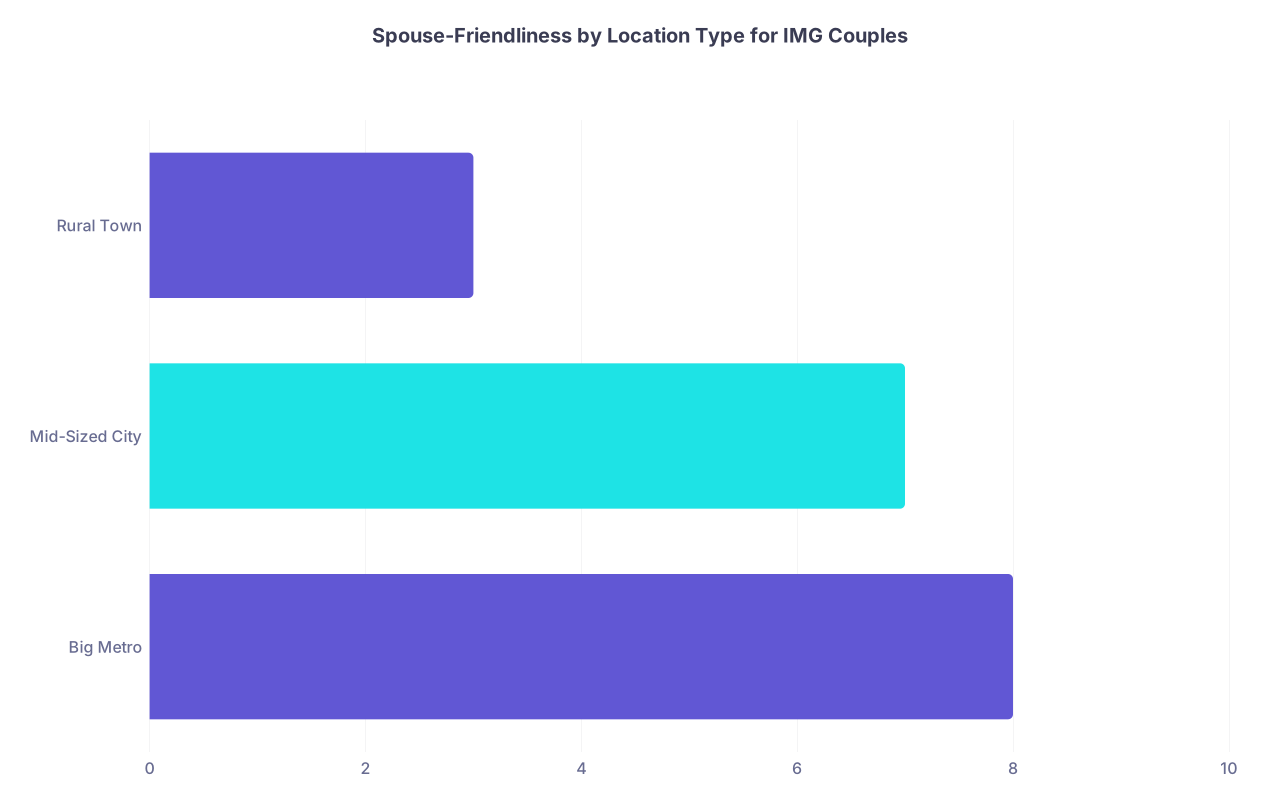
| Category | Value |
|---|---|
| Big Metro | 8 |
| Mid-Sized City | 7 |
| Rural Town | 3 |
Scale: 1 = terrible for most spouses, 10 = excellent.
This isn’t scientific. It’s what I’ve consistently seen.
9. Tactical tips for building your rank list as a couple
Once interview dust settles, you’ll sit together again with that spreadsheet. Here’s how to be systematic.
- Each of you independently rank locations (not programs) from 1–10 on:
- Job prospects for spouse
- Lifestyle tolerability
- Access to family / flights
- You rank programs 1–10 on:
- Training quality
- IMG track record
- Visa reliability
Then merge into a simple “combined score.”
Programs in cities where both of you can see yourself surviving → rank those higher than marginally more prestigious programs in places where your spouse will be miserable.
Yes, I’m telling you: for most people, happy spouse + decent program beats brand-name program + destroyed marriage.
You don’t want to finish residency with a fancy CV and a ruined relationship.
10. What to do now if you’re early in the process
If you’re pre-app or early applicant phase, here’s how to not waste the next year:
- Your spouse should start job scouting in 3–4 likely regions now. Not just dreaming—actually searching real postings.
- You should make a draft geographic preference map:
- Green zones: we both like and job market seems decent
- Yellow zones: okay if needed
- Red zones: absolutely not (for either of you)
Use that map when you decide where to do observerships, away rotations, or networking. There’s no point building connections only in places your spouse will refuse to move to.

FAQs
1. Should I prioritize visa type (J‑1 vs H‑1B) or my spouse’s ability to work?
If your spouse must work for financial or psychological reasons, you prioritize their ability to work. That usually means J‑1 over H‑1B when you’re on a single-physician track and they don’t have independent immigration status.
People overvalue H‑1B and undervalue not imploding as a couple. J‑1 with a working spouse in a decent mid-sized city is often a far better real-life setup than H‑1B in a remote, miserable town where your spouse is stuck at home.
2. Are university programs or community programs better for IMG couples?
For IMG couples, community or community-university hybrids often hit the right balance:
- More IMG-friendly admission patterns
- Often located in mid-sized cities (better for spouse jobs and cost of living)
- Slightly saner cultures than some malignant big-name university programs
Pure university programs in huge academic centers can work—but usually only if you’re strong on paper and your spouse’s career really benefits from big-city ecosystems.
3. My spouse doesn’t speak English well yet. How should that affect our location choices?
You’ll want:
- A city with an immigrant community that shares your language (or at least something close)
- ESL resources: community colleges, adult education centers, churches or cultural organizations offering language classes
- Low pressure for them to immediately work if they’re not ready
In practice, that usually means avoiding very small, isolated towns. Look for cities with established immigrant neighborhoods, religious centers, or cultural associations.
4. Is it smart to rank a prestigious but spouse-hostile program higher “for my career”?
If you’re single, maybe. If you’re married to a non-physician whose life depends on this move, usually no.
Residency is hard enough when your home life is stable. When your spouse is unemployed, lonely, and resents the place you dragged them to, your performance drops, your marriage suffers, and your “career advantage” is often not worth it. A solid, mid-tier, IMG-friendly program in a livable city that works for both of you almost always beats a prestige badge that costs you your support system.
Key points:
- You’re not just matching yourself—you’re matching your spouse’s job, community, and mental health. Treat that as non-optional.
- Favor IMG-heavy programs in mid-sized, affordable cities where your spouse has plausible work and a life outside your hospital.
- When in doubt, sacrifice a bit of prestige for a city and program that both of you can survive—and maybe even like—for three to four years.