IMG with Modest Scores but Strong Experience: Where Policies Favor You
What do you actually do if your Step scores are 215–225, but you’ve got real-world clinical experience, research, maybe even a prior residency abroad—and every “top” program wants a 240+?
If that is your situation, this is your playbook.
You are not chasing every program. You are hunting for specific policies and patterns that tilt the field in your favor as an IMG with average scores but above-average experience.
Let me walk you through where those places are, how to recognize them fast, and how to attack this strategically instead of emotionally.
1. First Reality Check: Your Profile Type
You’re not a generic “IMG.” You fall into a specific lane. Your lane dictates where policies will help you.
Common profiles I see:
- Fresh grad IMG, Step 1 pass, Step 2 CK 215–230, 0–1 US rotations
- Older grad (5–10+ years since graduation), strong home-country clinical experience, maybe already a specialist abroad
- Research-heavy IMG: average scores, but 2–5 publications, maybe US research
- US-based IMG: Green card or citizen, studied abroad (Caribbean, Eastern Europe, etc.), decent English and some US exposure
Programs that are strict about 240+ will not bend for you. Stop trying to “convince” them. They have enough applicants.
Your targets are:
- Programs with a track record of IMGs
- Programs with flexible minimum scores or none listed
- Community or safety-net hospitals desperate for boots on the ground
- Places that care more about work ethic and reliability than prestige
You win on maturity, work history, and being usable from day 1. Not on paper glamour.
2. The Types of Programs Where Policies Favor You
Let’s name them clearly, because this is where people waste years guessing.
A. Community Internal Medicine & Family Medicine Programs
No, they are not glamorous. But they match IMGs with modest scores every single year.
Look for:
- Non-university, non-name-brand hospitals
- Located in smaller cities or less “desirable” areas (Midwest, South, some Northeast community hospitals)
- Websites that say “We welcome IMGs” or show 30–80% IMG residents in current rosters
These programs want:
- People who show up on time, work hard, and don’t quit mid-year
- Residents who are okay with scutwork and volume
- Often, visa candidates (some are built around J-1s)
If you have strong experience—like several years as a physician abroad, solid LORs, or years as a US hospitalist scribe/MA/observer—this is where that actually matters.
B. Safety-Net & County Hospitals
These places exist to serve underserved populations. They often lean heavily on IMGs.
Typical patterns:
- Very high patient volume
- Underserved areas, Medicaid/Medicare heavy
- Residents do a lot; attendings are sometimes stretched thin
Programs like some Bronx community hospitals, Detroit-area safety-net programs, parts of New Jersey, parts of Texas—often full of IMGs with non-stellar scores, but serious work ethic.
These programs care about:
- Real patient care experience, even if it’s from abroad
- Evidence you’ve worked in tough environments, not just textbook-land
- Spanish or other language skills can be a real bonus in certain regions
C. Programs With Explicitly IMG-Friendly Policies
You can literally see this on their current resident page. Scroll through photos and bios:
- If >50% of them went to international schools, you’re in the right neighborhood.
- If they openly list countries: India, Pakistan, Egypt, Nigeria, Caribbean schools, Eastern Europe, etc.—that’s a green light.
Programs that say:
- “We sponsor J-1 visas” or “We sponsor J-1 and H-1B”
- “We have no minimum USMLE score requirement” or “We consider the application holistically”
Those are not marketing lines. They often reflect actual policy.
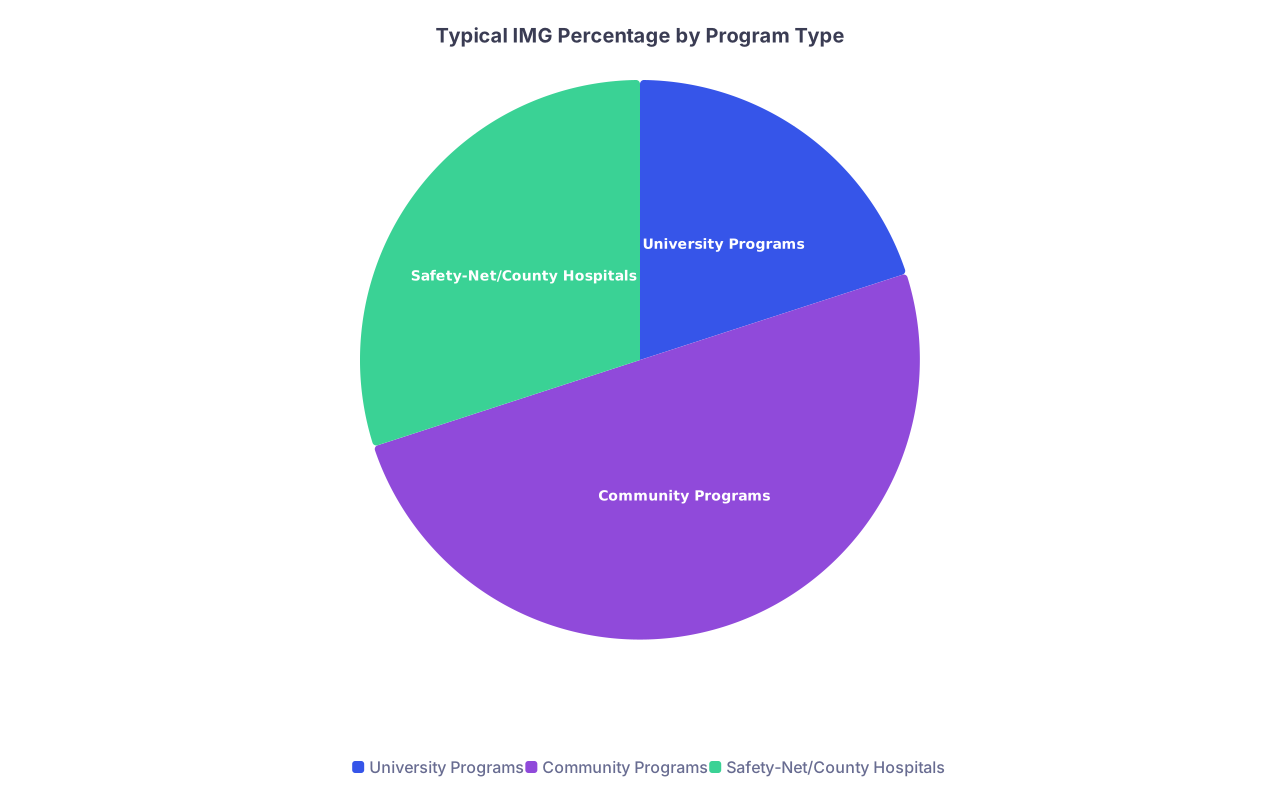
| Category | Value |
|---|---|
| University Programs | 20 |
| Community Programs | 50 |
| Safety-Net/County Hospitals | 30 |
D. New or Recently Expanded Programs
Newer ACGME-accredited programs have a huge problem: not enough applicants who trust them yet.
Which means: more open doors for you.
Clues:
- Program started within the last 5–8 years
- Rapid expansion of positions (e.g., from 8 → 12 → 16 per year)
- Located in “B-list” cities or rural areas
These programs sometimes relax score expectations in early years to fill slots. They are more willing to take chances on nontraditional candidates.
Your strong experience is a way for them to say to the hospital: “We didn’t get 250+ scores, but we got someone who has already managed patients, led teams, or done real clinical work.”
3. How to Systematically Find These Programs (Not Just on Reddit Rumors)
You should not be guessing. You should be filtering.
Step 1: Use Public Data + Program Websites
Go on FREIDA and program websites and build a short list.
You want programs that:
- Take IMGs (obvious, but many people ignore this)
- List visa sponsorship (J-1 at minimum)
- Have no strict cutoffs or have flexible ones (e.g., 210–220)
Then check current residents by name and med school.
If 10 out of 12 are IMGs from mid-tier or lesser-known schools, your 220 with strong experience is not “too weak.” You’re in their usual range.
| Filter Type | What to Look For |
|---|---|
| IMG Presence | ≥ 40–50% current residents are IMGs |
| Score Policy | No strict cutoff or cutoff ≤ 220 |
| Visa Policy | Explicit J-1 (and ideally H-1B) sponsorship |
| Location | Smaller cities, Midwest/South, non-coastal |
| Program Age | Newer or recently expanded programs |
Step 2: Track Score Friendliness Indirectly
Programs rarely say, “We take 215s.” But you can infer it:
- They list “We do not have a minimum score requirement” → softer on scores
- They mention “We look at attempts” heavily → they probably see lots of retakers
- Their residents list Step scores on LinkedIn (yes, people do this; search “[program name] internal medicine resident USMLE Step 1” on Google/LinkedIn)
If you see multiple residents who matched with 220–230 range and they’re IMGs, that’s an encouraging sign.
Step 3: Look for Older Grads in the Roster
If a program has residents who graduated med school 6–10 years ago and are IMGs, that means they’re flexible on “YOG” (year of graduation).
If you’re an older grad with strong experience, those programs are gold. They’re already proving they don’t automatically trash older applications.
4. Where Strong Experience Actually Gives You an Edge
Experience only matters if the program values it more than raw numbers.
Here’s where it moves the needle.
A. Hospitals Drowning in Workload
High-volume community or safety-net programs want residents who can:
- Handle stress
- Talk to 10–20 patients a day without melting down
- Not freak out when the ED calls for another admission at 6:45 pm
If you’ve worked as:
- A physician abroad
- An ICU doc or ER doc outside the US
- A busy GP in a low-resource setting
You become attractive—if you can articulate that in your personal statement and interviews as “I can work. I have done this before.”
B. Programs That Emphasize Service Over Research
Not every program is obsessed with publications.
Some pride themselves on:
- Serving underserved patients
- Community outreach
- Clinical excellence and bedside manner
You’ll see this language on their website: “Our mission is to serve a diverse, underserved community” or “We prioritize compassionate care.”
If you’ve:
- Run outreach clinics
- Worked in refugee camps
- Done long-term volunteer clinical work
Lean into that. These programs will appreciate that far more than a mediocre research CV.

C. Programs Struggling with Resident Retention
Some less-competitive programs have a huge problem: residents quit or transfer. Especially US grads who see them as a backup and then leave when something better appears.
So they quietly favor IMGs who:
- Are more likely to stay for the full program
- Need visa sponsorship (so they have strong reasons not to leave randomly)
- Have longer-term stability goals (permanent job, green card, etc.)
Your prior work history and life stability (family, roots, commitment) can make you more “reliable” in their eyes than a US grad who might bolt.
5. How to Package Your “Strong Experience” So Programs Care
Your score is your weak point. You can’t hide it. So you pivot.
You must make your experience the main story.
A. Personal Statement: Not Your Life Story. Your Usefulness Story.
Stop writing sentimental essays about childhood dreams of being a doctor.
Write like this instead:
- First paragraph: 1–2 sentences on who you are now (IMG with X years experience in Y setting)
- Middle: Specific, concrete examples of work you’ve done
- Final: How that makes you walk in as a PGY-1 who can already shoulder responsibility
Example angle:
- “In my 4 years as an internal medicine physician in a 300-bed hospital in Lahore, I routinely managed 20+ inpatients per day, including complex multi-morbidity cases with limited subspecialty access. That environment taught me to prioritize, communicate clearly across teams, and own my patients’ outcomes.”
That sounds like someone I can put on the floor and not babysit.
B. Letters of Recommendation: Aim for “Trust This Person With My Patients”
Your LORs must say more than “hardworking and smart.”
You want phrases like:
- “I would trust Dr. X with my own family’s care.”
- “Dr. X functioned at the level of a first-year resident in our program.”
- “She quickly became the point person for complex patients in our clinic.”
For US clinical experience (even observerships), push your attendings:
- Ask them to comment on your clinical reasoning
- Ask for mention of your communication with nurses, allied staff, and patients
- Ask them to explicitly compare you to current interns or residents
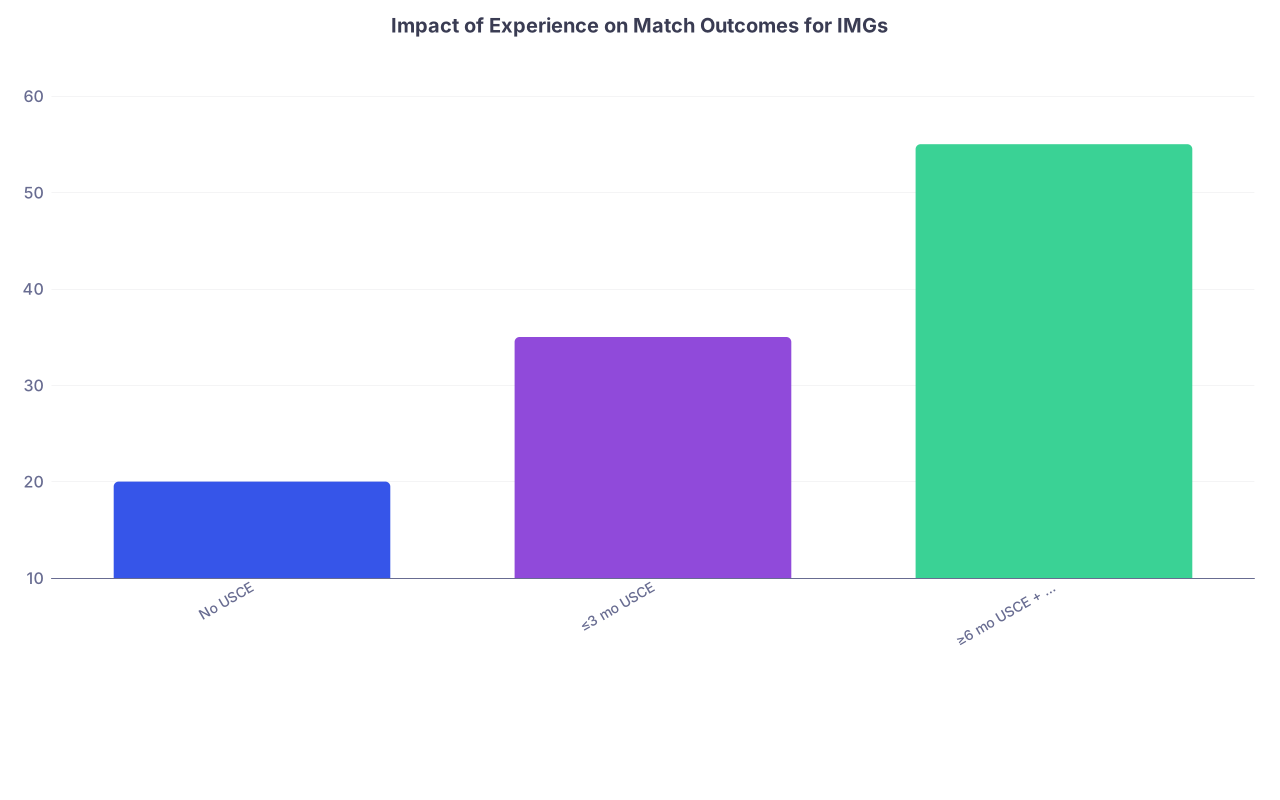
| Category | Value |
|---|---|
| No USCE | 20 |
| ≤3 mo USCE | 35 |
| ≥6 mo USCE + Strong LORs | 55 |
C. CV: Don’t Hide Real Physician Work under “Volunteer”
If you were a fully licensed attending abroad, do not tuck that under some tiny “volunteer” bullet.
Label it clearly:
- “Internal Medicine Physician – [Hospital Name], [City, Country]”
- List scope: inpatient/outpatient, average daily census, types of patients
- List concrete duties: supervising juniors, managing codes, communicating with families
Programs know what physicians do. They will get it.
6. Strategy: Where You Actually Apply (and Where You Don’t)
You don’t have unlimited money or time. You need a targeted shot.
A. Specialties That Will Actually Consider You
With modest scores:
- Realistic: Internal Medicine, Family Medicine, Pediatrics (at IMG-heavy community programs), Psychiatry (in some regions)
- Conditional: Neurology (at a few IMG-friendly places), Pathology (if you have some exposure), PM&R (if strong rehab exposure)
- Forget It Unless Exceptionally Connected/Unique: Dermatology, Ortho, Ophtho, ENT, Plastics, most Surgical subspecialties
If you tell me you have a 218 and want categorical surgery at a major academic center, I’ll be blunt: you are wasting your energy.
B. Number of Programs
- If you’re an IMG with 210–225 and modest red flags: 120–180 applications in IM/FM is common and often necessary.
- Mix: 60–70% heavy-IMG community/safety-net, 20–30% mid-tier programs that take IMGs but have some higher score ranges, 10% “reach” programs that match your specific experience (e.g., global health interest, language match).
C. Geographic Targeting
You are not competing evenly everywhere.
Regions often more IMG-friendly:
- New York (especially outer boroughs and upstate community programs)
- New Jersey
- Michigan (Detroit, Flint, Saginaw, etc.)
- Ohio, Pennsylvania (non-Philly, non-Pittsburgh community hospitals)
- Texas (varies, but several IMG-heavy programs exist)
- Some Southern states with trouble recruiting (Mississippi, Louisiana, Arkansas)
Ultra-competitive choices like Boston, San Francisco, Seattle university programs? You can apply if you want, but don’t build your hopes there.

7. Communication Strategy: How You Talk About Your Scores and Experience
At some point they’ll see your 215/220 and ask about it. You need one clean, confident answer.
A. The Script for a Modest Score
Something like this:
“My Step 2 score is not as high as I wanted. I underestimated the timing with my clinical work and family responsibilities. Since then, I’ve focused on sharpening my knowledge in real settings—managing complex patients, working closely with teams, and constantly reading around my cases. My day-to-day performance as a physician more accurately reflects my abilities than that single exam day.”
Short. No drama. Take responsibility. Then pivot to your strengths.
B. Don’t Over-Apologize
You are not a problem to be explained away. You’re a candidate with a weaker number but stronger lived experience.
If you start every answer with “Sorry about my score,” you’re done.
Mention it once if asked. Then keep talking about:
- Your work ethic
- Your adaptability
- Specific examples of patient care you’ve handled well

| Step | Description |
|---|---|
| Step 1 | IMG with modest scores |
| Step 2 | Address briefly if asked |
| Step 3 | Highlight strong clinical experience |
| Step 4 | Emphasize reliability and work ethic |
| Step 5 | Connect to program needs - high volume, underserved |
| Step 6 | USMLE score concern |
8. Red Flags That a Program Will Not Help You (Even if They Say “Holistic”)
Some programs love putting “we review applications holistically” on their site. Then quietly filter out everyone under 235.
Here’s how you sniff them out and avoid wasting applications.
Bad signs:
- Program website brags heavily about average Step 2 > 240 or insane fellowship match at top-tier places
- Current residents: mostly US MD, a few US DO, maybe 1–2 IMGs from “prestige” foreign schools
- PD or APD LinkedIn or talks repeatedly emphasize “academic excellence” and “research productivity”
- They require Step 3 for IMGs but not for US grads (this is sometimes a quiet filter)
If your profile is: no research, average scores, strong clinical experience, these places are simply not built around your strengths.
You’re not morally obligated to “just try.” You’re allowed to be strategic.
9. Putting It All Together: Your Next 30 Days
Here’s exactly what I’d do if I were you, right now.
- Define your specialty focus: likely IM, FM, maybe Psych or Peds.
- Use FREIDA + program websites to build a list of 150–200 programs sorted into:
- IMG-heavy community/safety-net programs
- Mixed programs with some IMGs and flexible policies
- A small set of reach programs that align with your experience
- For each program, quickly record:
- % IMGs in current residents
- Visa policy
- Any score language
- Location type (rural/small city/metro)
- Rewrite your personal statement to be completely experience-centered, not childhood-story-centered.
- Push your strongest attendings (especially US-based) for detailed LORs that explicitly state you function at resident level.
- Prepare a clean, confident answer for: “Tell me about your scores” and “Why are you an IMG still applying now?”
- Identify 5–10 programs that are your best fit (heavy IMG, value experience, match your background) and customize emails + ERAS messages to them:
- Short intro
- One paragraph tying your experience to their mission/population
- Clear interest in their specific program

You’re not trying to impress everyone. You’re trying to be obviously useful to the right programs.
FAQ (Exactly 3 Questions)
1. My Step 2 is 215 and I failed Step 1 once, but I have 5+ years of internal medicine experience abroad. Do I still have a realistic chance?
Yes, but only if you’re selective and honest with yourself. You should focus almost entirely on IMG-heavy community internal medicine and family medicine programs, especially in smaller cities and underserved areas. Your years of experience can absolutely outweigh a bad score for the right PD who needs dependable residents. But you’ll likely need to apply broadly (150+ programs), have strong, specific LORs, and be ready to explain your exam history clearly and calmly.
2. Is it worth doing unpaid observerships or externships if I already practiced as a physician in my home country?
Yes. Unfair, but yes. Program directors need to see that you can function in the US system—EMR use, communication with nurses, rounding culture, documentation, professionalism standards. Even 2–3 solid US observerships, with strong letters from attendings who say you function at a PGY-1 level, can push you over applicants who have only foreign clinical experience, even if they have slightly better scores.
3. I have strong research output but modest scores. Should I still target academic university programs?
Selective targeting only. If your research is serious—first-author papers, ongoing projects, US-based PI, conference presentations—then some mid-tier academic IM programs may look at you despite lower scores, especially if your research matches their interests. But pure research will not overcome modest scores at the most competitive university hospitals. Use your research strength to justify applying to a limited set of aligned academic programs, but keep the majority of your list solidly community and IMG-friendly, where your application is more likely to translate into actual interviews.
Key points: stop chasing prestige programs that are built around 240+ scores, hunt for places that rely on IMGs and value real-world experience, and package your background as “ready-to-work resident” instead of “test score redemption story.”