
The wrong residency choice will make living away from your family unbearable. The right one will not fix the pain, but it will make it survivable.
You are not just an “IMG applicant.” You are an IMG with your parents, spouse, or kids on another continent. That changes everything about how you should pick programs. Many people will pretend it doesn’t. They’re wrong.
Here is how you actually choose residency programs when your family is abroad and you need policies, culture, and logistics that do not destroy you.
Step 1: Admit What You Really Need (Not What Sounds “Impressive”)
Forget “top 10 programs” and name brands for a minute. If your family is abroad, your non‑negotiables are different:
- Time you can actually control
- A schedule that occasionally allows travel
- A place where people won’t look at you like an alien for needing visas, affidavits, or travel flexibility
- A program that doesn’t punish you for having a life outside the hospital
So before you even open FREIDA or ERAS, write down three categories:
Emotional / Family Needs
Examples:- Need at least 1 chance per year to travel home for 2–3 weeks
- Need predictable vacation blocks (not random scattered days)
- Need some weekends off to maintain video call times with family in different time zones
- Need access to an airport with direct or reasonably short connections to your country
Immigration / Visa Needs
Examples:- Need J-1 because H-1B is not realistic with my scores / specialty
- Need H-1B because of long‑term plans (spouse, kids, green card path)
- Need a program with actual experience sponsoring IMGs, not “we sponsored one person 8 years ago”
Workload / Burnout Risk
Examples:- Cannot handle malignant culture on top of homesickness
- Need a place with at least some support (wellness, counseling, IMG mentors)
- Need a city where you can build some kind of social life, not just survive in the hospital
Be honest. If “see my children in person at least once a year” is at the top of that list, then a brutally malignant surgical prelim spot in the middle of nowhere is not “better than nothing.” It’s how people quit medicine.
Step 2: Filter Programs Up Front Using the Right Data
You don’t have the luxury of applying blindly. You need to pre‑sort programs using filters that matter for IMGs with family abroad.
Use FREIDA, program websites, and past residents’ CVs/LinkedIn to answer:
- Do they take IMGs regularly?
- What visa types do they sponsor, every year, not “maybe”?
- Where are their residents from?
- What city/airport situation are you dealing with?
Start with this basic comparison frame:
| Factor | Better for IMGs with Family Abroad |
|---|---|
| Visa Type | Clear J-1 and/or H-1B policy stated |
| IMG Percentage | ≥ 20–30% of current residents |
| Airport Access | ≤ 1–2 hours from a major international hub |
| Vacation Policy | 3–4 weeks in blocks, not scattered single days |
| Culture Signal | Listed IMG advisors / diversity initiatives |
Now, three specific tricks I’ve seen work:
Look at resident bios
If a program has multiple residents from India, Pakistan, Nigeria, Egypt, the Philippines, etc., usually scattered across PGY years, that’s a strong sign they know how to deal with visas and international family issues. These residents have already gone through what you’re facing.Check airport and flight reality
I’m not exaggerating: proximity to a major international airport often matters more for your sanity than the brand of the hospital.- New York, Chicago, Houston, Dallas, Atlanta, Boston, DC, Miami, LA, SF = good access
- Tiny city 3 connections away from your country = every trip home becomes a 36‑hour ordeal each way. You won’t go often. You will feel it.
Use match lists and fellowships as a proxy for stability
If people from that program get fellowships or decent jobs regularly, the program is usually not chaotic. Chaos destroys schedules. Chaos cancels your flights.
Step 3: Understand Which Specialties and Program Types Give You More Control
You’re not starting from a blank canvas. Some specialties and program structures are simply more livable for someone separated from family.
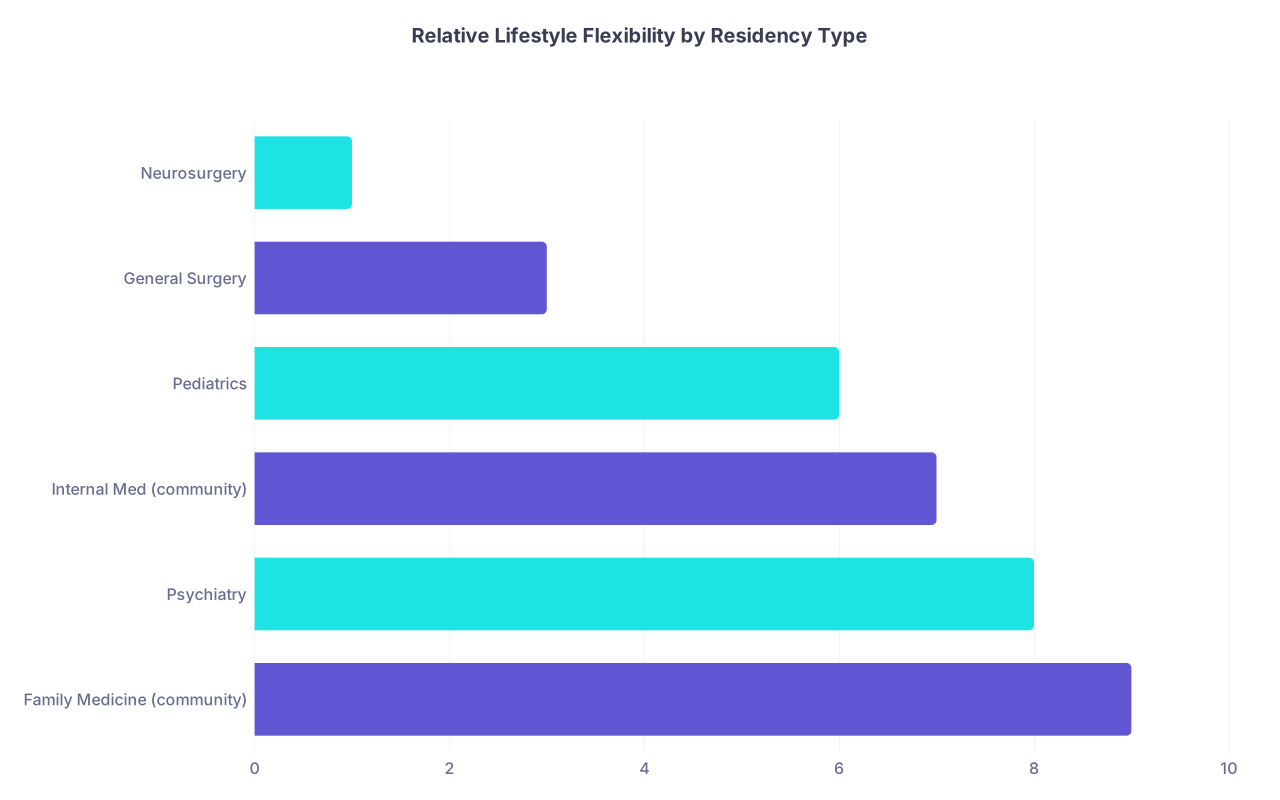
| Category | Value |
|---|---|
| Family Medicine (community) | 9 |
| Psychiatry | 8 |
| Internal Med (community) | 7 |
| Pediatrics | 6 |
| General Surgery | 3 |
| Neurosurgery | 1 |
This is not perfect science, but here’s the reality I’ve seen:
More manageable (for most IMGs with family abroad)
Family Medicine – community programs
Often 3 years, more outpatient time, more predictable blocks, slightly more humane call in many places.Psychiatry
Less overnight call in many programs, more structured clinic time, more attention to mental health (ironically, you might actually get mental health support).Internal Medicine – mid‑tier community
Still busy and hard, but some programs have reasonable schedules, especially after intern year. Usually more likely to take many IMGs.
Harder on separation and travel
General Surgery, Neurosurgery, Ortho, OB/Gyn
Long hours, brutal call, last‑minute changes. Even a single international trip a year can be difficult. I’ve seen programs cancel vacation during certain busy months outright.Highly competitive academic programs in any specialty
Great for research. Terrible for control over your life.
This doesn’t mean you can’t do surgery if that’s your absolute calling. But if your priority is minimizing the damage of being away from family, you lean toward programs and specialties with slightly more breathing room.
Step 4: Decode Program Policies That Directly Affect Your Ability to See Family
You need to interrogate program policies like a lawyer, not like a grateful beggar. The key areas are: vacation, leave, coverage, and visas.
Vacation Structures: The Difference Between Survival and Misery
Questions to look for on websites or ask residents:
- Is vacation 3–4 weeks per year in blocks, or chopped into random days?
- Can you take two weeks consecutively for international travel?
- How early do you have to request vacation?
- Does the program routinely deny requested dates?
The programs that work best for IMGs abroad usually:
- Offer 3–4 weeks of vacation in 1‑ or 2‑week blocks
- Let interns and residents request 1 longer block early in the year
- Have clear rules for how many people can be off per service (so it’s predictable)
If a resident quietly tells you, “They almost never let people take more than a week at once,” you should assume annual trips home will be hard.
Leave Policies: What Happens When There’s an Emergency at Home?
You do not want to find out about this in the middle of a crisis.
Ask anonymously or during 1‑on‑1 chats with residents:
- Has anyone taken emergency leave to go abroad?
- How did the program handle it?
- Did people get punished quietly afterwards (bad evaluations, bad schedules)?
- Do they follow ACGME + institutional policies, or do they “interpret” them aggressively?
Watch for red flags like:
- “We handle that case‑by‑case” with a hard tone
- “We almost never allow that”
- “You’d have to make up the time later, so it’s very tough”
A good‑enough program will say things like:
- “We had a resident whose parent was very sick; the program helped them rearrange rotations to go home.”
- “You lose some vacation time, but they don’t make it impossible.”
Visa Type: How It Changes Your Relationship to Home
Visa is not just paperwork. It’s how easily you can move, visit, and end up long‑term with your family.
| Aspect | J-1 Visa | H-1B Visa |
|---|---|---|
| Travel Flexibility | Decent, but watch renewal timing | Good, but stamping can be stressful |
| Program Availability | Very common for IMGs | Limited, mostly academic or strong IM |
| Home Country Return | 2-year home rule (with waiver options) | No home return requirement |
| Long-Term Plan | Requires waiver job after residency | Easier to transition to green card |
If your spouse and kids are abroad and you want them in the US eventually, H-1B is usually better long‑term. But many IMGs over‑optimize for H-1B and end up in one of 5 programs that sponsor it, regardless of culture.
You need a combination:
Decent visa + humane culture + realistic schedule.
If your only options are J-1 programs but they actually treat residents decently and allow vacation blocks, take that seriously.
Step 5: Use Airports, Time Zones, and Routes Like Part of Your Rank List
This part sounds “unacademic,” so people ignore it. Then they regret it.
Think about:
- Flight length and connections from your city to your home country
- Typical cost of a round trip during your likely vacation months
- Time zone difference and how that affects daily communication
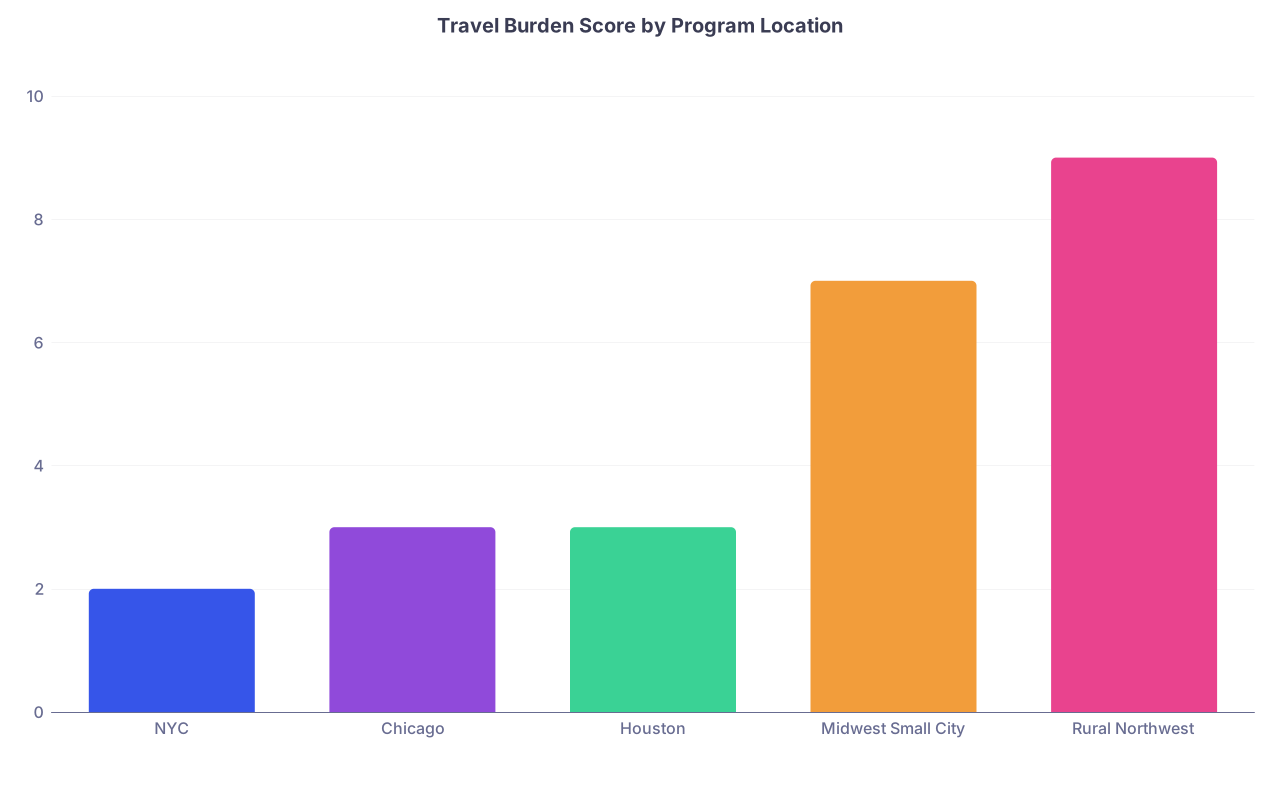
| Category | Value |
|---|---|
| NYC | 2 |
| Chicago | 3 |
| Houston | 3 |
| Midwest Small City | 7 |
| Rural Northwest | 9 |
(Lower score = easier travel; higher = harder)
Here’s what I’ve seen matter in real life:
- Residents in places like New York, Chicago, Houston, Atlanta managed to go home once a year, sometimes twice, on 2‑week blocks with red‑eyes.
- Residents in small, landlocked cities with tiny airports ended up either spending a fortune, burning 2–3 days per trip just on travel, or simply not going for years.
If your family is in:
- South Asia → East Coast and big hubs help a lot (NYC, DC, Chicago)
- West Africa → East Coast again usually better
- Middle East → East Coast or central (Chicago, Houston)
- East Asia → West Coast often better, or Chicago
You don’t need the perfect city. You just can’t be 3 flights and 26 hours from your loved ones every time.
Step 6: How to Ask the Right Questions Without Raising Red Flags
You cannot show up to interview day and say, “I need to travel internationally a lot, is that okay?” That makes PDs imagine a resident who’s always gone.
You need to ask targeted, mature questions that reveal the truth without branding you as “high risk.”
Ask residents, not PDs, things like:
- “How is the vacation scheduling here? Are you able to take longer blocks if you need to travel further?”
- “Have any residents had to travel internationally for family reasons? How did the program handle that?”
- “Is the culture here understanding of residents with family abroad?”
- “Does the program ever cancel vacation because of staffing issues?”
To PDs or APDs, you can ask more formal questions:
- “Can you describe how vacation is structured—are there week‑long blocks or individual days?”
- “Do international medical graduates make up a significant part of your resident group?”
Then you compare the PD’s polished answer with the resident’s honest version. Where they don’t match, you believe the residents.
Step 7: Evaluating Program Culture Through the IMG Lens
Not all “IMG‑friendly” programs are actually humane. Some just use IMGs as cheap labor.
Here’s what I pay attention to:
- Do residents from multiple countries seem happy and stable? Or do they look wrecked and burned out?
- Do senior residents step in to answer IMG/visa questions naturally? That’s a sign they’ve done it repeatedly.
- Are there any faculty who were IMGs themselves? They often fight for humane policies because they remember being in your shoes.
Red flags I’ve actually heard on interview days and socials:
- “We work hard here, we don’t complain about time off.” (Translation: vacation denial is normalized.)
- “We’re a family; this is our life.” (Translation: your actual family may not fit into this cult.)
- “We’ve had a few IMGs, but they usually struggle with our pace.” (Translation: you’ll be disposable.)
Green flags:
- “We have residents who go home once a year, it takes planning but it happens.”
- “We’re flexible with scheduling within ACGME limits.”
- “Many of us are here without family; we understand how that feels.”
Step 8: Ranking Strategy When You’re Balancing Career vs. Separation
Let’s be blunt. You’re juggling:
- Specialty competitiveness
- Long‑term career goals
- Visa realities
- And the fact that your mom might get sick 6,000 miles away and you’ll still need to function
Here’s a concrete way to rank, not just “follow your heart.”
Create a simple scoring system for each program on your list. Score 1–5 (5 = best) for:
- IMG support / culture
- Vacation / leave flexibility
- Travel ease (airport, flights, cost)
- Visa type and reliability
- Training quality (realistic, not prestige fantasy)
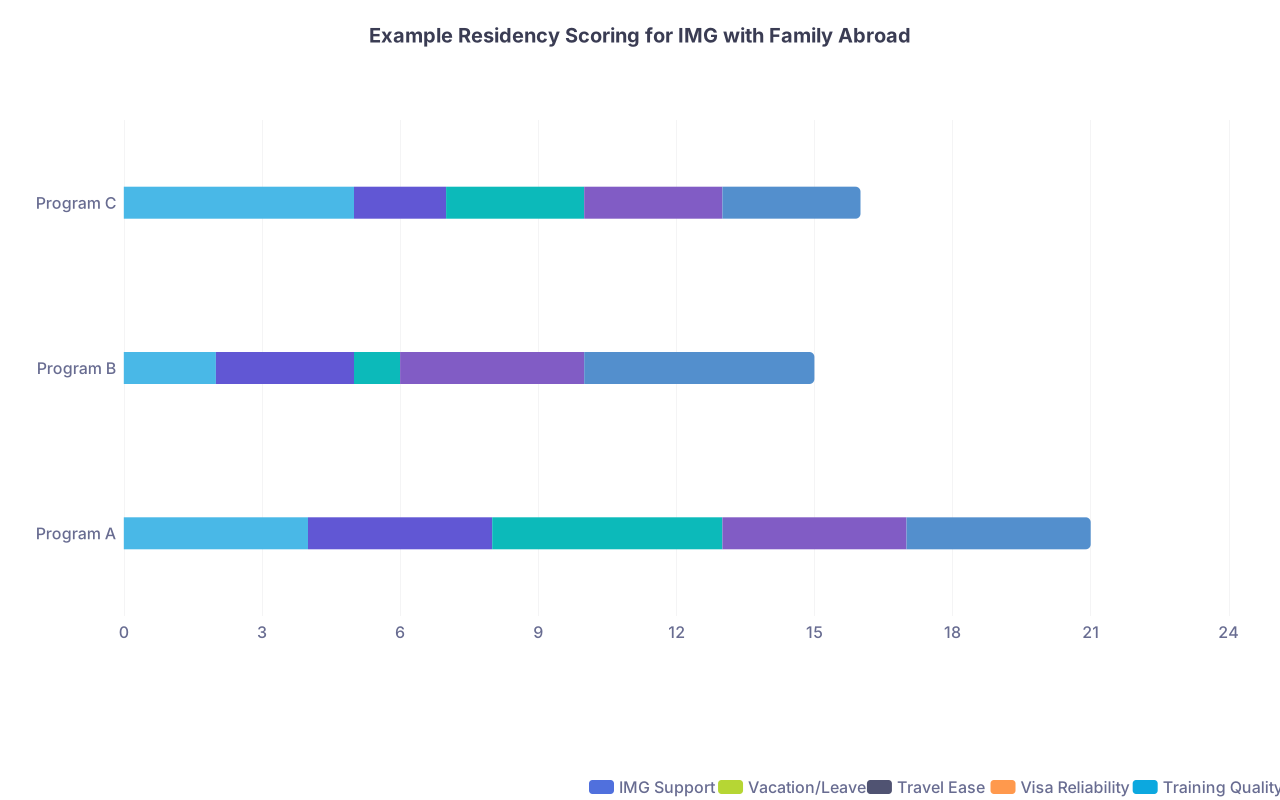
| Category | IMG Support | Vacation/Leave | Travel Ease | Visa Reliability | Training Quality |
|---|---|---|---|---|---|
| Program A | 4 | 4 | 5 | 4 | 4 |
| Program B | 2 | 3 | 1 | 4 | 5 |
| Program C | 5 | 2 | 3 | 3 | 3 |
Then sort by total score, but break ties by:
- Programs where you actually liked the residents
- Places you can imagine living for 3–7 years without falling apart emotionally
A “big name” with a score of 11 that will eat you alive is not better than a mid‑tier community program with a score of 19 where you’ll actually be a functioning human being who occasionally sees their family.
Step 9: Prepare Now for How You’ll Actually Use Leave Once You Match
You don’t wait until you’re drowning in intern year to figure this out. Once you match:
Talk early to your chief/administrator
- “I have family abroad; I’d like to plan a 2‑week block visit sometime this year. When is it usually easiest to schedule longer vacations?”
Reasonable chiefs will help you plan.
- “I have family abroad; I’d like to plan a 2‑week block visit sometime this year. When is it usually easiest to schedule longer vacations?”
Choose lower‑intensity rotations for travel
- Outpatient, electives, ambulatory blocks are often better than ICU or inpatient service for international trips.
Plan with your family around realistic dates
- Don’t promise you’ll come for every event. Aim for 1 good visit a year, maybe 2 if your specialty and program allow.
Have a plan for emergencies
- Keep your passport and visa documentation ready
- Maintain a small emergency fund for last‑minute flights
- Know who you’d contact in the program if something serious happens
Step 10: Mental Health: This Part Is Not Optional
I’ve seen strong IMGs break down not because of the workload, but because they were getting WhatsApp photos of their kids growing up without them and pretending they were “fine.”
You need a structure, not just willpower:
- Regular video call schedule with family (anchor time each week)
- One local support source: other IMGs, religious community, hobby group
- Counseling if your institution offers it (most do; many IMGs don’t use it because they think it’s “for weak people” – it isn’t)
You are not just choosing a workplace. You are choosing the conditions under which you will experience homesickness, grief, guilt, and pride all at once.
Do not leave that to chance.




The Short Version: What You Actually Do
- Define your real priorities: time with family, visa needs, mental health.
- Filter hard: IMG percentage, visa policy, airport access, vacation structure.
- Listen to residents more than brochures: they’ll tell you how it really works.
If you’re an IMG with family abroad, “any residency” is not good enough. You are allowed to care about where and how you’ll live, not just whether you match. And if you choose programs with that in mind, you’ll still become a good doctor. You’ll just have a better chance of arriving there with your relationships—and your sanity—still intact.