The usual advice for IMGs is useless if you graduated ten years ago. You are not a “typical” applicant—and pretending you are is how people burn 2–3 application cycles and thousands of dollars.
You’re older. You’re an IMG. Your graduation year is not recent. Here’s the reality: some programs will not touch your application. Others quietly welcome someone exactly like you—but they don’t advertise it.
Your job this cycle is not “apply everywhere and pray.” Your job is to surgically target programs that actually support older IMGs.
Let’s get specific.
1. Know What You’re Up Against (and What Is Just Noise)
You’re not competing with the whole pool. You’re competing within a niche: older IMGs, often with a gap after graduation, sometimes with visas, sometimes with family responsibilities.
Here’s what silently works against you:
- Year of graduation > 5–7 years ago
- Significant clinical gap (especially no recent US clinical experience)
- Visa need (J‑1 or H‑1B)
- Non‑US citizenship
- Non‑US clinical career that doesn’t translate easily on paper
Programs rarely say, “We don’t like older graduates.” Instead they say:
- “We prefer recent graduates.”
- “Graduation within 5 years is preferred.”
- Or nothing at all—but their resident list tells the truth.
On the flip side, programs that do support older IMGs tend to have at least one of these characteristics:
- Current residents with graduation years older than 7–10 years
- Many IMGs in each class (not just 1 token IMG)
- Community or safety-net hospital focus
- High service load, lower prestige, high hands-on need
- Leadership that came from IMG backgrounds themselves
You’re not trying to convince a hostile program to “take a chance” on you. You are trying to find your people: programs where your age and background are an asset, not a liability.
2. Build a Shortlist the Right Way: Data, Not Hope
This is where most older IMGs blow it. They look at state, prestige, and hearsay (“Someone from my school matched there once”). That’s not enough for you.
You need to reverse-engineer each program from who they actually take, not what they say on their website.
Step 1: Use program lists strategically
You start with raw lists: FREIDA, NRMP data, state lists. That’s fine, but then you filter aggressively.
Look for:
- Community programs vs big-name academic centers
- Geographic regions that historically take more IMGs (NY, NJ, MI, IL, TX, some parts of FL)
- Specialties with more IMG penetration: Internal Medicine, Family Medicine, Pediatrics, Psychiatry, sometimes Pathology
Then you build an initial pool of, say, 80–120 programs for IM (or 60–80 for FM/Psych/Peds).
Step 2: Stalk their current residents (yes, this is required)
This is the part most people are too lazy to do. You can’t afford to be lazy.
For each program on your list:
- Go to the residency program site.
- Open the “Current Residents” / “Our Residents” page.
- For each PGY-1–PGY-3, look at:
- Medical school (US vs international, and where)
- Graduation year (often in bio or on LinkedIn)
- Any visible age clues—previous careers, long gaps, advanced degrees.
If you see:
- Many residents with MD graduation 8–12+ years before their match year
- People who were pharmacists, engineers, or practicing docs abroad for years
- Multiple IMGs from a wide range of schools, not just one or two countries
That program is IMG-friendly and older-grad tolerant.
If you see:
- Mostly US MD/DOs
- IMGs only from one or two elite foreign schools
- Everyone seems to be “Class of 2022, 2023, 2024”
You can keep it on the list only if you have strong other reasons (like strong connections, US experience at that site, etc.), but it’s a lower-yield target.
Step 3: Check the actual policies (and read them like a lawyer)
Next, cross-check with FREIDA and program websites for:
- Maximum years since graduation
- US clinical experience requirements (often “recent USCE within 1–3 years”)
- Minimum scores, Step 3 requirements
- Visa sponsorship details
If a program says:
- “We consider applicants up to 10 years from graduation” → Possible
- “We prefer graduates within 5 years” BUT you see people from 8–10 years → Still possible
- “We require graduation within 3 years” and their residents match that → Hard no for you
Hard rule:
If your YOG is, say, 2012 and they clearly cap at 5 years, don’t waste the application fee. You’re not the exception they’re waiting for.
3. Learn the Patterns of Truly IMG-Friendly, Older-Grad-Friendly Programs
Certain program features are almost code words.
I’ve seen this pattern repeatedly with older IMGs who matched successfully:
| Feature | Good Sign for Older IMGs |
|---|---|
| Program type | Community or university-affiliated community |
| Resident mix | 50–90% IMGs across classes |
| YOG variation | Multiple residents >7 years post-grad |
| Location | Smaller cities, non-coastal, or underserved areas |
| Focus | High service load, safety-net, less research-heavy |
You’ll see these vibes on many of the programs that match older IMGs:
- Hospital serves large immigrant or underserved population
- Residents come from India, Pakistan, Egypt, Caribbean, Eastern Europe, etc.
- Leadership with IMG backgrounds—PD/APD with foreign medical degrees
- Less glossy website, more “workhorse” culture
The uncomfortable truth: programs that are harder, busier, less glamorous can be the exact ones that will give you a real shot.
4. Fix Gaps That Scare Programs Before You Apply
Programs will look at your file and instantly ask:
- What has this person done since graduation?
- Are they clinically “rusty”?
- Can they adapt to US medicine and documentation?
- Will they struggle as an intern after being away from structured training for years?
If you leave those questions unanswered, you’ll get silently filtered out.
Here is what you must do if you’re more than 5 years out:
Recent clinical currency
You need something in the last 12–18 months that looks like real, hands-on medicine:
- US observerships with active participation (discharges, notes, care plans)
- Clinical experience abroad with documented responsibilities (rounding, admitting, managing)
- Volunteering in free clinics, especially with US charting exposure (EPIC/Cerner experience is a bonus)
This cannot just be: “I read textbooks and did an online course.” That doesn’t reassure anyone.
US-relevant credibility
If you’re older, Step 3 is almost mandatory in competitive states or for H‑1B consideration. It tells programs:
- You can handle US-style exams.
- You’re serious about being here long-term.
- You’re lower risk academically.
If you can, aim for Step 3 done or at least scheduled before rank list season.
5. Communicate Your Story So Age Becomes a Strength, Not a Liability
You can’t hide your age or graduation year. Stop trying. Instead, control the narrative.
Your age can signal:
- Maturity
- Stability
- Leadership potential
- Ability to handle stress and family/work balance
But only if you frame it that way.
Personal statement: no vague “I did some things”
You want to directly address the elephant in the room without turning your statement into a confession.
Here’s the structure I’ve seen work for older IMGs:
Anchor your “why now”
A concise explanation of why you’re entering US residency at this point in your life—career transition, immigration pathway, family decision, etc.Show continuity of medicine
Make it clear that you did not disappear from clinical work for 8 years. Or, if you did for a while, show what you did instead that still builds relevant skills: teaching, research, healthcare admin, telemedicine, public health.Translate your prior career into residency value
Not “I am older and responsible” (everyone says that).
Instead: concrete skills—running teams, handling on-call solo, speaking multiple languages, dealing with complex families, managing scarce resources.End with a focused target, not “I like all specialties”
If you’re applying to IM, say Internal Medicine. If FM, say Family Medicine. No one wants an older applicant who still doesn’t know what they want.
6. Target Application Strategy: Wide, But Not Blind
Older IMGs cannot afford hyper-selective lists (“I’ll only apply to California and New York”). At the same time, applying to 250 programs blindly is statistical self-harm.
Here’s a more rational structure for, say, an older IMG in Internal Medicine:
- 20–30 programs: High-priority, have clearly taken older IMGs, your profile matches their residents
- 40–60 programs: Medium-priority, IMG-heavy but less obvious on age, OR your connections/USCE are there
- 10–20 programs: Stretch programs (slightly more academic, maybe more recent YOG preference, but something in your file fits them well)
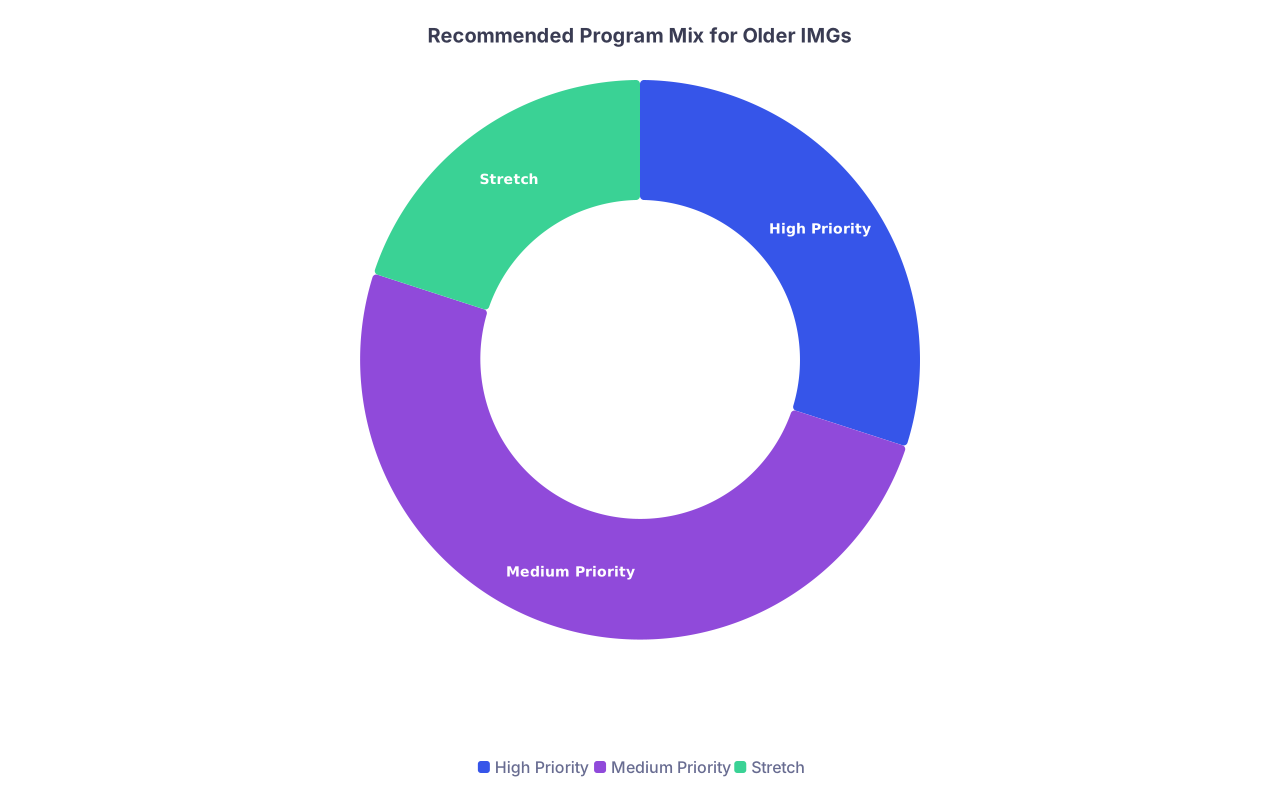
| Category | Value |
|---|---|
| High Priority | 30 |
| Medium Priority | 50 |
| Stretch | 20 |
You adjust the total number based on specialty competitiveness and budget, but the principle stands: most of your applications should go where older IMGs have already matched.
And do not forget:
- If you need a visa, make sure at least 70–80% of your list explicitly sponsors J‑1 or H‑1B
- If you have geographic constraints (family, spouse job), be honest with yourself: that may cost you interviews
7. Use Communication and Networking Like an Adult, Not a Desperate Student
You’re older. You should communicate like a colleague, not a begging applicant.
Strategic emails to programs
You do not send mass “Please consider my application” emails. Those get ignored.
Instead, you send highly targeted emails to:
- Programs where you did USCE
- Programs where your attending/mentor knows faculty/PD
- Programs that explicitly seem older-grad-friendly but where you want to clarify something (YOG cutoffs, visa nuance)
The email should:
- Be short (8–10 lines max)
- State your name, YOG, and visa status clearly
- Highlight 1–2 specific aspects of your background relevant to their program (not generic praise)
- Ask a concrete question if needed, or just respectfully express interest
If your age is a concern locally, sometimes it helps to say, “After X years of practice abroad, I bring [specific skills] and am fully committed to completing residency training in the US.”
Use your real-world network
If you worked as a hospitalist abroad, or a GP, or a specialist: somebody you know knows someone who trained in the US.
You should be:
- Asking former colleagues where they trained and if they’d be willing to email their old PD for you
- Using LinkedIn to see where alumni from your school, hospital, or region matched
- Getting quality letters from people who can compare you to US residents or have US connections
A personal, honest email from a former resident of that program saying, “This applicant is strong, I’d interview them,” is worth more than 200 anonymous ERAS submissions.
8. Red Flags: Programs That Look Friendly but Are Quietly Hostile
Some programs look IMG-friendly but are terrible fits for older graduates.
Watch for:
- Resident photos: all IMGs, but all very young, fresh grads, same few schools
- Website: “We prefer recent graduates” with no evidence of exceptions
- Reputation (ask around): malignant culture, heavy call with weak teaching, high attrition
You do not want to join a program that treats you as cheap labor and then blames your “age” or “IMG background” when they never supported you properly.
As an older IMG, you need:
- Solid orientation and supervision
- Attendings who remember what it’s like to learn, not just exploit
- A culture where asking for help is not punished
You’ve already had a career. You know what toxicity looks like. Trust that instinct.
9. Interview Season: How to Handle “You’re Older Than Our Usual Trainee”
If you’ve targeted correctly and your story is coherent, you will get interviews. Then the age factor shows up again, subtly.
Expect questions like:
- “You graduated in 2010—tell me about your path since then.”
- “How do you feel about starting as an intern again?”
- “You’ve had significant independent responsibility. How will you handle supervision?”
Bad answers sound defensive or apologetic. Good answers sound realistic and grounded.
Example points to hit:
- You understand the hierarchy and want structured training in the US system.
- You see your experience as helping you triage, communicate, and handle pressure, not as an excuse to resist feedback.
- You’re aware that documentation, EMRs, and US standards may differ—and you’re ready to learn them like a first-year, without ego.
If you seem resentful about “starting over,” programs will back away. If you seem relieved to finally have the chance to train in the US properly, they lean in.
10. If You’re Reapplying as an Older IMG
This is brutal but necessary: reapplying without changing anything major is pointless.
If you already applied once (or twice) as an older IMG and didn’t match, ask:
- Did I fix my recent clinical experience gap?
- Did I add Step 3 (or at least pass additional exams)?
- Did I change my program list to focus on real older-IMG-friendly programs?
- Did I rewrite my PS and LORs to clearly explain my path and strengths?
If the answer to all of those is “no,” then you did not reapply. You just resent.
Your age works against you more with every cycle. Either make significant upgrades, or consider alternative paths: research positions leading to categorical spots, prelim/TY with very strong performance and networking, or non-residency clinical roles if that’s acceptable to you.
FAQ (Exactly 3 Questions)
1. How many years after graduation is “too old” for US residency as an IMG?
There is no universal cut-off, but the practical threshold is around 5–7 years for many programs. After that, most competitive and academic programs will screen you out automatically. However, some community and safety-net programs routinely take applicants 10–15+ years after graduation—if they’ve stayed clinically active and built recent US-relevant experience. Once you cross 10 years, you must be very strategic: Step 3, strong recent clinical work, and laser-focused program selection become non-negotiable.
2. Should I hide or downplay non-medical gaps in my CV (family, illness, immigration issues)?
No. You should not dump your whole life story into ERAS, but you must not create mysterious blank periods. Program directors hate unexplained gaps more than they dislike honest, human reasons. A short, professional explanation—“Relocated for spouse’s job and completed licensing exams while caring for young children”—is far better than silence. The key is to pair any gap with what you did to stay engaged: studying, observerships, part-time clinical work, research, or structured exam preparation.
3. Is it still worth applying if I’m 15–20 years out from medical school graduation?
It can be, but only under specific conditions. You need: (1) ongoing clinical practice in the last few years, ideally in a hospital setting; (2) at least some US experience (observerships, externships, or direct collaboration); (3) exams that are all passed, ideally including Step 3; and (4) a realistic, primarily community-based program list in IMG-heavy regions. If you’re completely out of clinical work for many years and cannot secure recent credible experience, the odds are extremely low and it may be more rational to pursue non-residency roles (telemedicine, research, educator, allied health) rather than sink more time and money into ERAS.
If you remember nothing else:
- Your main weapon is targeted program selection based on who they actually take, not what they say.
- Your age is only a liability when you leave gaps unexplained and skills unrefreshed—fix your recency, own your path.
- You are not begging for a favor; you’re finding the subset of programs where an older IMG is exactly the kind of resident they need.