The way most IMG reapplicants approach a second (or third) match cycle is broken. They tweak a few lines in their personal statement, add three more programs, and hope the outcome magically changes. That’s not strategy. That’s denial.
You’re an IMG reapplicant. That means the clock is ticking on graduation year, visas, exams, and your own mental stamina. You do not have unlimited cycles to “see what happens.” You need to know when to rebrand yourself and when to shift your program targets—especially toward IMG‑friendly residency programs—so the next cycle is actually different from the last one.
Let’s treat this like what it is: a salvage and repositioning operation.
Step 1: Get Uncomfortably Honest About Your Last Cycle
Before you “rebrand,” you need to understand what brand actually failed.
Forget what your cousin in family medicine told you. Forget the Facebook group myths. Pull up your ERAS from last cycle and go through these categories one by one.
, No Step 3, Unrealistic List](https://cdn.residencyadvisor.com/images/articles_svg/chart-common-weakness-areas-for-img-reapplicants-6689.svg "Common Weakness Areas for IMG Reapplicants")
| Category | Value |
|---|---|
| Low Scores | 30 |
| Old Grad Year | 20 |
| [No USCE](https://residencyadvisor.com/resources/img-friendly-residency-programs/if-you-lack-usce-building-a-path-using-friendly-community-programs) | 25 |
| No Step 3 | 10 |
| Unrealistic List | 15 |
Ask yourself, very specifically:
Numbers
- USMLE Step 1/2/3 or equivalent scores
- Any failures or multiple attempts
- Year of graduation
US-Relevant Experience
- US clinical experience (USCE)—observerships, externships, hands-on vs shadowing
- Research in the U.S. vs abroad
- Time since last meaningful clinical activity
Application Materials
- Personal statement generic or specialty-specific?
- Letters of recommendation from U.S. physicians vs home country?
- CV with unexplained gaps?
Application Strategy
- How many programs? Which types?
- IMG‑friendly vs IMG‑hostile?
- Any geographic obsession (only NYC / only California) that boxed you in?
If you don’t know what went wrong, here’s a blunt rule: if you got zero interviews, the problem is global (scores, grad year, lack of USCE, or terrible program targeting). If you got a few interviews but no rankable outcomes, the problem is more likely fit and story (branding, interviews, letters, gaps).
Write down, in one line each, why a reasonable PD might have screened you out:
- “Step 1 fail and no Step 3 yet.”
- “Graduated 2016, no recent clinical activity.”
- “Applying to IM, no US inpatient experience, only outpatient shadowing.”
- “Applied mostly to university programs with very few IMGs.”
If you can’t do this alone, ask someone harsh but helpful—a current resident, mentor, or even an advisor who actually works with IMGs. You don’t fix vague problems. You fix specific ones.
Step 2: Decide if You Need a Full Rebrand or a Target Shift
Rebranding and retargeting are not the same thing.
- Rebranding = you change the way you present yourself: specialty focus, narrative, strengths, “why me, why now?”
- Target shift = you change where you apply: more community programs, more IMG‑friendly states, different specialties.
Sometimes you need both. Often you do.
When You Need a Full Rebrand
You should seriously consider rebranding if:
- You’re switching specialties (e.g., you applied psych, now going internal medicine).
- Your last personal statement could’ve been used by 500 other IMGs word-for-word.
- Your letters of recommendation did not match your claimed strengths or goals.
- You’re an “older grad” (5+ years since graduation) and your application does not scream “still clinically alive.”
- You previously led with “I love helping people” instead of something concrete (e.g., “I’ve spent 2 years doing US hospitalist research and QI projects”).
Rebranding is not just changing the first paragraph of your personal statement. It’s a shift in who you are on paper:
- Different lead story (not the same childhood asthma / grandmother died paragraph).
- Different emphasis in experience descriptions.
- New letters that match your new angle.
- Sometimes, a different “anchor” experience: a new USCE rotation, research role, or Step 3 pass.
When You Primarily Need a Target Shift
If this was your pattern:
- Step 2 CK ≥ 235
- Recent grad (≤ 3 years)
- A bit of USCE
- Decent letters
…and you applied:
- 30–40 programs, mostly university-heavy, big coastal cities, prestigious names…
Then your problem wasn’t that you’re “unmatchable.” Your problem is that you shopped at the wrong store.
You may not need a personality transplant. You need to hit the right market: community programs, smaller cities, programs with a track record of taking IMGs and sponsoring visas.
Step 3: Understand What “IMG-Friendly” Actually Means
“IMG-friendly” is not a vibe. It’s data.
Here’s how I see IMGs get burned: they look at one blog post that says “Program X took 3 IMGs last year” and assume that means “good for IMGs.” Then they find out those 3 were U.S. citizens who went Caribbean and had 255+ scores.
You need to drill deeper.
| Signal | Why It Matters |
|---|---|
| % of current residents who are IMGs | Shows consistent willingness to train IMGs |
| Visa sponsorship (J-1/H-1B) | Critical for non-U.S. citizens |
| Step score filters published or reported | Helps avoid automatic rejections |
| Program type (community vs university) | Community programs are often more open to IMGs |
| Number of IMGs who are non-U.S. citizens | More relevant if you need a visa |
Look directly at:
- Program websites (resident bios: where did they graduate, what year?)
- FREIDA (filters for IMGs, visa sponsorship, etc.)
- NRMP charting outcomes for IMGs in your specialty
If a program’s current residents are:
- 80–90% U.S. MD/DO,
- 0–1 non‑US citizen IMG per class,
- and requires Step 3 before ranking…
That’s not your reapplicant home—as a non‑U.S. IMG—unless your scores are stellar and your story is exceptional.
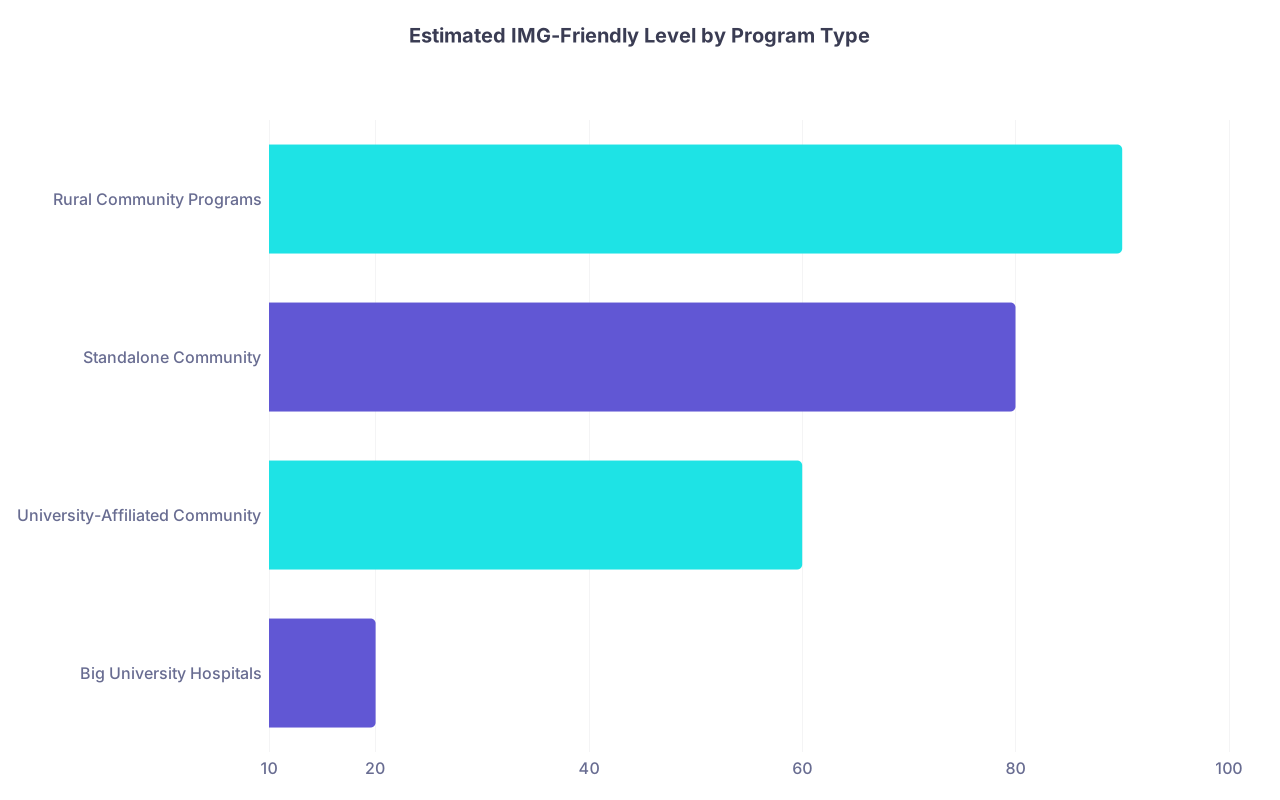
| Category | Value |
|---|---|
| Big University Hospitals | 20 |
| University-Affiliated Community | 60 |
| Standalone Community | 80 |
| Rural Community Programs | 90 |
Step 4: Identify When It’s Time to Shift Specialty
Sometimes “rebranding” means admitting your original specialty target is fantasy for your profile.
Harsh but real: some IMGs will not match into dermatology, plastics, ortho, or even radiology, no matter how many cycles they run. The data is brutal for non‑US IMGs in these fields.
So, you ask:
- Did I get any interviews in this specialty last cycle?
- Are there multiple matched IMGs in this specialty with my kind of stats (similar scores, grad year, visa needs)?
- Do I have credible specialty-specific experiences (USCE, research, mentorship) or is this just a dream in my head?
If the answer to all three is “no,” you need to heavily consider:
- Internal Medicine
- Family Medicine
- Pediatrics
- Psychiatry
- Pathology
- (Occasionally) Neurology
These are not consolation prizes. They’re realistic entry points for many IMGs, especially reapplicants.
If you are 7 years post‑grad, no U.S. residency, no current clinical work, and you’re still focused on a super competitive specialty, you are wasting cycles. Rebrand to something with real IMG demand.
Step 5: Decide How Hard to Pivot Your Brand
You’ve got three basic rebrand levels.
1. Light Rebrand (Same Specialty, Better Angle)
Use this if:
- You got some interviews last cycle.
- Your scores are in range.
- But you did not close the deal.
Changes to make:
- Rewrite your personal statement around 1–2 strong U.S. experiences (not generic life story).
- Tighten your CV descriptions to show outcomes, not chores.
- Add at least one new U.S. letter of recommendation (from this year).
- Address red flags briefly but directly (old grad, gap, prior attempt).
Example shift: from “I like internal medicine because it’s broad” to “My interest in inpatient internal medicine grew from my sub‑internship at [US hospital], where I led daily follow-up on complex CHF/COPD patients under close supervision.”
2. Medium Rebrand (Same Specialty, Stronger Profile + New Programs)
Use this if:
- You got zero interviews, but your specialty is still realistic.
- You had little to no U.S. experience.
You need:
- New U.S. clinical experience (3–6 months observership/externship if possible).
- At least two new strong LORs from U.S. physicians in your target specialty.
- A cleaner, more targeted personal statement focused on recent U.S. work.
- Better program list: majority IMG‑friendly, heavy on community programs, multiple states.
Example: Last year, 45 mostly university IM programs, no USCE. This year, 120–150 programs, majority community, Midwest/South, plus 3 months inpatient USCE and Step 3 passed.
3. Full Rebrand (New Specialty or Big Narrative Shift)
Use this if:
- Your original specialty is a long shot (for your stats/profile).
- You’ve had major changes: Step 3 pass, new research position, significant USCE, or new clear interest.
Your new personal statement, LORs, and CV should all converge on the new specialty. Not “I like everything, so I’m applying everywhere.” That’s suicide. Each specialty needs its own coherent application set—even if, in your head, you’d take anything.
Step 6: Build a New, Rational Program List
Most IMGs underestimate how much list design matters, especially as reapplicants. It’s not just “apply more.”
You need:
- Enough programs
- The right mix of program types
- The right geographic spread

Quick ranges (for non‑US IMGs in IM/FM/Peds/Psych as reapplicants):
- Competitive but realistic profile (recent grad, no failures, USCE, decent scores): 80–120 programs.
- Older grad, attempts, weak USCE: 120–180 programs (yes, really, if finances allow).
You should heavily weight:
- Community hospital programs
- University‑affiliate community sites
- Smaller cities and non‑coastal states: Midwest, South, some Northeast
Avoid obsession with:
- Big-name coastal cities everyone wants (NYC, LA, SF, Miami, Chicago, Houston). You can include some, but they cannot be the backbone of your list.
- Programs with 0–1 IMGs historically unless you have something exceptional to offer.
Step 7: Time Your Rebrand vs Your Next Application
Timing is where many reapplicants blow it. They rush into the next ERAS cycle with nothing meaningfully changed.
Here’s a simple decision flow:

| Step | Description |
|---|---|
| Step 1 | Failed Match |
| Step 2 | Reapply next cycle |
| Step 3 | Delay 1 year, build profile |
| Step 4 | Consider alternative paths |
| Step 5 | Major changes ready by next ERAS? |
| Step 6 | Can you secure USCE or Step 3 in 6-9 months? |
You should reapply this coming cycle if:
- You can add at least one of the following before September:
- Step 3 pass
- 2–3 months of solid USCE
- New U.S. LORs
- Substantial new research work (especially if targeting academic-ish IM programs)
You should strongly consider sitting out one full cycle if:
- You are an older grad with large clinical gaps and no way to get USCE before ERAS opens.
- You’ve just failed an exam and are still recovering / re-prepping.
- You’re switching specialties and have literally zero exposure to the new field.
You do not get infinite deferrals though. If you’re already 7–10 years out from graduation, another year off with nothing major added is dangerous. In that case, you either secure tangible U.S. work/USCE quickly or you start thinking about non‑residency routes.
Step 8: How to Actually “Rebrand” Your Materials
Let’s get concrete. You’re not doing a philosophical rebrand. You’re re‑packaging yourself for a specific buyer: IMG‑friendly program directors who do not have time to guess why you’re a good bet.
Personal Statement
Stop recycling your old statement with a few edits. Start from scratch:
- Open with recent, concrete clinical experience, ideally in the U.S.
- Tie your story to the reality of their program: community medicine, underserved populations, inpatient continuity, QI projects.
- Address reapplication in 1–2 sentences if needed:
- “I applied last cycle and did not match, which led me to seek additional clinical experience at [US hospital], where I…”
Do not:
- Lead with vague childhood inspiration.
- Make this about how unfair the last cycle was.
- Over‑explain your whole life story. That’s self‑therapy, not strategy.
CV / ERAS Experience Section
Rewrite bullets to emphasize:
- Responsibility
- Complexity
- Outcomes
Example:
Bad: “Observed patient care in internal medicine clinic.”
Better: “Followed 8–10 internal medicine patients daily in a U.S. outpatient clinic, presented cases to attending, and documented assessment/plan drafts under supervision.”
Letters of Recommendation
For a rebrand to stick, your LORs must match the new image.
If you’re rebranding as:
- A strong inpatient IM candidate → letters should talk about your work on wards, follow‑up, notes, presentations, reliability.
- A psych candidate → letters should emphasize communication, rapport, empathy, management of complex psychiatric or behavioral patients.
Do not lean only on old, generic letters from home-country professors saying you’re “hardworking” and “punctual.” That language screams “no idea how this person functions in a U.S. system.”
Step 9: Consider Strategic Extras (Step 3, Research, Prelim Years)
These are the optional but sometimes game‑changing pieces.
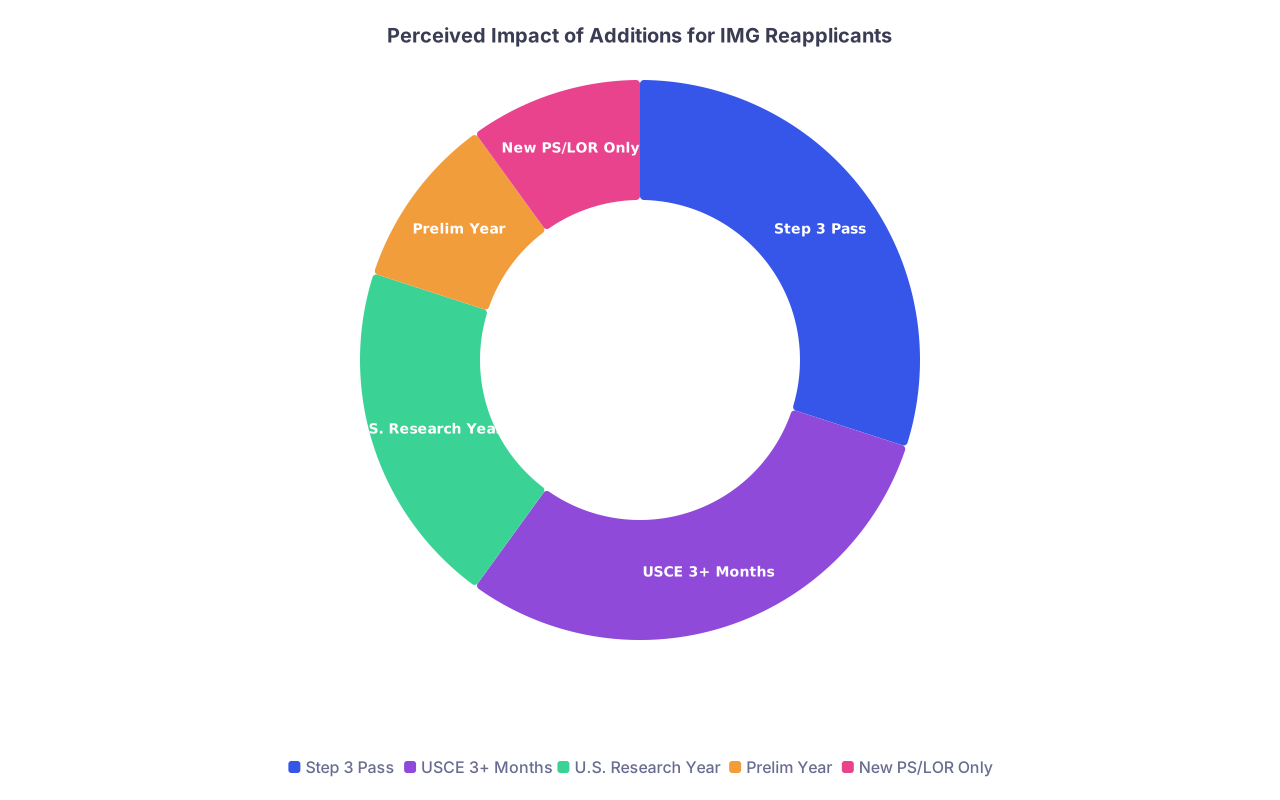
| Category | Value |
|---|---|
| Step 3 Pass | 30 |
| USCE 3+ Months | 30 |
| U.S. Research Year | 20 |
| Prelim Year | 10 |
| New PS/LOR Only | 10 |
Step 3
For non‑US IMGs in IM/FM/Psych/Neuro:
- A Step 3 pass can push you over a filter and signal readiness (especially if you had a previous Step failure).
- Some IMG‑heavy programs quietly prefer or require it for ranking.
If you’ve failed an exam before, Step 3 with a pass and respectable score can be a reputational patch.
U.S. Research
If you can land a paid or volunteer research position at a U.S. academic center, even in a peripheral role, it helps:
- Keeps your timeline active.
- Generates possible U.S. LORs.
- Shows you can function in the U.S. healthcare environment.
Just don’t overestimate it: research alone doesn’t fix ancient graduation dates or repeated exam failures. It supports a package; it doesn’t rescue a sinking ship on its own.
Prelim / Transitional Year
If you’re considering:
- Prelim IM or Surgery as a foot in the door
- Transitional year where you’ll reapply after PGY‑1
This can work but is not a magic cure. You need:
- Strong in-training performance
- New, very solid clinical letters
- A realistic target specialty the second time around
And you must be prepared for the possibility that you’ll still end up in the same pool again if you don’t address underlying issues.
Step 10: Emotional Rebrand – How You Show Up This Cycle
Program directors can smell desperation and bitterness in applications. Reapplicants often radiate it without realizing.
Your tone—on paper and in interviews—needs to be:
- Realistic: You acknowledge the previous failure without melodrama.
- Accountable: You show what you changed.
- Forward-looking: You’re focused on what you can contribute now.
One line I’ve seen work well (adapted to your situation):
“Not matching last cycle was disappointing, but it pushed me to seek more U.S. clinical experience and refine my goals. Over the past year at [hospital], I’ve strengthened my clinical reasoning, communication with multidisciplinary teams, and commitment to caring for underserved patients—skills I’m eager to bring to residency.”
That’s rebranding. Not excuses—evidence of growth.

FAQs
1. I’m an IMG who didn’t match twice. Should I still keep trying?
Maybe. The answer depends on trajectory, not just the number of failures. If, between attempts, you added:
- Step 3 with a pass
- 3–6+ months meaningful USCE
- New U.S. letters
- Better, more realistic program list
—then a third attempt may be reasonable, especially for IM/FM/Psych/Peds in IMG‑friendly programs. If, however, each cycle looks the same on paper, you’re just paying for a rerun. In that case, consider pausing to build a substantially stronger year (USCE, research, U.S. job in healthcare), or start researching alternative careers where your medical background is valued but residency isn’t mandatory.
2. How do I explain being a reapplicant in my personal statement or interviews?
Briefly, directly, and with a focus on what changed. One or two sentences in the personal statement is enough:
“I previously applied for residency but did not match. Since then, I have completed [X experience], which has strengthened my clinical skills and clarified my commitment to [specialty].”
In interviews, expand slightly but keep it factual: what you learned, what you did differently, and why you’re a better candidate now. Do not blame the system, the pandemic, or “bad luck” as your primary explanation.
3. What counts as “good enough” USCE for a reapplicant IMG?
Aim for at least 2–3 months of recent (within 1–2 years) U.S. experience that’s as hands-on as possible for your visa/status:
- Inpatient rotations in your target specialty are ideal.
- Outpatient can be fine, especially for FM/Psych, if you’re actively involved (case presentations, notes, care coordination) under supervision.
- Pure shadowing where you stand in the back and observe is better than nothing, but as a reapplicant, you should push for more involvement and at least one strong LOR from those experiences.
4. Is it a bad idea to apply to two specialties as a reapplicant?
It’s risky but sometimes necessary. If you do it, do it properly:
- Separate personal statements for each specialty.
- Letters tailored to each field (at least 2 specialty-specific LORs per field).
- Program lists that make sense (don’t apply IM and Psych at the exact same hospital unless they rarely cross-communicate, which is uncommon).
Never send a generic “I love internal medicine and psychiatry” statement to both. That looks unfocused and desperate. If you’re forced to dual-apply, do the extra work to make each specialty see a coherent, committed version of you.
Open your last ERAS application today and physically mark every element that will be different and stronger this cycle—scores, USCE, LORs, personal statement, program list. If you can’t highlight at least 4–5 concrete upgrades, your first job is not to reapply. It’s to build those upgrades before you press submit again.