
The residency world loves to say “we value non‑linear paths” while quietly punishing anyone who actually takes one.
If you’re an IMG trying to change specialty, you’re not doomed—but you are playing on “hard mode.” You need to be strategic, specific, and a little ruthless.
This is the playbook.
1. Get Real About Your Starting Point (Harsh but Necessary)
Before you start emailing programs about second chances, you need a cold, honest audit of your situation.
Here’s what matters most for an IMG changing specialty:
- USMLE scores and attempts (including any fails)
- Current/previous residency experience (US or abroad)
- Visa status
- Gap years and what you did in them
- Clinical experience and letters in the new specialty
If any of these are weak, you do not spread yourself thin applying everywhere. You target the handful of programs that are actually open to stories like yours.
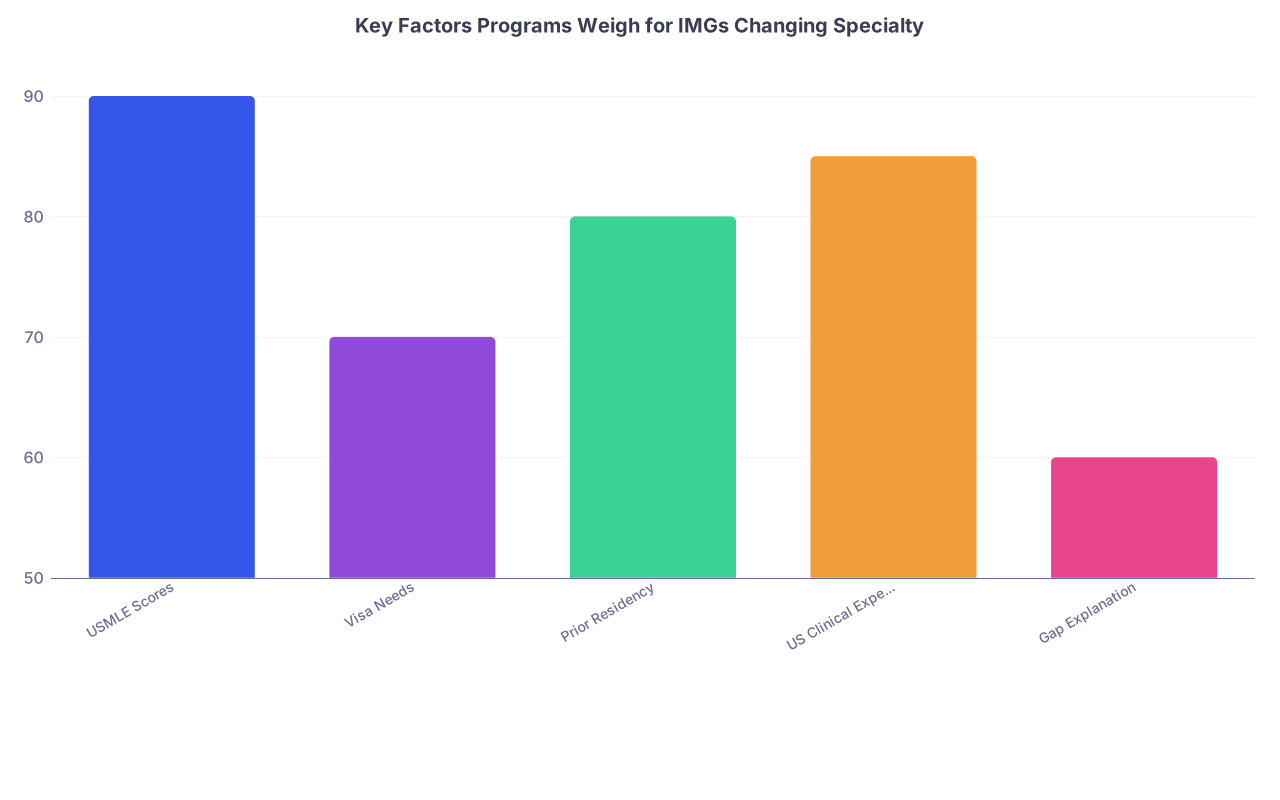
| Category | Value |
|---|---|
| USMLE Scores | 90 |
| Visa Needs | 70 |
| Prior Residency | 80 |
| US Clinical Experience | 85 |
| Gap Explanation | 60 |
Let me translate that:
- A single Step failure is not the end—but some programs will automatically filter you out.
- Prior residency (even in another country or specialty) can be a plus if you frame it right.
- Visa needs do close some doors, but not all. Stop assuming you’re excluded everywhere.
- Gaps are survivable if you can clearly show growth, not drift.
If you’re not sure how bad (or not bad) your profile is, compare yourself honestly to this:
| Factor | Relatively Strong | Concerning but Salvageable |
|---|---|---|
| Step 1/2 CK | 230+ (or solid pass for pass/fail Step 1) | <220 or failures |
| Attempts | 1 each | >1 attempt on any Step |
| US clinical | 3+ months, recent | Observerships only, old |
| Visa | Green card/US citizen | Needs J‑1/H‑1B |
| Prior residency | Completed or ≥1 year, good standing | Dismissal, probation, or big gap |
You do not need to be strong in every column to match. But if you’re weak in multiple, you must be laser‑targeted and realistic about which programs might take a risk on you.
2. Understand Which Programs Actually Give Second Chances
Not all programs treat second‑specialty IMGs the same. Some are quietly open. Some are brick walls.
The programs most likely to give you a chance fall into a few buckets:
Community‑based programs (especially non‑university‑owned)
- Often have fewer applicants than academic powerhouses.
- Care more about work ethic, reliability, and service than “clean CV.”
- Frequently more IMG‑friendly.
Newer or expansion programs
- Programs that recently increased positions or are newly accredited.
- They need bodies who can hit the ground running.
- Prior residency = you’re less risky day‑to‑day.
Programs with historically high IMG percentages
- They understand foreign training.
- Their faculty often include former IMGs.
- They may be more flexible with “nontraditional” routes.
Safety‑net / underserved area hospitals
- Heavy workload, complex social medicine.
- They value maturity and resilience, which you probably have.
Here’s how that tends to look on paper:
| Program Type | Usually More Open To You? | Typical Clues on Website |
|---|---|---|
| Big university flagships | Rarely | Heavy research focus, low IMG % |
| University‑affiliated community | Sometimes | Community hospital + university logo |
| Standalone community | Often | Emphasis on service, local care |
| New programs | Often | Recently ACGME accredited, small alumni list |
If you’re trying to move into something competitive like Derm, Ortho, or ENT as an IMG changing specialty—you’re basically climbing Everest without oxygen. Possible with insane networking and unique circumstances, but I wouldn’t build a plan around it.
If you’re going into:
- Internal Medicine
- Family Medicine
- Psychiatry
- Pediatrics
- Pathology
- Neurology
You have real, actionable options.
3. Concrete Examples of “Second‑Chance Friendly” Program Patterns
No, I’m not going to give you a magic list of “these 12 programs will love you.” That list would be outdated and you’d be competing with half the internet by tomorrow.
Instead, I’ll show you what to look for.
A. Programs that mention “prior training welcome”
You’ll sometimes see phrases like:
- “Applicants with prior training are encouraged to apply.”
- “We consider applicants who have completed residency elsewhere.”
- “We welcome applicants changing specialties.”
Those lines are gold. That’s an invitation.
B. Programs that explicitly accept “off‑cycle” or “advance standing” residents
If they’ve ever:
- Accepted PGY‑2+ transfers
- Listed open positions mid‑year on their website
- Posted on the AMA list of open residency positions
…it means they’re already used to people with messy paths.
C. Programs with many IMGs and some non‑linear bios
Read the resident bios. Look for:
- IMGs who clearly had prior training abroad.
- People who did another career or PhD first.
- Residents who “transitioned from another specialty.”
If nobody at the program has a non‑traditional story, your odds there are lower.

4. How to Frame Your Story Without Sounding Like a Red Flag
If you’re changing specialty, programs have three fears:
- You’re running away from problems.
- You’re indecisive and may leave again.
- There’s something you’re not telling them (discipline, performance, conflict).
Your job is to kill those fears in your application.
Your narrative needs three elements, clearly and briefly:
Why you started in the first specialty.
“I began training in general surgery in India because I enjoyed acute care and procedures.”What changed—and how you know the new specialty is a better fit.
“During my years on surgery, I found that the parts of my work I valued most were the complex medical optimization, ICU decision‑making, and long‑term management, which led me to seek out more medicine‑focused roles.”Why this will not be another pivot.
“Over the last two years I have worked exclusively in internal medicine roles, completed US clinical rotations in IM, and built research and QI projects in this field. This isn’t a shift I’m exploring—it’s the work I’ve already committed to.”
Write that once, clearly. Then echo it consistently in:
- Personal statement
- Interview answers
- LORs (ask writers to mention your commitment to the new field)
You don’t overshare drama. If you had conflict, illness, or family reasons that forced a change, you mention the facts briefly and move on to what you’ve done since.
5. Tactical Targeting: How to Build Your Program List
This is where most people waste money. Only applying to “dream” academic programs that quietly screen out anyone with prior training.
Here’s a more intelligent approach.
Step 1: Decide your realistic lane
If you’re an IMG changing specialty with any of the following:
- Step failure
- Visa needs
- Older YOG (>5–7 years out)
- Large gap (>2–3 years)
…you should assume you’re competing mainly in community and newer programs. Not MGH or Hopkins.
Step 2: Use filters that actually matter
On FREIDA and program websites, pay attention to:
- % IMGs in program
- Minimum Step scores or “no minimum”
- Statements about multiple attempts
- Visa sponsorship history (J‑1 vs H‑1B vs none)
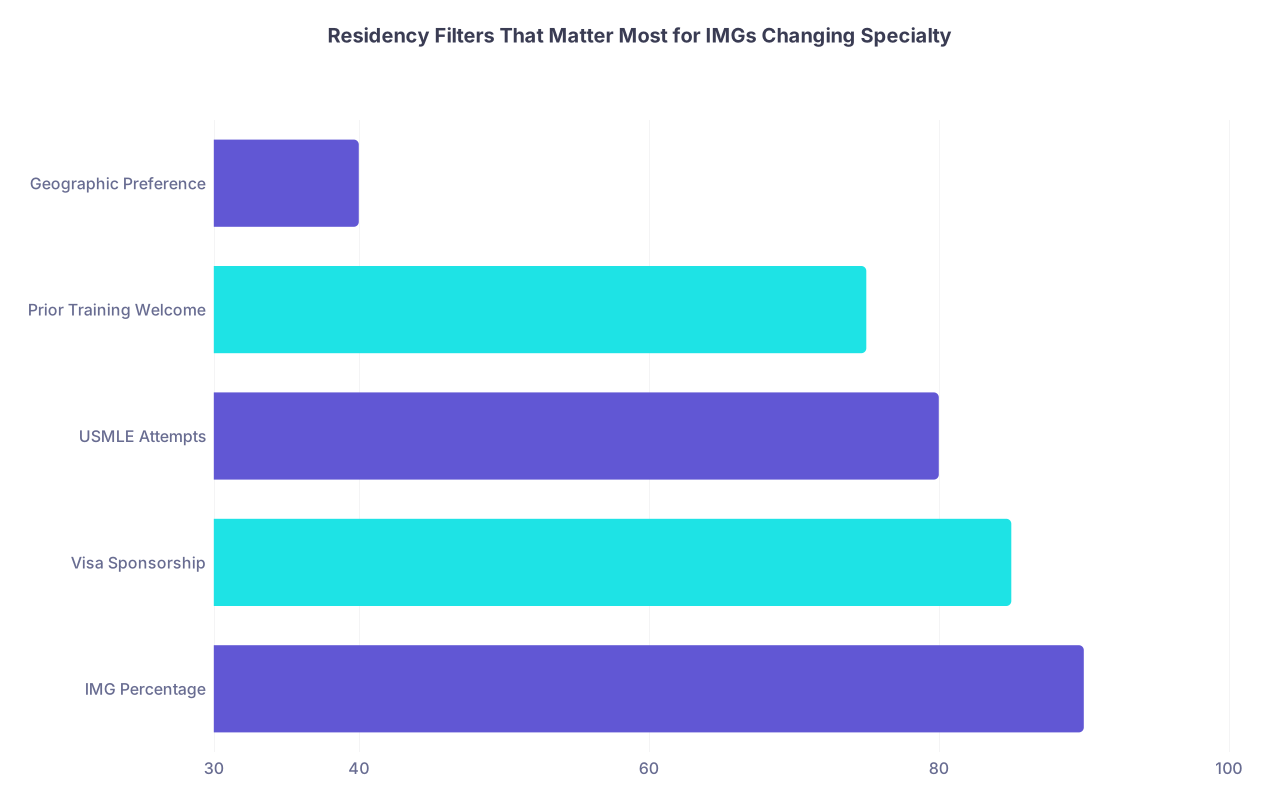
| Category | Value |
|---|---|
| IMG Percentage | 90 |
| Visa Sponsorship | 85 |
| USMLE Attempts | 80 |
| Prior Training Welcome | 75 |
| Geographic Preference | 40 |
Ignore:
- Vague “we value diversity” lines without specifics.
- “Holistic review” buzzwords if they also list “Step 1 > 240 preferred.”
Step 3: Build tiers
Roughly:
- 20–40%: “Reach” programs (university‑affiliated, IMG‑friendly, but higher bar)
- 40–60%: “Target” programs (community, many IMGs, explicit visa support)
- 10–20%: “Safety” programs (newer, rural, heavily IMG, lower cutoffs)
If you’re extremely borderline (multiple failures, big gaps), shift more toward the “safety” side.
6. Specific Situations: What To Do If This Is You
Let’s hit some real, messy scenarios I’ve seen.
Scenario A: You completed a residency abroad and want to switch to IM/FM in the US
Emotional trap: “I already did this once; will they think I’m starting over because I wasn’t good enough?”
Programs will actually like parts of your profile if you emphasize:
- You can function independently.
- You’ve managed large patient loads.
- You understand team dynamics and systems.
Your moves:
- Get at least 2 recent US letters from the new specialty.
- Have one letter from your prior specialty if it strongly praises your work ethic and professionalism.
- In your personal statement, show how the prior specialty strengthens you in this new one (e.g., Surg → IM critical care awareness; OB → FM women’s health; Peds → FM adolescent care).
Scenario B: You started a US residency in another specialty and left
This is delicate but not hopeless.
You must be absolutely clean on:
- Did you leave in good standing? Get that in writing if possible.
- Was there any remediation, probation, or non‑renewal? You cannot hide this.
Programs that are open to second chances will still take a hard look at:
- Your professionalism.
- Your ability to function safely.
- Your insight into what happened.
Your moves:
- Get a letter from your prior PD if at all possible. Programs will call them anyway.
- Be direct but brief about why you left:
- “After six months in anesthesia, it became clear I was more drawn to longitudinal patient care than procedural practice. In discussion with my PD, we agreed that internal medicine would be a better long‑term fit.”
- Show that you have not been idle—US clinical work, research, or structured roles in the new field.

Scenario C: You failed Step 1 or Step 2 and want to change specialty
Your biggest issue is not the change of specialty—it’s the exam history. But the specialty switch can actually help if:
- Your prior track was hyper‑competitive (e.g., surgery, radiology) and you’re moving to a less competitive field.
- You can show improved performance afterward—like a strong Step 2 CK or strong clinical evals.
Your moves:
- Explicitly mention your improvement pattern in the personal statement:
- “After my initial Step 1 failure, I restructured my study approach and passed on my second attempt. This new system led to a Step 2 CK of 233.”
- Target programs that:
- Accept multiple attempts.
- Have many IMGs.
- Emphasize clinical over test scores.
7. Contacting Programs: When and How It Actually Helps
Randomly emailing 150 PDs with your CV attached is spam, not strategy.
Reach out only when:
- You have a specific, relevant question, and
- You can add value with your background.
Examples of good reasons to email:
- You see the program has accepted residents with prior training and want to clarify if they still consider off‑cycle or second‑specialty applicants.
- You’ve done a significant QI or research project directly related to something on their website and can connect the dots concisely.
- You’re applying as a PGY‑2 transfer and need to ask if they’ll have positions.
Email structure:
- 3–6 sentences max.
- One‑page attached CV, clearly labeled.
- Very specific subject line: “Prospective IMG applicant with prior surgery residency—question about IM PGY‑1 positions.”
If you’re still in doubt: when you read your own email, if it sounds like you’re begging for a chance rather than offering a motivated applicant with unique experience, rewrite it.
8. Protect Yourself: Common Mistakes That Kill Second Chances
I’ve watched people with workable profiles sabotage themselves. Do not:
Hide prior training or exams.
Programs will find out. When they do, you’re done.Sound bitter about your previous specialty or program.
Even if you were treated unfairly, framing it as “they were terrible, I was the victim” makes you look risky.Apply to a ridiculous list of impossible programs instead of a realistic mix.
“But I really want Boston / California / big‑name only” is how people end up unmatched twice.Use a generic personal statement that could apply to any specialty.
You’re changing specialty. They need to see thought, not vibes.Waste time on random observerships in unrelated fields.
Every new experience from now on should support your target specialty, not just “US exposure.”
9. A Simple Action Plan for the Next 3–6 Months
If you’re serious about switching, here’s a realistic roadmap.
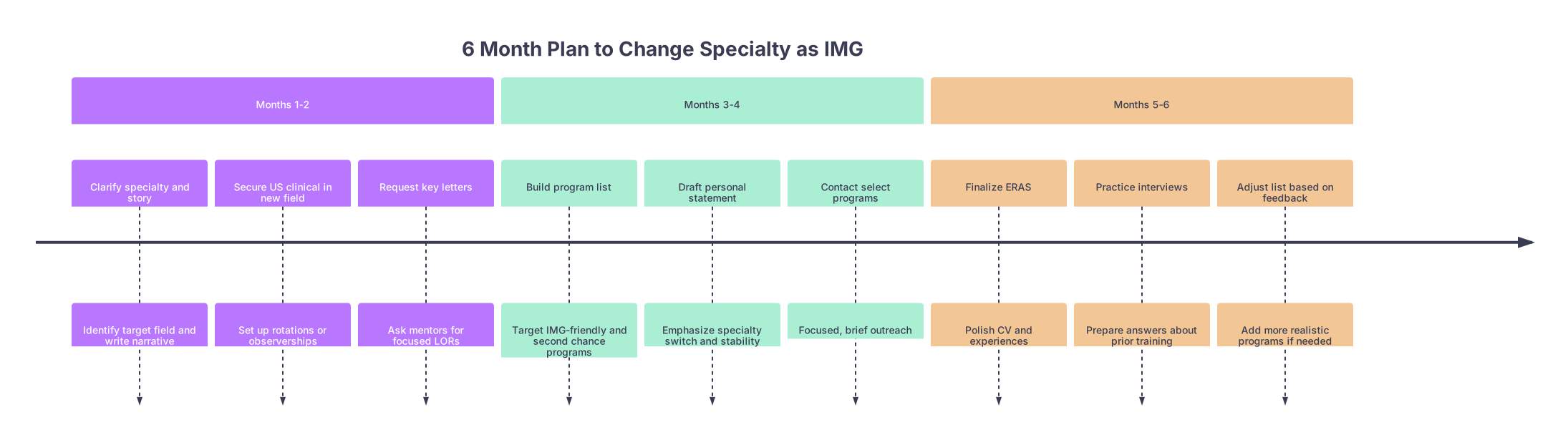
| Period | Event |
|---|---|
| Months 1-2 - Clarify specialty and story | Identify target field and write narrative |
| Months 1-2 - Secure US clinical in new field | Set up rotations or observerships |
| Months 1-2 - Request key letters | Ask mentors for focused LORs |
| Months 3-4 - Build program list | Target IMG-friendly and second chance programs |
| Months 3-4 - Draft personal statement | Emphasize specialty switch and stability |
| Months 3-4 - Contact select programs | Focused, brief outreach |
| Months 5-6 - Finalize ERAS | Polish CV and experiences |
| Months 5-6 - Practice interviews | Prepare answers about prior training |
| Months 5-6 - Adjust list based on feedback | Add more realistic programs if needed |
FAQs
1. Should I disclose my prior specialty change in every application, or only if they ask?
You disclose it. Always. ERAS will ask about previous training and you must answer truthfully. In the personal statement, you don’t need a blow‑by‑blow biography, but you do need a short, clear explanation of your path that matches what they’ll see in your CV and MSPE. Hiding it is the fastest way to get blacklisted when they inevitably find out during background checks or reference calls.
2. How many programs should I apply to as an IMG changing specialty?
More than the average US grad, but not blindly to 200+ places. For IM/FM/Psych/Neuro/Peds, many IMGs changing specialties land in the 60–120 range, if they’re targeted. If you have multiple red flags (failures, big gaps, visa needs), your number should be on the higher end—but still built around IMG‑heavy, community, newer, and explicitly flexible programs. Volume without targeting is just paying extra to get rejected more.
3. Is it ever smarter to finish my original specialty and then sub‑specialize, instead of switching residencies?
Sometimes, yes. If you’re already deep into a residency (PGY‑3+), in good standing, and your new interest overlaps (e.g., surgery → critical care, OB → MFM‑style interests, Peds → adult congenital care via cards), finishing and using fellowships or focused practice may be both faster and safer. But if you’re early (PGY‑1–2) and absolutely certain this specialty is wrong for you, forcing yourself through several more miserable years just for “completeness” can backfire—burnout, poor evaluations, and a worse story later. You have to weigh: how misaligned is your current field, how competitive is the target, and how much runway (time, finances, visa) you actually have.
Open a blank document today and write three paragraphs: why you started your first specialty, why you’re changing, and why this new field is where you’re staying. That story will drive which programs you target, who you ask for letters, and how you spend every month until Match.