What do you do when you have a prior US visa denial, you are an IMG, and ERAS season is here—do you tell programs, hide it, or avoid the US entirely?
You’re not the first to be in this mess. I’ve seen applicants with B1/B2 denials, F1 denials, J1 denials, even revoked visas, match into residency. And I’ve also watched strong candidates waste thousands of dollars applying blindly to programs that were never going to touch them once they saw “prior visa refusal” in the DS-160 or heard it in the consulate interview.
Let’s cut the theory. You need to do three things:
- Understand how a prior visa denial actually affects your residency chances.
- Choose programs that are realistic given your situation.
- Control the story you tell—on paper, in emails, and eventually at the visa interview.
I’ll walk you through all three.
Step 1: Get Clear on What Your Visa Denial Really Means
Not all denials are equal. Programs—and consular officers—see them very differently.
The first distinction: reason and pattern.
| Denial Type | Typical Impact on Residency Visa |
|---|---|
| 214(b) B1/B2 | Mild–Moderate, usually overcome with residency |
| 214(b) F1 | Mild–Moderate, depends on documentation issues |
| 221(g) Admin Processing | Usually low impact if later resolved |
| Prior J1 refusal | Moderate, needs explanation |
| Overstay/Status violation | High risk, some programs avoid |
| Misrepresentation (212(a)(6)(C)) | Very high, often disqualifying |
If you do not know exactly why you were denied, that’s your first problem.
Figure out what’s in your record
Do this now, not after you’ve already applied.
- Check your old DS-160/DS-160 confirmation email if you still have it.
- Recall what the officer actually said. Typical 214(b) language: “You do not demonstrate strong ties…”
- If needed, consider a FOIA request to the Department of State about your visa records, especially if you suspect anything major (misrepresentation, fraud, overstay).
If your denial was:
- 214(b) for a B1/B2 or F1 (most common): programs and consulates generally care less, especially if they see a bona fide residency contract later.
- Overstay, unauthorized work, or removal: this can be a real problem. Some programs will quietly screen you out.
- Misrepresentation / fraud (even “small” lies): this can kill a visa even with a signed residency contract unless you qualify for a waiver.
If you’re in that last group (fraud, major immigration violations), you need immigration counsel before you waste a cycle. I’m not joking.
Step 2: Know Which Visa You’re Actually Targeting
You can’t choose programs intelligently if you haven’t picked a default visa path.
Basic reality: you don’t really control the visa choice—programs and their GME offices do. But you can control which type of program you’re applying to.
Quick refresher: J-1 vs H-1B for IMGs
| Feature | J-1 (ECFMG-sponsored) | H-1B (Employer-sponsored) |
|---|---|---|
| Common for IMGs? | Very common | Less common |
| Requires Step 3? | No | Usually yes |
| 2-year home requirement? | Yes (often applies) | No |
| Program paperwork burden | Lower | Higher |
| Flexibility after residency | Limited at first | More flexible |
Where the prior denial matters:
- Many consular officers are more comfortable approving J-1s for residency after previous tourist/visitor denials. They see it as structured, monitored, clearly temporary.
- H-1B, especially after multiple refusals, sometimes raises more “immigrant intent” issues if your story doesn’t add up.
So, if your only problem is a simple 214(b) tourist visa refusal and no status violations, J-1 is usually quite survivable.
If you’ve had J-1 problems or waivers before, it’s more delicate. Some officers scrutinize repeat J categories harder, especially if you previously didn’t return on time.
Step 3: Screening Programs With Realistic Visa Awareness
Here’s where people screw up: they sort by “IMG-friendly” and “sponsors visa” and call it a day. That’s not enough when you have a denial history. You need visa-risk-aware and policy-stable programs.
Think of programs on a spectrum:
- Group 1: “We sponsor J-1 only. No case-by-case.”
- Group 2: “We sponsor J-1 routinely; H-1B occasionally. We know what we’re doing.”
- Group 3: “We say we sponsor everything, but GME or legal panics at any red flag.”
- Group 4: “No visa sponsorship.”
You want mostly Groups 1 and 2, but with structure and history of dealing with real immigration complexity.
How to read between the lines on program websites
Look past the marketing sentence “We support diversity and IMGs.” Useless. Look for things like:
- “We sponsor J-1 clinical visas through ECFMG.”
- “H-1B sponsorship considered for competitive candidates who have passed USMLE Step 3.”
- “We have a long history of training international medical graduates.”
- “We require Step 3 passed by X date for H-1B consideration.” (This shows they actually know the rules.)
- Profiles of current residents/fellows clearly IMG + foreign med school, especially from your region.
Red flags:
- Vague lines like, “Visa sponsorship may be possible depending on institutional policy” and zero current foreign-name residents in photos. Translation: they really do not want the hassle.
- “We do not sponsor visas” paired with a couple of IMGs who are actually green card holders or US citizens. That doesn’t help you.
- Programs that abruptly changed policy recently (“Due to institutional changes, we no longer sponsor H-1B”)—means they’re risk-averse.
Step 4: Building a Risk-Aware Application List
You’re not just “an IMG.” You’re:
- IMG + prior denial history
- X Step scores
- Y years since graduation
- Z level of US clinical experience
That combo determines how aggressive you can be.
To keep this practical, think in bands. Example for a typical non-US citizen IMG with a 214(b) B1/B2 denial and reasonable scores (Step 2 CK ≥ 230) and YOG within 5 years:
Aim for something like:
- 50–60%: Core IMG-heavy, J-1 friendly community/academic programs in less competitive locations (Midwest, South, inland states).
- 20–30%: Slightly more competitive university-affiliated programs that clearly list visa support and have visible IMG residents.
- 10–20%: Long-shot H-1B programs if you have Step 3 and strong scores.
And for you, because of the prior denial, I’d strongly bias toward programs that:
- Have at least several current J-1 IMGs on their resident roster now, not 10 years ago.
- Explicitly mention collaboration with ECFMG for J-1 on their site.
That tells you their GME office is used to pulling visa paperwork together, dealing with consulates, and not panicking when something isn’t 100% “clean.”
Step 5: When (and How) to Disclose a Prior Visa Denial
You’re probably worrying: “If I tell them, they’ll reject me. If I hide it, will it show up later?”
Here’s the uncomfortable truth: the visa denial matters more at the consulate stage than at the residency application stage. Many PDs frankly don’t have the time or expertise to analyze your visa history in detail—until they’re burned once.
So your strategy:
1. On ERAS and during applications
ERAS doesn’t have a standard field asking, “Have you ever been denied a US visa?” Most programs don’t ask this directly either.
My rule:
- Don’t volunteer your denial in the personal statement or CV. That’s not what they’re evaluating.
- If a program’s supplemental form explicitly asks about prior visa refusals: answer truthfully, briefly, and without drama.
Example answer on a program-specific form:
Yes. In 2021 I applied for a B1/B2 visa to attend a non-required observership and was refused under section 214(b) (insufficient ties). I have had no status violations, overstays, or immigration infractions. I am now applying for a J-1 clinical visa through ECFMG sponsorship for residency.
Clean, boring, non-defensive. That’s what you want.
2. If you email programs about visa questions
You don’t need to dump your full immigration history on a coordinator. You ask targeted questions:
- “Do you currently sponsor J-1 visas through ECFMG for IMGs?”
- “Have you recently had residents on J-1 visas from [your region/country]?”
If you had something more serious than a simple tourist denial (like an overstay or previous J-1 issue), that’s when I might advise limited, strategic disclosure to programs that seem genuinely interested, after an interview invite, not before. You frame it like:
I wanted to mention that I previously had a B1/B2 application refused under 214(b) in [year]. I have not had any status violations or immigration issues. I’ve been advised this should not prevent J-1 issuance for an accredited GME position, but I wanted to be transparent as your office prepares visa paperwork.
If you have actual immigration complications, run that wording by an immigration lawyer before sending.
Step 6: Targeting Programs with Actual Immigration Competence
Some programs just check a “we sponsor J-1” box. Others actually know how to handle tricky cases. You want the second group.
Clues that a program actually knows what they’re doing:
- The GME office page has a clear section about non-US citizen residents, J-1 process, and documentation.
- They list a Designated Institutional Official (DIO) and maybe an international office that handles visas.
- Residents mention, in reviews or alumni pages, smooth J-1 processing or help from the international office.
- The institution has multiple fellowship programs with many foreign fellows—these places are used to transfers, renewals, and the occasional consular headache.
Places that scare easily:
- Small hospitals where you see maybe one IMG total, and that person is a green card holder.
- Programs that start every visa sentence with “depending on institutional policy” and then respond very vaguely over email.
- Any coordinator who, when you ask a simple visa question, replies “We are not sure; you can check with ECFMG.” That level of uncertainty is not what you want when you already have a denial.
If you’re trying to be systematic, map it out.
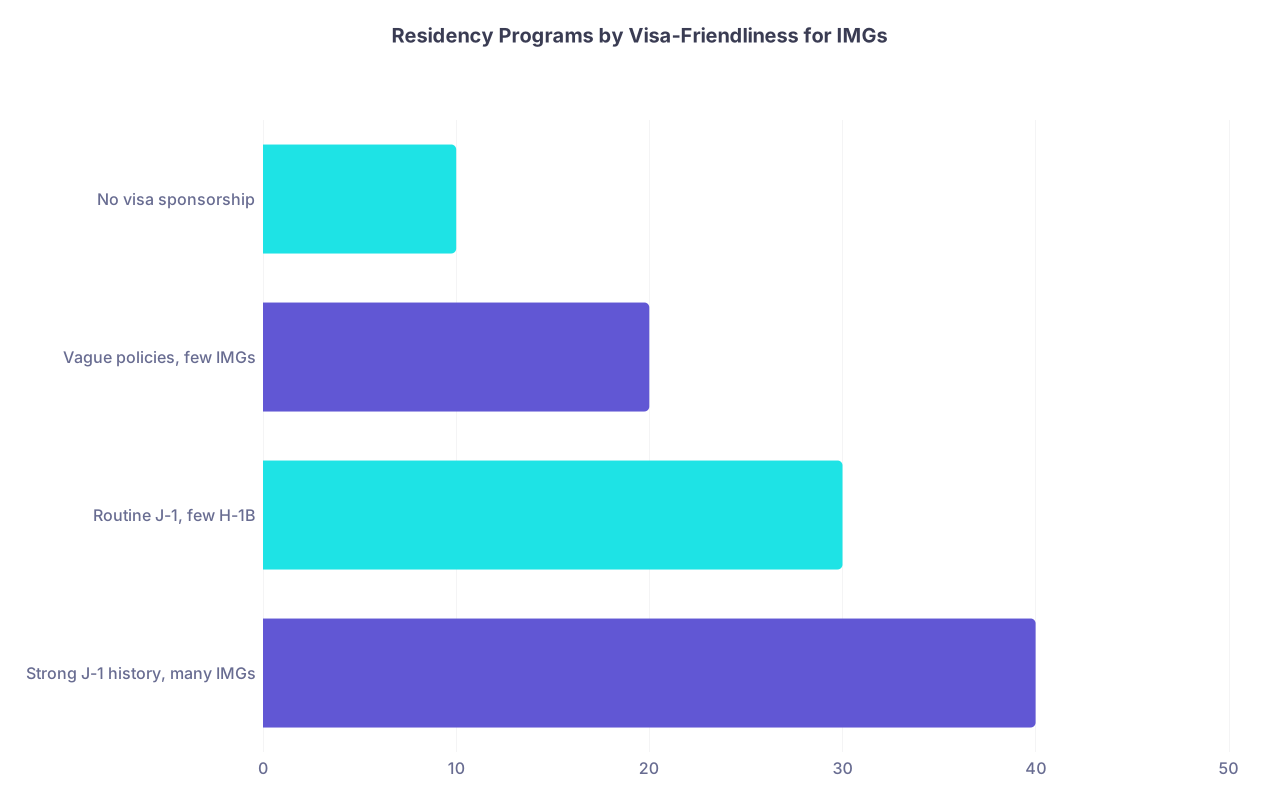
| Category | Value |
|---|---|
| Strong J-1 history, many IMGs | 40 |
| Routine J-1, few H-1B | 30 |
| Vague policies, few IMGs | 20 |
| No visa sponsorship | 10 |
The numbers are just illustrative, but you get the idea: you want your application list loaded in the left two groups.
Step 7: Adjusting Strategy Based on Your Specific Denial
Let’s get granular. Different scenarios, different approaches.
Scenario A: Single 214(b) tourist visa denial, nothing else
This is the most common and least scary.
Your playbook:
- Apply broadly to J-1 friendly programs like any other IMG.
- Do not bring up the denial unless asked.
- Prepare a simple, calm explanation for the consulate:
- At that time, you were applying for a tourist/observership with no strong ties.
- Now, you have a structured, time-limited clinical training program with sponsorship.
I’ve watched dozens in this category get J-1s without drama.
Scenario B: Multiple tourist denials, maybe from a high-fraud-post country
Here, consular officers can be more suspicious—but residency still changes the equation.
Your playbook:
- Heavily emphasize structured, reputable institutions on your list. Big academic centers, well-known community programs.
- Prefer J-1 path; it’s a cleaner story: education/training, not tourism.
- If asked (visa interview):
- You acknowledge prior refusals.
- Explain your situation then (limited ties, student/early in career).
- Contrast it with your situation now (contract, GME, clear training plan, funded position, intention to comply with the program and return requirement if J-1).
You don’t need to emo-monologue in ERAS. But you must be ready for the consular conversation.
Scenario C: Prior overstay or status violation
This is where you must talk to an immigration lawyer before getting too excited. Not Reddit, not Telegram. A real lawyer.
Some overstay issues can be cured or worked around. Others trigger 3- or 10-year bars. You need to know which.
If you’re still legally able to obtain a J-1 or H-1B:
- Prioritize programs at institutions that routinely bring in foreign faculty/fellows on visas; their legal departments are stronger.
- Be ready that some programs, once they hear “overstay,” will pass. You only need a few that don’t.
Scenario D: Misrepresentation / fraud finding
If you had a visa refused with a note about providing false documents or information and it’s coded as misrepresentation, that’s a huge red flag at the consulate stage. Waivers exist, but they’re specialized, slow, and not guaranteed.
Hard truth: in this situation, the limiting factor is often the US government, not programs. Programs might be willing; the consulate may not.
Your playbook:
- Get legal advice to see if a waiver path exists.
- Seriously consider other countries’ residency systems (UK, Canada, Australia, Germany, etc.) as a parallel or alternative track.
- Do not lie to programs to “bury” this. That’s how a bad record becomes a career-ending one.
Step 8: Protecting Yourself From Program-Level Surprises
Even if you pick well, things go wrong:
- Program says they sponsor J-1, then their GME office changes policy mid-year.
- Legal department suddenly gets cautious after a bad experience with another resident.
- They discover your prior denial late and freak out.
You can’t control institutional chaos. But you can reduce exposure.
Here’s a solid pre-Match checklist once interview season is underway:
For any program where you’re a serious candidate (you’d rank them high), email the coordinator after your interview:
I’m an international medical graduate and would require visa sponsorship to train in your program. Could you please confirm which visa types the program/institution currently supports for residents (J-1 via ECFMG, H-1B, etc.)?
If you get a generic answer, push gently:
Thank you. And just to clarify, do you currently have residents on J-1 visas?
Save these emails. If a program reverses itself later, you at least know it was a genuine change, not something you missed.
Step 9: Aligning Your Story for the Consulate Interview
All of this—program selection, ERAS strategy—is a setup for one moment: the visa interview.
Your biggest risk with a prior denial isn’t the residency PD. It’s the consular officer who has 3 minutes to decide whether to stamp “Approved” or “Refused.”
Your story has to line up:
- What your DS-160 says
- What ECFMG/program’s paperwork says
- What you say at the window
- What your past applications show
If on your previous tourist application you insisted you had “no intention to study or work in the US,” and now you show up for residency, that’s fine—you’re allowed to change plans. But you must sound coherent, not desperate.
Questions they’re mentally asking:
- Is this a legitimate, accredited training program?
- Is this applicant likely to comply with the terms of the visa?
- Did they lie before?
That last one is the killer. If your prior denial involved half-truths, fix your approach now. Full honesty from this point forward, even if it feels uncomfortable.
Step 10: If You Don’t Match the First Time
A prior denial plus an IMG profile sometimes means a longer path. If you go unmatched:
- Use the year to strengthen US ties in legitimate ways: paid research positions, observerships through big academic centers, US-based MPH or clinical research degrees if you can secure F1 properly.
- Keep your record clean. No shady visa mills, no random “volunteer work” that’s unauthorized employment.
- Revisit your program list and bias even more heavily toward structured, IMG-heavy, J-1-experienced institutions.
And if in the meantime your life situation genuinely changes—marriage to a US citizen, different immigration status—factor that into your next cycle’s strategy. The visa side can shift fast.
Key Takeaways
- A prior visa denial is a factor, not an automatic death sentence. Simple 214(b) refusals are usually survivable for residency, especially on J-1.
- Your safest play is a risk-aware program list: many J-1–experienced, IMG-heavy institutions with real immigration infrastructure, not just “we sponsor visas” on paper.
- Control your narrative: tell the truth, keep it short, and make sure what you say to programs, on forms, and at the consulate all line up.