
Most applicants chase “IMG-friendly” lists and ignore the one thing that will actually save their careers: how a program handles failure.
If you are an IMG, the program’s remediation system matters more than the cafeteria, the call rooms, or the shiny fellowship match list. Because when you hit your first real wall – failed in‑training exam, marginal Step 3, shaky clinical evaluations – you will either get a structured path back…or get quietly labeled as a “problem resident” and frozen out.
Let me break this down specifically.
Why Exam Remediation Matters More for IMGs
IMGs walk into U.S. residency with three predictable disadvantages:
- Different medical school curriculum and exam style
- Variable familiarity with U.S. test formats (especially NBME-style questions)
- Much smaller margin for error – one bad metric can reinforce every bias a PD already has
So when you struggle with:
- The Internal Medicine In‑Training Exam (ITE)
- ABSITE (for surgery)
- SITE/ITE equivalents in other specialties
- USMLE Step 3 during PGY1/PGY2
- Board prep during PGY3
…you need a program that has a system, not just “read more and do UWorld.”
Programs that are genuinely supportive of IMGs tend to share certain characteristics:
- They expect exam variability and plan for it.
- They track data at a granular level (by rotation, PGY year, topic area).
- They intervene early and in a structured, non-punitive way.
- They adjust coverage so remediation is actually feasible, not theoretical.
The rest is marketing.
Core Components of a Strong Exam Remediation System
Let’s build a mental checklist. When you look at a program website or talk to residents/PDs, this is what you should be hunting for – explicitly.
1. Data-Driven Performance Tracking
Good programs do not wait for someone to fail. They maintain dashboards of resident performance in:
- ITE or specialty-specific in‑training exams
- USMLE Step 3 pass timing and pass rates
- Board pass rates (overall and first-time)
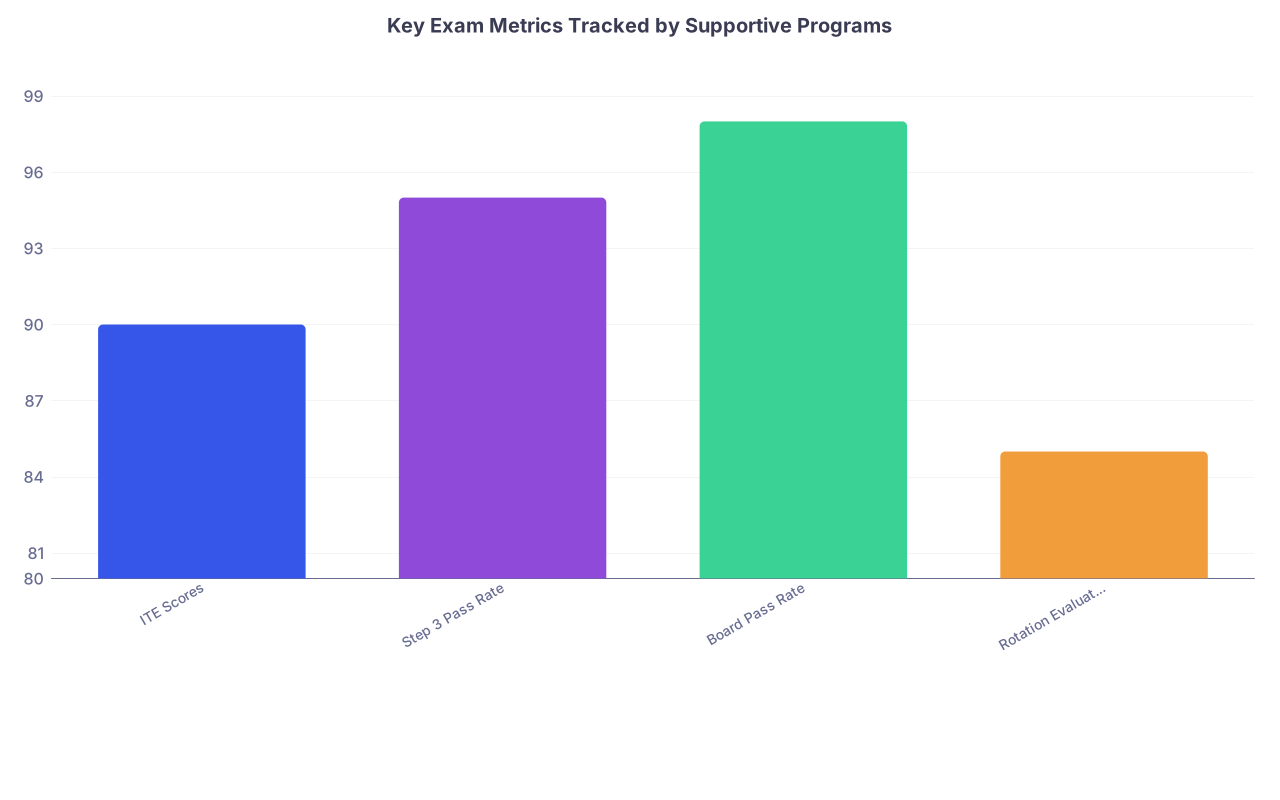
| Category | Value |
|---|---|
| ITE Scores | 90 |
| Step 3 Pass Rate | 95 |
| Board Pass Rate | 98 |
| Rotation Evaluations | 85 |
Supportive programs track:
- Year‑to‑year score progression (e.g., ITE PGY1 → PGY2 → PGY3)
- Percentile distribution (are you constantly in the bottom 20% or just had one off year?)
- Topic‑level weaknesses (cardiology vs nephrology vs ID, etc.)
Red flag: programs that only quote “100% board pass rate for the last X years” but cannot tell you what they do with the bottom quartile of ITE scores.
2. Early Identification and Trigger Thresholds
Serious programs define clear thresholds that trigger support. Not guesswork. Not “we’ll see how they do next year.”
Concrete triggers you want to hear about:
- ITE score below a specific percentile (often <20th or <30th percentile)
- Step 3 failure or narrow pass on second attempt
- Consistent pattern of “needs improvement” in medical knowledge on evaluations
- Failing shelf exams (for prelims/transition years) or board-style blocks in didactics
They do not wait until you actually fail your board exam. That is malpractice on the program side.
3. Structured, Documented Remediation Plans
If a program just tells residents, “We counsel them and recommend resources,” that is not a remediation system. That’s passing the problem back to you.
A real remediation plan has:
- A written document
- Specific exam targets (e.g., move from 15th → ≥40th percentile on next ITE)
- A clear timeframe (typically 3–6 months)
- Defined interventions: reading, question banks, faculty coaching, protected study blocks
- Check‑ins at pre‑set intervals (monthly, sometimes biweekly)
For IMGs, the best programs also adjust for:
- Language/reading speed issues in timed blocks
- Test-taking strategy gaps (e.g., misreading stems, overthinking distractors)
- Differences in pharmacology/brand names vs international usage
What “IMG-Friendly and Supportive” Actually Looks Like
Ignore the fluff. Look for how a program handles residents in trouble.
1. Protected Time That Is Real, Not Fiction
Residents cannot “just study more” on 6+ inpatient weeks in a row. When I hear a PD say, “We expect them to use their free time more efficiently,” I already know how their weaker IMGs do.
Better programs do things like:
- Pull a struggling PGY1 off an elective and convert it into a structured study month
- Reduce call frequency temporarily in PGY2 while targeted remediation is ongoing
- Schedule lighter rotations before a re-take of Step 3 or a critical in‑service exam
- Protect certain conference blocks strictly (no pages except emergencies) during board review sessions

| Step | Description |
|---|---|
| Step 1 | Low ITE or exam failure |
| Step 2 | Program reviews performance data |
| Step 3 | Routine monitoring |
| Step 4 | Create written remediation plan |
| Step 5 | Assign faculty mentor |
| Step 6 | Protected study time and resources |
| Step 7 | Monthly progress meetings |
| Step 8 | Return to standard schedule |
| Step 9 | Enhanced remediation or extension |
| Step 10 | Meets remediation criteria |
| Step 11 | Improved on repeat exam |
Probe for details during interviews: “Can you give an example of how you adjusted a resident’s schedule to help them remediate an exam?”
If they hesitate or give a vague, philosophical answer, that tells you everything.
2. Faculty Who Actually Teach Test Strategy
IMG-friendly programs with strong remediation systems do not just throw UWorld subscriptions at people.
They offer:
- Regular, mandatory board review conferences led by faculty who know the exam blueprint
- Small group “test‑taking strategy” workshops, not just content reviews
- Case‑based question breakdown sessions:
- Why each distractor is wrong
- How to identify the “NBME angle”
- How to avoid classic traps (e.g., treating the lab abnormality and not the patient)
Some of the best IMG-heavy community internal medicine programs literally have ITE/board review power users on faculty – that one associate program director who lives inside MKSAP and NEJM Knowledge+ and hammers question logic every week.
3. Step 3 and Licensing Support
USMLE Step 3 has become the quiet graveyard for a lot of IMGs. Programs that support you:
- Expect and encourage Step 3 by a specific time (usually PGY1 or early PGY2)
- Provide:
- Paid or subsidized access to a primary Qbank
- Clear guidance: “Aim for 1,500–2,000 questions before test day”
- Sample study schedules that work with their specific rotation calendar
- Intervene aggressively after one failure:
- Immediate faculty meeting
- Review of your score report in detail
- Concrete retake timeline (not endless delay)
- Lighter rotation assigned before retake when possible

If you ask, “What happens if a resident fails Step 3?” and the PD says, “That has not happened here in many years,” that is not reassuring. That is a red flag for lack of systems.
4. Board-Style Didactics Built Into the Curriculum
Programs that support IMGs typically bake exam prep into the weekly rhythm:
- Weekly or twice‑weekly board review sessions
- Required attendance for PGY1s, sometimes all classes
- Question-of-the-day or morning report structured explicitly around ABIM/ABFM/ABSITE style vignettes
- Longitudinal curriculum (e.g., 18-month repeating board series) rather than one panic-heavy PGY3 review
| Activity Type | Frequency |
|---|---|
| Board review conferences | Weekly or biweekly |
| ITE review meetings | After each exam |
| Dedicated study rotations | 1–2 blocks for at-risk residents |
| Step 3 planning sessions | 1–2 per year |
If residents say, “Board review is optional and not well attended,” assume weaker residents are on their own.
Examples of Program Types Known to Support IMGs with Exams
I am not going to give you a fake top-10 list. But I will describe the patterns of programs where I have repeatedly seen strong remediation systems and IMG support.
1. Large Community Internal Medicine Programs with High IMG Proportion
Think of places with:
- 60–100+ categorical IM residents
- Majority IMGs (often >60–70%)
- Historically average but improving board pass rates
These programs have faced the pain of exam failures before. They learned the hard way and built systems.
Common features:
- Program directors who quote specific board pass rate trends for the last 5–10 years
- Formal ITE review meetings after the exam for every resident
- Clear policy: bottom quartile gets a defined remediation plan
- Partnership with major resources (MKSAP, UWorld, Board Basics) provided for free
During interviews, ask current residents: “Do low ITE scores carry stigma, or do they trigger actual help?” Their facial expression will tell you a lot.
2. University-Community Hybrid Programs with Growing Academic Ambition
These departments care about their metrics now. Board pass rates and ITE improvements are on their strategic dashboards.
Strong examples often:
- Have an Associate Program Director whose explicit job is “Assessment and Remediation”
- Run data‑driven educational research projects on ITE and board outcomes
- Present posters at APDIM or specialty education meetings about their remediation models
- Use formal learning plans, not ad hoc emails
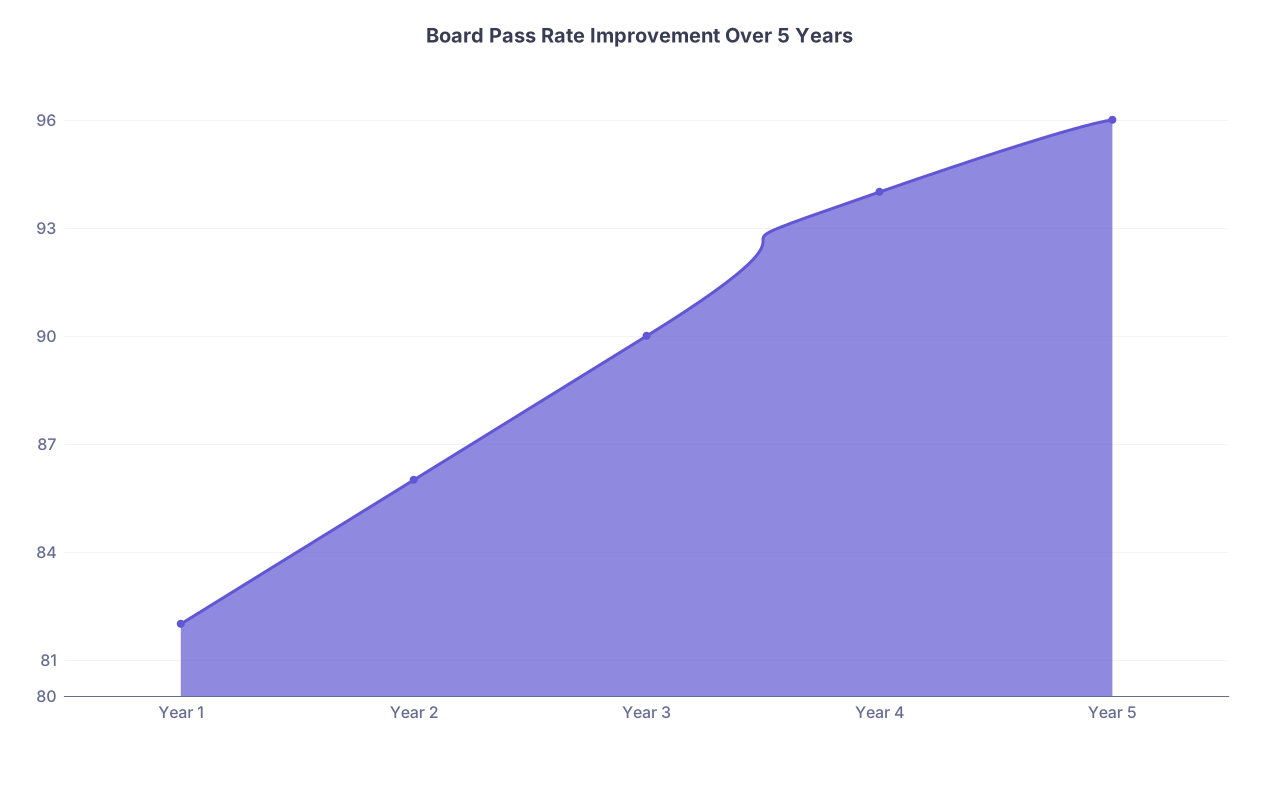
| Category | Value |
|---|---|
| Year 1 | 82 |
| Year 2 | 86 |
| Year 3 | 90 |
| Year 4 | 94 |
| Year 5 | 96 |
These are the programs that take pride in telling you: “Five years ago, we had two residents fail boards. We responded by building X, Y, and Z. Now our pass rate has been 95–100% for the last three years.”
3. Programs with Formal Academic Support Offices
Some institutions, especially larger university hospitals, have centralized offices:
- Office of Graduate Medical Education (GME) Academic Support
- Resident Performance Improvement Committees
- Institutional learning specialists or educational psychologists
For IMGs, this can be gold.
What they offer:
- Formal test-taking strategy evaluation
- Assessment of reading speed and comprehension
- Coaching on anxiety, procrastination, and burnout related to exam stress
- Structured group remediation programs across departments

Ask directly: “Does the GME office have a structured process for supporting residents after an exam failure?”
If they do, you want to hear specific phrases: learning plan, coaching, follow‑up meetings, documented outcomes.
How to Identify Strong Remediation Systems During the Application Process
You cannot rely on program websites. They never say “we abandon residents who fail.” You have to interrogate the system indirectly.
Step 1: Pre-Interview Research
Look for:
- Published board pass rates, ideally 3–5 year averages
- Any mention of:
- “academic remediation,”
- “scholarly oversight for struggling residents,”
- “academic support,”
- “educational improvement plans.”
Programs that actually invested in remediation often brag about their improved outcomes.
Step 2: Questions for Residents
Do not waste your 10 minutes with residents asking about moonlighting. Ask these:
- “Has anyone in your class struggled with exams? How did the program respond?”
- “Does the program provide protected time or resources for people who are below average on ITE?”
- “Do residents feel safe disclosing if they are worried about exams, or does it feel risky?”
- “How early do most residents take Step 3, and what support do they get before that?”
You are listening for:
- Specific stories (“We had a co‑resident fail Step 3; they gave them a lighter rotation and a structured plan and they passed the next time.”)
- Consistency between what different residents say. If one says the program is supportive and another hints that low scorers get labeled, believe the second one.
Step 3: Questions for Program Leadership
You can be direct without sounding like a disaster risk. Phrase it like this:
- “What systems do you have in place to support residents who are below average on ITE?”
- “How do you approach Step 3 timing and support, especially for international graduates who may not be familiar with the U.S. exam format?”
- “Can you walk me through the process if a resident fails a major exam?”
- “Do you use any formal learning plans or academic remediation protocols?”
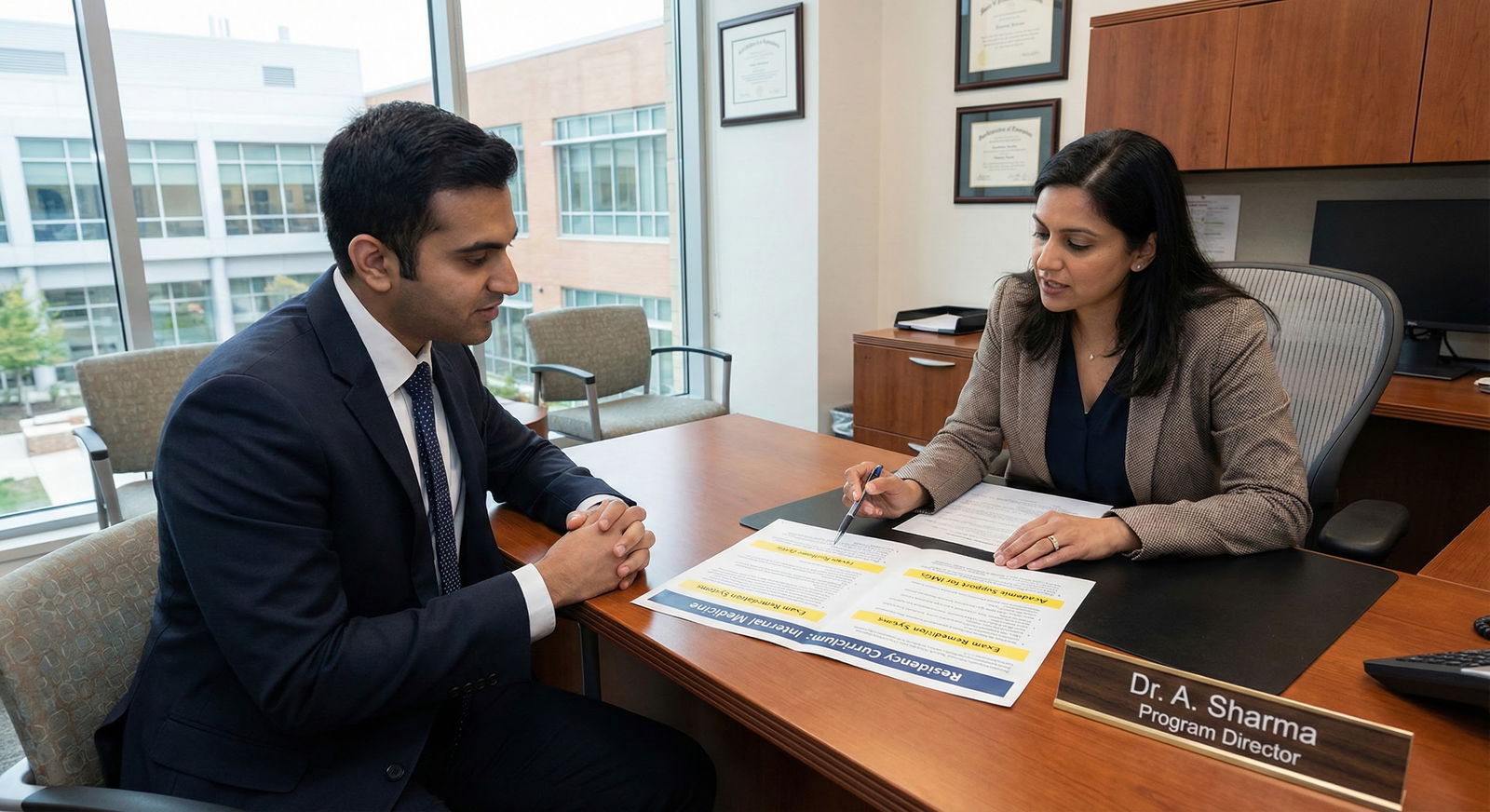
If they give you polished but generic answers about “we support all our residents” without structure, that usually means they have no real system.
Step 4: Watch for Red Flags
You are an IMG. You cannot afford to ignore these:
- PD downplays exams: “We do not worry too much about ITE.” Translation: no remediation system.
- No one can give a concrete example of how they helped a struggling resident.
- Residents say, “People just study on their own; the schedule is what it is.”
- PD talks about “our strong board pass rates” but cannot break that down by cohort or discuss what they do for low scorers.
What a Good Remediation Plan Actually Looks Like (Concrete Example)
Let’s say you are a PGY1 IMG in internal medicine. You score 12th percentile on ITE.
At a serious, IMG‑supportive program, here is a plausible sequence:
Post‑ITE Meeting (Month 1 after exam)
- Scheduled 30–60 minute meeting with PD or APD
- They review your score report:
- Overall percentile
- Performance by subspecialty (cards, GI, ID, etc.)
- Comparison to your PGY1 peers
Written Remediation Plan (Immediately after)
Includes:- Goal: raise ITE to at least 40th percentile next year
- Weekly commitment:
- 20–25 board-style questions per day, 5 days per week
- 1–2 hours of targeted reading per week
- Resources: MKSAP, UWorld IM, question log spreadsheet
Schedule Adjustments (Next 6–12 months)
- Avoid stacking the heaviest rotations back-to-back when possible
- Assign at least one lighter elective before next ITE as a study month
- Try to avoid testing during the most brutal ICU month
Monthly Check‑ins
- Quick 20–30 minute conversations:
- Review question log and correctness rate
- Discuss hardest topics
- Adjust plan if unrealistic
- Quick 20–30 minute conversations:
Group Board Review
- Strong expectation that you attend weekly or biweekly board review
- Sometimes targeted small group for bottom quartile residents
Re-Test and Debrief
- After the next ITE, repeat the analysis
- If significant improvement: gradually step down intensity of remediation
- If minimal improvement: escalate – possible extension of training, more aggressive schedule changes, involvement of institutional learning specialists
That is what you are looking for. Not magic. Just clear, structured, consistent action.
How IMGs Can Work With These Systems, Not Against Them
Even the best remediation system cannot help you if you:
- Hide your struggles until there is a formal failure
- Refuse to engage in the plan
- Treat feedback as personal criticism rather than data
Your job:
- Signal early: If you feel repeatedly lost in conferences or question sessions, say something by month 2–3.
- Ask for structure: “Could we set a concrete weekly goal for questions and reading?”
- Track your own data: Keep a simple log of:
- Questions done per week
- Percent correct per block
- Topics that you keep missing
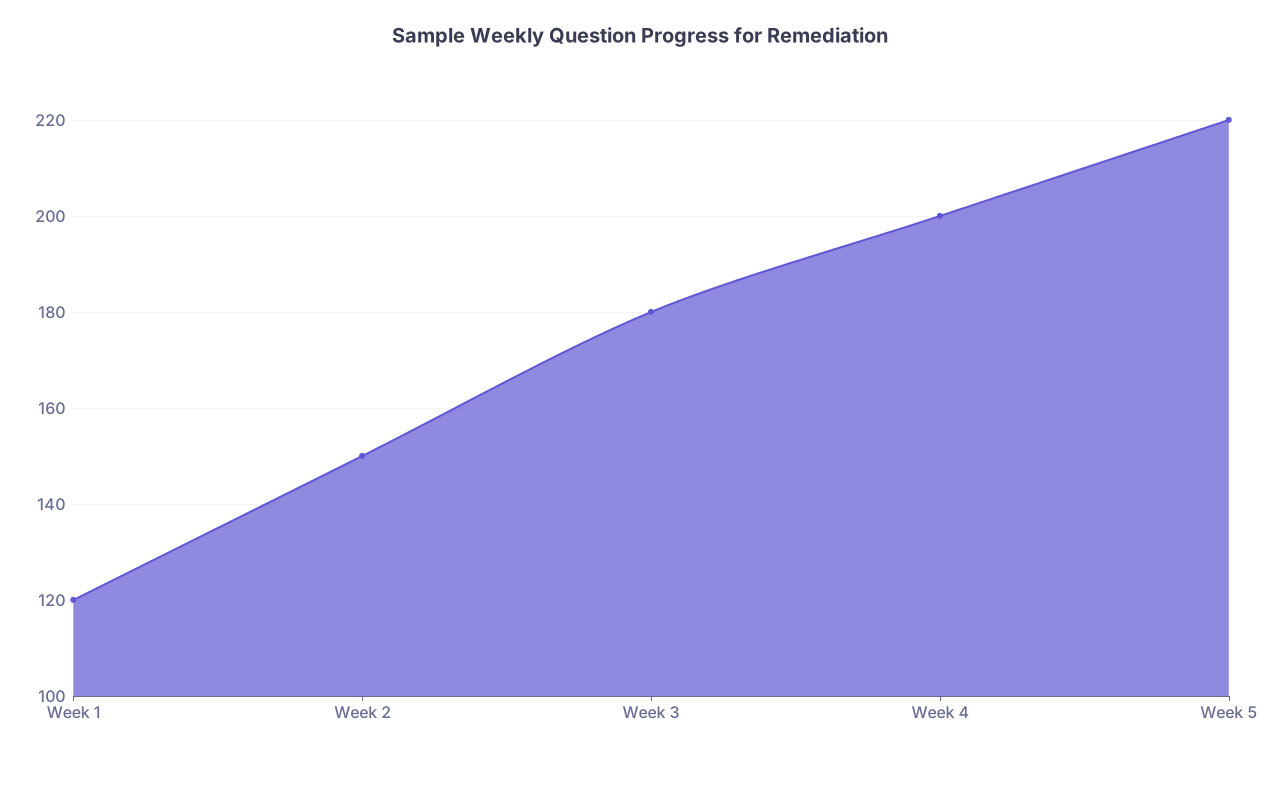
| Category | Value |
|---|---|
| Week 1 | 120 |
| Week 2 | 150 |
| Week 3 | 180 |
| Week 4 | 200 |
| Week 5 | 220 |
An IMG who is proactive, transparent, and data‑driven is the ideal candidate for a strong remediation system. Faculty like helping residents who are clearly trying.
FAQs
1. Should I avoid programs with historically lower board pass rates as an IMG?
Not automatically. A previously mediocre board pass rate that is clearly improving, paired with explicit remediation systems, can be safer for you than a brand‑name program that assumes everyone will pass without support. Look for trajectory and structure, not just a single percentage.
2. Is it risky to ask about exam failures during interviews?
If you phrase it poorly, yes. If you ask with a systems focus, no. Use language like, “How does the program support residents who are struggling academically?” You are evaluating their quality, not advertising your own weakness.
3. Do community programs or university programs tend to be better for remediation?
It depends. Large community programs with many IMGs often have more experience and more practical remediation systems. University programs may have better access to learning specialists and institutional resources. The key is not the label; it is whether they can describe concrete processes and examples.
4. How soon should I plan to take Step 3 as an IMG resident?
In most IMG-heavy internal medicine and family medicine programs, a common and reasonable target is by the end of PGY1 or early PGY2. The advantage of earlier is getting it off your plate before heavier responsibilities hit. The risk is stacking it on top of US acclimatization. A supportive program will help you time it around your actual performance and rotation schedule.
5. If I already failed Step 2 once, should I only rank programs with very strong remediation systems?
You should prioritize them. A prior failure means you are at higher risk for struggle with ITE, Step 3, or boards, especially in a new system and culture. A program that is explicit, non‑punitive, and structured about remediation is not optional for you; it is protective.
Key takeaways:
- “IMG-friendly” means nothing if a program cannot describe, in detail, how they support residents who struggle with exams.
- Strong remediation systems are structured, data‑driven, and involve real schedule adjustments plus faculty engagement – not just “study harder.”
- During applications and interviews, you should actively probe for these systems; as an IMG, this can be the difference between a recoverable stumble and a derailed career.