Most IMGs choose residencies by reputation and visa policy—and completely ignore language support. That is a mistake.
If you are an IMG, your clinical knowledge is not what will kill your evaluations in the first 6 months. Your communication will. With nurses. With patients. With families at 3 a.m. who are angry and scared. The programs that understand this and invest in structured ESL and language resources are where IMGs actually thrive, not just “get a position.”
Let me break this down specifically: which types of programs are truly IMG‑friendly from a language perspective, what support they offer, what “ESL resources” really look like in residency (hint: it is not like high school English class), and how to identify strong vs. weak language support during the application and interview phase.
Why Language Support Matters More Than You Think
Everyone focuses on Step scores and visa sponsorship. Reasonable. But those are just the ticket in. What keeps you in—and makes attendings trust you with complex patients—is your ability to communicate clearly and efficiently.
Common early problems I have seen with IMGs who had good medical knowledge:
- Superb notes but disorganized verbal case presentations.
- Perfect understanding of pathophysiology but missing subtle patient cues because of idioms or slang.
- Misunderstandings with nursing staff due to accent plus speed plus stress.
- Family meetings that turn into disasters because the resident uses technically correct but culturally off‑tone phrases.
Here is the blunt truth: many “IMG‑friendly” programs simply mean “we take a lot of IMGs because no one else wants to come here” and they provide no real scaffolding for language or communication. The better programs treat communication like a clinical skill that can be taught and refined.
You need to learn how to identify those better programs.
What “Language Support” in Residency Actually Looks Like
Forget the image of sitting in a classroom doing grammar worksheets. Good language and ESL support in residency is embedded, clinical, and performance‑oriented.
Typical Components of Strong Language Support
These are the things I look for when someone asks me, “Is this program actually supportive for IMGs?”
Formal Clinical Communication Curriculum
Not just “we give feedback on rounds.” Real, scheduled teaching:
- How to structure oral case presentations (SOAP, problem‑based, ICU‑style).
- Hand‑off templates: I‑PASS or similar, practiced out loud.
- Difficult conversations: breaking bad news, goals of care, code status.
- Phone etiquette: calling consults, calling attendings at night, calling families.
Access to Professional ESL or Accent‑Modification Services
These can be:
- Hospital‑based ESL or communication workshops.
- University‑affiliated language centers offering discounted or protected‑time sessions.
- Tele‑based coaching for accent clarity and speech pacing.
Simulation‑Based Communication Training
The strong programs use standardized patients and recorded simulations:
- Family meetings with standardized patients and a debrief afterward.
- Simulated nursing pages at night: rapid verbal responses under time pressure.
- Recorded case presentations analyzed for clarity, organization, and tone.
Protected Time and Not Just “Extra” Work
If everything is “on your own time” after 14‑hour shifts, it will not realistically happen. Look for programs that build communication into:
- Orientation week.
- Weekly academic half‑day.
- Dedicated “professional development” sessions during the year.
Structured Evaluation and Feedback
Not vague “you need to work on your English.” You want:
- Rubrics for presentations and hand‑offs.
- Specific, non‑punitive feedback early in PGY‑1.
- Remediation pathways that are educational, not disciplinary.
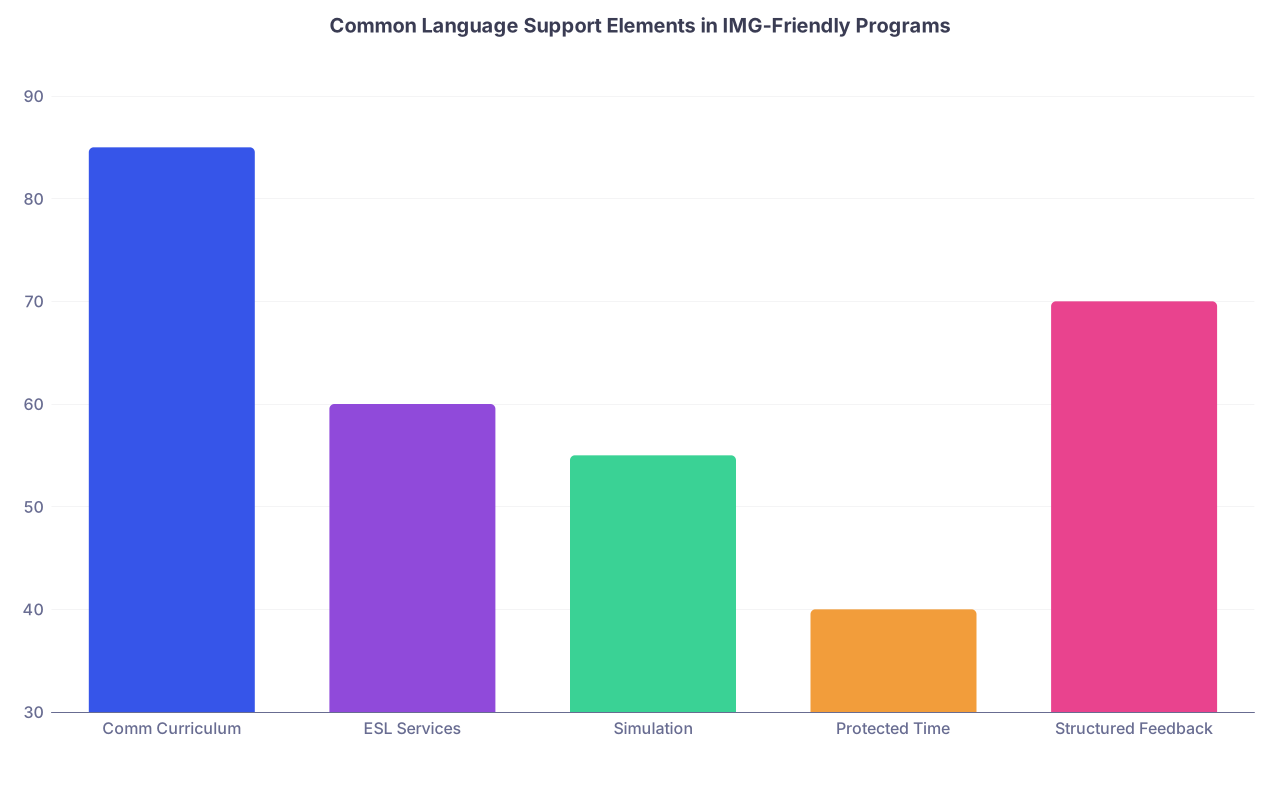
| Category | Value |
|---|---|
| Comm Curriculum | 85 |
| ESL Services | 60 |
| Simulation | 55 |
| Protected Time | 40 |
| Structured Feedback | 70 |
Those percentages are what I see approximately among genuinely IMG‑supportive large programs. Smaller community hospitals may not hit all of these, but they can still be decent if they are intentional and flexible.
Which Types of Programs Tend To Be Strong For ESL Support?
I am not going to pretend there is a single magical list of “best ESL residencies for IMGs.” That is not how this works. But there are patterns.
1. Big University‑Affiliated Programs With High IMG Volume
Think of places like:
- Internal Medicine at large safety‑net hospitals (NYC HHC hospitals, Cook County, Jackson, Detroit Medical Center–affiliated programs).
- University‑affiliated community programs that explicitly state high IMG percentages.
These programs often have:
- Institutional diversity offices.
- University language centers.
- Larger GME infrastructures that can sponsor communication workshops.
They are used to IMGs. They have already seen your challenges ten times and have some systems in place.
2. Large Community Programs Serving Multilingual Patient Populations
Hospitals where half the patients speak Spanish, Mandarin, Arabic, or Haitian Creole. These places must be language‑sensitive by necessity.
You will often see:
- Robust interpreter services.
- Cultural competency trainings.
- Patient education materials in multiple languages.
They may not advertise “ESL” but the clinical environment itself forces structured, clear communication. And they often appreciate multilingual residents and are more patient with your English while you get up to speed.
3. Programs With Explicit IMG Mentorship Tracks
When a program lists:
- “Dedicated IMG mentorship.”
- “Transition to US system” curriculum.
- “International Medical Graduate Committee.”
…they usually include communication coaching under that umbrella. At least informally. If that is paired with a university or larger health system, you almost certainly have access to language resources.
4. Veterans Affairs (VA)‑Affiliated Programs
VA patients speak fast, use slang, and have complex psychosocial histories. Programs know this and many VA‑affiliated residencies are very intentional about communication training.
Pros here:
- Standardized templates for notes and hand‑offs.
- Emphasis on patient education and shared decision‑making.
- Often more scheduled teaching time.
If these programs take IMGs, they frequently have some built‑in support for clinical communication because all residents need it, not only IMGs.
Concrete Examples of Language‑Friendly Program Features
Let me spell out what strong vs. weak looks like in practice.
| Feature | Strong IMG-Friendly Program | Weak Program |
|---|---|---|
| Orientation | 2–3 sessions on presentations, hand-offs, pages | One generic lecture on ACGME competencies |
| Ongoing teaching | Monthly or quarterly comm workshops | “Feedback on rounds if needed” |
| ESL / accent support | Formal referral pathway to language center | “You can search online for classes” |
| Simulation | Scheduled SP sessions with video review | None or rare, not focused on language |
| Evaluation | Rubrics, early flags, non-punitive remediation | Vague criticism in semi-annual reviews |
| Culture | PD openly discusses IMG transition | Language issues treated as individual flaw |
If on interview day the PD can list specific workshops, timelines, and who runs them—you are in good territory. If they say “we just give a lot of feedback” and nothing more concrete, assume minimal structure.
Practical ESL and Communication Resources You’ll Actually Use
You are not going to sit through basic English grammar in residency. You do not have time, and that is not your problem. Your problem is high‑speed, high‑stakes clinical English.
These are the types of resources and tools that actually help IMGs during residency.
1. Hospital‑ or University‑Based Communication Courses
Courses labeled like:
- “Advanced Communication Skills for Health Professionals.”
- “Professional Speaking and Presentation Skills.”
- “Accent Clarity for Healthcare Providers.”
If your residency is attached to a university, there is often a language or continuing education center with this exact offering. Many residents never bother to ask. You should.
What these courses usually target:
- Pacing and clarity, not “losing your accent.”
- High‑frequency clinical vocabulary and collocations.
- Strategies for checking understanding with patients and staff.
2. ESL Focused on Medical and Professional English
If your program lacks institutional courses, you can still use external options smartly:
Online platforms with health‑care specific modules.
Small‑group or 1:1 tutoring focused on:
- Case presentations.
- Patient interviews.
- Family discussions.
The key: tell any tutor you hire you do not care about TOEFL. You care about 5–10 minute verbal tasks under time pressure.
3. Self‑Training Structures That Actually Work
This is where most IMGs waste or save time. A few high‑yield habits:
Daily oral case presentation practice
Use your actual patients. After rounds, re‑present 1–2 cases to yourself out loud (in your call room, in the car). Time yourself. Aim for 2–3 minutes, structured, no notes.Record and review
Many residents hate this. The ones who do it improve twice as fast. Record yourself giving a sample H&P presentation and a brief family explanation, then listen and write down:- Words you keep stumbling over.
- Sentences that are too long.
- Spots where your attending previously interrupted you.
Phrase banks
Build a personal “script library” for:- Calling consults (“Hi, this is Dr. X from Y team, I am calling about a Z‑year‑old with…”).
- Discussing code status.
- Explaining test results in simple language.
You are not reading from a script with patients. You are training your brain to have ready phrases under stress.
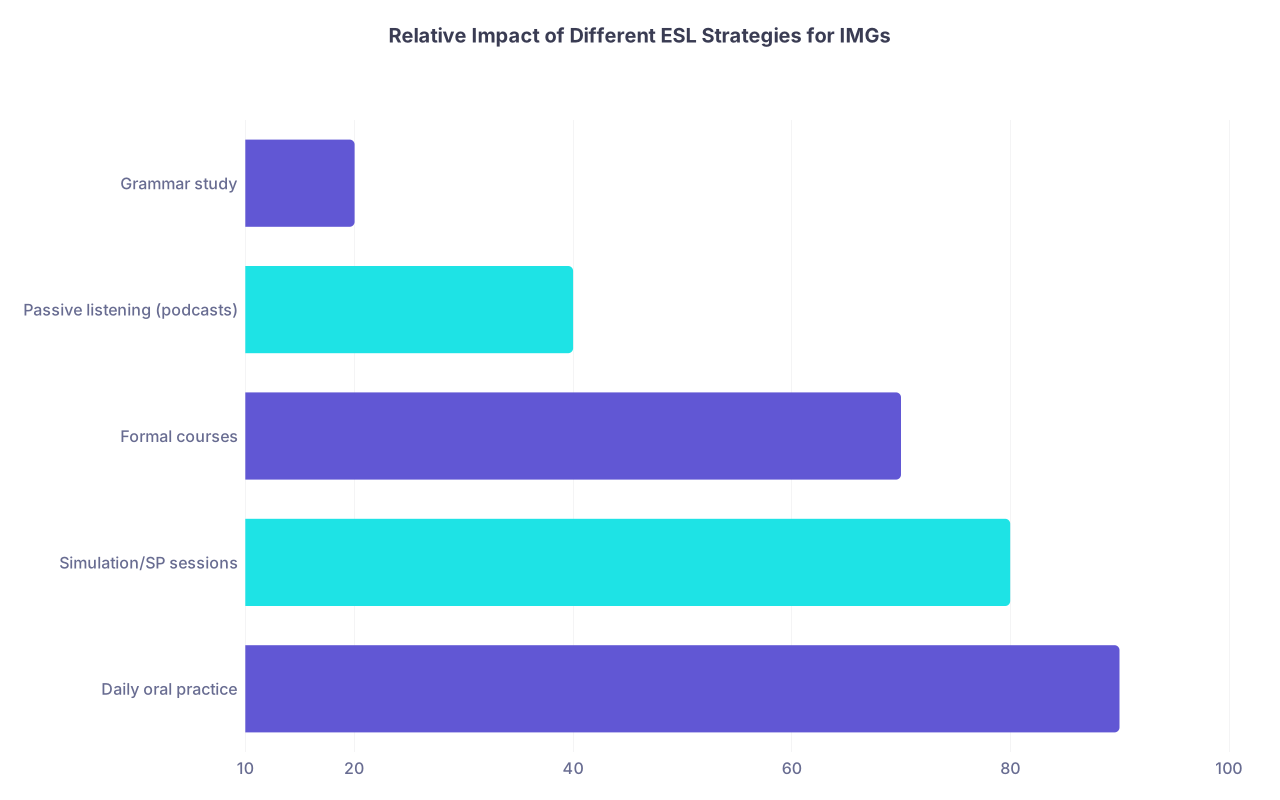
| Category | Value |
|---|---|
| Daily oral practice | 90 |
| Simulation/SP sessions | 80 |
| Formal courses | 70 |
| Passive listening (podcasts) | 40 |
| Grammar study | 20 |
Passive listening (podcasts, TV) is fine, but if you have limited time, prioritize active, spoken practice.
How to Evaluate Language Support During Applications and Interviews
You will not see a webpage that says “We fix your English.” You have to probe intelligently.
What To Look for on Program Websites
Red flags and green flags are subtle but real.
Positive signs:
“Transition to residency” or “Professional development” series described in detail.
Explicit mention of:
- Case presentation workshops.
- Communication skills curriculum.
- IMG mentorship support.
Photos or bios showing a high proportion of IMGs in recent classes.
Neutral or concerning signs:
- No mention of teaching structure beyond “morning report” and “noon conference.”
- No IMG representation on resident leadership pages in a program that claims to be IMG‑friendly.
Questions You Should Ask (Precisely)
You need to ask targeted, concrete questions. Not “Is the program supportive of IMGs?” Everybody will say yes.
Better questions on interview day:
- “Do you have any formal workshops or sessions on oral case presentations or hand‑offs for new interns?”
- “How do you support residents who are strong clinically but need to build confidence in spoken English or communication with patients?”
- “Are there institutional resources—like a language center or communication courses—that residents can use during the year?”
- “Have IMGs in your program used any ESL or communication services in the past, and how did that work logistically with scheduling?”
- “How early in the year do you provide structured feedback on communication skills?”
Ask this to different people:
- Program Director (for institutional view).
- Chief residents (for actual execution).
- Current IMGs (for reality check).
If the PD gives a polished answer but the multiple current IMGs all say, “We never had anything like that,” believe the residents.

| Step | Description |
|---|---|
| Step 1 | Research Program Website |
| Step 2 | Shortlist program |
| Step 3 | Proceed with caution |
| Step 4 | Ask targeted questions on interview |
| Step 5 | Strong IMG friendly choice |
| Step 6 | Consider alternative programs |
| Step 7 | Comm curriculum described |
| Step 8 | IMGs report real support |
Specialty‑Specific Considerations for IMGs and Language
Not all specialties stress the same kind of communication. The type of ESL support you need varies slightly with your field.
Internal Medicine / Family Medicine
You need:
- Long‑form patient interviews.
- Explanations of chronic disease management.
- High‑frequency family conversations.
So:
- Prioritize programs with strong outpatient and inpatient communication training.
- Look for structured continuity clinic teaching around patient education.
Psychiatry
Here language nuance matters brutally:
- Subtle affect.
- Idioms and metaphors.
- Cultural references.
IMGs can absolutely excel in psychiatry, but they need a program very aware of language barriers. You want:
- Heavy use of role‑play and SPs.
- Supervisors familiar with working through interpreters and multilingual nuances.
- Extra patience with early sessions as you adjust to slang and idiomatic speech.
Surgery and Surgical Subspecialties
Do not be fooled. Surgery is not “less communication.” It is just different:
- Very concise hand‑offs.
- Fast telephonic communications with ED, ICU, and consult services.
- Brief but intense pre‑op and post‑op conversations.
Language support here should focus on:
- Crisp, structured hand‑off language.
- Calling consults and giving clear “ask.”
- Communicating operative risks in plain terms.
Pediatrics and OB/GYN
Layer on:
- Talking to parents and families.
- Reproductive health communication with added cultural sensitivities.
Programs dealing with underserved communities in these fields tend to have better patient‑education resources and interpreter integration, which indirectly supports you.
How To Use ESL Support Without Stigmatizing Yourself
Many IMGs worry that asking for language support will mark them as “weak.” That is nonsense in well‑run programs. In fact, the PGY‑1s who seek feedback early almost always progress faster and end up as some of the strongest seniors.
A few practical ways to handle it:
During orientation, say to a chief:
“I want to make sure my presentations are at the standard expected here. Could you watch a couple and give me direct feedback in the first weeks?”Email the PD or APD once you start:
“I am interested in improving my clinical communication and presentation skills as quickly as possible. Are there any institutional resources, workshops, or contacts you recommend I connect with in the first few months?”If there is a university center:
Ask GME if there is a standard referral; they often have agreements, and you might get discounted or free sessions.
Framing this as professional development, not as “my English is bad,” changes how others perceive it. This is what strong residents—IMG or AMG—do.
Shortlist Strategy: Balancing Visa, Competitiveness, and Language Support
Here is the real problem: you cannot just rank based on language resources. You have to balance:
- Visa friendliness (J‑1 vs H‑1B, institutional history).
- Your competitiveness (scores, attempts, year of graduation).
- Specialty competitiveness.
- Location preferences.
- And then, language and IMG support.
But language support is not optional. It is a risk‑management factor.
If you have:
- Strong Step scores but limited U.S. experience and are conscious of your accent or fluency → You must prioritize programs with explicit IMG support and communication training.
- Average scores but excellent spoken English → You can be a bit more flexible and focus on match probability, though good support still helps.
A pragmatic approach:
Build a primary list based on visa policy and your competitiveness.
From that list, flag:
- Programs with clear IMG/communication curricula.
- Programs in large, diverse cities with academic or safety‑net hospitals.
Prioritize those on your ERAS list and interview acceptances.
During interviews, use the questions above to stratify them further.
You are not looking for perfection. You are looking for enough structure that if you do your part, the program will meet you halfway.
FAQ: Language Support and ESL Resources in IMG‑Friendly Residencies
1. Will programs think less of me if I ask about ESL or language resources during the interview?
Not in any program you actually want to join. Programs that are genuinely IMG‑friendly see this as maturity and insight. Phrase it as interest in “clinical communication skills,” not “my English is bad.” If a program reacts negatively or seems surprised by the question, that is data: they probably have no infrastructure and limited experience helping IMGs grow.
2. Is it realistic to do external ESL or accent training during residency given the workload?
Yes, but only if you are strategic. Weekly 60‑minute focused sessions (online or in-person) during lighter rotations—outpatient, electives, or night‑float with downtime—are realistic. Combine that with short, daily self‑practice built into your routine (for example, 10 minutes of re‑presenting cases after rounds), and you can see significant gains over 3–6 months. Trying to do heavy coursework on ICU months is a fantasy.
3. How long does it usually take for IMGs to feel comfortable communicating in residency?
For most IMGs with intermediate to advanced English, there is a rough pattern: the first 2–3 months feel overwhelming; 6 months in, you can function independently but still notice gaps; around 12 months, you are usually comfortable in most clinical situations. The curve is much steeper upward if you systematically seek feedback and practice presentations out loud, instead of just “hoping it improves with time.”
4. My accent is strong. Should I focus on accent reduction or on general communication skills?
Prioritize clarity and structure, not “sounding American.” Attendings and nurses care about understanding you quickly and trusting your judgment. Accent‑modification that targets pacing, stress, and key consonant sounds can be useful, but only when layered onto strong organization and vocabulary. If you can present a case clearly, answer questions directly, and close the loop with nurses, your accent becomes a smaller issue very quickly.
5. Are there specialties where IMGs with weaker English should be especially cautious?
Yes. Psychiatry, pediatrics, and some outpatient‑heavy primary care tracks demand nuanced, emotionally complex conversations from day one. If your spoken English is significantly limited, you either need a program in these fields with very strong communication training and supervision, or you should consider starting in a field with more structured, formulaic communication (for example, internal medicine or some surgical prelim years) while you build fluency and confidence.
6. How can I demonstrate my commitment to strong communication in my application itself?
Use your personal statement and experiences section to highlight situations where you communicated in challenging settings: using interpreters, leading family meetings, teaching patients, or presenting cases in English at conferences or observerships. Ask U.S. letter writers to comment specifically on your communication skills if they are a strength. Mention any workshops, language courses, or presentation training you have already completed. This signals to programs that you take communication as seriously as test scores.
Key takeaways:
- Language support in residency is not about grammar; it is about high‑stakes, high‑speed clinical communication, and good programs treat it as a teachable skill.
- IMG‑friendly programs with real support have structured curricula, access to communication or ESL resources, simulation, and a culture where asking for help is normal.
- During applications and interviews, you must actively probe for these features and then use them aggressively once you match, because they directly affect your evaluations, your confidence, and your patient care.