You are on a Zoom “meet and greet” with a program that is supposedly IMG‑friendly. A current resident with a slight accent presents a case. The attending pauses, asks a clarifying question about how the resident explained a cultural belief the patient held, then calmly reframes it in more patient‑centered language. No one looks uncomfortable. The resident nods, takes a note, moves on.
That small interaction tells you far more about the program’s culture, feedback style, and how they treat international graduates than any “we value diversity” slide.
Let me walk through what IMG‑friendly programs that actually know what they are doing do with cultural competency and feedback. And how you, as an IMG, can spot them from the outside.
1. What “IMG‑Friendly” Really Looks Like On The Ground
Everybody writes “we welcome IMGs” on their website. That means nothing. The serious programs operationalize it.
Here is what separates the cosmetic from the real.
| Feature Type | Weak Signal (Talk) | Strong Signal (Action) |
|---|---|---|
| Website | Diversity statement | Examples of IMG-led initiatives |
| Curriculum | One DEI lecture | Longitudinal communication/culture series |
| Feedback | Annual eval forms | Structured, frequent feedback with coaching |
| Support | List of resources | Dedicated IMG faculty mentor/liaison |
The best IMG‑friendly programs share three things:
They normalize accents, different communication styles, and varied training backgrounds as expected, not as “deficits to fix”.
They have explicit systems to teach U.S. cultural norms in medicine, not just “learn on the wards and hope you do not offend someone”.
They treat feedback as a trainable skill for faculty and residents, not as a personality trait (“Dr. X is just blunt”).
If you are not seeing those three, be suspicious of the “IMG‑friendly” label.
2. How These Programs Actually Teach Cultural Competency
I am not talking about generic one‑off diversity lectures. I am talking about how programs that match and graduate IMGs without drama structure the learning.
2.1 Core components you should see
Most competent programs have a longitudinal structure, usually spread over PGY‑1 and PGY‑2. The labels vary, the bones do not.
Typical components:
Foundations of U.S. clinical communication
Focused on: how to structure a conversation with American patients and teams.Examples:
- How to introduce yourself, give a “headline” first, then details.
- Translating direct communication styles from other countries into U.S. expectations (especially with nurses and consultants).
- Avoiding phrases that land badly here: “You must…”, “You cannot do that”, “It is your fault”.
Cultural humility and patient context
Not “fun facts about cultures”. Rather: how to ask, not assume.This often includes:
- Using the “explanatory model” questions (What do you call this problem? What do you think caused it?)
- Working with interpreters efficiently and respectfully.
- Recognizing power dynamics: physician vs patient, U.S. system vs recent immigrant.
Systems and bias in U.S. healthcare
Strong programs do not pretend racism, xenophobia, and class issues do not matter.They address:
- How bias affects pain management, mental health, OB care, etc.
- How being an IMG might change how patients, nurses, or consultants treat you.
- Concrete scripts for how to respond when you experience bias or microaggressions.
Legal and ethical expectations specific to the U.S.
Many IMGs underestimate this part.Topics:
- Mandatory reporting (abuse, threats, impaired colleagues).
- Documentation standards and their legal implications.
- Informed consent nuances and shared decision making vs paternalism.
Strong programs embed all of this in case discussions, simulations, and direct observation, not just PowerPoints.
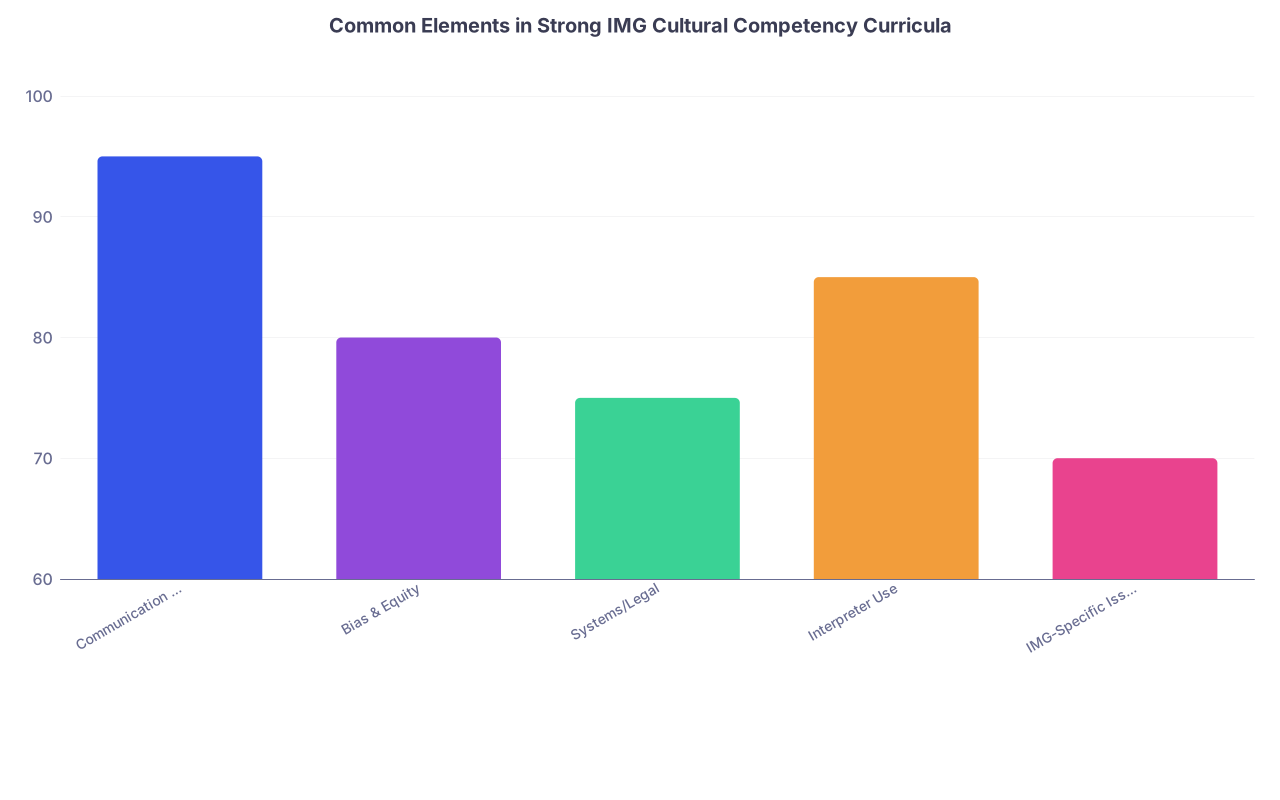
| Category | Value |
|---|---|
| Communication Skills | 95 |
| Bias & Equity | 80 |
| Systems/Legal | 75 |
| Interpreter Use | 85 |
| IMG-Specific Issues | 70 |
2.2 How they adapt for IMGs specifically
A generic “cultural competency” session is not enough. The better programs explicitly build IMG‑relevant angles into the curriculum.
You might see:
- Sessions run by senior IMGs: “Things I wish I knew PGY‑1 about U.S. patients and staff.”
- Role‑plays around “You have an accent, I want a different doctor” and how to manage that professionally, with backup from attendings.
- Workshops on “translating” prior practice habits to ACGME expectations. For example: you may be used to giving direct orders to nurses; here, orders are collaboration, and tone matters.
In some places, they also provide communication coaching 1:1 for IMGs flagged early for struggles with handoffs, presentations, or patient communication. Not punitive. Structured.
You can usually sniff this out on interview day with a very targeted question:
“Do you have any formal sessions where IMGs and other residents can talk directly about adapting to U.S. clinical culture, beyond the standard DEI curriculum?”
Weak programs give you a vague “we are very diverse.” Strong programs name specific sessions, often with dates and faculty names.
3. What Good Feedback Systems Look Like For IMGs
Here is where most programs fail their IMGs: feedback. Either they avoid it (to be “nice”), or they dump it unfiltered (and call that “honest”).
IMG‑friendly programs do this differently and quite deliberately.
3.1 The architecture: clear, predictable, not random
You want to see multiple feedback channels that are structured, not just “when something goes wrong”.
Common elements in well‑run programs:
- Scheduled observation + feedback blocks for interns. For example: attending explicitly observes your patient interview and gives you a 10‑minute debrief that day.
- Monthly or quarterly CCC (Clinical Competency Committee) reviews with a program director or associate PD who actually explains what the committee discussed.
- Mid‑rotation and end‑of‑rotation feedback as a requirement, not a suggestion, with prompts like: “One thing you are doing well. One thing to prioritize next month.”
Here is the key difference: in better programs, feedback is framed around competencies and behaviors, not personality.
“Your handoffs are missing anticipatory guidance. Start telling the night team what you actually worry may happen overnight.”
That is coachable. It is not “You are bad at handoffs.”
3.2 How they deliver hard feedback to IMGs without destroying them
I have watched this go very badly. An IMG is told, “You need to be more assertive with nurses.” They interpret that through their home culture lens (where assertive might mean confrontational) and overcorrect. Now nurses label them “rude” and “disrespectful”. Spiral begins.
Programs that understand this dynamic do a couple of things differently:
They give examples and scripts, not adjectives.
Not: “be more assertive”.
Instead: “When a nurse questions an order, say: ‘I see your concern. Here is why I think this is safe. If you are still uncomfortable, we can clarify with the attending together.’”They check understanding explicitly.
“Can you tell me how you are understanding this feedback and what you would actually say on the floor?”They connect feedback to U.S. cultural norms directly.
“In our environment, nurses expect you to explain your reasoning and negotiate; if you just repeat ‘because I am the doctor’, it is seen as unsafe and disrespectful.”They time it properly.
Not just in a high‑stress code debrief. They set aside protected time to talk, where you are not on edge.
When you talk to current IMGs at a program, ask them:
“Can you describe a time you got hard feedback here, and how it was delivered?”
If they hesitate, laugh nervously, or tell you about being blindsided by a CCC letter months later, that program still has work to do.
4. How Cultural Competency and Feedback Intersect For IMGs
These are not separate silos. Cultural issues often show up first as “communication problems” or “professionalism concerns.” Good programs know this and stitch the two domains together carefully.
4.1 Classic failure patterns
I have seen the same patterns on every CCC I have sat on.
Common failure modes for IMGs:
“Family thought the doctor was rude.”
Resident used direct, efficient language consistent with their home culture. In U.S. context, it sounded cold or dismissive.“Resident does not speak up on rounds.”
Resident comes from a very hierarchical system and reads questioning the attending as disrespectful. So they never push back, never say “I disagree.”“Nurses feel resident does not listen.”
Resident gives commands, not collaborative language. Or avoids eye contact because in their culture that is respectful. Interpreted here as dismissive.
An IMG‑competent program does not just label all this “unprofessional”. They ask: is this a cultural mismatch plus a feedback gap?
Then they design the intervention accordingly.
4.2 What intervention looks like in a serious program
Let me give you a concrete pattern that I have seen work.
Scenario: PGY‑1 IMG gets two 360‑degree evals from nurses mentioning “abrupt” communication.
In a weak program:
- Program director sends a vague email: “Several concerns have been raised about your professionalism. Please be more polite with staff.”
- Resident panics, becomes overly deferential, stops giving clear orders. Patient care actually worsens.
In a strong IMG‑friendly program:
- APD meets with the resident with printed comments, de‑identified.
- They walk through specific phrases from the incidents.
- APD links this to cultural norms: “Here, we usually say X instead of Y in this context.”
- They do a quick role‑play of a similar situation, and the APD coaches phrasing plus tone.
- Plan is documented: “We will re‑check 360‑degree feedback in 4–6 weeks. If similar comments persist, we will pull in communication coaching.”
Notice: specific, constructive, with a path forward. Not character assassination.
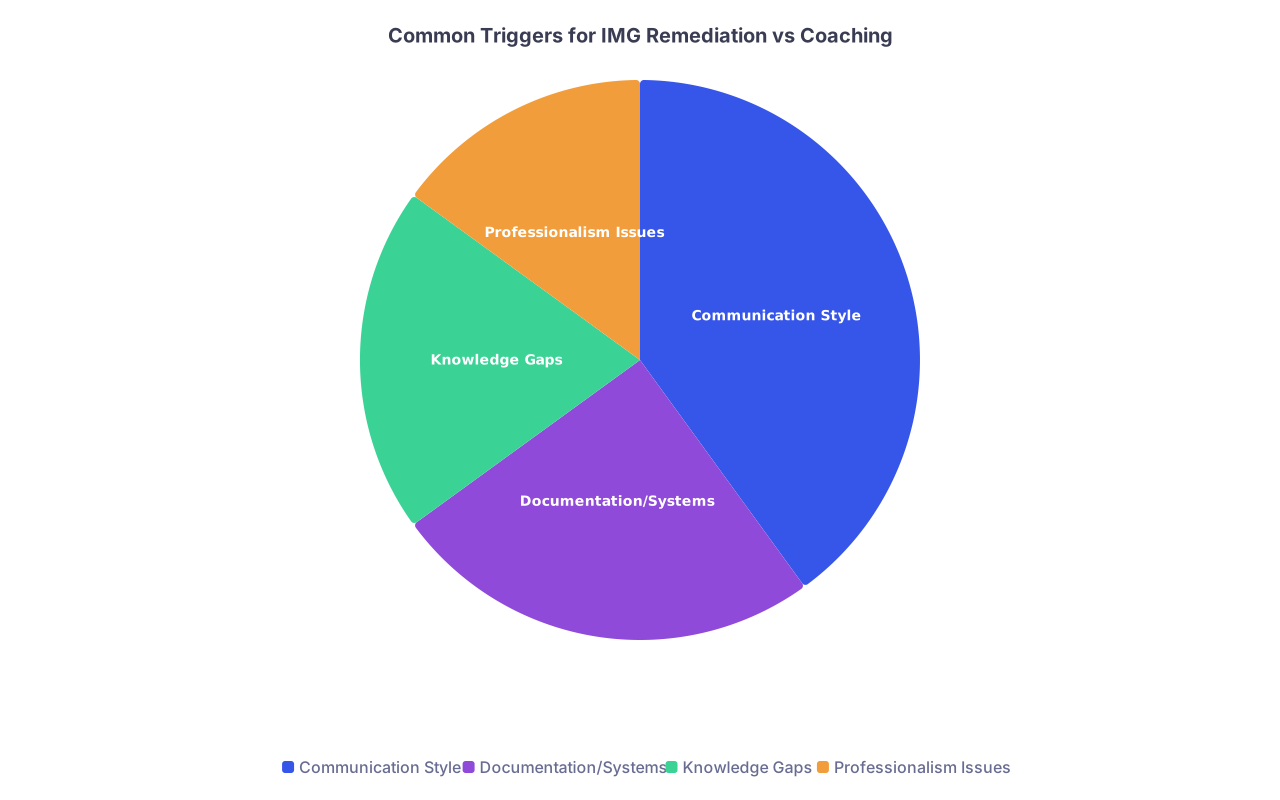
| Category | Value |
|---|---|
| Communication Style | 40 |
| Documentation/Systems | 25 |
| Knowledge Gaps | 20 |
| Professionalism Issues | 15 |
Most IMG performance “issues” that show up in early PGY‑1 are communication and system‑navigation problems, not raw medical knowledge. Programs that understand this treat them as coaching targets first, remediation second.
5. Red Flags And Green Flags On Interviews
You do not have time to read an entire GME policy manual before ranking programs. You have one interview day. Use it intelligently.
5.1 Direct questions that expose the culture
Ask specific, uncomfortable‑but‑polite questions. The wording matters.
Examples:
“Can you describe how your program addresses communication or cultural challenges for new IMGs in the first six months?”
Vague answer = they do not have a system.
Concrete answer with specific sessions and mentors = good sign.“If an IMG struggles with patient or nurse complaints about communication style, what is the usual sequence of support?”
Watch if they jump straight to “probation” language or if they talk about coaching first.“How does your CCC distinguish between cultural communication differences and true professionalism problems?”
If the person looks confused by the question, they probably do not.
5.2 What residents say when faculty are not in the room
This is where you will get the real story. Talk specifically to IMGs who are 1–2 years ahead of you, not just chief residents.
Ask them:
- “Did you ever feel your accent or background was treated as a problem?”
- “Have you seen anyone get blindsided by negative feedback late in the year?”
- “If you needed help understanding U.S. patient expectations, who did you actually go to?”
You are listening for:
- Stories of early, clear feedback and real support.
- Examples of attendings stepping in when patients were discriminatory.
- A sense that IMGs are not clustered at the bottom of evaluations year after year.
If every IMG tells you about “learning the hard way” through complaints and rumor, that program is not serious about being IMG‑friendly, no matter how many IMGs it matches.

6. Concrete Structures The Best Programs Use
Let me break down specific mechanisms that I have repeatedly seen in programs that truly support IMGs.
6.1 Orientation tailored for IMGs
Strong programs do not throw you into the wards after a half‑day HR slideshow.
You might see:
- A dedicated IMG orientation half‑day: explanation of ACGME milestones, U.S. “hidden curriculum”, and basic HR / visa topics.
- Sample charts and notes for their EHR, with explicit “This is what a good daily note looks like here.”
- An explanation of U.S. team hierarchy and how nurses, PAs, NPs, case managers, social workers fit into your daily workflow.
6.2 Early‑year protected time for feedback
Some of the best programs literally block out:
- A scheduled 30‑minute feedback session after your first week on wards.
- “Direct observation” clinics where faculty watch your patient visit in real time and then debrief.
They build it into the schedule so feedback is not optional and not just for the “problem” residents.
6.3 IMG mentorship structures
I will be blunt: programs where all IMGs end up informally mentoring each other, with no faculty involvement, are better than nothing but not ideal. The strong version includes:
A designated IMG faculty liaison or mentor (often an IMG themselves) who:
- Meets 1:1 with new IMGs in the first 1–2 months.
- Is present at CCC when IMG performance is discussed.
- Helps interpret feedback across cultural lines.
Peer IMG support groups that meet quarterly to discuss challenges and share strategies.
These are not therapy groups. More like: “Here is how I handle ‘I want a doctor without an accent’ requests.”

| Step | Description |
|---|---|
| Step 1 | Start of PGY1 |
| Step 2 | IMG Orientation |
| Step 3 | Direct Observation |
| Step 4 | Routine Feedback |
| Step 5 | Continue with Standard Support |
| Step 6 | IMG Mentor Meeting |
| Step 7 | Communication Coaching |
| Step 8 | Formal Remediation Plan |
| Step 9 | Concerns Raised? |
| Step 10 | Improvement? |
If, on interview day, you can get someone to describe something approximating this flow, that is a very strong green flag.
7. How To Use This As An Applicant: Strategy, Not Theory
You are not designing a curriculum; you are trying to match. So let us get practical.
7.1 Pre‑interview homework
Before you talk to anyone, scan:
Program website:
Look for:- Longitudinal communication / professionalism curricula.
- Any named faculty role with “diversity”, “inclusion”, or “IMG” in the title.
- Evidence of workshops on difficult patient interactions, bias, or communication skills.
Resident bios:
Count how many are IMGs, and from where.
A distribution of multiple countries and schools suggests real openness. One school feeding multiple residents may mean a special relationship, not broad IMG‑friendliness.
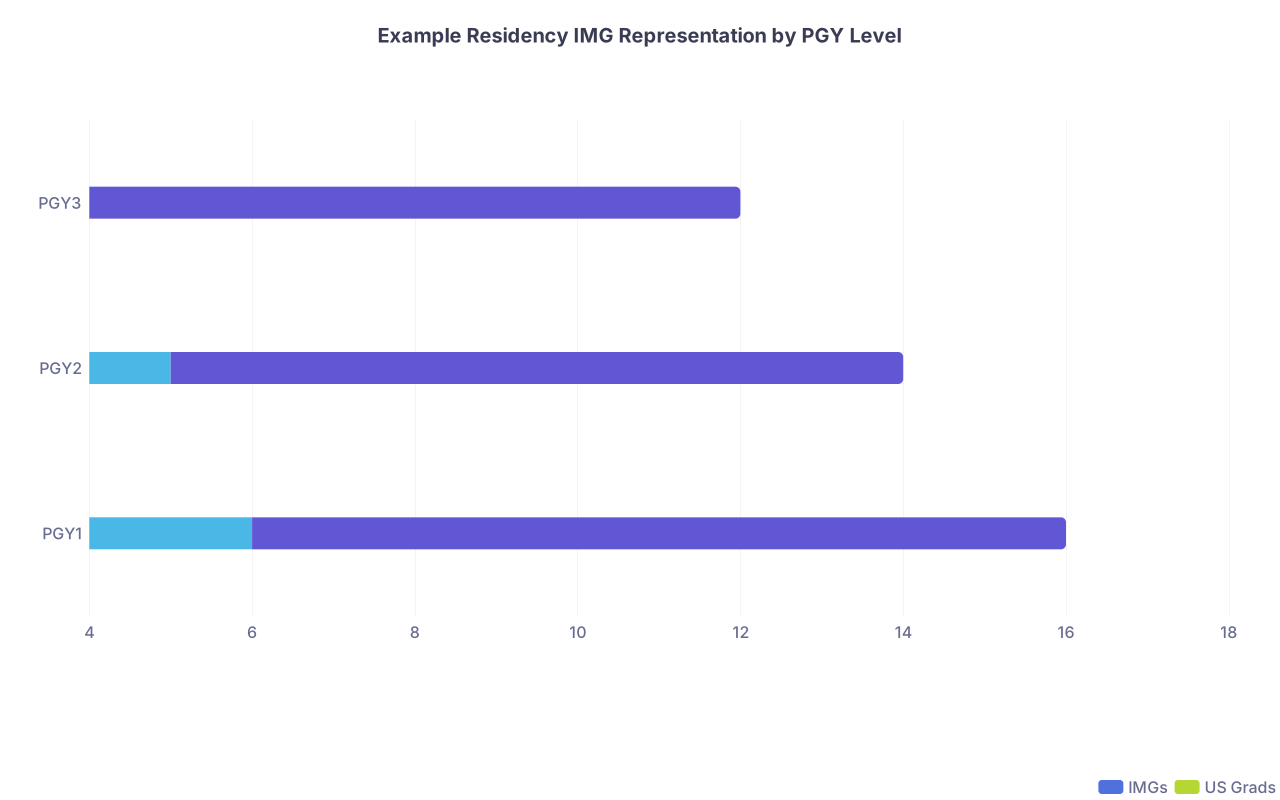
| Category | IMGs | US Grads |
|---|---|---|
| PGY1 | 6 | 10 |
| PGY2 | 5 | 9 |
| PGY3 | 4 | 8 |
You are not trying to be exact; you are just checking if IMGs appear at all levels and are not disappearing between PGY‑1 and PGY‑3.
7.2 During the interview
Target your questions differently for faculty vs residents.
With faculty / PD:
- “Can you walk me through how your CCC uses feedback from nurses and patients, especially when there may be cross‑cultural communication differences?”
- “Do you have faculty development on giving feedback across cultures or to residents with different training backgrounds?”
With residents (especially IMGs):
- “What surprised you most about U.S. patient expectations, and how did the program help you adapt?”
- “If you had trouble with a patient complaint, how did the program respond?”
- “Have you seen IMGs successfully turn around after early struggles, and what did that look like?”
Take mental notes not just on the content, but the affect. Confident, specific answers suggest experience. Hesitation or vague “We all just get along” is not reassuring.
7.3 After the interview: ranking calculus
You will weigh many factors: location, visa, fellowship prospects. Add this to your calculus:
- Programs where IMGs talk candidly about feedback they have received and how it helped them improve are safer for you long term.
- Programs that cannot articulate how they distinguish cultural mismatch from professionalism problems are riskier, especially if you have a strong accent or very different training background.
- A slightly “less prestigious” program with robust IMG support may be a better move than a big‑name but chaotic program that leaves IMGs to sink or swim.
You are not just matching for a line on a CV; you are matching for three years of being watched, judged, coached, and eventually trusted. Cultural competency and feedback are the engine of that process.

8. What Strong Programs Do When Things Go Really Wrong
We should be honest. Sometimes issues are serious: boundary violations, repeated unsafe behavior, or refusal to adapt communication after multiple attempts.
You want a program that:
- Documents clearly and shares concerns early with you.
- Ties concerns to specific behaviors and expectations, not vague “fit” language.
- Offers concrete improvement plans with timelines and resources.
- Differentiates between “cannot” and “will not” change.
For IMGs, there is an extra layer: visa status, fear of losing the position, and often less familiarity with your rights.
In truly IMG‑friendly programs, when remediation is on the table:
- GME, legal, and sometimes the union (in unionized hospitals) are involved early.
- You are told, explicitly, what is at stake and what success looks like.
- Cultural or language factors are considered in designing the remediation (e.g., communication coaching rather than only professionalism lectures).
If you hear from current residents that people are “suddenly not renewed” without prior conversation, especially IMGs, that is a major red flag.
9. Pulling This Together
You are trying to answer a specific question: “If I struggle with the cultural, communication, or feedback expectations of U.S. residency as an IMG, will this program help me adjust, or will they quietly label me a problem and move on?”
Cultural competency and feedback are not buzzwords here. They are survival tools.
FAQ (Exactly 5 Questions)
1. How can I tell from the program website alone if they take cultural competency seriously for IMGs?
Look for specifics, not slogans. Signs they are doing real work: a longitudinal communication or professionalism curriculum; mention of workshops on “difficult conversations” or “cross‑cultural communication”; named roles like “Director of Diversity and Inclusion” or “IMG Liaison”; and evidence of IMGs in leadership roles (chiefs, QI leads, committee members). If all you see is a generic diversity statement and a photo collage, assume it is mostly marketing.
2. What should I do if, as an IMG resident, I receive feedback that feels unfair or culturally biased?
First, document the feedback in your own notes with date, who said what, and context. Then request a follow‑up meeting focused on specifics: “Can you give me concrete examples of what I did and how I could do it differently next time?” Bring a trusted mentor (ideally an IMG faculty member) into the loop early. Ask explicitly whether cultural or communication style differences may be influencing perceptions, and request clear behavioral goals and a timeline for reassessment.
3. Is it a bad sign if a program has many IMGs but no formal cultural competency curriculum?
Not automatically, but it is a yellow flag. Some programs rely on strong informal mentorship and a generally supportive culture. Others rely on IMGs “figuring it out” through painful trial and error. When you interview, ask current IMGs, “How did you learn what was expected in terms of communication and culture here? Was that structured or mostly informal?” Their answers will tell you which category the program falls into.
4. How do I respond if a patient says they do not want a doctor with an accent or from my country?
In a well‑run program, you should not handle this alone. A standard approach: acknowledge the concern without agreeing to the prejudice (“I hear that you have a concern about communication; my goal is to make sure you feel safe and understood”), offer to adjust (e.g., “We can use an interpreter if that helps”), and then involve your attending or the charge nurse. Good programs have explicit policies that discriminatory requests are not automatically honored and that faculty will back you up.
5. What is the single most important feedback skill for an IMG to develop early in residency?
Ask for clarification and examples every time feedback is vague. Do not accept “be more confident,” “be more assertive,” or “improve your professionalism” as complete guidance. Your default response should be: “Can you give me a specific situation where you saw this, and what you would have preferred me to say or do instead?” That habit alone converts fuzzy, culturally loaded criticism into concrete, trainable behavior—and it signals to the program that you are coachable and serious about improvement.
Key points to keep in your head as you rank:
- Real IMG‑friendly programs have explicit, structured approaches to cultural competency and feedback, not just slogans.
- How residents describe receiving hard feedback is the clearest window into whether a program will grow you or quietly label you a problem.
- On interview day, ask targeted, uncomfortable questions; the specificity (or lack of it) in the answers is your best filter.