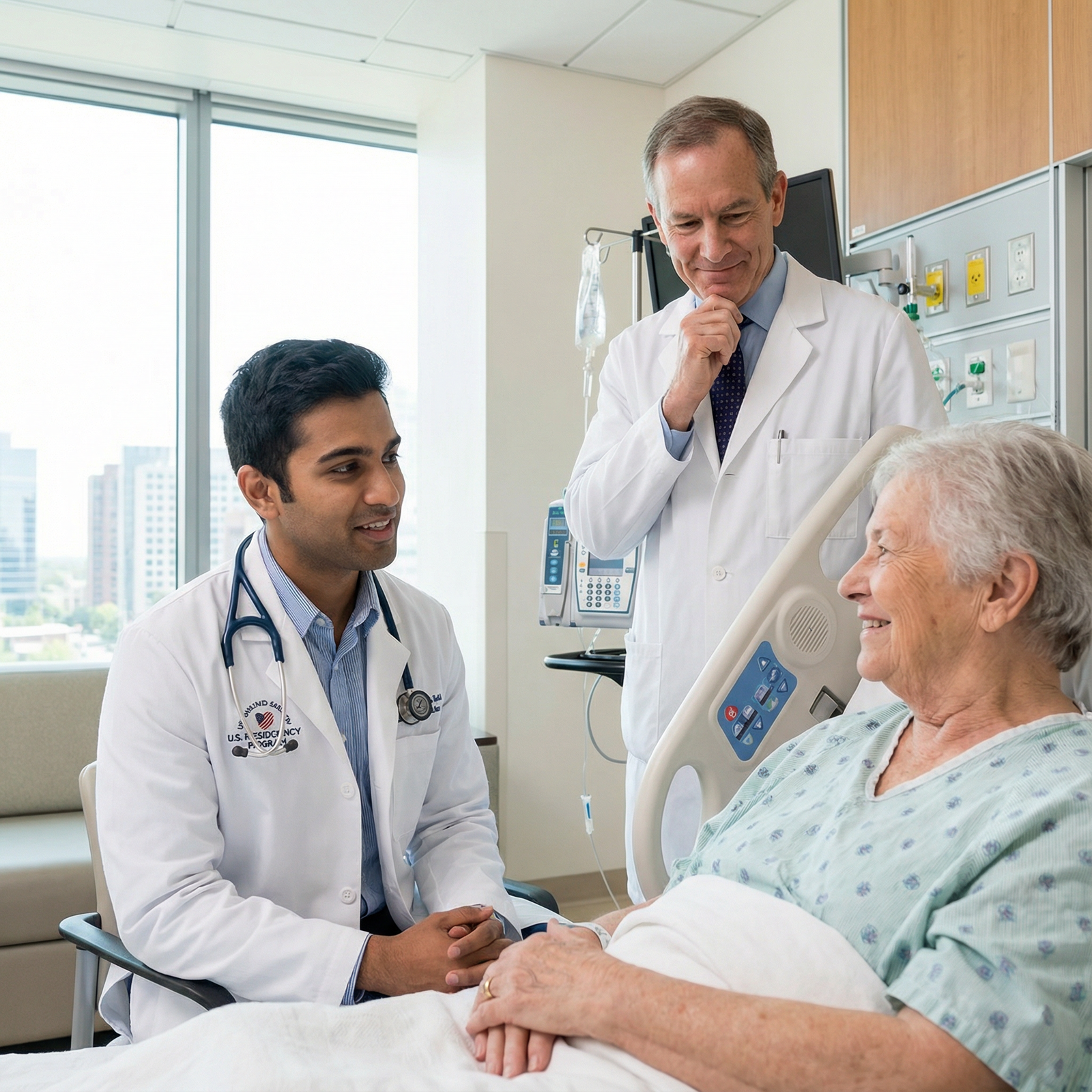
Only 27% of U.S. residency programs have a formal, written orientation track specifically tailored for IMGs—yet those few programs account for a disproportionate number of happy, high-performing international graduates.
Now let me show you why. And exactly how those IMG‑friendly programs structure orientation differently from everyone else.
1. What “IMG‑Friendly Orientation” Actually Means (Not the Marketing Version)
Most programs say they “welcome IMGs.” That phrase is almost meaningless. What matters is what happens the first 4–8 weeks.
In truly IMG‑friendly programs, orientation is not a 2‑day PowerPoint marathon followed by “Good luck, here’s the pager.” It is a structured, multi‑week on‑ramp where:
- Expectations are made painfully explicit.
- Cultural and systems differences are taught, not assumed.
- Clinical supervision is front‑loaded and then gradually tapered.
- Feedback is frequent, bidirectional, and documented.
- Mistakes are anticipated and pre‑empted, instead of punished.
Here is the key pattern I see across mature IMG‑heavy programs (think BronxCare, Lincoln, some HCA hospitals, many community IM programs, a few “quietly IMG‑friendly” university affiliates):
| Domain | What IMG-Friendly Programs Do |
|---|---|
| Length | 3–6 weeks structured, not just 2–3 days |
| Content | Clinical + systems + culture + communication |
| Assessment | Low-stakes, repeated, with remediation built-in |
| Supervision | Very close early, with stepwise autonomy |
| IMG-Specific Support | Visa, licensing, communication, cultural coaching |
If a program’s orientation is shorter than 1 week, has no structured assessment, and offers nothing specific for IMGs, it is not IMG‑friendly—no matter what the website copy says.
2. The Orientation Timeline: Week‑by‑Week Reality
Let me break down the typical structure I see in well‑run, IMG‑heavy internal medicine or family medicine programs. Surgery and OB/GYN will have more procedure time but the skeleton is similar.

| Step | Description |
|---|---|
| Step 1 | Pre-Arrival |
| Step 2 | Week 0 Admin |
| Step 3 | Week 1 Core Orientation |
| Step 4 | Week 2–3 Supervised Clinical |
| Step 5 | Week 4–6 Consolidation |
| Step 6 | Full Duties with Ongoing Check-ins |
Pre‑Arrival (3–6 Months Before Start)
IMG‑friendly programs start orientation before you ever land at the airport.
Common pre‑arrival elements:
- Visa and credentialing support, with a designated coordinator who actually responds to emails.
- ECFMG verification, state license paperwork, hospital medical staff application.
- Access to EMR training modules and basic HIPAA/safety modules online.
- Welcome packet that does not just list parking and dress code, but explains:
- Call structure.
- How night float really works.
- Expectations for note timing and discharge volume.
- How to reach chiefs and program coordinator for “dumb questions.”
Good programs even pair you with a “pre‑arrival buddy”—often another IMG in PGY‑2 or PGY‑3—who will tell you the real rules, like which attending hates late notes and how strict the 80‑hour rule is in practice.
Week 0: Administrative And Legal Survival
This is the part everyone underestimates. For IMGs, Week 0 is often chaos: Social Security, bank accounts, health insurance, immigration paperwork, phones, housing, transportation.
IMG‑friendly programs compensate by:
- Blocking 1–2 full days only for:
- HR, ID badges, EMR logins.
- Occupational health, vaccines, TB testing.
- NPI enrollment, DEA (if applicable), hospital privileges.
- Scheduling group trips to:
- Social Security office.
- Bank branch that is familiar with non‑US IDs.
- Providing a simple checklist: “By Day 5, you must have completed A, B, C.”
Programs that pretend you can do all this “after shifts” during the first week of wards are delusional. And cruel. The friendly ones build admin time into orientation.
3. Clinical Orientation: How They Actually Teach The System
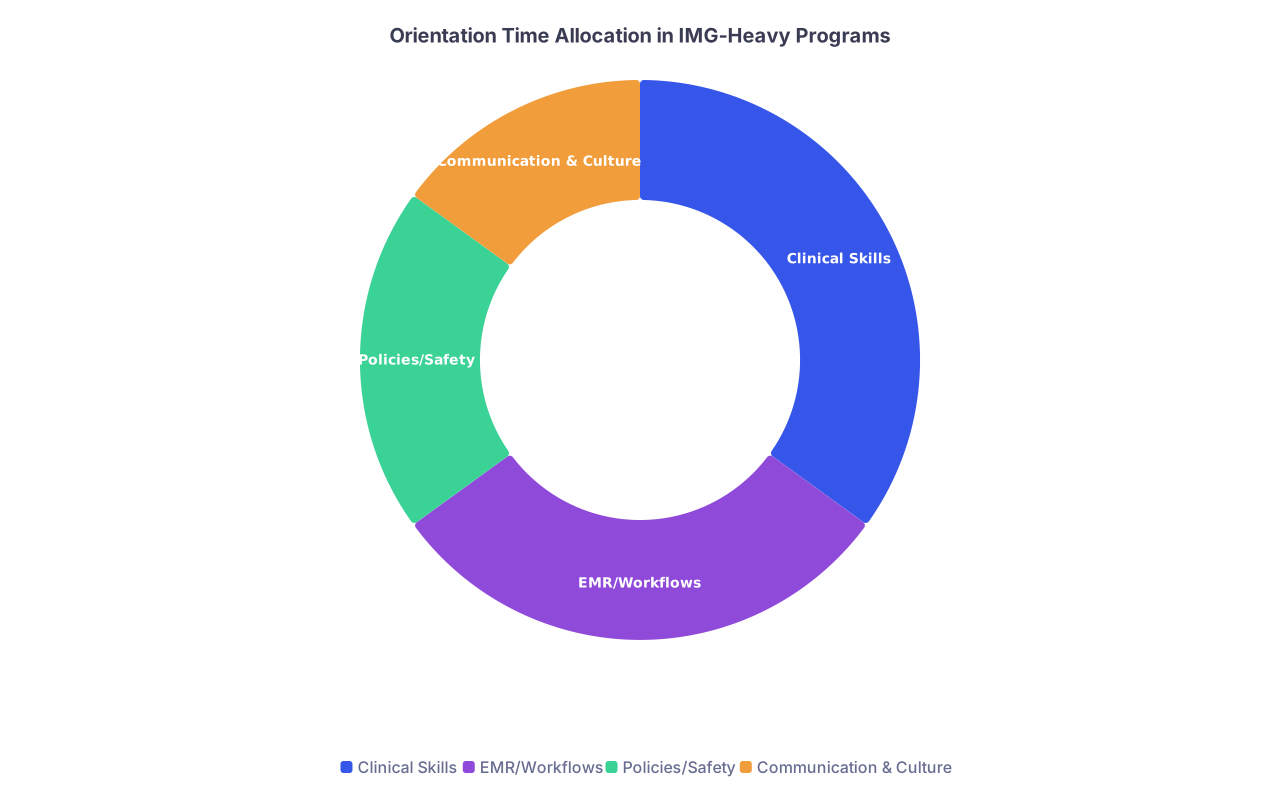
| Category | Value |
|---|---|
| Clinical Skills | 35 |
| EMR/Workflows | 30 |
| Policies/Safety | 20 |
| Communication & Culture | 15 |
In IMG‑friendly programs, clinical orientation is not just “this is how to log into Epic.” It is an organized crash course in “how medicine is actually practiced in this hospital.”
Core Pieces You Should Expect
EMR Boot Camp
- Templates for H&P, progress notes, and discharge summaries.
- How to place orders, reconcile meds, and use order sets.
- Common pitfalls:
- Forgetting to sign orders.
- Duplicate or conflicting orders.
- Incomplete problem lists.
- At least 2–3 supervised charting sessions with feedback.
Workflow and Roles Programs spell out, explicitly:
- What the intern does vs. resident vs. attending vs. APP vs. nurse.
- Who calls consults and how.
- When you must personally see patients before calling rapid response or code.
- How handoffs are done, with concrete examples of “good” vs “bad”.
Policies That Can Get You in Real Trouble Focused sessions on:
- Duty hours and why lying about them is career suicide.
- HIPAA, with realistic scenarios (clinic hallway gossip, WhatsApp patient photos, etc.).
- Documentation rules that affect billing and compliance (teaching physician statements, time-based billing, critical care).
Well‑designed programs will run simulated patient encounters on the EMR: you write the note, place orders, then a faculty or chief reviews it live. Painful. Invaluable.
4. Communication And Culture: The IMG‑Specific Gap
This is where IMG‑friendly programs separate themselves from the rest. They treat communication and culture as trainable skills—not personality traits.

Language And Accent Support
Some programs quietly offer:
- Accent modification or clear speech coaching.
- One‑on‑one sessions with communication specialists focusing on:
- Speaking slower under stress.
- Intonation and emphasis in English.
- Strategies for asking patients to repeat themselves without looking incompetent.
The best programs normalize this. They do not make it remedial. They make it standard for all IM interns and quietly push their IMGs to take full advantage.
“How Americans Communicate in Hospitals” 101
Typical cultural content in IMG‑friendly orientation:
- How to address attendings, nurses, patients (“Dr. Smith,” “Mr. Jones,” not “Sir/Madam”).
- How to give and receive feedback:
- What “You might want to think about…” really means.
- Why silence in a meeting does not equal agreement.
- How to say “I do not know” safely, without losing face.
- How to handle conflict with nurses, consultants, or case managers without escalating unnecessarily.
I have watched strong IMGs sink because they interpreted a soft suggestion as optional, or they thought disagreeing respectfully with an attending was forbidden. Programs that know this explicitly role‑play those scenarios.
Structured Patient Communication Training
You will often see:
- Standardized patient sessions for:
- Breaking bad news.
- Goals of care conversations.
- Discharge teaching in 5–7 minutes.
- Script frameworks: SPIKES, NURSE, Ask‑Tell‑Ask.
In some programs, an IMG faculty member co‑leads these sessions, translating these frameworks to how an IMG brain actually processes them.
5. Supervision, Shadowing, And The Gradual Autonomy Ladder
This is probably the most critical design feature.
IMG‑friendly programs do not throw you on nights alone “to see how you swim.” They build an autonomy ladder.
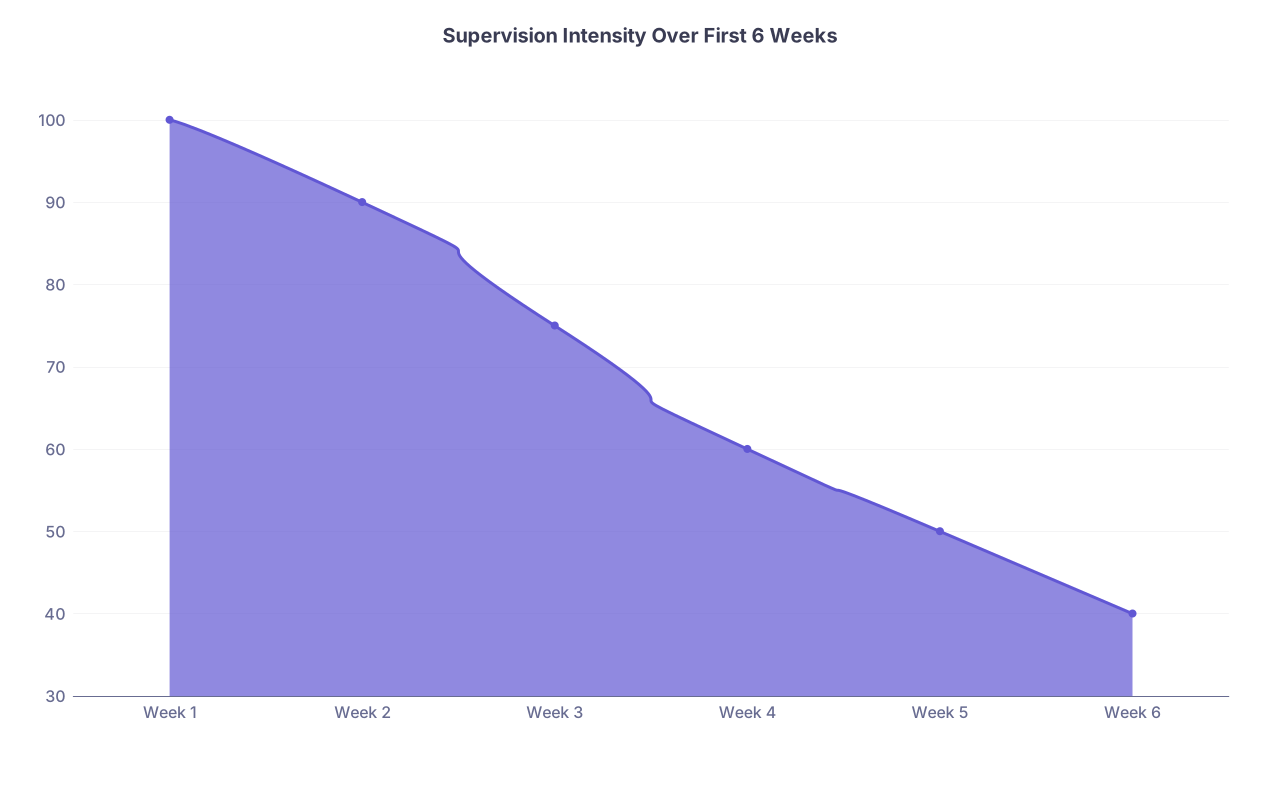
| Category | Value |
|---|---|
| Week 1 | 100 |
| Week 2 | 90 |
| Week 3 | 75 |
| Week 4 | 60 |
| Week 5 | 50 |
| Week 6 | 40 |
(Think of 100 as “direct, over-the-shoulder supervision” and 40 as “normal intern”).
Shadowing And Co‑Signing Phase (Week 1–2)
Common structures:
- 2–5 days of pure shadowing:
- Rounds with the team but zero independent orders.
- You write “practice” notes that are not part of the official record.
- Then 3–5 days of:
- You write real notes, but every note is reviewed before sign‑off.
- You place orders that residents co‑sign and glance over.
Some chiefs will literally say: “Everything you do this week is a draft. Make mistakes now. We are watching closely on purpose.”
Stepwise Increase In Responsibility (Week 3–6)
Autonomy expands along three axes:
Clinical Decision‑Making
- Initially: Present your plan, attending/resident essentially replaces most of it.
- Later: Your plan is edited, not rewritten, and you own follow‑through.
Procedures
- Initial: Only observe central lines, paracentesis, etc.
- Then: Perform under direct supervision.
- Much later: Perform with indirect supervision if competency documented.
Cross‑Coverage And Nights IMG‑friendly programs:
- Keep you off solo nights in the first 4–6 weeks.
- Place you on night teams with a senior physically present.
- Give you a smaller cross‑cover list initially.
Programs that are IMG‑hostile love trial by fire: “We all survived, so you should too.” They call it tradition. I call it lazy education.
6. Assessment, Feedback, And Early “Course Corrections”
The programs that consistently train strong IMGs are ruthless about early feedback. But they pair that ruthlessness with concrete support.
Multi‑Modal Early Assessments
You will see structured evaluation in at least four domains:
- Clinical knowledge and reasoning.
- EMR and workflow competence.
- Communication (with patients and team).
- Professionalism and reliability.
Examples of tools:
- Mini‑CEX (Mini Clinical Evaluation Exercise) on early encounters.
- Direct observation checklists for H&P, progress note, sign‑out.
- Short quizzes on local antibiotic guidelines, sepsis protocol, VTE prophylaxis.
Results are not used to shame you. They are used to build a remediation or support plan before bad habits calcify.
The 2–4 Week “Checkpoint Meeting”
IMG‑friendly programs formally sit you down around week 2–4.
Typical structure:
- You, your faculty advisor or APD, maybe a chief resident.
- Review of:
- Direct observation feedback.
- Nursing or ancillary staff comments.
- Any flagged incidents (late notes, missed labs, consult issues).
- They highlight both:
- 2–3 strengths they want you to lean into.
- 2–3 specific behaviors to change, with a written plan.
Bad programs skip this and then spring a “you are in trouble” meeting on you in October when very little can be fixed quietly.
7. Non‑Clinical Orientation: Life Logistics And Emotional Survival
This is where many IMGs actually crash—outside the hospital.

Strong IMG‑friendly programs take a frankly paternalistic approach for at least the first month. It works.
Housing, Transportation, And Banking
At minimum, you see:
- Guidance on safe and affordable neighborhoods near the hospital.
- Help understanding leases, deposits, and tenant rights.
- List of fellows/residents with spare rooms or short‑term sublets.
- Advice on transportation:
- Parking realities.
- Public transit passes.
- Areas to avoid at night.
Some programs organize:
- An “arrival week” WhatsApp group for all new residents.
- A resident‑led “city basics” tour: grocery stores, pharmacies, cheap furniture, ethnic markets.
Mental Health And Social Support
Serious programs build social support into orientation:
- Formal talk by mental health services focusing on:
- Burnout.
- Impostor syndrome, especially among IMGs.
- Confidential counseling and how to access it without stigma.
- Social events:
- IMG potluck night.
- City walk with co‑residents and their families.
- Optional faith community connections (if residents request).
I have seen well‑qualified IMGs deteriorate clinically because they were isolated, homesick, and ashamed to admit it. Orientation that pretends everyone is “excited and fine” is dishonest. The good programs know this.
8. Visa, Licensing, And Career Navigation: Program‑Level Infrastructure
IMG‑friendly orientation is not complete without addressing the elephant in the room: visas, long‑term plans, and real career trajectories.
| Area | Strong IMG-Friendly Practice |
|---|---|
| Visas | In-house legal liaison, clear J-1/H-1B policies |
| Licensing | Help with state medical board nuances |
| Exams | Dedicated time for USMLE/COMLEX Step 3 |
| Career | Sessions on fellowships, waivers, green cards |
Visa And Immigration Reality Session
In week 1–2, the best programs bring:
- GME office and sometimes an immigration attorney.
- Clear explanation of:
- J‑1 vs H‑1B implications.
- 212(e) requirement.
- Waiver options (Conrad 30, VA, academic vs underserved).
They encourage you to think early about:
- Priority: fellowship vs waiver job vs direct employment.
- Geographic flexibility.
- Research or QI work that might strengthen fellowship applications.
If your program cannot answer basic waivers or H‑1B questions during orientation, do not assume they will magically become experts later.
Licensing And Step 3 Strategy
IMG‑heavy programs often:
- Block a few days of elective time in PGY‑1 or early PGY‑2 specifically tagged for Step 3.
- Provide:
- Recommended resources.
- Sample study schedules.
- Clarify:
- State‑specific deadlines for full license.
- Impact on moonlighting eligibility.
This should start during orientation. If no one mentions Step 3 until you ask, that is a yellow flag.
9. Concrete Examples: How Specific Programs Structure It
I will keep this anonymized and composite, but these patterns are real.
Example 1: Urban Community Internal Medicine Program (IMG Majority)
- Orientation length: 4 weeks.
- Week 1:
- Mornings: EMR, policies, simulated cases.
- Afternoons: communication workshops and tour of ancillary departments (pharmacy, PT/OT, case management).
- Week 2:
- Mornings: Shadowing inpatient teams.
- Afternoons: Writing practice notes and reviewing them with chiefs.
- Week 3:
- Full team member on wards, but lighter census and no new admits after 6 pm.
- Every discharge summary reviewed by senior before sign-off.
- Week 4:
- Normal intern responsibilities, but check-in meeting with APD.
- Night float taster: one buddy shift with senior, no independent cross-cover decisions.
They also run an IMG‑only lunch series on: “How to disagree with consultants,” “Talking to families who are angry,” and “Election season in the U.S.: what to expect.”
Example 2: University‑Affiliated FM Program With 40–50% IMGs
- Orientation length: 3 weeks.
- Mix of:
- Clinic‑based EMR training with standardized patients.
- “Life in the U.S.” session with social worker and former IMG: banking, child schooling, spouse job hunt.
- Community visits: FQHC, local mosque/church/temple networks.
- Formal communication OSCE in Week 2; feedback with video review.
They state openly: “If you fail multiple OSCE stations, we will extend your supervision period and customize additional coaching.” Not as a threat. As reassurance.
10. How You Can Spot An IMG‑Friendly Orientation Before You Match
You are not powerless here. You can interrogate programs—politely—during interviews and virtual open houses.
Specific questions to ask:
“How long is your formal orientation, and what happens after the first week?”
- Red flag: “We do a 2‑day general hospital orientation, then you join your teams.”
- Green flag: “We have a multi‑week ramp‑up with shadowing, supervised notes, and scheduled check‑ins.”
“What support do you provide specifically for international medical graduates?” You are listening for:
- Visa help beyond just “we sponsor J‑1.”
- Communication coaching.
- Extra supervision early on.
“Are new interns ever on nights or cross‑cover alone in the first month?”
- A hard “yes” is a problem, especially in high‑acuity hospitals.
“How do you assess interns during orientation, and what happens if someone struggles?”
- Mature answer involves:
- Structured assessment.
- Clear remediation pathways.
- Protecting you from being labeled “bad” permanently.
- Mature answer involves:
“Do you have many IMGs in leadership roles—chiefs, faculty, PD/APD?”
- Orientation culture tends to follow leadership. If no IMG has ever been chief, think about what that says.
11. What You Should Do During Orientation To Maximize It
Even in a good program, orientation is only as useful as what you extract from it.
Three very practical strategies:
Ask For Direct Observation If no one is watching you take a history or call a consult, ask:
“Can you listen to me present to the cardiology fellow once and tell me what to fix?”Collect Micro‑Feedback Daily End each day by asking one simple question to a senior or attending:
“Is there one thing I can do differently tomorrow that will make your life easier?”
You will learn more from that than from any formal workshop.Map The Hidden Curriculum Keep a notebook list:
- Which attendings care a lot about data precision?
- Who obsesses about documentation?
- Which departments are slow to respond to pages? This becomes your survival manual.
Orientation in an IMG‑friendly program is not a formality. It is your launch pad. If it is designed well and you engage intentionally, it will compress 6–12 months of painful trial‑and‑error into a focused few weeks.
With those foundations in place, you are positioned not just to “survive as an IMG,” but to become the resident others copy. The next phase is leveraging that foundation for fellowships, waivers, and long‑term career moves. But that is a story for another day.
FAQ (Exactly 5 Questions)
1. How long should a “good” IMG‑friendly orientation last?
In my view, anything under 2 weeks is inadequate for most IMGs in U.S. teaching hospitals. The strongest IMG‑heavy programs run 3–6 weeks of structured orientation and ramp‑up, with at least 1–2 weeks of gradual responsibility rather than instant full‑duty. Shorter than that often means corners are being cut in supervision, EMR training, or communication coaching.
2. Is it a bad sign if a program mixes IMGs and AMGs in orientation?
Not automatically. The best programs run a unified orientation for everyone (so IMGs are not stigmatized) but layer additional supports specifically for IMGs: extra EMR practice, accent or communication coaching, more shadowing days, dedicated sessions on visas and U.S. culture. What matters is not separation; it is whether IMG‑specific gaps are addressed intentionally.
3. Should I avoid programs that put interns on nights in July?
I would be very cautious, especially as an IMG. If nights are team‑based with a physically present senior and attending, it might be acceptable by late July. If the program expects you to handle cross‑cover alone in the first few weeks, that is a structural risk both for patient safety and for your confidence. IMG‑friendly programs typically delay solo nights and pair you with strong seniors initially.
4. How can I tell if a program will actually support my visa and long‑term plans?
During interviews or Q&A sessions, ask specific, not vague, questions. “How many current residents are on J‑1 vs H‑1B?” “How many graduates on visas matched into fellowships or secured waivers in the last 3 years?” “Who manages immigration paperwork—GME, hospital legal, or an outside attorney?” Programs that support IMGs well will have concrete answers and recent success stories, not general reassurances.
5. What should I do if orientation feels chaotic or inadequate once I start?
Do not silently hope it improves. Speak early with your chief resident and faculty advisor. Frame it as: “I want to be safe and effective as quickly as possible. I feel I need more support with X (EMR orders, communication, cross‑cover decisions). Can we set up some extra observation or coaching in the next two weeks?” Reasonable programs will respond; if they do not, document your concerns and quietly seek mentorship from senior IMGs who have already learned to work around the system.