
The biggest mistake IMGs make about mentorship is assuming “any mentor is good mentorship.” It is not. The wrong model will waste your time, stall your growth, and quietly kill your chances in the Match.
Let me break down what actually works for IMGs in genuinely friendly programs—and what only looks good on paper.
The Reality: Why IMGs Need Different Mentorship Structures
IMGs do not start residency on the same playing field as U.S. graduates. Pretending otherwise is naïve.
You are fighting on at least four fronts at once:
- Clinical culture gap: Different documentation, expectations, communication patterns, even different “unspoken rules” of morning report and sign-out.
- Systems gap: EMR workflows, billing requirements, APP roles, chain-of-command, “who actually gets things done” in the hospital.
- Perception gap: Suspicion about your training quality, Step scores, and whether you can “handle” U.S. acuity and volume.
- Career gap: You often start with fewer connections, less U.S.-based research, and no built‑in alumni network.
A generic “you can reach out if you need anything” mentor does not fix any of this.
Friendly programs that truly support IMGs do something very specific: they build layered, structured mentorship models that attack these gaps in parallel.
Let’s go through the models that actually work—and how to recognize them during your application and interview process.
Model 1: Tiered “Pyramid” Mentorship – The Non-Negotiable Foundation
If a program has a large IMG population and no tiered mentorship, that is a red flag. Friendly programs almost always have some version of this.
Tiered mentorship basically means: you have multiple mentors at different levels of training, each with a defined role, not just a random collection of “people you can email.”
The classic structure that works for IMGs looks like this:
- One senior resident mentor (PGY-2 or PGY-3)
- One faculty mentor
- Often one IMG-specific peer mentor (same country/region or similar background)
These are not interchangeable. They solve different problems.
What the senior resident mentor is actually for
The senior resident mentor is your “survival guide.” Programs that know what they are doing assign this early—ideally in orientation week. For IMGs, the senior mentor must be:
- On the same service or same track (prelim vs categorical, or IM vs FM vs Psych)
- Accessible in person, not just an email address
- Explicitly tasked with meeting you on a schedule, not “as needed”
A good senior resident mentor for an IMG:
- Walks you through how to preround efficiently in the local culture.
Example: “At this hospital, attendings want you to pre‑chart vitals, labs, and imaging before seeing the patient. Do that first, then bedside, then write your note. Oh, and always have a plan for code status when you present.” - Shows you what a good note looks like in this exact EMR, for this exact attending group.
- Practices presentations with you and corrects “US style” gaps.
I have literally sat in workrooms hearing seniors say: “Shorten that HPI by half. Labs before imaging. Say what you think the diagnosis is. Do not just recite.” - Translates social expectations: when you call consults, how to sign out, what attendings here hate.
If a program cannot articulate this level of senior‑to‑intern support when you ask, they are not mature in IMG mentorship.
What the faculty mentor is actually for
The faculty mentor is not primarily to teach you how to manage sepsis. You can get that from multiple attendings.
The faculty mentor for an IMG must do three things:
Career navigation
- Which fellowships historically take IMGs from this program
- How many research months to take and when
- Whether you should aim for academic vs community positions
Reputation management
This part usually happens in hushed tones:- “Dr. X is brilliant but savage with IMGs; rotate later when you are stronger.”
- “Program Y loves our graduates, but they want very strong letters—do cardiology consults with Dr. Z.”
Advocacy
- Speaking up in Clinical Competency Committee (CCC) if your “accent” or “style” is misinterpreted as lack of knowledge
- Helping you get on projects where your work will be visible to promotion/selection committees
When you interview, you are trying to determine whether faculty mentorship is:
- A checkbox: “We assign everyone a faculty advisor.”
vs. - A functioning path: “We pair most IMGs with faculty who either trained abroad themselves or have heavily mentored prior IMGs, and there are scheduled check‑ins at 1, 3, 6 months.”
Guess which one moves your career.
IMG-specific peer mentor
This is underappreciated but disproportionately powerful.
A peer mentor who:
- Just went through Step 3, visa renewals, fellowship interviews, or cultural adaptation
- Comes from a similar context (Caribbean, India, Pakistan, Egypt, Nigeria, etc.)
- Can tell you the “emotional truth” about what hurts and what helps
This is the person who pulls you aside and says:
- “You are over-explaining every answer. They interpret that as not knowing. Start with your conclusion, then explain.”
- “Stop trying to sound like an American. Clear English is enough. The more you fake the accent, the less confident you sound.”
- “You must start Step 3 prep by month 3. Visa issues hit you harder than you think.”
Programs that “get” IMGs often have an IMG group or committee that formalizes this kind of pairing.
Model 2: Structured Onboarding + “Bridge” Mentorship
The most IMG‑friendly programs do not treat July 1 as a hard start date. They build a bridge into residency.
You are looking for two things:
- A formalized onboarding curriculum targeting IMGs
- Extended, high-touch mentorship in the first 3–6 months
Onboarding that is more than EMR training
Weak programs: one‑day orientation, EMR login, HR paperwork, benefits lecture. Done.
Strong, IMG‑aware programs: a dedicated “transition to residency” period that covers:
- U.S.-style clinical reasoning and documentation
- How to present on rounds in this program (literally with example scripts)
- Hands‑on sessions walking through sample notes (admission, progress, discharge)
- Practice consult calls and sign‑outs with feedback
And—crucially—dedicated time for IMGs.
This is what it looks like in practice:
- A 1–2 week “boot camp” where you carry 1–2 non-acute patients with a shadowing senior rather than full load
- Faculty reviewing your notes daily and giving targeted feedback
- Simulation sessions for rapid responses or codes (many IMGs come from systems where code teams function differently)
If a program director tells you: “We place our IMGs on lighter rotations first with closer supervision, and your primary mentor will meet with you weekly for the first month,” that is gold.
If they say: “Orientation is the same for everyone,” and then move on—more cautious.
Bridge mentorship: the first 90–180 days
IMGs crash in U.S. residency not because they are clinically weak, but because:
- Expectations are not explicit
- Feedback is vague
- Cultural pitfalls accumulate silently
Bridge mentorship fixes that by forcing regular, structured check‑ins during the highest-risk period.
The best models I have seen:
- Weekly meetings with a senior or chief for the first 4–6 weeks
- Then monthly meetings with a faculty mentor for the first 6–9 months
- Defined agenda: not just “how are you,” but targeted questions:
- “Any recent feedback that confused you or felt unfair?”
- “Any difficult attendings or situations?”
- “How are you doing on notes, pages, and time management?”
You should ask directly on interview day:
“How often do mentors meet with new residents, especially IMGs, in the first six months? Is it scheduled or just ‘whenever we need it’?”
If the answer is the latter, recognize the difference. Unsurprising numbers of IMGs quietly drown in those systems.
Model 3: Affinity- or Background-Based Mentorship (Used Correctly)
This one is powerful when handled well and toxic when done lazily.
Friendly programs often match you with someone who “gets you”:
- Same country or region
- Same med school or similar training system
- Same language or cultural background
This is not about comfort alone. It is about precision.
A Pakistani IMG who matched from a low‑name‑recognition school will have:
- Different visa issues
- Different patterns of clinical exposure (e.g., high-volume, low-resource)
- Different stereotypes to overcome
than a Caribbean IMG with US clinical electives and fluent American slang.
How it helps when done right
Used well, affinity-based mentorship gives you:
Realistic career mapping
Example: “From this background, these are the fellowships that have historically been receptive. Here is how I sequenced research, Step 3, and electives to make it happen.”Shortcut strategies
“Stop spending 3 hours on each note. At home, you wrote full narratives because no one sues. Here, you must learn the accepted minimum for a safe, billable note and move on.”Visa-specific mentoring
H‑1B vs J‑1, waivers, timing of Step 3, and what fellowship directors really think about each pathway.
When background-based mentorship goes wrong
I have also seen programs do this badly:
- They pair every IMG with the “one senior IMG” and overload that person.
- They assume cultural similarity automatically means good mentorship skill.
- Or worse—they isolate IMGs into a “parallel track” community instead of integrating them across the program.
What you want is:
- At least one mentor who shares your background
and - At least one mentor who is deeply embedded in the mainstream U.S. academic network
You need both the translator and the gatekeeper.
Model 4: Networked Mentorship – Committees, Not Heroes
The best IMG‑friendly programs do not rely on one charismatic PD or one superstar mentor. That is fragile. People leave.
They build structures.
The IMG mentorship committee
You sometimes see this in large internal medicine or family medicine programs with high IMG percentages.
Typically:
- A small group of faculty + chiefs + senior residents
- Explicitly responsible for:
- Monitoring IMG performance and well-being
- Reviewing CCC feedback for bias patterns
- Identifying IMGs ready for leadership or research roles
- Coordinating Step 3 prep resources and visa timing
This is where mentorship becomes system-level, not personality‑dependent.
| Feature | Weak / Token | Strong / IMG-Friendly |
|---|---|---|
| Mentor Assignment | One generic advisor per resident | Multiple mentors (senior + faculty + peer), assigned early |
| Meeting Frequency | Resident-initiated, irregular | Scheduled check-ins, especially first 6 months |
| IMG Oversight | None specific | IMG-focused committee or working group |
| Data Use | No tracking | Tracks IMG outcomes (board pass, fellowship, visas) |
| Feedback Response | Ad hoc, individual | System changes when recurring IMG issues appear |
Friendly programs can tell you, concretely:
- “Our IMG board pass rate is X over Y years.”
- “Here is how many IMGs matched into fellowships last cycle, and where.”
- “We meet quarterly to review how our IMGs are doing and adjust mentorship.”
If they have never looked at their own IMG outcomes, their “we are very supportive of IMGs” line is just that: a line.
Model 5: Task- and Outcome-Based Mentorship
This is where the mentorship stops being warm and fuzzy and starts moving your career.
For IMGs, the critical tasks are predictable:
- Passing Step 3 on first attempt (often visa-linked)
- Building at least 1–2 meaningful research or QI outputs
- Securing strong U.S. letters with concrete, narrative detail
- If desired, building a realistic fellowship application
Programs that are serious about IMG mentorship build mentoring around these outcomes, not vague “support.”
Example: Step 3-focused mentorship
A serious IMG‑friendly program might:
- Identify IMGs at highest risk (older graduation year, lower Step 1/2 scores, long gaps)
- Pair them with recent graduates who crushed Step 3
- Provide a concrete timeline:
“We want you to sit for Step 3 between month 6 and 12. Here is a study schedule that works with our call schedule. Here is coverage support if visa timing is tight.”
Some even track NBME practice scores or UWorld progress in a non-punitive way.
Example: Research / fellowship mentorship
If you mention fellowship interests and the answer you get from the PD or faculty is:
- “You can always reach out to people doing research here.”
That is worthless.
What you actually need:
- Named faculty in your interest area willing to mentor IMGs
- A pre‑identified project (QI, retrospective study, case series) that you can plug into without reinventing the wheel
- A timeline: when to start, when abstracts are usually submitted, who goes to which conferences
Good programs often do something like:
- During intern year: low‑intensity QI project with stepwise guidance
- During PGY-2: more serious research (if you prove reliability)
- During PGY-3: abstract and manuscript support, letters emphasizing scholarship
You can probe this in interviews by asking:
- “Can you tell me about IMGs from your program who have matched into [your specialty of interest] fellowship in the last 5 years? What mentorship structures helped them?”
- “If I told you I was interested in [field], who would you connect me with and how would that be arranged?”
If they cannot name names and concrete projects, you know where you stand.
Model 6: Mentorship Integrated With Evaluation (Not Opposed To It)
IMGs often fear evaluations in U.S. systems because the stakes feel opaque and high. A good mentorship model does not “shield” you from evaluation. It aligns with it.
How this looks in a mature program
Your mentor knows the evaluation forms and milestones intimately.
You review early evaluations together and translate generic feedback into specific actions.
Example:
Comment: “Needs to work on efficiency.”
Mentor translation: “You are writing admission notes that are too long and prerounding until 11 AM. Let us redesign your pre‑round workflow and template your notes.”When you struggle, your mentor sits in on CCC discussions or at least knows what was said, and you get a plan, not just a vague “you are fine” or “you should try harder.”
The worst case is separation: mentors who “like you” but have no idea how you are being evaluated, and evaluators who see only your on‑service behavior with zero context.
You want a program where:
- Faculty mentors attend CCC or are at least briefed on outcomes.
- Senior mentors are empowered to advocate: “This IMG is slower on notes, yes, but their medical knowledge is strong; we need to adjust onboarding, not label them as weak.”
How to Identify IMG-Friendly Mentorship Models During Applications
This is where most IMGs misplay. They listen to vague comfort phrases instead of forcing specificity.
Here is how you evaluate mentorship during the Match cycle.
Step 1: Decode the website vs reality
Program websites love the word “mentorship.” Very few define it.
Look for:
- Mention of dedicated IMG support or committees
- Explicit description of mentorship structure (faculty, peer, senior)
- Any data on IMG outcomes (board pass rates, fellowships, leadership roles)
Silence on these points does not automatically mean unfriendly. But it means you must probe harder on interview day.
Step 2: Ask pointed questions on interview day
You want concrete answers, not vibes. Use questions like:
- “When an IMG joins your program, what does their mentorship structure look like in the first 6 months? Who do they meet, and how often?”
- “Can you describe how senior residents are involved in mentoring IMGs, especially around adapting to documentation, presentations, and U.S. hospital culture?”
- “Do you have any formal group or committee that reviews how IMGs are doing and adjusts support if needed?”
- “Could you tell me about a time when an IMG struggled early on and how mentorship helped them turn things around?”
Listen for specificity: names, timelines, examples.
If the answer is all principles and no details—“We are very supportive; we are like a family”—assume minimal structure.
Step 3: Talk to current IMG residents
This is the most reliable data point.
Do not ask, “Is mentorship good?” That invites politeness.
Ask:
- “How often do you actually meet your assigned mentor?”
- “What was the most concrete thing your mentor has done for you this year?”
- “If you had a clinical or personal crisis, who would realistically help you and how would that work?”
- “Have you seen IMGs ahead of you get into fellowships or good jobs? Who helped them get there?”
Look for patterns in their answers. One star success story does not equal a system.
Putting It Together: Matching Your Needs to the Right Mentorship Model
Not every IMG needs the same thing. You should match yourself to a program’s mentorship strengths.
If you are:
- Older graduate
- Longer gap since clinical work
- Limited U.S. clinical experience
You need:
- Very strong Model 1 and 2: tiered plus onboarding/bridge mentorship
- Someone watching you closely early and correcting course fast
If you are:
- Strong scores
- Recent graduate
- Ambitious for competitive fellowship
You care more about:
- Model 4 and 5: networked + task-based mentorship
- Clear access to research mentors, conference exposure, and strong letters
If you are:
- On a visa
- With complicated immigration constraints
You must prioritize:
- Mentors who have navigated visa timing and Step 3 under pressure
- Programs that explicitly track and support visa issues, ideally with prior success placing IMGs in waiver jobs or fellowships
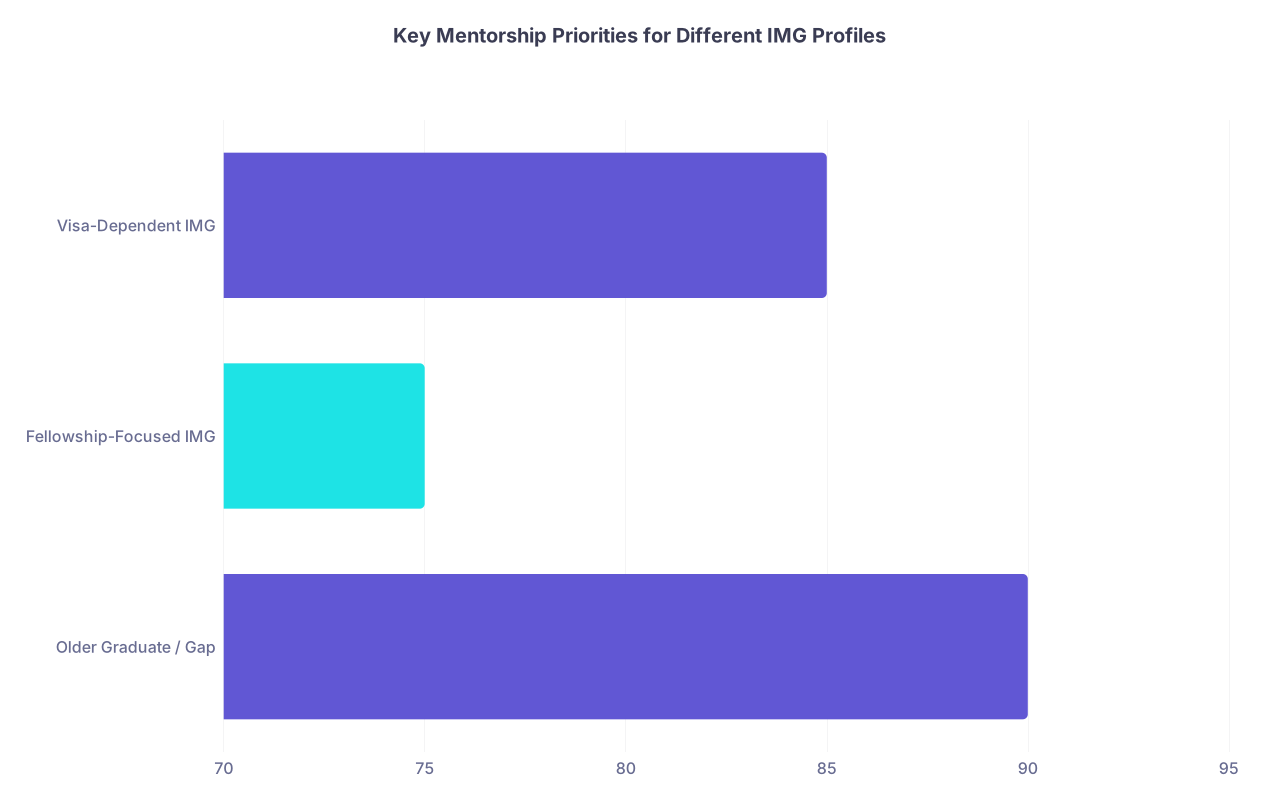
| Category | Value |
|---|---|
| Older Graduate / Gap | 90 |
| Fellowship-Focused IMG | 75 |
| Visa-Dependent IMG | 85 |
(Those numbers are not statistics; they represent relative priority intensity. If you are an older graduate with a gap, structured mentorship is almost non‑negotiable.)
Common Mentorship Traps IMGs Fall Into
Let me be blunt about a few patterns I have seen repeatedly.
Over‑valuing a single “famous” mentor
You meet one big‑name faculty who is kind and encouraging. You assume that covers your mentorship needs. It does not. You still need someone granular for daily survival and someone plugged into resident‑level culture.Confusing emotional support with strategic mentorship
A co‑resident from your home country who listens to you vent is valuable. But that is not enough. You also need people who can pick up the phone for you, edit your CV, and tell you which elective to take when.Accepting “open-door policy” as a valid mentorship model
“My door is always open” almost always means “you are on your own unless you are already confident enough to demand help.”Ignoring red flags in how programs talk about IMGs
If anyone says, “Our IMGs are very hard‑working but sometimes they struggle with communication,” without following it up with what they actually do about it, pay attention. That is code for “we blame culture, not our lack of mentorship structure.”
How This Changes Your Application and Rank List Strategy
You are not just matching to a hospital. You are matching to a mentorship ecosystem.
During the application and interview phase, you should:
Prioritize programs that:
- Have a visible IMG presence
- Can articulate their mentorship structure clearly
- Have recent IMG success stories with names and destinations you can verify
De-prioritize programs that:
- Have mostly generic “family” language with no structural detail
- Cannot name recent IMG outcomes
- Rely entirely on one or two individuals for all IMG support

| Step | Description |
|---|---|
| Step 1 | Program Interview |
| Step 2 | Lower priority |
| Step 3 | Mid priority |
| Step 4 | High priority |
| Step 5 | High IMG presence? |
| Step 6 | Structured mentorship described? |
| Step 7 | Specific IMG outcomes? |
The point is not to find perfection. That does not exist. The point is to avoid systems where you will be improvising your own mentorship from scratch while already overloaded and under scrutiny.
Final Thought: Your Mentorship Strategy Starts Before You Match
Strong mentorship for IMGs does not “appear” after you arrive. You identify the right models now, in the application and interview phase, and rank accordingly.
Once you match, you will still need to:
- Proactively use the structures that exist
- Plug the gaps with your own networking if needed
- Evolve your mentor circle over time (what you need in month 3 is not what you need in PGY-2)
That is the next phase—how to build and upgrade your mentor team once you are actually inside a program, without annoying people or wasting your own time. With a clear understanding of which mentorship models work best for IMGs, you are finally positioned to choose environments where your effort translates into progress, not just survival. The strategy for building that mentor network from day one of residency—that is a conversation for another day.