
You are here
You are on a Zoom interview with a mid-tier university internal medicine program. The PD just finished their standard slide deck. Now it is your turn for questions.
You are an IMG. You know you can work hard. That is not the concern. You are worrying about call. Night float. “Short call” that turns into “admit until midnight.” Being the only one on nights who still needs Google Translate open in another tab.
So you ask the polite version: “Can you tell me about your call schedule and how you support interns, especially those new to the US system?”
Some programs answer with vague reassurance: “We adhere to ACGME duty hours. People cope fine.”
The better programs talk specifics: capped admissions, structured night float, protected golden weekends, pairing new IMGs with senior residents on first nights, smart cross-coverage policies. These are the places where IMGs do not silently implode by January of PGY‑1.
Let me break down what “IMG‑friendly call schedule policies” actually look like and how to identify them before you sign your life away.
Why call hits IMGs harder (and why schedule design matters)
Before we talk policies, you need to understand the pressure points. I have watched multiple IMGs hit a wall around November–December of PGY‑1. Same pattern every year.
Not because they are weaker. Because they are carrying additional cognitive and emotional load on top of the usual intern grind:
- Working in a second (or third) language at high speed
- Adapting to unfamiliar EMR, order sets, and documentation style
- Learning US cultural norms: end-of-life, pain control, “customer service” medicine
- Navigating visa stress and family thousands of miles away
- Often with less local social support
Now put that person on a badly designed call schedule: q4 28‑hour calls with uncapped admissions, cross-cover on three services, no predictable weekends off, plus a malignant “sink or swim” approach to nights.
Burnout is not a risk. It is a guarantee.
Well-designed call schedules do three quiet things for IMGs:
- Limit chaos and unpredictability early.
- Protect sleep in a way that lets your brain actually consolidate the insane amount of new information.
- Make sure you are never the only thin layer between disaster and a confused patient at 3 a.m.
You cannot see “supportive culture” reliably from the website. You can see call structure and policies—if you know what to look for and what to ask.
Core call models: which ones are kinder to IMGs?
Most internal medicine programs now use some combination of these for inpatient services: traditional 24–28‑hour call, night float, or shift-based models. Each can be done well or badly.
1. Traditional 24–28‑hour call
This is the old-school q4, q5 style: you come in early, admit all day, stay overnight, and round post‑call.
For IMGs, this model is only tolerable if several safeguards are in place:
- Strict admission caps (for both day and night)
- True “no new admissions” after a defined hour
- Protected handoff and post‑call exit time actually respected
- Senior resident present overnight, not “home call” pretending to be supervision
If you hear “We still do 28‑hour calls, but it’s fine, you get used to it,” without concrete guardrails, that is a red flag. Especially as an IMG in your first US job.
2. Night float systems
Generally more humane if they are properly designed. Night float can protect circadian rhythm and prevent the yo‑yo of q4 call. But it can also be a black hole if the team is swamped and understaffed.
Look for:
- Reasonable continuous duration (1–2 weeks at a time for interns, not 4–6)
- Night admissions capped and cross-cover load realistic
- Weekend structure that gives you at least one functional day off
3. Shift-based / hospitalist-style models
Some community programs have moved to 12‑hour shifts for residents (e.g., 7a–7p days, 7p–7a nights). These can be fantastic for predictability and recovery.
The main risk here is volume: if they run residents like cheap hospitalists with RVU‑style expectations, your burnout risk skyrockets.
So the model alone is not your friend or enemy. The policies wrapped around that model are what quietly protect or destroy you.
The specific call policies that protect IMGs (and how to spot them)
Now we get concrete. Below are the levers in a call schedule that dramatically change your day-to-day life. Programs that are quietly IMG‑friendly usually have most of these features, even if they never advertise them as “IMG policies.”
1. Strict, enforced admission caps
Caps are not a cosmetic number. They are a safety valve for your brain.
Good programs specify:
- Admit cap per call shift for the team
- Admit cap per intern
- Total census cap for the team before they divert admits elsewhere
| Policy Type | Reasonable Number |
|---|---|
| Intern admit cap (24h) | 5–8 new patients |
| Team daily admit cap | 8–10 new patients |
| Team census cap | 14–18 patients |
| Night float cap | 6–8 admissions |
Questions you should ask directly:
- “What are your intern and team admission caps on call and night float?”
- “What happens when you hit the cap? Where do the extra admissions go?”
- “Are caps actually followed, or is there a ‘soft cap’ that gets ignored when it is busy?”
An IMG adjusting to US medicine is already slower at the beginning—note‑writing, order entry, navigating the EMR. A program that caps you at 5–6 as a fresh intern gives you a chance to be safe and actually learn.
2. Reasonable cross-cover load at night
The worst burnout I have seen in IMGs has come from abusive cross-coverage: one intern covering 60–80 patients on multiple teams while also admitting.
Red flags:
- “Our night intern covers all floor patients for three services.”
- “The cross-cover pager can be heavy, but you manage.”
Supportive policies look more like:
- Clear upper limit on number of patients one intern can cross-cover
- Senior resident or nocturnist expected to handle complex issues, not just “backup if needed”
- Nurse triage protocols that prevent every minor issue from hitting the intern pager
You want to hear things like: “Our night intern covers 25–35 patients, with a senior and admitting hospitalist also present, and clear escalation expectations.”
If they cannot answer how many patients an intern typically cross-covers, that is telling. They do not track it because they do not care.
3. Structured, not chaotic, night float blocks
Good night float for IMGs has three features:
- Short blocks (1–2 weeks) with planned recovery
- Predictable schedule pattern (e.g., Sunday–Thursday nights, Friday–Saturday off, or variants)
- Realistic admission and cross-cover expectations
Bad night float is: 4 weeks straight, every night, covering the universe, then flipping back to days with no ramp.
Ask:
- “How long are your night float rotations for interns?”
- “What do your post‑night days off look like?”
- “How many patients do you typically admit per night on night float, and how many are you cross-covering?”
If seniors tell you in a breakout room, “Night float is survivable, actually pretty chill after the first few days,” that is a radically different vibe from, “Night float is brutal, but at least you learn.”
One quietly IMG‑friendly policy: assigning night float for IMGs slightly later in the year (e.g., after 3–4 months of daytime blocks) so they are not dumped into US‑style cross-cover on day one.
4. Front-loaded supervision on early calls
Here is where IMGs get burned: first two months of intern year, they are on call, reading midnight EKGs, fielding chest pain pages, and trying to guess what “soft blood pressures but she looks okay” actually means to this nurse.
Programs that actually support IMGs:
- Pair new IMGs with stronger seniors or faculty on their first call nights
- Adjust early‑year calls so that brand‑new IMGs are not alone on the hardest admitting services
- Require in‑house senior or nocturnist presence, not phone supervision
You want to hear specifics, not fluff. For example:
- “All of our interns, especially those new to the US system, have a more experienced senior physically with them on their first few call shifts.”
- “We never have an intern alone in the hospital at night. Senior or nocturnist is always in‑house.”
If they say, “You can always call the fellow from home if you need help,” that is supervision theater, not support.
Weekend structure: the underrated burnout variable
Weekends will either keep you sane or slowly destroy you. Most applicants under-appreciate this.
Look at:
- How many golden weekends (Sat+Sun off) you get per month
- Whether post‑call days reasonably align with weekends
- Whether “one day off in seven” is the floor or the norm
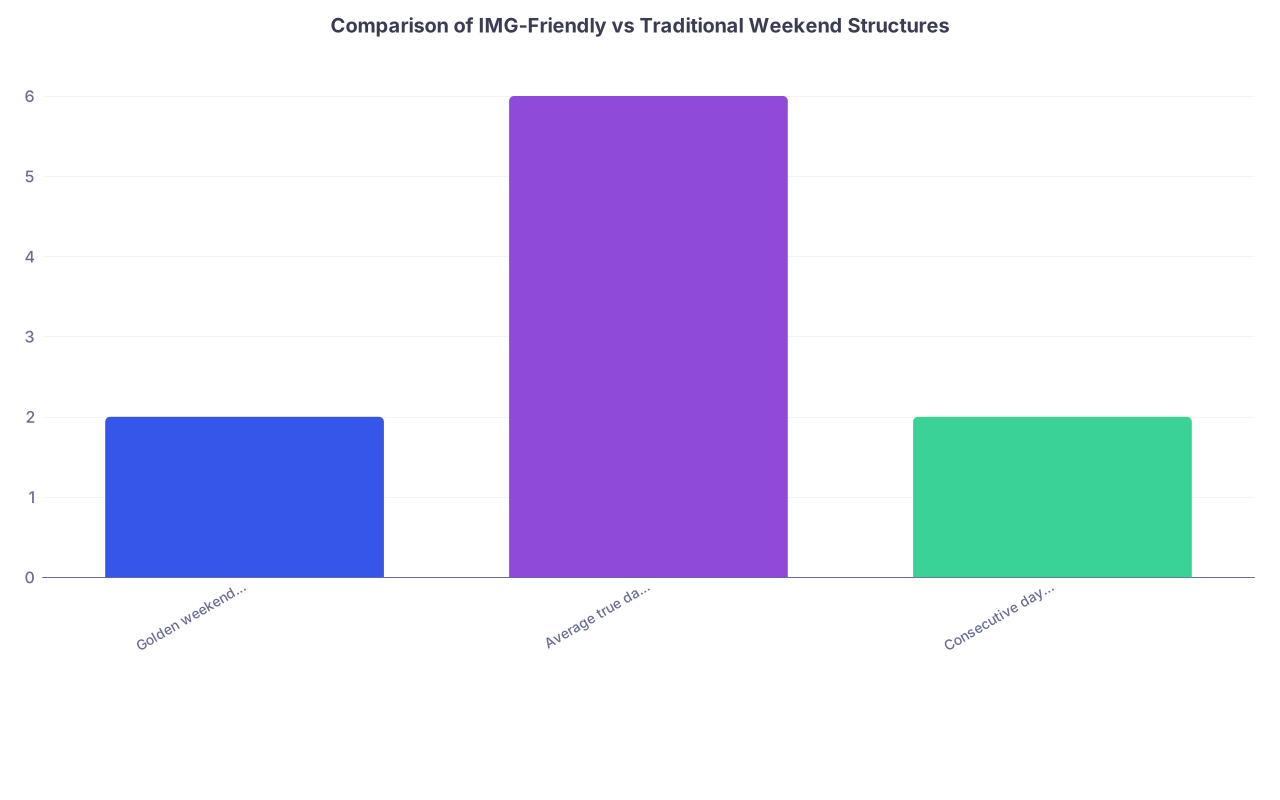
| Category | Value |
|---|---|
| Golden weekends per 4-week block | 2 |
| Average true days off per month | 6 |
| Consecutive days off | 2 |
Programs that quietly protect IMGs:
- Schedule at least 1–2 true golden weekends per 4‑week block, even on heavy inpatient rotations
- Avoid post‑call on Saturday that “counts” as your day off
- Enforce that your day off is not routinely violated by “can you just log in and sign this note”
Questions to ask residents:
- “On your worst inpatient month, how many weekends did you actually feel off?”
- “How many golden weekends do you typically get on wards?”
- “Does post‑call Saturday usually turn into a real day off, or are you still finishing work at home?”
You are looking for eye rolls or laughter. That is data.
Protected didactics and “no‑page” policies
IMGs often feel behind on “US style” medicine: billing language, quality metrics, documentation tricks, local treatment algorithms. Protected didactics are key to closing that gap.
What helps:
- A true “no‑page” block during noon conference or morning report
- Coverage by a jeopardy or float resident during your teaching time
- Clear expectation with nursing that educational time is respected unless emergent
If the program says, “We have noon conference every day,” your follow‑up needs to be: “Are residents actually protected from pages or cross-cover during that time?”
Examples of quietly powerful policies:
- “From 12–1 p.m., nursing pages go to a designated float resident so the rest can attend noon conference without interruption.”
- “On call days, interns still attend morning report, and seniors protect them from non‑urgent issues.”
IMGs in particular benefit from uninterrupted teaching because you are processing medical language and culture at the same time. Constant pager interruptions prevent the kind of deep learning that reduces your anxiety on call.
EMR efficiency and documentation support: not glamorous, but huge
This is where residents either drown or keep their heads above water. And IMGs almost always start slower here.
Protective systems:
- Templates and smart phrases shared program‑wide (notes, discharge summaries, H&Ps)
- Dedicated EMR training that goes beyond the generic hospital “click here” orientation
- Early pairing with co‑interns or seniors who are fast and willing to show you workflows
Look for programs that say things like:
- “We have a shared folder of smart phrases that all incoming interns get access to.”
- “We schedule extra EMR training sessions the first month for anyone who wants it.”
- “Our seniors are expected to review and streamline intern workflows during the first 2–3 weeks.”
This reduces the late‑night charting that turns a hard call into a brutal one.
Cross-cover expectations and escalation culture
On nights, your brain is doing risk triage constantly: Can I watch this? Do I need labs? Do I need to wake the attending? An IMG new to US malpractice culture will lean too far in one of two directions: over‑order everything or freeze and under‑call.
Supportive programs:
- Have explicit cross-cover protocols (for fever, chest pain, low urine output, etc.)
- Clarify expectations about when to involve the senior or attending
- Do not shame interns for “over‑calling” in the beginning
On interview day or second looks, ask:
- “What are the expectations for when interns should call seniors or attendings at night?”
- “Have people ever been criticized for calling too often overnight?”
- “Do you have standard cross-cover protocols or order sets for common issues?”
If residents say, “Our attendings prefer to be called too early rather than too late,” and that matches what seniors say—that is protective. If someone jokes, “You learn quickly who you can wake and who you cannot,” that is a warning sign.
How IMG‑friendly programs stage exposure to heavy call
The smartest programs do not throw their IMGs into the deepest end on July 1. They structure year‑one so that your call responsibilities ramp reasonably.
Common protective staging:
- First month on a somewhat lighter service (e.g., general medicine with robust senior support, not the admit‑to‑infinity night service)
- Night float scheduled after 2–3 blocks of daytime wards or electives
- ICU rotations not scheduled as the very first block for fresh IMGs
Here is what a more protective PGY‑1 sequence can look like:

| Step | Description |
|---|---|
| Step 1 | July - Day Wards with strong senior |
| Step 2 | Aug - Clinic/Elective mix |
| Step 3 | Sep - Day Wards with call |
| Step 4 | Oct - Night Float 1-2 weeks |
| Step 5 | Nov - ICU or Step-down |
| Step 6 | Dec - Day Wards |
You can ask bluntly:
- “Do you schedule any consideration for IMGs who are new to the US system, in terms of when they take their first nights or ICU?”
- “When did you personally do your first night float and ICU month?”
You are not asking for special treatment. You are asking whether they even think about staged difficulty. Programs that care about resident well‑being usually do.
How to interrogate a program’s call culture without sounding paranoid
You only get a few questions in each setting. Use them surgically. Do not ask, “Is your call schedule humane?” Everyone will say yes.
Ask for concrete, checkable facts and then listen closely to the tone.
Here are high-yield questions that reveal IMG‑relevant policies:
- “How many new admissions does an intern typically do on a call day on your busiest service?”
- “On night float, approximately how many cross-cover patients does the night intern handle and how many admits?”
- “How long are your night float blocks, and what does your schedule look like during that time?”
- “How many true golden weekends did you personally have on your last heavy inpatient month?”
- “Are there any services where residents feel the call schedule is not sustainable?”
- “If an intern is struggling—maybe new to the US system or language—are there adjustments made to their call duties early on?”
Pay attention to:
- Hesitation before they answer
- Whether different residents give wildly different numbers
- Whether anyone volunteers, “To be honest, our X rotation is rough, but the PD is working on it”—that is actually a good sign. It means they are not gaslighting you.
Real‑world patterns: what I’ve seen work and fail for IMGs
I will give you composite examples that mirror actual programs.
Program A: Classic burnout factory for IMGs
- Traditional q4 28‑hour call on multiple services
- “Soft” intern admit cap of 10–12 new patients on call
- Night intern cross‑covers 70+ patients, plus admits, with attending at home
- Night float is 4 weeks straight, with minimal weekend off
- ICU block as first month for several IMGs with weak senior support
- One golden weekend in an entire 4‑week inpatient block
Outcome: IMGs look fine on paper in September. By December, they are making more errors, dreading every call, and seriously considering leaving internal medicine.
Program B: Quietly protective of IMGs
- Daytime wards with intern admit cap of 5–7, team cap of 16
- Night float for interns is 1 week at a time, 3–4 blocks per year, with max 6 admits and cross‑cover ~30 patients
- All nights have in‑house senior and nocturnist; interns never alone
- Protected noon conference with float resident covering pages
- Strong EMR onboarding and shared note templates
- PGY‑1 year deliberately starts with lower‑acuity wards and clinic, ICU comes after at least one night float block
Outcome: IMGs are tired (everyone is), but they are not terrified of call. They improve steadily, feel supported, and by January they are operating close to speed with US grads.
Subtle signs a program has actually thought about IMGs
You will rarely see a slide titled “Policies that protect IMGs.” Instead, you need to infer.
Clues:
- They mention a formal IMG mentorship group or faculty lead for IMGs.
- They talk about extra orientation content for those new to US medicine (documentation, communication, cultural expectations).
- Seniors casually mention “We try to pair new IMGs with certain seniors on their first nights so they can ask more questions comfortably.”
- PD or APD can answer questions about how they support IMGs without resorting to “We treat everyone the same.”
Uniform treatment sounds fair. It is not. Because IMGs are starting the race with extra weight on their backs. Programs that pretend otherwise usually have higher burnout and more quiet suffering.
How to prioritize this when building your rank list
You cannot get a perfect program. You can absolutely avoid the worst call structures that will grind you down.
When you look at your list, ask yourself for each program:
- Do I have concrete data about their call caps, night float length, and cross-cover loads?
- Did the residents sound tired‑but‑supported, or resigned-and-bitter?
- Did anyone explicitly acknowledge the extra challenges IMGs face, or was it all “everyone is treated equally”?
If a program refuses to give specifics or gives clearly unrealistic numbers (“we admit unlimited but people cope”), you should assume the worst.
Key takeaways
- Call structure is not a minor detail; it is the skeleton of your daily life as an IMG intern.
- The most IMG‑friendly programs have strict caps, staged night exposure, strong overnight supervision, and protected learning time—even if they never use the word “IMG” in the brochure.
- On interview day, you are not just trying to impress them; you are running a stress‑test on their call policies. Ask specific, numerical questions. Listen harder to how the residents answer than to any slide deck claim.