
The myth that all residents are treated the same is false. Elective access and moonlighting rules often hit IMGs differently—and sometimes deliberately.
Let me break down how this really works, which programs are actually IMG-friendly on these points, and how you evaluate policies before you match yourself into a box you cannot escape.
1. The Real Landscape: Why Electives and Moonlighting Hit IMGs Harder
Most program websites act like electives and moonlighting are generic perks. They are not. They are structural levers that can seriously help or quietly limit IMGs.
For international medical graduates, three facts shape everything:
- Your visa status (J‑1, H‑1B, or green card / citizen).
- Your exam profile (especially if Step 2 was your “rescue” after a marginal Step 1/CK attempt).
- How much flexibility the program gives you to build a U.S.-relevant profile during residency.
Here is what I consistently see:
IMGs often need high-yield electives (U.S. subspecialty exposure, research blocks, away electives at fellowship-heavy centers) to compensate for:
- Limited U.S. clinical experience pre-residency.
- Fewer “home program” connections.
- Need for strong in-system LORs for fellowship.
They also often need moonlighting more:
- To send money home.
- To cover visa costs, exam fees, travel for interviews and observerships.
- To buffer against lower starting salaries compared to home country expectations.
But many programs quietly restrict these two things more aggressively for IMGs than for AMGs. Sometimes explicitly. Sometimes through “policies” that only apply in practice to visa-holders.
You need to see past the brochure.
2. Electives: What “IMG-Friendly” Actually Means
Elective policies are not just about “4 weeks vs 8 weeks.” They determine whether you can:
- Build a competitive fellowship application.
- Get exposure to U.S. systems you did not have as a student.
- Recover from a weak early record.
The Three Axes of Elective Friendliness for IMGs
I look at elective policies for IMGs on three axes:
- Timing flexibility
- Content flexibility
- External access (“away” electives / visiting rotations)
Let us be specific.
1. Timing Flexibility
Programs differ wildly on when you are allowed electives.
Good for IMGs:
- Electives starting PGY‑1 second half or early PGY‑2.
- Ability to cluster electives before a fellowship application cycle.
- Willingness to schedule research or subspecialty blocks for IMGs even if they “normally” prioritize categorical AMGs.
Bad for IMGs:
- “No electives in PGY‑1” plus “all PGY‑2/3 electives must be in-house core services.”
- Electives only in PGY‑3 after fellowship applications are due.
- Scheduling rules that give priority to chief favorites or home med students over IMGs.
Practical impact: If oncology is your target but your first heme/onc elective is in November PGY‑3, you are already late for most competitive fellowships.
2. Content Flexibility
Look for whether you can meaningfully tailor:
- Subspecialty electives: Cardiology, GI, pulm/crit, nephrology, ID, rheum, heme/onc, hospitalist medicine, etc.
- Nonclinical electives: Quality improvement, medical education, health informatics, ultrasound, global health.
- Research blocks: Protected time with a mentor, not just “you can do research at night if you want.”
IMG-friendly signs:
- At least 12–16 weeks of electives over 3 years.
- Explicit mention of research electives and fellowship-oriented subspecialty rotations.
- Historical pattern: IMGs who matched to fellowship got two or more electives in their target field.
Less friendly:
- Electives are just “ambulatory IM,” “geriatrics clinic,” or low-yield primary care continuity clinics.
- No dedicated research blocks.
- “You can do research on top of your normal rotations” (translation: you will be reading papers at 1 a.m. on night float).
3. External Electives and Away Rotations
This is where most IMGs get blindsided.
Programs fall into one of four categories:
| Policy Type | External Rotations | Visa Complexity | IMG Benefit Level |
|---|---|---|---|
| Fully Closed | None allowed | Low | Very Low |
| Limited In-System Only | Sister hospitals | Low-Medium | Low-Medium |
| Selective External | Case-by-case | Medium | High (if approved) |
| Open with Structure | Formal process | Medium-High | Very High |
For IMGs, “Fully Closed” and “Limited In-System Only” can be fatal if you are trying to:
- Get exposure at a big-name fellowship institution.
- Work with specific researchers outside your own program.
- Build geographically targeted networks for post-residency hiring.
IMG-friendly programs:
- Explicitly allow away electives at affiliated or external academic centers.
- Have a clear process (forms, deadlines, supervising attending, malpractice coverage).
- Do not automatically block visa-holding residents from traveling for rotations.
Less friendly programs:
- “We used to allow this but GME shut it down.”
- “We might approve it if the PD likes you” (these rarely materialize for IMGs unless you are already a star).
3. Moonlighting: Where Visa, GME, and Reality Collide
This is where things get messy, and where IMGs on visas often get quietly sidelined.
Moonlighting is shaped by four forces:
- ACGME duty hour rules (80 hours / week averaged; day-off rules; between-shift rest).
- Institutional GME policy (some hospitals simply say no).
- Program leadership culture (PD’s philosophy on resident fatigue and “side hustles”).
- Immigration/visa law for J‑1 and H‑1B.
Let me walk through each, specifically for IMGs.
A. Internal vs External Moonlighting
Most IM-friendly programs differentiate:
- Internal moonlighting: Extra shifts within your own hospital system—night cross-cover, ED coverage, short-call hospitalist work. Usually easier to approve.
- External moonlighting: At outside hospitals, urgent care, or telemedicine platforms. Much harder, often blocked for visa-holders.
For IMGs, internal moonlighting is usually the only realistic path. External often dies at the intersection of visa rules and legal risk.
Common rules I see in well-run IMG-heavy Internal Medicine programs:
- Only PGY‑2 and above.
- Must be in good academic standing.
- Must have completed USMLE Step 3.
- Must not exceed 80 hours/week average with duty hours logged honestly.
Moonlighting-unfriendly patterns:
- Internal moonlighting technically exists but:
- “We reserve it for preliminary residents transitioning in-house.”
- “Our seniors rarely use it because schedules are already full.”
- There are only 3–4 shifts a month, snapped up by favored residents.
B. Visa-Specific Realities: J‑1 vs H‑1B vs Permanent Residents
This is where IMGs need actual clarity, not rumors from the WhatsApp group.
1. J‑1 Visa (ECFMG Sponsored)
For J‑1 residents, the core concept is “incidental to training.”
That phrase controls everything.
- All clinical work must be part of your ACGME-approved program.
- Any extra work (moonlighting) must:
- Be approved by ECFMG.
- Be documented by GME as part of your educational program.
- Not conflict with duty hours or core training.
Result: Many institutions take the conservative route and ban moonlighting for J‑1s outright. It is legally safer and administratively simpler.
The more sophisticated, IMG-friendly systems:
- Allow internal moonlighting if:
- It is at the same sponsoring institution.
- It is logged, supervised, and contractually folded into your training program.
- Still often block external moonlighting because of:
- Contracting complications.
- Billing and malpractice coverage.
- Immigration interpretation risk.
If you are J‑1, and a program website says “moonlighting allowed,” you must explicitly ask: “Does this policy also apply to J‑1 residents?” Many times, the answer is no, whispered only after you match.
2. H‑1B Visa
For H‑1B residents, the key concepts are:
- Employer-specific: You can only work for the sponsoring employer as defined in the petition.
- Location-specific: Work must be at the approved work sites unless amended.
- Position-specific: Role and hours are defined.
Translation:
- Internal moonlighting at the same sponsoring hospital can sometimes be incorporated.
- Any work at another site, even within the same health system, may require H‑1B amendment or fresh petition.
- External moonlighting is almost always either impossible or an administrative nightmare.
I have seen a few large systems (think: major academic centers in NY, TX) that:
- File H‑1B petitions that explicitly cover several member hospitals.
- Allow internal moonlighting at those covered sites. They are rare but valuable.
3. Green Card / Permanent Resident / U.S. Citizen
Here the constraints are almost entirely:
- GME rules
- PD preference
- State licensure
Not immigration.
IMGs with permanent status are often the only ones who can:
- Do external moonlighting at community sites.
- Stack significant extra income in PGY‑2 and PGY‑3.
- Mix telemedicine or urgent care shifts into their schedule.
If you are an IMG with permanent status, you are playing a different game. You should be aggressively targeting programs that actually let you use that flexibility.
4. Concrete Features of Truly IMG-Friendly Elective and Moonlighting Policies
Instead of vague “friendliness,” let me spell out what I look for when I review program policies from an IMG perspective.
Elective Policy: IMG-Friendly Checklist
You want to see things like:
Elective time: 16–24 weeks over 3 years.
Electives start no later than mid-PGY‑2.
Dedicated research elective blocks with:
- A named research director or mentor.
- Clear system to approve projects.
- Prior residents with publications or conference presentations.
Flexibility to do:
- Double subspecialty exposure (e.g., two separate cardiology rotations).
- Outpatient and inpatient versions of the same subspecialty.
At least limited away elective options, ideally:
- Affiliated academic centers.
- Structured application process.
- Previously used by IMGs (ask the current residents).
Moonlighting Policy: IMG-Friendly Checklist
You want language like:
- “Moonlighting is permitted for residents in PGY‑2 and PGY‑3 who are in good standing.”
- “Internal moonlighting opportunities include hospitalist cross-cover, ED coverage, and urgent care.”
- “Residents on visas may moonlight internally once ECFMG/immigration and GME approvals are obtained.”
And you want actual behavior that matches the paper:
- Multiple current IMGs doing legitimate internal shifts.
- Transparent pay structure (rate per hour or per shift).
- Duty hours tracked but not weaponized (“You worked 79.5 hrs once, we are banning you from moonlighting”).
5. Program Types: How Different Institutions Treat IMGs on These Issues
Let me generalize a bit. It is not perfect, but patterns hold.
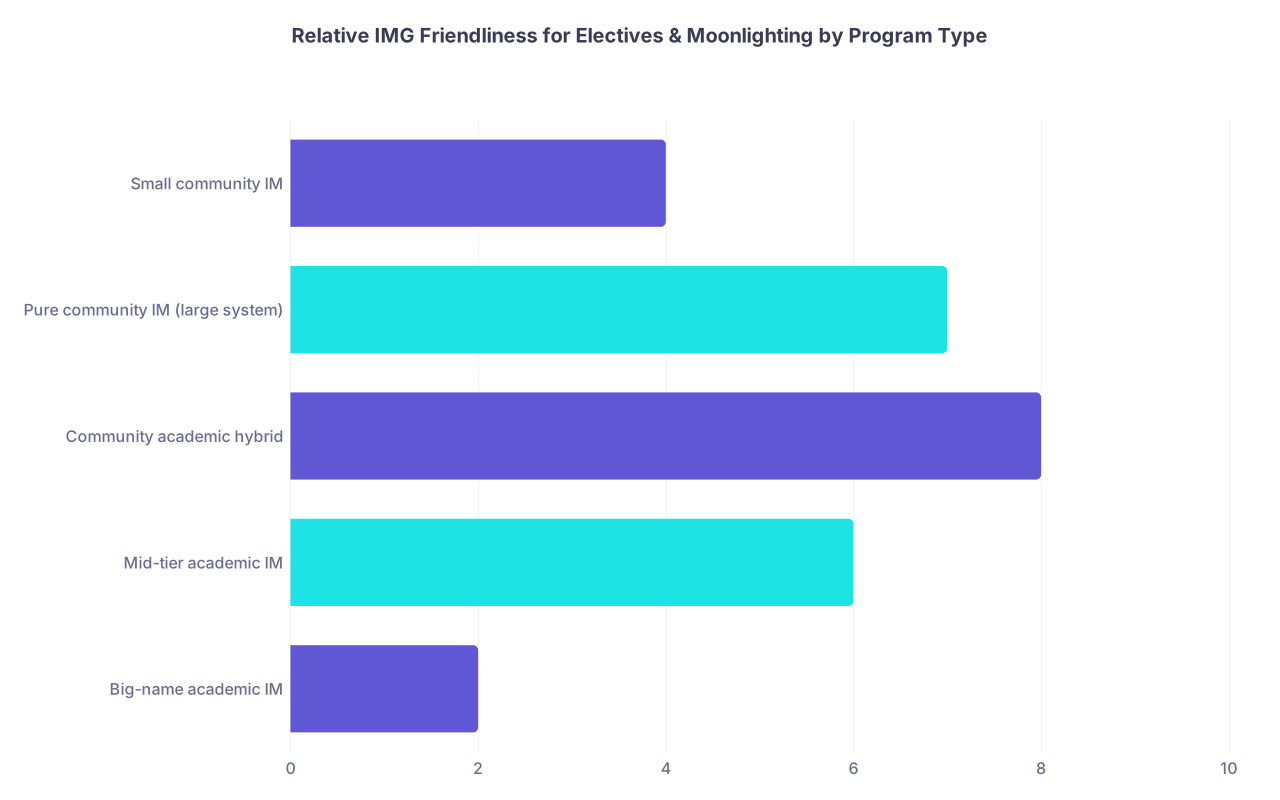
| Category | Value |
|---|---|
| Big-name academic IM | 2 |
| Mid-tier academic IM | 6 |
| Community academic hybrid | 8 |
| Pure community IM (large system) | 7 |
| Small community IM | 4 |
(Scale 1–10: Higher = more IMG-friendly on electives + moonlighting combined, not competitiveness.)
1. Big-Name Academic Internal Medicine (Top 20)
Examples: MGH, Hopkins, UCSF, Penn.
- Electives: Rich, with tons of subspecialty and research access. Great for fellowship.
- Away electives: Possible but often unnecessary; they are already the prestige site.
- Moonlighting:
- Often restricted, especially early.
- Heavy service load makes moonlighting practically impossible for many.
- Visa policies conservative.
Impact on IMGs:
- Fantastic for career trajectory if you can match there.
- Moonlighting income often limited.
- Visa-holding IMGs may be structurally disadvantaged compared to their permanent resident peers when it comes to extra work.
2. Mid-Tier Academic IM (University-Affiliated, IMG-Friendly)
Think: state universities, safety-net hospitals, mid-rank academic centers that match a lot of IMGs.
- Electives: Usually 12–20 weeks; good subspecialty options; often decent research access.
- Away electives: Sometimes allow selectively, especially for strong residents.
- Moonlighting:
- Internal mostly allowed in PGY‑2 and PGY‑3.
- J‑1 allowed internal moonlighting at some places if GME is organized.
- H‑1B sometimes more restricted unless system-wide petition.
These are often the sweet spot for IMGs needing both career-building electives and some extra income.
3. Community Academic Hybrid Programs
Examples: Large community hospitals with university affiliation; strong fellowship network.
This is where I see some of the best IMG policies:
- Electives:
- 16–24 weeks, with strong subspecialty variety.
- Research blocks exist, but you must chase them.
- Moonlighting:
- Internal moonlighting for PGY‑2 and PGY‑3.
- Sometimes shifts at affiliate community sites under the same corporate umbrella.
- More relaxed culture about seniors picking up extra shifts.
For many IMGs who are not matching at brand-name places, this is the most rational target.
4. Large Pure Community IM Programs
No med school. Just a big hospital system.
- Electives:
- Can be good or terrible; highly variable.
- Sometimes heavy on service and light on research.
- Moonlighting:
- Often numerous internal options (night float coverage, ED, observation unit).
- Visa rules vary: some systems are surprisingly flexible, others paranoid.
I have seen IMGs pay off exam debts and support families heavily through moonlighting at these sites—if the program is supportive and transparent.
5. Small Community IM Programs
- Electives: Often limited (8–12 weeks), mostly in-house, minimal research.
- Moonlighting: Sometimes allowed, but:
- Patient volume may be low.
- Financial pressure on the institution may make them cut back on moonlighting shifts.
These programs can be life-savers to get you into the U.S. system, but are not ideal if you are chasing competitive fellowship or need strong external electives.
6. How to Evaluate Policies Before You Rank Programs
Do not rely on websites. They all blur together and most are half out-of-date. You need a targeted information-gathering strategy.
Step 1: Ask Straight Questions on Interview Day
To PD/APD:
- “How many weeks of electives do residents typically have over 3 years?”
- “When do electives start—PGY‑1, PGY‑2?”
- “Do you allow away electives at other academic centers if a resident has a clear educational goal?”
To Chief Residents / Current IMGs:
- “How many of you are doing moonlighting currently?”
- “Does the policy differ for J‑1 vs H‑1B vs green card holders?”
- “Do seniors actually get their elective choices, or are they blocked by service needs?”
Step 2: Cross-Check With Actual Resident Behavior
What matters is not policy; it is practice.
Ask:
- “How many residents in your last 2 graduating classes went into subspecialty fellowships?”
- “Did they get more than one elective in their chosen field?”
- “Did they do any outside rotations?”
On moonlighting:
- “What is a realistic monthly moonlighting income for a PGY‑3 here?”
- “Do people feel pressure not to moonlight because of the workload?”
- “Have any J‑1 residents been approved for internal moonlighting recently?”
If they cannot name a single resident on a visa currently moonlighting, treat the “we allow it for everyone” line as suspect.
Step 3: Careful Reading Between the Lines
Watch for red flags in language:
“Moonlighting is a privilege and may be revoked at any time”
(fine, but how often does it get “revoked” for IMGs only?)“Away electives are rarely necessary”
Usually means “we do not like dealing with the paperwork.”“Residents are strongly discouraged from moonlighting due to wellness concerns”
Often means the PD does not believe in it, and you will feel subtle pressure not to do it.
Programs that are genuinely IMG-friendly on these points are not vague. They will show you:
- Sample schedules with electives clearly marked.
- Documentation of moonlighting pay rates.
- Examples of J‑1 residents who were approved for internal shifts.
7. Strategy: Matching Your IMG Profile to the Right Policy Environment
Different IMGs have different priorities. Let me be blunt.
Profile A: Visa-Dependent, Fellowship-Focused (e.g., J‑1, aiming for Cardiology)
Your priority stack:
Elective structure and research access.
You need:- 2+ rotations in your target subspecialty.
- At least one research block.
- Evidence IMGs from this program actually match into your target fellowship.
Early exposure timing.
You want:- Subspecialty elective by early-mid PGY‑2.
- Research started by then at the latest.
Moonlighting is secondary.
For J‑1, it may be limited anyway. Do not choose programs solely on the promise of moonlighting that will never materialize for you.
Profile B: Permanent Resident IMG, Fellowship Optional, Financial Pressure High
Your priority stack:
Moonlighting flexibility.
- Internal shifts with decent rates.
- PGY‑2 access.
- Clear sign many seniors actively moonlight.
Reasonable electives.
- 12–20 weeks is usually enough to keep doors open.
- At least some subspecialty access if you later decide to chase fellowship.
Location and cost of living.
- A program in a lower COL area with good moonlighting can create a much better financial runway for you than a big-name coastal program that bans extra work.
Profile C: Late-Career IMG, Primary Goal = U.S. Board Certification and Stability
Here, a solid, stable community or hybrid program with:
- Predictable elective structure.
- Minimal toxicity.
- Some moonlighting for cushion.
…may be far better than a top-tier academic environment that burns you out and blocks side income entirely.
8. Example Structures: What Good Looks Like
To make this less abstract, here is what a genuinely IMG-friendly policy structure might resemble (based on composites of real programs).
Sample IMG-Friendly Elective Structure (Internal Medicine, 3 Years)
| Year | Elective Weeks | Typical Options |
|---|---|---|
| PGY‑1 | 4 | Cardiology, Infectious Disease |
| PGY‑2 | 8 | GI, Pulm, Heme/Onc, Research |
| PGY‑3 | 8–12 | Advanced subspecialty, Away elective |
Key features:
- PGY‑1 elective exposure starts early.
- Dedicated PGY‑2 research (4 weeks minimum).
- At least one slot open for potential outside rotation.
Sample IMG-Friendly Moonlighting Policy Snapshot
- Eligibility: PGY‑2+ in good standing; Step 3 passed.
- Internal shifts:
- Night cross-cover on med floors.
- Admitting shifts in observation unit.
- Weekend rounding in low-acuity units.
- J‑1 Residents:
- Allowed for internal moonlighting only after formal ECFMG clearance.
- H‑1B Residents:
- Allowed internal moonlighting at covered sites within the H‑1B petition.
- Rate:
- $90–$130 per hour (varies by geography and role).
If a program’s actual practice looks like this and you are an IMG, you have something viable.
9. Pulling It Together: How You Actually Use This Information
Do not treat electives and moonlighting as side issues. For IMGs, they shape:
- How competitive you become for your next step.
- How much debt and financial pressure you carry.
- How much autonomy you have in shaping your training.
Your move:
Before interview season:
- Make a simple spreadsheet with columns:
- Elective weeks
- Research blocks
- Away electives allowed?
- Moonlighting (Y/N)
- Visa moonlighting differences
- Fill it as you research and attend interviews.
- Make a simple spreadsheet with columns:
During interviews:
- Ask targeted, uncomfortable questions. Program leaders who are truly IMG-friendly will not dodge them.
- Talk explicitly to current IMGs on visas about their experiences.
When ranking:
- Align program structure with your actual profile and goals.
Not your fantasy self. Your real self: visa type, financial needs, fellowship ambition.
- Align program structure with your actual profile and goals.
If you do this well, you avoid the trap I have seen too many IMGs fall into: a residency that looks decent on paper but quietly chokes off electives, bans moonlighting for visa-holders, and leaves you boxed in for three years.
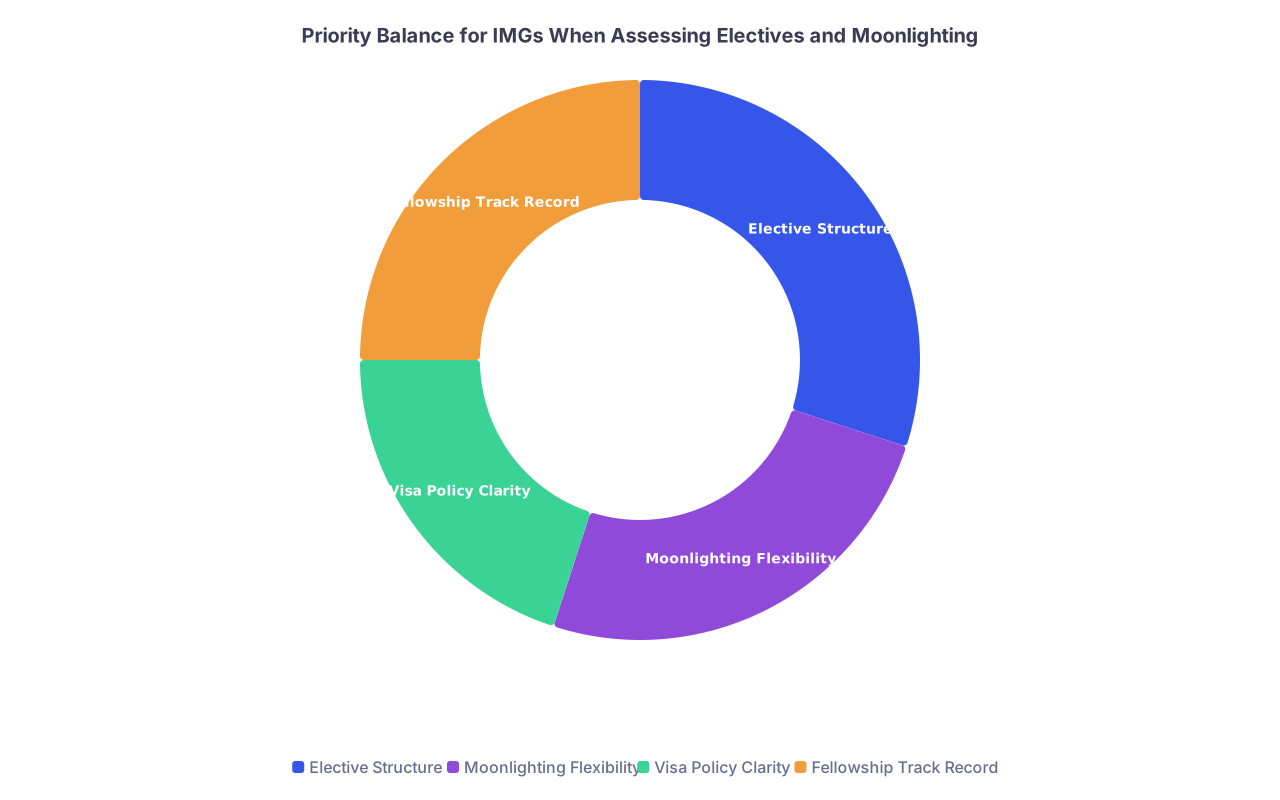
| Category | Value |
|---|---|
| Elective Structure | 30 |
| Moonlighting Flexibility | 25 |
| Visa Policy Clarity | 20 |
| Fellowship Track Record | 25 |
FAQ (exactly 4 questions)
1. As a J‑1 IMG, should I even factor moonlighting into my program choice?
Yes, but treat it as a secondary criterion. Many J‑1s will either be blocked or heavily constrained in moonlighting. If two programs are similar in elective quality, and one has a proven track record of J‑1 internal moonlighting, that is a meaningful edge. But do not pick a weaker elective/research environment solely for a speculative promise of extra shifts.
2. Can I negotiate elective or moonlighting policies after matching?
You cannot rewrite institutional policy, but you can sometimes negotiate how it applies to you. For electives, a motivated PD may front-load or cluster your subspecialty and research blocks. For moonlighting, once you are a trusted senior, PDs and GME are often far more willing to sign off on internal opportunities. But if the baseline policy is “no moonlighting for residents,” you are not going to overturn that as a PGY‑1.
3. Are away electives essential for IMGs targeting competitive fellowships?
Not essential, but very helpful if your home program lacks strength in your target field. If your program already has a strong cardiology division with active research and good fellowship match history, an away elective is optional. If your program has minimal exposure in your target subspecialty, an away elective at a strong center can compensate for institutional gaps and help you secure letters from recognized faculty.
4. How do I verify if IMGs at a program actually moonlight or do advanced electives?
You ask residents directly and you ask for examples. “Can you name a J‑1 or H‑1B resident in the last two classes who did internal moonlighting?” “Which recent IMGs did away electives, and where?” If they cannot give names, or they keep speaking in generalities, assume the practical answer is no. Programs with real, functioning policies can easily point to specific residents who used them.
Key points:
- Elective structure and timing matter more to IMGs than to most AMGs; it directly shapes your ability to recover, specialize, and match to fellowship.
- Moonlighting for IMGs is heavily mediated by visa status and institutional appetite for administrative work; ignore the generic “moonlighting allowed” line and ask how it applies to J‑1/H‑1B residents specifically.
- The best IMG-friendly programs combine flexible, early electives with transparent, realistically usable internal moonlighting options—and you can verify this by talking to current IMGs rather than trusting the brochure.