Most applicants read “We sponsor J‑1 visas” and think that means the program is IMG-friendly. That is wrong.
Visa language on program websites hides an entire hierarchy of how much a program actually invests in international medical graduates. If you do not decode that hierarchy, you will waste applications, interviews, and possibly your entire match cycle.
Let me break this down specifically.
The Three Realities Behind “We Accept IMGs”
Before talking tiers, you need to understand the basic game: almost every ACGME-accredited residency can legally take IMGs. Most do not want the administrative or perceived risk burden. So they use visa policy as the first layer of filtration.
In practice, you see three broad realities:
- Programs that openly support both J‑1 and H‑1B and match multiple IMGs every year.
- Programs that “accept IMGs” but only under very narrow circumstances or only J‑1, and match 1–2 IMGs in some years.
- Programs that technically could but practically do not (or almost never) take IMGs, hiding behind vague wording like “visa sponsorship considered on a case-by-case basis.”
You want to systematically sort programs into these buckets before you spend money on ERAS tokens.
To do that efficiently, I use a “visa support tier” model. Not official, obviously. But brutally predictive of how your application will be treated.
The Visa Support Tiers: From Marketing to Meaningful
Think of programs on a spectrum from “paper-only support” to “full institutional backing.” I break it into four main tiers, plus a red-flag tier.
| Tier | Visa Types | Typical IMG Volume | Policy Clarity |
|---|---|---|---|
| 1 | J-1 only | 0–2 per year | Vague to Minimal |
| 2 | J-1 only | 3–10 per year | Clear, consistent |
| 3 | J-1 + limited H-1B | 5–15 per year | Moderately clear |
| 4 | J-1 + robust H-1B | 10+ per year | Highly explicit |
| Red Flag | Case-by-case / unclear | 0–1 per year | Ambiguous |
We will walk through each tier: what the website actually says, what happens behind the scenes, and how to identify them quickly.
Tier 1: Minimal J‑1 Sponsorship – Technically Open, Practically Cold
Tier 1 is where many IMGs burn applications.
These are programs that:
- Only accept or “prefer” J‑1 via ECFMG
- Match very few IMGs, often none in a given year
- Provide almost no detail beyond a single line about “J‑1 sponsorship through ECFMG”
What their website sounds like:
- “We accept J‑1 visas sponsored by ECFMG.”
- “We are unable to sponsor H‑1B visas.”
- “International graduates are welcome to apply.” (With no numbers to back that up.)
What this usually means operationally:
- They will not fight for your file at the GME office.
- They do not have an established administrative workflow for visa issues.
- The PD might like an IMG occasionally, but the default culture is USMD/DO-focused.
How to recognize Tier 1 quickly:
Look at their current residents page.
- You see mostly U.S. schools and maybe 1–2 IMGs in the entire program.
- Often those IMGs are U.S. citizens or green card holders (you have to click through LinkedIn or bios to figure this out sometimes).
Check their GME or institutional visa page.
- Only mentions “J‑1 sponsorship available” with generic language.
- No details on H‑1B, no bullet points on requirements, no deadlines, nothing specific.
Match lists or alumni pages.
- Scattered IMGs, no pattern.
- Years with zero IMGs are common.
Who might still consider Tier 1?
- IMGs with U.S. citizenship or permanent residency (visa not needed).
- Extremely strong IMGs (high scores, U.S. research, strong connections) targeting very specific geography where options are limited.
For everyone else, Tier 1 programs are usually low-yield. They are not truly IMG-friendly; they are just not legally IMG-closed.
Tier 2: True J‑1 Friendly – Bread and Butter for Most IMGs
Tier 2 is the workhorse category for non‑U.S. IMGs. These programs predominantly use J‑1 but actually rely on IMGs to staff their residency.
These programs generally:
- Clearly state they accept J‑1 via ECFMG
- Have multiple IMGs per class, consistently
- Sometimes say “We do not sponsor H‑1B” but are transparent about it
Typical website language:
- “We accept J‑1 visas sponsored by ECFMG for residents.”
- “Our program does not sponsor H‑1B visas.”
- “We welcome applications from international medical graduates. Recent classes include graduates from [list countries or schools].”
Operationally, Tier 2 means:
- The GME office processes J‑1 visas every year. It is routine work, not a special event.
- Program coordinators know ECFMG timelines, SEVIS issues, and start date formalities.
- PDs and APDs have no anxiety about “taking a chance on an IMG.” They already do.
How to identify Tier 2:
Resident roster:
- Multiple IMGs in each PGY year
- Often a wide mix: India, Pakistan, Middle East, Latin America, Eastern Europe, etc.
- Names plus listed schools make it obvious.
Program/Q&A pages:
- Explicit: “We accept J‑1 only / We do not sponsor H‑1B.” No hedging.
- Sometimes they mention ECFMG requirements or link to ECFMG J‑1 info.
Match pattern over 3–5 years:
- Consistent IMG presence, not just a one-off.
This is where the majority of IMGs should focus their list, especially for internal medicine, pediatrics, family medicine, psychiatry, and neurology.
If you are fine with a J‑1 route (and honestly, for most people it is workable if you plan early for waivers), Tier 2 programs are high-yield.
Tier 3: Limited H‑1B Sponsorship – The Cautious Upgraders
Tier 3 is where things get more nuanced. These are programs that:
- Primarily use J‑1
- Do sponsor H‑1B in select situations
- Often say they sponsor H‑1B but in practice sponsor only a few per year, under strict conditions
Typical website language:
- “We sponsor J‑1 and H‑1B visas for eligible residents.”
- “H‑1B sponsorship is considered for exceptionally qualified applicants who meet USMLE and timing requirements.”
- “Preference is given to J‑1 visas, but H‑1B may be sponsored depending on institutional guidelines.”
Operationally, this usually means:
- The GME office allows H‑1B, but the bar is high: all Steps passed on first attempt, no visa gaps, on-time credentialing.
- They are very wary of H‑1B start date delays, cap issues (if cap-subject), and the extra cost.
- PDs may reserve H‑1B for top candidates or specific service needs.
You will often see patterns like:
- Class of 10 residents: 5–6 J‑1 IMGs, 2–3 U.S. grads, maybe 1 H‑1B.
- H‑1B residents often have 250+ on Step 2, multiple U.S. publications, or prior U.S. clinical appointments.
How to verify if Tier 3 is real H‑1B or just marketing:
Check the institutional GME visa page (not just the program page).
- Does it explicitly mention H‑1B for residents/fellows?
- Does it specify “H‑1B cap-exempt sponsored by [university/medical center]”?
Look at residents’ bios.
- Find current or recent H‑1B residents. Often they list “H‑1B visa” in LinkedIn or personal websites.
- If possible, email or message a current IMG resident and ask directly: “Are there any current residents on H‑1B?”
Ask a sharply worded question if you are invited to interview:
- “How many incoming residents in the last three classes have been sponsored on H‑1B, and what were the usual criteria?”
- If they cannot answer or dodge, assume H‑1B is rare and unpredictable.
For H‑1B hopefuls, Tier 3 programs are worth applying to, but you must be realistic. You are usually competing for 1–2 unofficial “H‑1B spots” per year.
Tier 4: Robust H‑1B and J‑1 – The Gold Standard for Visa-Sensitive IMGs
Tier 4 programs do what everyone else claims they do: they consistently sponsor both J‑1 and H‑1B and have a track record of matching multiple IMGs on each visa type.
These are often large academic medical centers, safety-net hospitals, or high-volume community programs closely affiliated with a university.
Typical website language:
- “We sponsor both J‑1 and H‑1B visas for incoming residents who meet institutional and USMLE requirements.”
- “H‑1B applicants must have completed Step 3 and all USMLE exams on the first attempt before rank list submission.”
- “Our residency includes trainees on J‑1 and H‑1B visas from multiple countries.”
Operationally:
- The institutional legal and HR teams do H‑1B filings regularly.
- Administrators understand cap-exempt rules; they know the timelines cold.
- PDs feel comfortable ranking H‑1B-seeking IMGs because they know the process works.
What you often see:
- Explicit bullet lists on requirements: Step 3 deadline, ECFMG certification timing, no exam failures, etc.
- Dedicated visa contact at GME or an international office.
- Multiple H‑1B residents across different PGY levels.
For IMGs who:
- Want H‑1B as a path to long-term U.S. practice
- Have Step 3 before match season
- Have strong scores and a clean exam history
…Tier 4 should be heavily prioritized.
The Red-Flag Tier: “Case-by-Case” and Other Vague Nonsense
Now the category that quietly kills many applications: the ambiguous, lawyer-written, “we don’t want to commit to anything” tier.
You will see phrases like:
- “Visa sponsorship may be considered on a case-by-case basis.”
- “We have sponsored J‑1 and H‑1B in the past, depending on candidate qualifications.”
- “Due to institutional policies, visa sponsorship availability is limited.”
This is usually code for:
- The default is no.
- The PD or GME office wants maximum flexibility, minimum obligation.
- You will only be sponsored if you are a unicorn candidate with strong political backing.
These programs might have a single IMG on a visa every 3–4 years. Or they might have a senior resident grandfathered in from old policies. The present reality is: they do not want to be labeled IMG-friendly and do not want to say they are IMG-closed. So they say nothing helpful.
How to handle this:
- If you are applying broadly and have a very strong profile, you can include a few of these.
- If you are budget-limited, these are low-yield and should be trimmed first.
Decoding Common Website Phrases (Without Getting Tricked)
Let me translate some of the recurring lines you will read on program and GME sites.
| Website Phrase | Realistic Interpretation |
|---|---|
| “We accept J-1 visas sponsored by ECFMG.” | J-1 allowed. Level of IMG-friendliness depends on resident roster, not this sentence. |
| “We do not sponsor H-1B visas.” | Believe them. H-1B is off the table. J-1 only. |
| “Visa sponsorship considered on a case-by-case basis.” | Unreliable. Assume low support unless you see multiple current IMG residents. |
| “We have sponsored H-1B in the past.” | May be historical or rare. Check current residents; do not assume regular H-1B. |
| “International graduates are welcome to apply.” | Pure marketing unless backed by numbers and explicit visa details. |
Do not stop at policy text. Always cross-check with actual resident demographics.
The J‑1 vs H‑1B Reality Check for IMGs
You cannot talk about tiers without being blunt about these two visas.
J‑1 (ECFMG-Sponsored)
Pros:
- Almost universally recognized and processed by teaching hospitals
- Cap-exempt, no lottery issue
- ECFMG handles the core sponsorship, which reduces institutional fear
Cons:
- Mandatory 2-year home-country physical presence requirement (unless you get a waiver)
- Waiver process can strongly dictate where and how you practice after residency (often underserved / rural jobs, 3+ years)
H‑1B (Institution-Sponsored, Cap-Exempt for Most Academic Centers)
Pros:
- Dual intent; aligns better with long-term U.S. practice and green card plans
- No 2-year home return requirement
- Easier transition to attending H‑1B or straight to green card
Cons:
- Harder to obtain: Step 3 required early, clean exam history often required
- More expensive and paperwork-heavy for institutions
- Some community programs are terrified of start-date delays, so they avoid H‑1B altogether
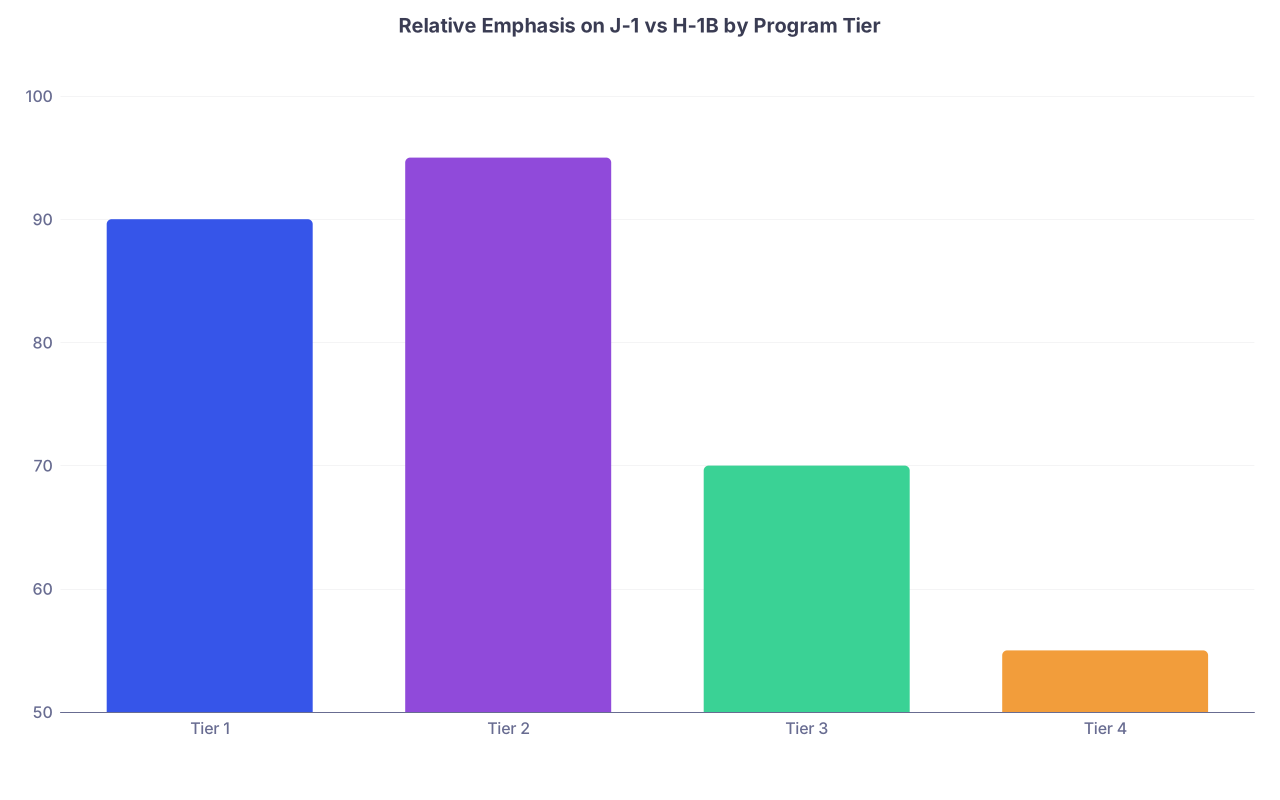
Here is what that looks like visually for priority decisions:
| Category | Value |
|---|---|
| Tier 1 | 90 |
| Tier 2 | 95 |
| Tier 3 | 70 |
| Tier 4 | 55 |
(Think of those numbers as “percent reliance on J‑1” – Tier 1 and 2 are heavily J‑1 focused; Tier 4 has the most meaningful split.)
If you are early in medical school or just starting exams, planning for Step 3 before application season can open Tier 3 and 4 doors that are simply closed to late Step‑3 takers.
How To Rapidly Tier a Program in Under 10 Minutes
You do not have time to deep-dive 150 programs. You need a triage process.
Here is a workflow that works, and I have seen applicants use it successfully:
Open three tabs per program:
- Program website “Applicants” or “How to Apply” page
- GME/Institutional visa policy page
- Current residents (or recent alumni) page
Scan for exact visa language.
- Does it explicitly say J‑1 only? J‑1 and H‑1B? Nothing?
- Is there any mention of Step 3 requirements for H‑1B? That is a good sign.
Count IMG names/schools.
- Total IMGs per class.
- Diversity of countries/schools.
- Any obvious U.S. citizen IMGs (Caribbean, etc.).
Place in a working tier:
- 0–1 IMGs and vague language → Tier 1 or Red Flag
- 3–8 IMGs per class and clear J‑1 language only → Tier 2
- J‑1 + H‑1B mentioned, a few IMGs on H‑1B → Tier 3
- Multiple H‑1B residents, explicit policy, high IMG volume → Tier 4
Adjust based on geography and competitiveness.
- New York, New Jersey, Texas: many high-volume IMG programs; tiers 2–4 are common.
- West Coast, major name-brand academic centers: may have IMGs but be extremely competitive, functioning more like Tier 3–4 for super-strong candidates only.
That 10-minute investment per program will save you thousands of dollars and a lot of emotional frustration.
Specialty Differences: Internal Medicine vs Everything Else
You cannot apply the same expectations to every specialty.
Internal Medicine, Family Medicine, Pediatrics, Psychiatry, Neurology
- Many Tier 2 and Tier 3 programs.
- J‑1 is common and widely accepted.
- H‑1B is available at a decent subset of mid- to large-size academic and community programs.
General Surgery, OB/GYN, EM, Anesthesia
- Far fewer IMG-friendly positions overall.
- Visa policies skew conservative.
- A program saying “we accept J‑1 only” in these specialties may still be effectively closed to IMGs in practice, because they rarely rank them highly.
Competitive specialties (Derm, Ortho, ENT, Plastics, Rad Onc, etc.)
- For most IMGs, visa tier analysis is almost irrelevant; the bottleneck is just getting ranked at all.
- Very rare H‑1B sponsorships for IMGs, almost always tied to exceptional profiles and deep pre-existing research ties.
In other words, an internal medicine J‑1 Tier 2 program is worlds apart from a surgery J‑1 program in the same city. Do not confuse visa permissiveness with actual IMG-friendliness.
Common Mistakes IMGs Make With Visa Tiers
I see the same errors every cycle:
Equating “we accept IMGs” with “we actively sponsor visas.”
- Those are not the same sentence. Look for explicit visa details, not diversity platitudes.
Assuming “we have sponsored H‑1B in the past” equals “we regularly do H‑1B now.”
- Policies change. New GME directors clamp down. Treat old statements as historical, not guaranteed.
Ignoring the Step 3 timing trap.
- Many H‑1B friendly institutions require Step 3 before rank list deadline.
- If you plan Step 3 after interview season, you may have already locked yourself out of Tier 3–4 H‑1B options.
Overweighting a single IMG success story.
- “My friend matched there on H‑1B” is not a policy. You need to know if that friend was the exception.
Underestimating J‑1 waiver flexibility.
- Plenty of physicians build stable U.S. careers via J‑1 + waiver jobs.
- Rejecting all J‑1 programs without understanding the actual waiver landscape is often shortsighted.
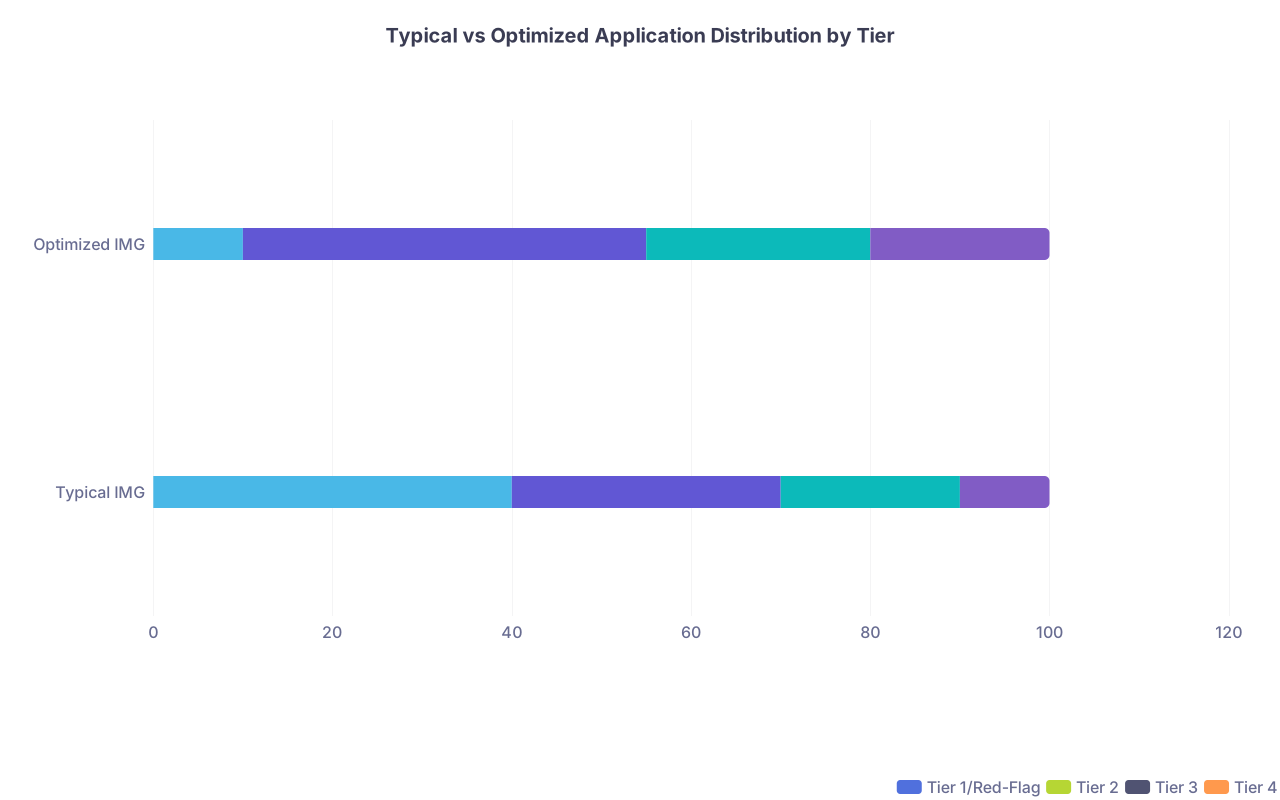
Here is roughly how applicants often end up splitting their applications without a strategy, versus a more rational distribution once tiers are understood:
| Category | Tier 1/Red-Flag | Tier 2 | Tier 3 | Tier 4 |
|---|---|---|---|---|
| Typical IMG | 40 | 30 | 20 | 10 |
| Optimized IMG | 10 | 45 | 25 | 20 |
Most people overapply to Tier 1 / ambiguous programs because they look nicer on paper (prestige, geography), and underapply to the Tier 2 workhorses that actually sponsor them.
Putting It All Together: A Practical Targeting Strategy
Let me give you a simplified, realistic scenario.
You are:
- Non‑U.S. IMG
- Step 2 CK 238, no failures
- 3 months U.S. clinical experience, 1–2 publications
- No Step 3 yet, but you could take it by December if you plan aggressively
- Applying in internal medicine
How do you use tiers?
Decide your visa flexibility honestly.
- If you are open to J‑1: Tier 2 becomes your foundation.
- If you strongly prefer H‑1B: you must plan for Step 3 early and lean into Tier 3–4.
Build your list something like:
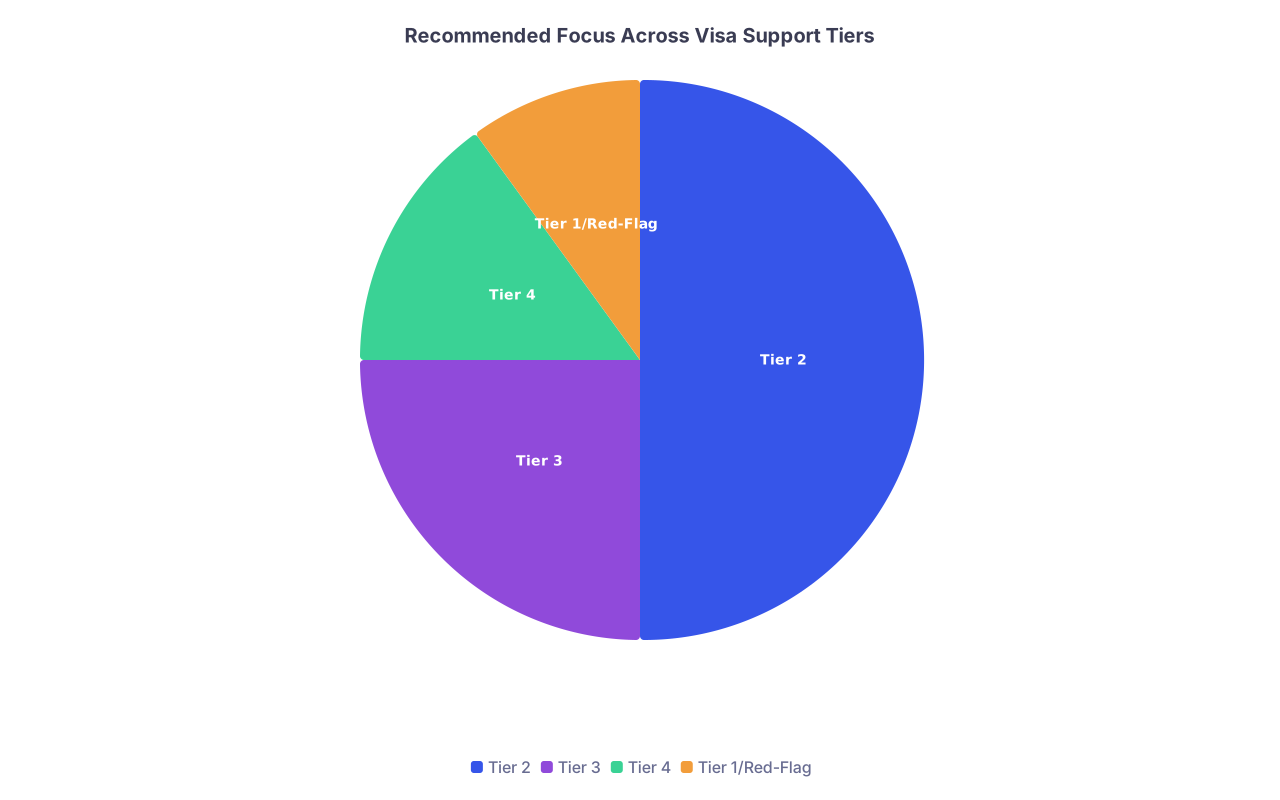
- 50–60% Tier 2 J‑1 heavy IMG programs (NY, NJ, MI, IL, TX, etc.)
- 20–30% Tier 3 programs that sponsor H‑1B selectively (if you can get Step 3 done)
- 10–20% Tier 4 robust H‑1B/J‑1 programs (larger academic centers known for IMGs)
- Max 10% Tier 1 / ambiguous “case-by-case” programs, mainly for geographic or prestige reasons
Use ERAS filters plus independent checking.
- ERAS “Sponsorship of visas” filter is crude. It does not differentiate Tier 2 vs 3 vs 4.
- You must manually verify using the 10-minute process I described earlier.
If you are late with Step 3, accept reality.
- Focus heavily on Tier 2 now.
- Take Step 3 earlier in PGY‑1 to open better chances for H‑1B in fellowship or job transitions.
To visualize a typical personal weighting, think of your application energy allocated roughly like this:
| Category | Value |
|---|---|
| Tier 2 | 50 |
| Tier 3 | 25 |
| Tier 4 | 15 |
| Tier 1/Red-Flag | 10 |
Final Thoughts
Three things I want you to walk away with:
- Visa wording on websites is not neutral; it encodes how much a program is actually willing to invest in you. Learn to read it like a second language.
- J‑1-only programs are not automatically bad, and H‑1B-sponsoring programs are not automatically safe. The tier is defined by consistency, volume of IMGs, and clarity of policy.
- If you match your own visa flexibility, exam timeline (especially Step 3), and specialty choice to the right tiers, you dramatically improve your odds without applying to 200 programs blindly.
If you want to go deeper, we can dissect a specific program list and tier it line by line. That exercise alone will change how you see “IMG-friendly” forever.