
It is January of your MS3 year. You are between wards, sneaking looks at a Google Sheet titled “Residency Options – Internal Medicine?” You have Step 1 done (maybe pass/fail, maybe a number), you still owe Step 2, and everyone on Reddit is yelling different things about “IMG‑friendly programs.” You are trying to answer one simple question:
When do I actually start targeting specific IMG‑friendly programs instead of just vaguely “preparing for residency”?
Here is the honest timeline. Month‑by‑month, then week‑by‑week when it matters. At each point: what you should do, what you can ignore, and when IMG‑friendly programs move from abstract concept to a concrete list in your spreadsheet.
Big Picture: The IMG Timeline from Early MS3 to Match Week
Before we go month by month, anchor the whole year.
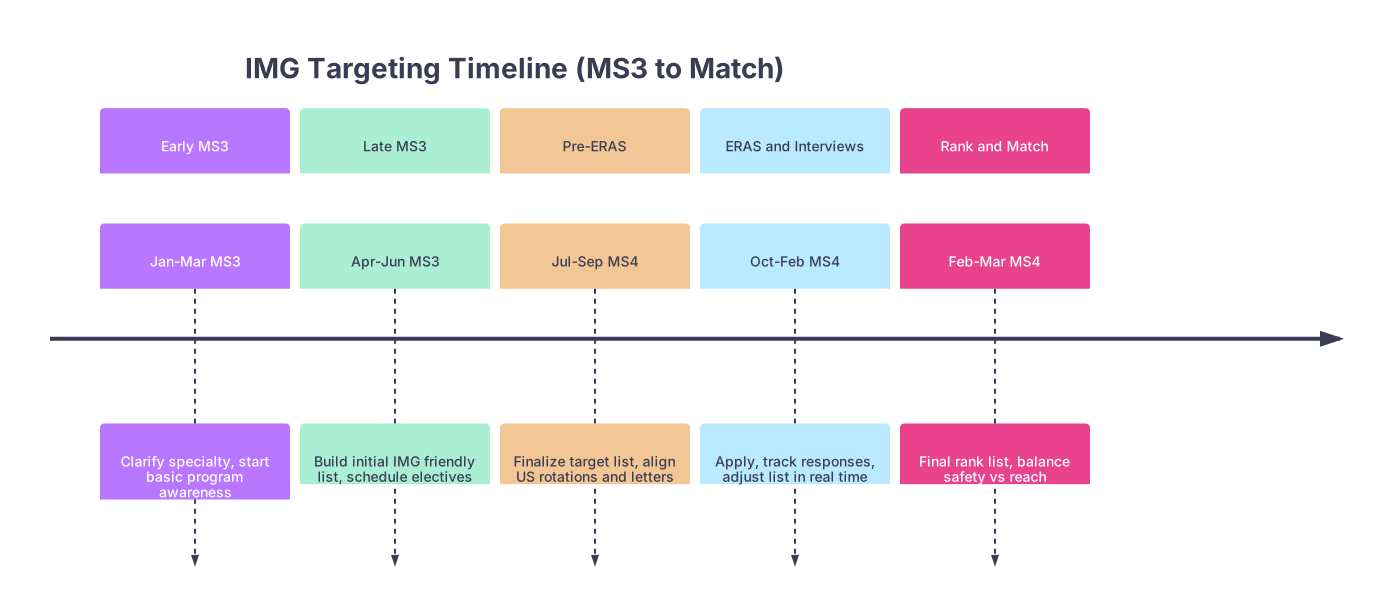
| Period | Event |
|---|---|
| Early MS3 - Jan-Mar MS3 | Clarify specialty, start basic program awareness |
| Late MS3 - Apr-Jun MS3 | Build initial IMG friendly list, schedule electives |
| Pre-ERAS - Jul-Sep MS4 | Finalize target list, align US rotations and letters |
| ERAS and Interviews - Oct-Feb MS4 | Apply, track responses, adjust list in real time |
| Rank and Match - Feb-Mar MS4 | Final rank list, balance safety vs reach |
For most IMGs, the critical shift is this:
- Early MS3: You are targeting a specialty, not programs.
- Late MS3: You start building a rough IMG‑friendly program universe.
- MS4 pre‑ERAS: You narrow to a prioritized target list.
- After ERAS opens: You use interview responses to refine that list in reality.
Early MS3 (Months 0–3): Foundation, Not Obsession
Assume MS3 starts in January for this guide. Adjust the months to your own calendar, but keep the sequence.
Month 0–1: Clarify Specialty and Basic Competitiveness
At this point you should:
Lock in your primary specialty
- Internal Medicine, Family Med, Psych, Peds, Path, etc.
- If you are an IMG dreaming of Derm, Ortho, or Plastics and you do not already have elite scores + heavy US research, you are gambling. Hard.
- I have watched IMGs waste a full cycle on “maybe I can” in ENT and then quietly reapply in IM a year later.
Get a blunt assessment of your profile
Have someone who understands IMGs in the US look at:- Step 1 (pass / score)
- Any Step 2 CK practice exams
- Any US clinical experience (USCE) or planned electives
- Graduation year (YOG)
- Visa needs (J‑1 vs H‑1B vs none)
Ask them directly: “Which specialties are realistic and which are fantasy?”
Start a simple tracking file
One Google Sheet. Columns for:- Program Name
- State
- Specialty
- IMG‑friendly? (Yes/Maybe/No)
- Visa policy (J‑1, H‑1B, None, Unclear)
- Step 1 policy (score vs P/F)
- Step 2 minimum
- Requires US LORs? (how many)
You will not fill this yet. You are building the structure.
What you should not be doing yet:
- You do not need a 200‑program list.
- You do not need to stalk every program coordinator.
- You definitely do not need to cold email PDs.
Month 2–3: Learn the Contours of “IMG‑Friendly”
At this point you should start understanding what makes a program truly IMG‑friendly, not just “has one IMG on the website.”
Look for these data points for your chosen specialty:
- Percentage of current residents who are IMGs.
- How many IMGs matched there in the last 2–3 years.
- Visa sponsorship patterns.
- Historical Step score thresholds (if available).
- Whether they explicitly state “no IMGs” or “no visas” (many do).
You are just learning patterns, not building your final list. To keep it structured:
| Signal | What You Want to See |
|---|---|
| Current IMG residents | Multiple per class |
| Visa status | J-1 clearly sponsored |
| H-1B for strong candidates | Optional but a plus |
| Application filter language | No "US grads only" line |
| Step 2 info (if published) | Clear but not extreme cutoffs |
Sources to use now:
- Program websites “Current Residents” pages
- NRMP Charting Outcomes + Program Director Survey
- Specialty‑specific IMG forums where people list where they matched
- True “IMG‑friendly lists” from reputable sources (not random Facebook rumors)
Your goal in these first 3 months is pattern recognition, not commitment.
Mid MS3 (Months 4–6): Start Building a Real IMG-Friendly Universe
This is when “IMG‑friendly programs” moves from fuzzy concept to an actual working list.
Month 4: Rough Program Universe (Target: 80–150 Programs)
At this point you should:
Lock your first‑pass specialty list
- Example: Primary – Internal Medicine. Backup – Family Med.
- Or: Primary – Psychiatry. Backup – Transitional + IM prelim (if you must).
Build a wide net for your primary specialty
Your first universe should probably be:- 80–120 IM programs, or
- 60–90 Psych/Peds/Path/Family Med programs
Criteria for adding a program to the sheet now:
- Has current IMGs in the resident list, or
- Reported as IMG‑friendly in the last 2 years by multiple credible match reports, or
- Explicitly states they accept IMGs and sponsor visas.
Tag programs as A/B/C tiers based on IMG friendliness
Tier A – Very IMG‑Friendly
- Many IMGs in each class
- Clear J‑1 sponsorship
- Known to take fresh grads with average scores
Tier B – Selective but open to IMGs
- Some IMGs, often with stronger profiles
- Maybe require US LORs, USCE, or higher Step 2
Tier C – Long shot but not impossible
- Few IMGs, but at least one in past 3–5 years
- Visa policy less clear or stricter
This tiering will matter later when you are deciding how many applications to send.
Month 5–6: Align Rotations and Electives With Friendly Programs
This is where targeting becomes strategic.
At this point you should:
Plan US clinical rotations with targeting in mind
- Visiting electives or observerships at Tier A or strong Tier B programs first.
- If you cannot get into those, choose hospitals in the same geographic area. PDs like “regional ties.”
Map rotations to letter‑of‑recommendation (LOR) needs
Look at your sheet and note how many programs want:- 2–3 US clinical LORs
- 1–2 specialty‑specific LORs
Then schedule rotations that will give you those letters from IMG‑friendly sites.
Start a short “Dream but real” list (10–20 programs)
These are not Harvard‑Mass General‑Hopkins fantasies.
These are programs where:- Your stats are at or slightly above their IMG average.
- You like the location.
- They clearly accept IMGs and sponsor your visa type.
You are not finalizing yet. You are aligning your experiences so that when you apply, your CV talks directly to programs that might actually read it.
Late MS3 to Early MS4 (Months 7–9): Convert Data into a Target List
This is the phase where most IMGs are either late or chaotic. You will not be.
Assume ERAS submission is in September. Count backwards.
Month 7 (About 2–3 Months Before ERAS Opens): Hard Reality Check
At this point you should:
- Have your Step 2 CK test date booked
Ideally:- Take Step 2 by June–July.
- Get your score back before or very close to ERAS opening.
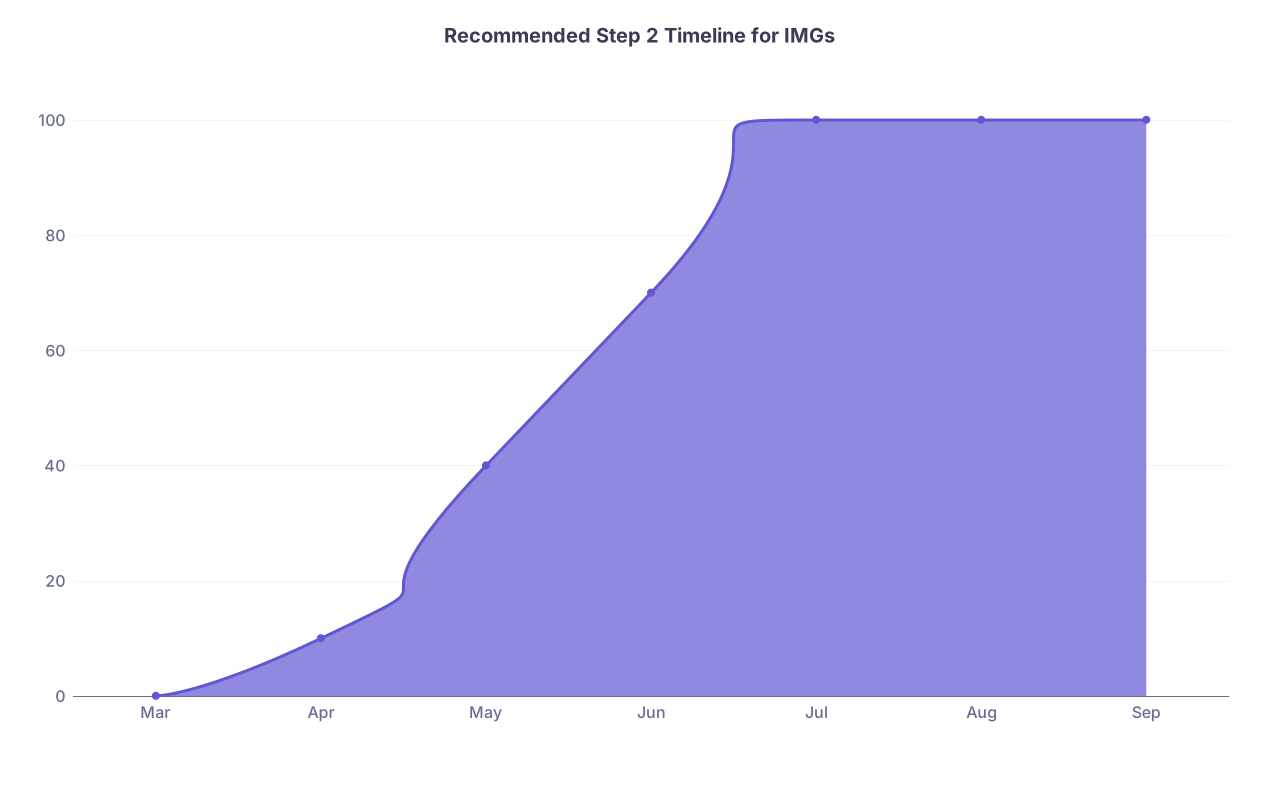
| Category | Value |
|---|---|
| Mar | 0 |
| Apr | 10 |
| May | 40 |
| Jun | 70 |
| Jul | 100 |
| Aug | 100 |
| Sep | 100 |
(Values = % of content review completed. You want to peak well before ERAS.)
Re‑tier your universe based on your final stats
You now know:- Step 1 result (pass/score)
- Step 2 result or NBME range
- Actual USCE completed
- Final YOG (how old you are at application)
Now go through your spreadsheet and:
- Move some Tier B programs to Tier C if your numbers are below their usual range.
- Move some Tier C programs to “delete” if they explicitly require something you do not have (e.g., no visa sponsorship, US grad only, YOG ≤ 2 years).
Narrow your “targetable” programs to a realistic number
For IMGs in competitive but reasonable specialties, here is what I usually see work:
| Profile Strength | Primary Specialty Apps | Backup Apps |
|---|---|---|
| Strong IMG (high Step 2, recent YOG, USCE) | 80–120 | 0–20 |
| Average IMG | 120–160 | 20–40 |
| Weak IMG (older YOG / low Step) | 160–220 | 40–60 |
Your “target list” now becomes:
- Core list: 60–100 programs where you are fully within range and they are clearly IMG‑friendly.
- Stretch list: 20–40 where you are slightly below average or they are less IMG‑dense but still possible.
- Backup specialty list: Optional depending on risk tolerance.
Month 8–9: Final Targeting Before ERAS Submission
At this point you should start doing the detail work program by program.
- Convert your sheet into an ERAS‑ready action grid
For each program (especially your Core list), add:
- Application priority (High/Medium/Low)
- Any program‑specific requirements (e.g., “upload Step 2 by Oct 1,” “3 LORs from IM”)
- Notes on what to mention in your personal statement or supplemental (e.g., “rural interest,” “strong research,” “underserved care”)
- Identify true “no‑go” programs and delete them
This is where many IMGs sabotage themselves by wasting money and hope.
Immediate delete if:
- Website says “No IMGs” or “No visa sponsorship” and multiple recent reports confirm that.
- Programs that explicitly require US grads for categorical spots.
- Step 2 minimums you absolutely do not meet, with no sign of exceptions.
- Draft program‑clustered personal statement variants
You do not need 100 personal statements. You do need 2–3 variants aligned with clusters of IMG‑friendly programs:
- Variant A – Academic‑leaning / research‑friendly IM programs
- Variant B – Community‑based, clinical heavy programs
- Variant C – Rural / underserved focused
You will not mention program names, but you will tailor focus and tone so that IMG‑friendly programs see a fit.
ERAS Open to Submission (Weeks –4 to 0): Week‑by‑Week Targeting
Now we zoom into weeks.
4–3 Weeks Before ERAS Submission
At this point you should:
- Have your Core program list locked.
- Still be adjusting the Stretch list depending on last‑minute info (like new visa policies).
Tasks:
Double‑check IMG and visa policies one last time
Programs change. A lot. I have seen a program go from “J‑1 sponsored” to “US grads only” in one year.Email or call coordinators only if truly unclear
Ask specific questions, not “Do you accept IMGs?”
Try: “Do you sponsor J‑1 visas for categorical residents?” or “Does your program consider IMGs from non‑US schools with 2020 YOG?”
Then update your sheet immediately.Assign each program a submission day priority
ERAS does not reward micro‑timing, but you should still:- Submit all High priority programs on Day 1.
- Submit Medium and Low over the first 3–5 days if you need more time for fees.
2 Weeks Before ERAS Submission
At this point you should:
- Finalize your LOR strategy per program type
- Academic / research‑heavy IMGs: emphasize your best academic letter for Tier B / C programs.
- Purely clinical letters for highly IMG‑friendly community programs.
- Different combinations saved in ERAS and assigned logically.
- Review your geographic spread
Look at your sheet’s state column:
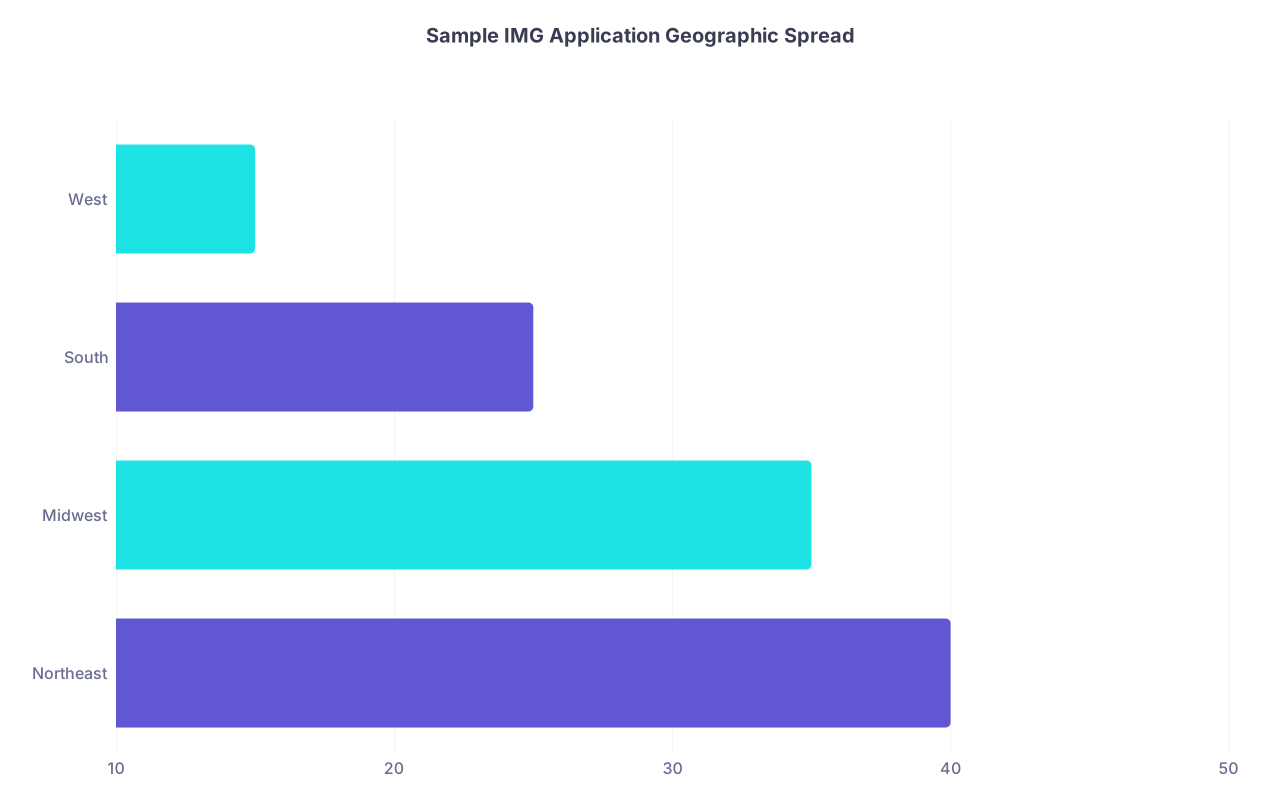
| Category | Value |
|---|---|
| Northeast | 40 |
| Midwest | 35 |
| South | 25 |
| West | 15 |
You want:
- Heavy weighting toward regions and states known to be more IMG‑friendly (Northeast, some Midwest, certain Southern community programs).
- Less focus on hyper‑competitive coastal academic hubs that barely touch IMGs.
ERAS Submission Week
At this point you should:
- Submit to all Core programs on Day 1.
- Submit to most Stretch and Backup within the first 3–4 days.
Do not overthink adding or removing two or three programs the night before. Your real leverage was in the previous 6–9 months of structured targeting.
Interview Season (Months 10–14): Real‑Time Adjustment of Targeting
This is the part few people talk about clearly. Once invites start:
Early Invites (First 4–6 Weeks)
At this point you should:
- Track where interviews actually appear
Update your sheet with:
- II (interview invite)
- R (rejection)
- Silence (no response yet)
Patterns you want to catch:
- Zero interest from all your Tier B/C stretch but reasonable interest from Tier A community programs.
- Geographic clusters (e.g., multiple invites from Ohio / Pennsylvania, nothing from California).
- Consider “top‑off” applications if your invitations are low
If by mid‑October you have very few interviews (for IM/psych/FP, less than 3–4), you should:
- Add 20–40 more highly IMG‑friendly community programs.
- Focus on states well known for IMGs and J‑1s (New York community hospitals, some Michigan/Ohio/Pennsylvania programs, certain Texas community IM programs if they clearly state J‑1).
Do not add more academic long‑shot programs. They have already screened you out.
Mid to Late Interview Season
Your targeting job now:
- Show up prepared with specific knowledge about each IMG‑friendly program:
- Mention their patient population, safety‑net mission, or known strengths.
- Reference that you value their history of training international graduates.
- Keep logging every interaction in your sheet (good fit, bad vibe, visa clarity).
Rank List Phase (Final 4–6 Weeks): Converting Targeting into a Safe Rank Order
Now your list shifts from “where could I apply” to “where would I be willing to train.”
At this point you should:
Re‑score programs based on:
- Real interview experience
- Visa reliability
- Resident satisfaction (what you heard off‑zoom)
- Support for IMGs (mentoring, board prep, fellowship placements)
Build your final rank list with brutal honesty
For IMGs in primary‑care type specialties:
- You need all real interview programs on your rank list unless:
- They clearly cannot sponsor your needed visa, or
- They are truly unsafe training environments (and I mean truly unsafe, not just “ugly hospital”).
- Avoid the “only rank places I love” trap
I have seen IMGs go unmatched because they ranked 6–8 “favorite” programs and left 5 more “OK but not perfect” places off. That is poor risk management.
FAQs
1. When is the latest an IMG should start seriously targeting IMG‑friendly programs?
If you are waiting until right before ERAS opens to figure out your IMG‑friendly list, you are late. The real work starts 6–9 months before submission. You can still scramble together a list in August, but you will not have aligned your rotations, letters, and Step 2 timing to those targets. That misalignment is exactly why many IMGs with decent scores still get only 1–2 interviews.
2. How do I know if a program is truly IMG‑friendly versus just having one token IMG?
Two quick tests. First, count: are there multiple IMGs per class over several years, or just one random person from 2016? Second, check patterns from recent match cycles in IMG communities: do multiple people report interviews / matches there, or is it just listed on old “IMG‑friendly lists” without confirmation? When in doubt, prioritize programs with consistent IMG representation, clearly stated J‑1 sponsorship, and recent positive reports from applicants like you.
Today’s next step: open a blank spreadsheet and create columns for Program, State, IMG‑Friendly Tier (A/B/C), Visa Policy, and Current IMG Residents. Add just five programs you already know are IMG‑friendly and fill in those fields. That is your starting grid.