The biggest mistake IMGs make in the last 30 days before the rank list deadline is trusting vague promises instead of verified visa and support policies.
You cannot afford that.
You’re in the phase where a single poorly researched line on your rank order list can cost you a visa, a paycheck, and a future. So in these final 30 days, your job is brutally simple: verify, not assume.
I’ll walk you through this like a countdown clock—week by week, then day by day in the last stretch—so by the time you hit “Certify,” you know exactly where you can legally work, how you’ll be sponsored, and how you’ll be supported as an IMG.
Overview: Your 30‑Day Mission
At this point you should stop thinking like “an applicant” and start thinking like “a risk manager with a stethoscope.”
Your core questions for each program on your rank list:
- Will they actually sponsor my visa category (this year)?
- Do they have a track record of matching and graduating IMGs?
- What structured support exists for licensing, onboarding, and transition?
- What’s written down vs what someone casually told you on interview day?
Think in four lanes:
- Visa feasibility – J‑1 vs H‑1B vs “no sponsorship”
- Policy confirmation – what’s in writing and from whom
- Historical IMG‑friendliness – not one token IMG, but a pattern
- Support systems – orientation, mentorship, exam prep, wellness
Here’s what your month should look like.
Days 1–7: Build Your “Visa Reality” Board
At this point you should stop relying on your memory of interviews and start building a hard, shareable document.
Step 1 (Day 1–2): Make a Master Program–Visa Table
Create a spreadsheet or document with columns like:
- Program name
- ACGME ID
- State
- Sponsorship type: J‑1 / H‑1B / Both / None
- H‑1B requirements: Step 3? Minimum scores? USMLE attempts?
- Minimum scores (unofficial but real)
- IMG percentage in current residents
- Last confirmed source (website, email from coordinator, FREIDA, etc.)
- Date you last verified
Then start filling it.
Where to pull data from on Days 1–2:
- FREIDA and official program websites
- Last year’s program PDFs / recruitment brochures
- Your saved interview day materials
- WhatsApp/Telegram groups with current residents (but never treat this as final proof)
| Program | Visa Types | H-1B Step 3 Required | IMG % in Residents |
|---|---|---|---|
| Program A | J-1 only | N/A | 45% |
| Program B | J-1 & H-1B | Yes | 30% |
| Program C | No sponsorship | N/A | 0% |
| Program D | J-1 only | N/A | 60% |
| Program E | J-1 & H-1B | No | 50% |
If your list is long (30+ programs), prioritize:
- Programs you’re strongly considering in your top 10
- Programs with unclear or conflicting visa info
- Programs in states with stricter licensing rules (e.g., certain states with fixed Step attempt limits)
Step 2 (Day 3–4): Separate “Visa Fantasy” from “Visa Reality”
By Day 3, every program on your spreadsheet should be labeled as one of:
- Green – Written, current, explicit visa policy that matches your needs
- Yellow – Information exists, but is old, vague, or secondhand
- Red – No sponsorship or policies conflict with your situation
Be ruthless. “We’ve sponsored in the past” is a yellow flag, not green. “We will sponsor H‑1B if possible” is yellow leaning red unless clearly spelled out.
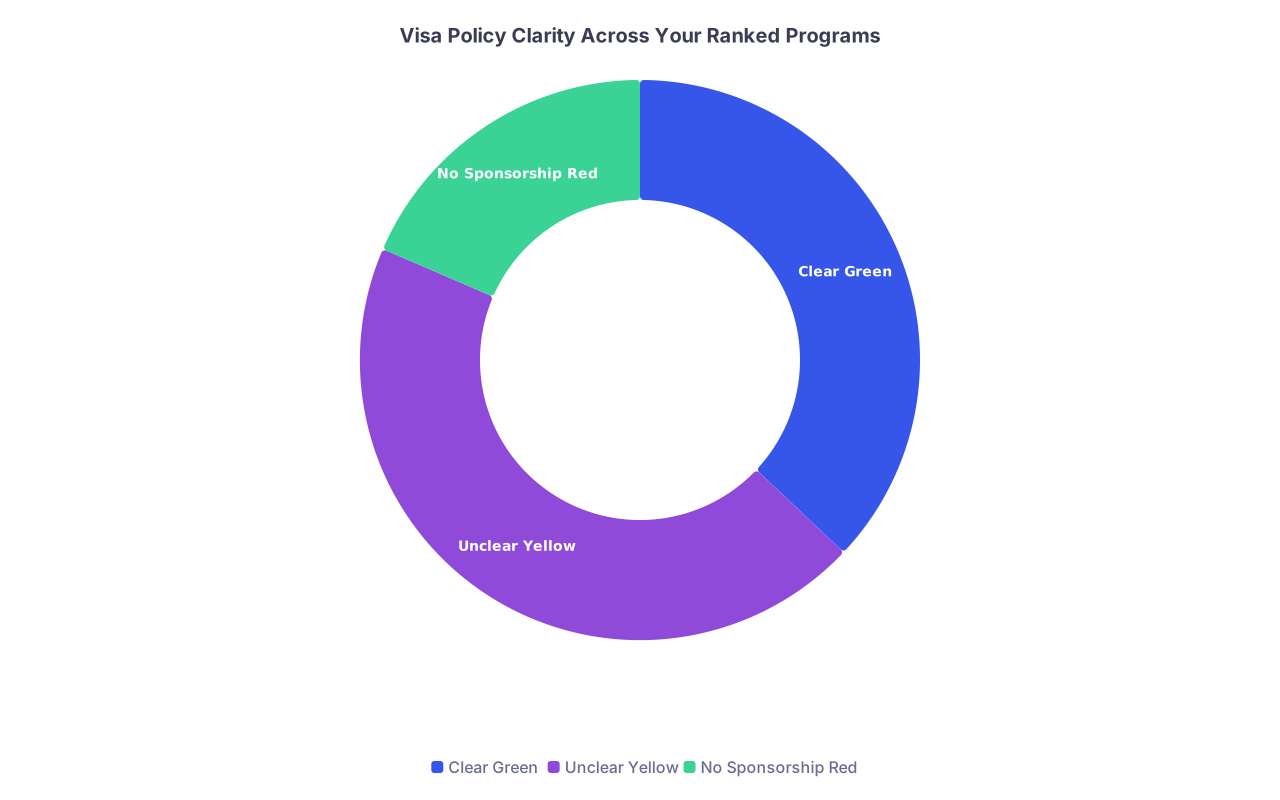
| Category | Value |
|---|---|
| Clear Green | 10 |
| Unclear Yellow | 12 |
| No Sponsorship Red | 5 |
Step 3 (Day 5–7): First Contact Round – Clarify Yellow Programs
At this point you should start contacting programs, but in a controlled, professional way.
Template for email to the program coordinator (not the PD first):
Subject: Clarification of Visa Sponsorship Policy for 2025–2026 Match
Dear [Coordinator Name],
I am an applicant to your [Specialty] residency program and am in the process of finalizing my rank order list. I’m an international medical graduate requiring [J‑1 / H‑1B] visa sponsorship.
Could you please confirm your current policy for the 2025–2026 cycle regarding:
– Visa types sponsored (J‑1, H‑1B, or both)
– Any specific requirements for H‑1B sponsorship (USMLE Step 3, score thresholds, attempt limits)I greatly appreciate your time and help as I finalize my list.
Best regards,
[Full name, AAMC/NRMP ID]
Batch these emails over Days 5–7. Track responses in your spreadsheet.
Do not send daily follow‑ups. One polite follow‑up after 5–7 days is enough.
Days 8–14: Verify IMG Support and Real IMG‑Friendliness
By the second week, visa data should be mostly in place. Now you shift to: “If I match here, what is my life actually going to look like?”
Step 4 (Day 8–9): Analyze Resident Rosters and Graduates
At this point you should be digging deeper than “they have some IMGs.”
Check:
- Program’s “Current Residents” page – count IMGs vs AMGs
- Class diversity – are IMGs spread over multiple years or just one year?
- LinkedIn profiles of residents – see who’s on J‑1 vs H‑1B, where they’re from
- Alumni – do IMGs actually graduate and go into fellowships/jobs with waivers?
Programs that are actually IMG‑friendly:
- IMG percentage is stable across PGY1–PGY3/4/5
- IMGs are chiefs, not only interns
- Fellowship placements include noncitizen IMGs
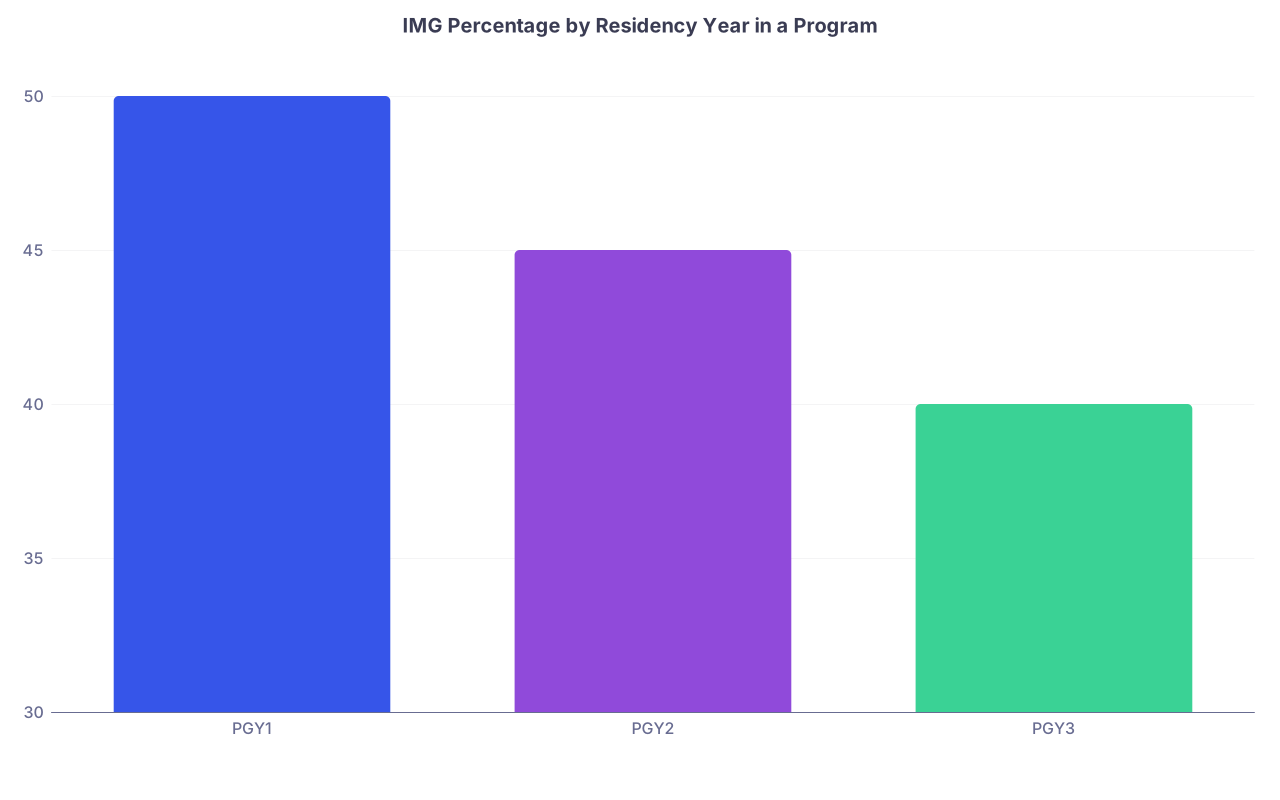
| Category | Value |
|---|---|
| PGY1 | 50 |
| PGY2 | 45 |
| PGY3 | 40 |
If you see 1 lonely IMG in PGY1 and none above that, that’s not “friendly.” That’s “accidental.”
Step 5 (Day 10–11): Ask Residents Targeted Questions
Now is the time to ping residents you met on interview day or via social media.
Do not send a vague “Can you tell me about your program?” message. That’s noise. Instead, focus on 4–5 sharp questions:
- Have there been any recent changes in visa sponsorship at your program?
- How many current residents are on J‑1 vs H‑1B?
- Does the program provide structured support for Step 3 and state licensing?
- Are there formal orientation or mentorship systems for IMGs?
- Any recent IMGs unable to continue due to visa or licensing issues?
You’ll be surprised what comes out:
- “They used to do H‑1B but stopped last year.”
- “Several IMGs had to scramble to find Conrad 30 waivers with no program support.”
- “They say they’re supportive, but you’re on your own for state license documents.”
Log these responses with dates and names (just for your own reference).
Step 6 (Day 12–14): Formalize Your “Support Score” for Each Program
At this point you should assign each program a simple 1–5 “IMG Support Score” based on:
- Visa clarity (current, written policies)
- IMG representation in residency
- Administrative support (visa office, GME office responsiveness)
- Academic support (USMLE/board prep, remediation, mentorship)
- Cultural and logistical support (orientation, housing help, spouse/children support)
| Program | Visa Clarity (1-5) | IMG Representation (1-5) | Overall Support Score |
|---|---|---|---|
| A | 5 | 4 | 9 |
| B | 3 | 3 | 6 |
| C | 1 | 1 | 2 |
| D | 4 | 5 | 9 |
| E | 2 | 4 | 6 |
This doesn’t have to be perfect. But forcing yourself to score each program prevents you from ranking purely on “nice interview, good food, friendly PD.”
Days 15–21: Resolve Conflicts and Edge Cases
By the third week, your main work is cleaning up contradictions and making decisions under uncertainty.
Step 7 (Day 15–17): Handle Mixed or Conflicting Visa Messages
You’ll run into this situation:
- Website says “J‑1 only”
- Resident says “We have H‑1Bs”
- Coordinator says “We’ve done H‑1B in the past, case by case”
At this point you should escalate politely but firmly.
Email the coordinator again, more specific this time:
Dear [Name],
Thank you again for your help. I wanted to clarify one point as I finalize my rank list.
I’ve seen that your website states J‑1 sponsorship, and I’ve also heard that some residents are on H‑1B. For the upcoming 2025–2026 cycle, should I consider your program as J‑1 only, or is H‑1B sponsorship still a realistic option for new incoming residents?
I understand this may depend on institutional decisions; I just want to be sure I do not rank your program with incorrect expectations.
Sincerely,
[Your Name]
If the response is vague (“depends on institution,” “we will see what we can do”), treat the program as J‑1 only for ranking purposes unless you already have Step 3 done and meet all H‑1B criteria.
Do not rank based on wishful thinking.
Step 8 (Day 18–19): Cross‑Check with State Licensing Rules
Visa is only half the story. Some states are quietly brutal with IMGs.
You should at this point:
- Check the state medical board website for each program’s state
- Confirm IMG‑specific rules:
– Minimum weeks/months of clinical training
– Max number of USMLE attempts
– Time limits between Step exams
– Whether Step 3 is required for a training license

| Step | Description |
|---|---|
| Step 1 | Identify Program State |
| Step 2 | Check State Medical Board |
| Step 3 | Confirm Attempts and Time Limits |
| Step 4 | Standard Requirements |
| Step 5 | Compare With Your Profile |
| Step 6 | Adjust Program Rank if Needed |
| Step 7 | IMG Requirements? |
If your attempt history or exam timing conflicts with a state’s rules, it does not matter how IMG‑friendly the program is. That state’s license board can block you.
Mark those programs clearly. If there’s any doubt, email the GME office and ask if any current residents have matched with your number of attempts or timeline.
Step 9 (Day 20–21): Draft Your Provisional Rank List
At this point you should be able to create your first serious draft of your rank order list.
Sort programs by:
- Places you’d be happy to train
- Among those, where your visa + licensing picture is cleanest
- Among those, where IMG support is strongest
Key rule:
Never rank a program higher just because it offers H‑1B if:
- They have poor IMG support
- Visa info is shaky
- You’d be miserable living there
A supported, J‑1 friendly program where IMGs thrive beats a risky H‑1B slot that might never materialize.
Days 22–27: Tightening, Confirming, Eliminating
These days are for final checks and cutting dead weight.
Step 10 (Day 22–24): Second Contact Round for Unanswered Programs
If some programs never replied to your first message, now is the final follow‑up window.
Short, direct:
Dear [Name],
I’m finalizing my rank list this week and wanted to follow up on my previous email regarding your visa sponsorship policies for IMGs.
I would be very grateful for any clarification regarding J‑1 and H‑1B sponsorship for incoming residents this year.
Thank you again for your time,
[Your Name]
If they still do not reply, interpret that silence. Programs that cannot be bothered to answer simple, time‑sensitive questions about visas are unlikely to be stellar at supporting you once you’re there.
Step 11 (Day 25–26): Identify Programs You Should Drop Lower or Remove
At this point you should face some hard calls:
Drop a program down the list (but keep it) if:
- Visa policy is J‑1 only but very clear and consistent
- IMG support is moderate, not great
- Location or training is good, but not worth top 5
Consider removing or bottom‑ranking a program if:
- No visa sponsorship for your situation
- Conflicting policies with no resolution
- State licensing rules clearly conflict with your exam history
- Repeated stories from IMGs of poor administrative or visa support
Do not keep a program high “just in case” if the visa risk is obvious. If the algorithm matches you there and they cannot sponsor you, you’re stuck.
Step 12 (Day 27): Sanity Check with Someone Experienced
By now you should have:
- A nearly final rank list
- A spreadsheet with visa/support data and notes
Run it by:
- A trusted senior resident (IMG if possible)
- An advisor familiar with IMG issues
- A friend who matched as an IMG in the last 1–2 years
Ask them specifically:
- “Do any of these programs look risky from a visa/support perspective?”
- “Am I over‑ or under‑valuing H‑1B vs J‑1 here?”
- “If you were me, would you move any program up or down for IMG reasons alone?”
You’re not asking them to choose for you, just to flag blind spots.
Days 28–30: Final 72 Hours – Locking and Certifying
Now we zoom in. Hour by hour mindset.
Day 28: Final Cross‑Check and Documentation
At this point you should:
- Go through your ranked programs one by one
- For each, confirm you have:
- Visa type(s) and exact wording
- A date of confirmation
- At least one tangible sign of IMG‑friendliness
- No obvious licensing conflict
Keep a short document or folder with:
- Screenshots/PDFs of program visa web pages
- Key email confirmations (saved as PDFs)
- Your spreadsheet
If anything feels like a gut‑level red flag, pause and reconsider.
Day 29: Freeze the List, Sleep on It
On Day 29 you should:
- Enter your rank list into NRMP (if you haven’t already)
- Arrange programs only by your true preference now, assuming you’ve removed impossible options
- Then stop touching it for at least 12–24 hours
You’re more likely to harm your list with last‑minute panic than help it.
Ask yourself for each of your top 5–8:
- “If I match here, do I clearly understand my visa path?”
- “Do IMGs like me actually succeed here?”
- “Could I explain to a friend why this program is above the one below it?”
If you cannot answer those, you’re ranking on vibes, not reality.

Day 30: The Certification Day Checklist
On the final day, your process should be mechanical:
- Re‑open your spreadsheet and your NRMP list side by side.
- For each program in your top 10–15:
- Confirm visa category you’re expecting (say it out loud if you have to)
- Confirm there’s no deal‑breaking licensing issue
- Confirm there is at least minimal IMG structure/support
- Ask yourself one brutal question:
- “If I matched here, would I be surprised by the visa situation?”
If the answer is yes → fix it or move it.
- “If I matched here, would I be surprised by the visa situation?”
Only then hit “Certify.”
Take a screenshot of your final certified list. Then walk away. No edits after that.
Quick Visual: Your 30‑Day Verification Timeline

| Period | Event |
|---|---|
| Week 1 - Days 1-2 | Build visa spreadsheet |
| Week 1 - Days 3-4 | Color code programs by visa clarity |
| Week 1 - Days 5-7 | First email round to coordinators |
| Week 2 - Days 8-9 | Analyze rosters and IMG presence |
| Week 2 - Days 10-11 | Message residents for inside info |
| Week 2 - Days 12-14 | Assign IMG support scores |
| Week 3 - Days 15-17 | Resolve conflicting visa info |
| Week 3 - Days 18-19 | Check state licensing rules |
| Week 3 - Day 20-21 | Draft provisional rank list |
| Week 4 - Days 22-24 | Second follow up to silent programs |
| Week 4 - Days 25-26 | Drop or lower risky programs |
| Week 4 - Day 27 | Get outside sanity check |
| Week 4 - Day 28 | Final policy cross-check |
| Week 4 - Day 29 | Freeze list and sleep on it |
| Week 4 - Day 30 | Certify final list |
FAQ (Exactly 2 Questions)
1. Should I ever rank a program that doesn’t sponsor my required visa type?
If a program explicitly states they do not sponsor your required visa (e.g., they’re J‑1 only and you must have H‑1B, or they offer no sponsorship at all), you should treat that program as non‑viable and either remove it or push it to the very bottom as a purely theoretical option. The match algorithm doesn’t care about visa feasibility. It will match you there if your preferences and theirs align. Then you’re scrambling with no realistic path forward. Rank only programs where visa plus licensing is at least plausible and confirmed, not hypothetical.
2. Is it smarter for IMGs to chase H‑1B programs over J‑1?
Chasing H‑1B at the expense of everything else is a common IMG trap. H‑1B can be great if: you already have Step 3, your scores and attempt history are strong, the program has a proven H‑1B track record, and the rest of the environment is solid. But a stable, supportive J‑1‑friendly program where IMGs consistently graduate, pass boards, and get waivers often beats a shaky H‑1B promise from a program that barely understands immigration. Your priority order should be: 1) training quality and well‑being, 2) realistic visa path (J‑1 or H‑1B, not fantasy), 3) long‑term plans. Not the other way around.
Open your rank list and your spreadsheet right now. For your top 5 programs, add one column: “Exact visa type I am expecting here and how I know.” If you can’t fill that in clearly for any of them, that’s where you start today.