
Most IMGs waste the first 90 days of residency reacting. Friendly programs expect you to use them to quietly build power.
You are not just surviving orientation. You are positioning yourself for evaluations, visas, fellowships, and long‑term credibility. The programs that are truly IMG‑friendly will give you opportunities—if you hit the right tasks at the right time.
I’ll walk you through it in strict timeline form: pre‑arrival, week‑by‑week, then day‑by‑day for the truly critical windows.
0–30 Days Before Start Date: Pre‑Arrival Setup
At this point you should be building the foundation so day 1 is paperwork‑light and clinical‑heavy.
Core goals this month:
- Lock down all immigration and HR requirements
- Understand the program culture and IMG expectations
- Pre‑load your documentation and tech
Weeks −4 to −3: Visa, License, and HR
If you’re an IMG, this window can make or break your first month.
This week you should:
- Finalize visa details
- Confirm with GME office: J‑1 vs H‑1B, start date, SEVIS updates
- Ask explicitly: “Is there anything still pending on my visa or DS‑2019/I‑797?”
- State license / training permit
- Verify your application is complete, all documents received
- Track: medical school transcripts, ECFMG certificate, USMLE/COMLEX scores
- Occupational health
- Upload immunization records (MMR, Varicella, Hep B, TB, COVID)
- Schedule any titers or vaccines you’re missing
- Background checks and drug screen
- Do these immediately; delays here can delay your start
- Banking and pay
- Set up a US bank account if you do not have one
- Confirm direct deposit forms are correctly submitted
Friendly IMG programs usually have a coordinator spelling all this out. Use them. Email or call once and get a checklist; do not piece this together from random messages.
Week −2: Tech, Systems, and Expectations
Now you shift from visas to actual work logistics.
Tasks for this week:
- Get logins for:
- EMR (Epic, Cerner, etc.)
- Learning portals, duty hour systems (MedHub, New Innovations)
- Ask for:
- Sample admission notes and H&P templates
- Example sign‑out format used on your main inpatient service
- Clarify expectations for IMGs specifically:
- Ask your chief:
- “What’s the most common challenge IMGs have here in the first 3 months?”
- “What does a strong intern look like to attendings on day 30?”
- Ask your chief:
This is where IMG‑friendly programs stand out—they answer these questions clearly and without attitude. If they give you specifics, write them down. That becomes your target.
Week −1: Light Prep, Heavy Orientation to Culture
Do not cram clinical knowledge this week. You’ll learn more in 48 hours on the wards than in 2 weeks of random reading.
Instead, this week you should:
- Review only what you’ll use daily:
- Writing admission orders (DVT prophylaxis, code status, insulin)
- Common inpatient problems: chest pain, dyspnea, sepsis, AKI
- Watch US‑focused communication videos:
- How to discuss goals of care
- How to present on rounds (SOAP, one‑liner style)
- Logistics:
- Confirm your arrival time and location for orientation day
- Pack original documents:
- Passport
- Visa/DS‑2019/I‑797
- ECFMG certificate
- Degree if requested
At this point, your only job is to walk into orientation with nothing “pending” or “still missing” in HR or licensing.
Days 1–7: Orientation and Survival Mode
This week sets your reputation. Friendly programs are watching for which IMGs ask for help early versus which silently drown.
Day 1–2: Hospital Orientation
These first two days you should:
- Get physical access:
- ID badge (test it on call rooms and units)
- Scrub access
- Parking or transit passes
- Confirm who owns your immigration file:
- Name and email of the GME or institutional officer managing your visa
- Ask: “Who should I notify if I need to travel or renew anything?”
- EMR basics:
- Learn exactly how to:
- Place orders
- Pend orders for cosign
- Write and sign notes
- Review imaging and labs
- Message nurses through EMR or pager
- Learn exactly how to:
Take notes. Not on your phone (it looks like you’re texting). Use a small notebook; everyone in residency understands that.
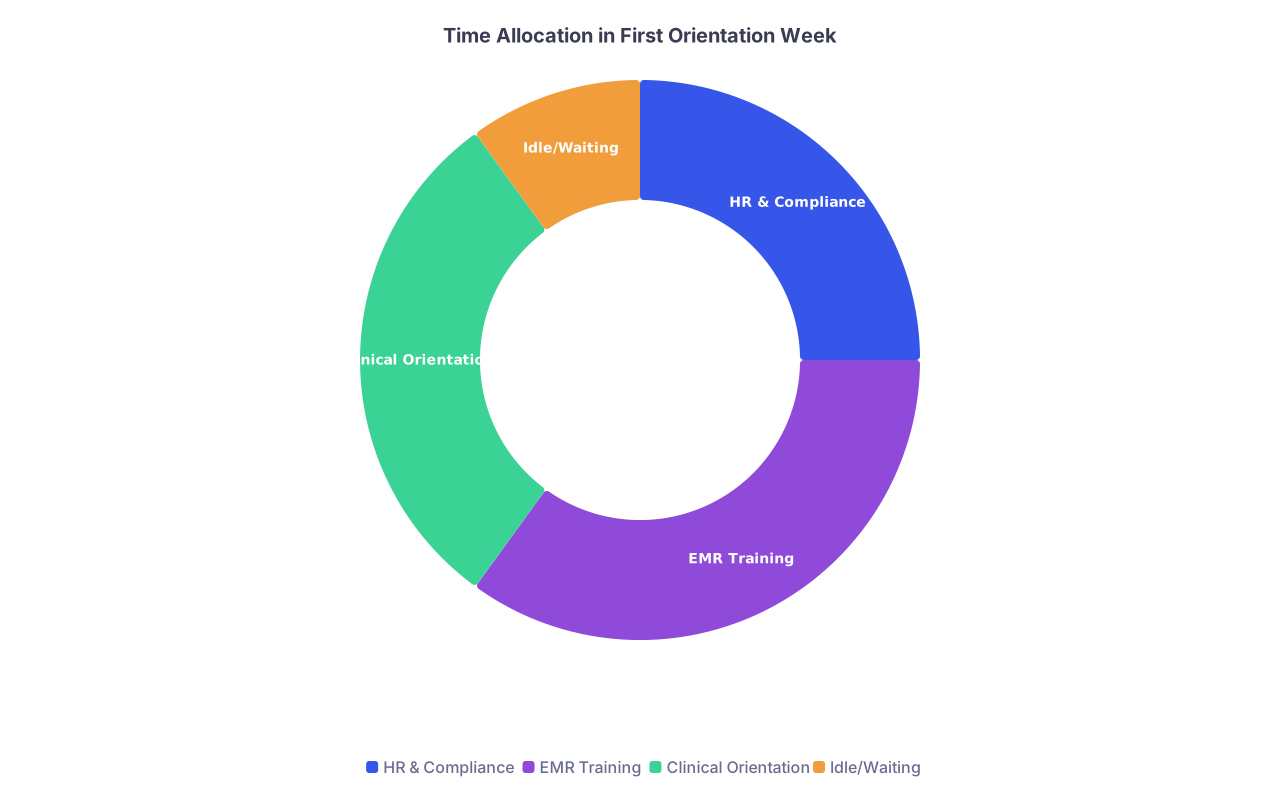
| Category | Value |
|---|---|
| HR & Compliance | 25 |
| EMR Training | 35 |
| Clinical Orientation | 30 |
| Idle/Waiting | 10 |
Day 3–4: Program and IMG‑Specific Orientation
Here’s where IMG‑friendly features show up.
You should look for and actively use:
- Assigned faculty advisor or mentor
- IMG cohort meetings or WhatsApp group
- Sessions on:
- US documentation standards (billing, coding, compliance)
- Cultural norms in patient communication
- Clarify evaluation mechanics:
- How often are evaluations done?
- Who fills them out?
- What gets you labeled as “struggling” in month 1?
Write down 2–3 priorities your PD/chief keeps repeating. Examples I’ve seen:
- “Close the loop on every result”
- “Never hide mistakes”
- “Always update the family daily”
These are cheat codes for your behavior in the first 90 days.
Day 5–7: Shadow and Soft Start
By now, you may start shadow shifts or light clinical exposure.
This stretch you should:
- Shadow a senior on:
- Pre‑rounding workflow
- Writing progress notes
- Calling consults
- Learn communication templates:
- How they introduce themselves:
- “Hi, I’m Dr. X, one of the internal medicine residents.”
- How they present:
- One‑liner: age, sex, key condition, clinical status
- Pertinent positives/negatives
- How they introduce themselves:
- Ask a senior explicitly:
- “What do staff nurses dislike about new interns?”
- Then write down and avoid those things (being unavailable, unclear orders, no follow‑through).
At this point, your goal isn’t speed. It’s building a clean, reliable pattern.
Days 8–30: First Month on Service
This is when “orientation grace” starts expiring. For IMGs, the first 3–4 weeks on the wards are where you either confirm the PD’s confidence—or make them question it.
Week 2 (Days 8–14): Structured Clinical Habits
You’re actually carrying patients now. Often 4–6 at first, then up.
Every day this week you should:
- Follow a fixed early‑morning routine:
- Check overnight events and vitals
- Read new labs and imaging
- Adjust active problems list
- Prepare a 1–2 sentence plan per problem
- Present on rounds using local style:
- Ask your attending: “How would you like presentations formatted?” then copy it exactly.
- Document thoroughly:
- Always include: code status, DVT prophylaxis, diet, lines/tubes, discharge barriers
Once this week you should:
- Meet your mentor/advisor for 15–30 minutes:
- Ask: “Can you watch one of my presentations or notes and give blunt feedback?”
- Introduce yourself to:
- Unit clerk
- Charge nurse
- Case manager / social worker
These people can save you when language, systems, or culture trip you up.
Week 3 (Days 15–21): Communication and IMG‑Specific Risks
By now, the “IMG gap” shows up in specific areas: documentation style, confrontation avoidance, or passive communication.
This week you should focus on three areas:
Nurse and consultant communication
- Before calling a consult, clarify:
- Question in one sentence
- Urgency (now, today, routine)
- For any significant change:
- Call the nurse first, then the senior if needed
- Phrase to use if you’re unsure:
- “I’m the new intern on this team and I want to make sure I’m doing this correctly—does your team prefer X or Y?”
- Before calling a consult, clarify:
US standards for autonomy
- Friendly programs expect you to ask early rather than “figure it out silently.”
- If unsure about a management decision, say:
- “I’d do X because of Y and Z, but I want to confirm that’s consistent with our approach here.”
Evaluation and feedback
- Ask one attending:
- “Is there anything I’m doing that might hurt my evaluation if I keep doing it?”
- Then stop doing it. Immediately.
- Document this feedback in a private file; use it as a checklist.
- Ask one attending:
Week 4 (Days 22–30): Consolidate and Correct
Time to stabilize. By end of month 1, you want to be described as “reliable, coachable, improving quickly.”
This week you should:
- Fix one recurring weakness:
- Example: always slow in writing notes → pre‑template common plan sections
- Example: uncertain speaking up → write down what you’ll say before calling attendings
- Start a “pattern log”:
- Common admission orders you reuse
- Dosing you always look up (e.g., heparin, insulin, Lasix)
- Ask for a mid‑month check‑in from:
- Chief resident
- Mentor or friendly faculty
- “Do you have any concerns about my performance so far?”
IMG‑friendly programs will be honest and practical if you show you’re serious.
Days 31–60: Building Credibility and Independence
Now you shift from “new shaky intern” to “junior colleague who can be trusted.” The bar gets higher.
Week 5–6 (Days 31–42): Efficiency and Systems
At this point you should be turning raw work into predictable systems.
Your goals for these two weeks:
- Build standardized “bundles”:
- Admission checklist for common diagnoses (CHF, COPD, pneumonia, DKA, stroke)
- Discharge checklist (med rec, follow‑up, instructions, pending labs)
- Time blocking:
- Fixed times for:
- Pre‑rounds
- Writing notes
- Updating families
- Discharge planning calls
- Fixed times for:

Once during this window you should:
- Sit down with a senior resident you respect and ask:
- “What makes someone labeled as a ‘top IMG resident’ here?”
- “What did they do differently in the first 3 months?”
Write down the answers; turn them into concrete weekly actions.
Week 7 (Days 43–49): Exam, Licensing, and Paperwork Clean‑Up
Friendly IMG programs understand you juggle exams, visas, and boards. But they still expect you to handle them like a professional.
This week you should:
- Confirm status of:
- State license / training permit (if still temporary)
- DEA or institutional prescribing number (if applicable)
- Any pending immigration paperwork (extensions, visa notes)
- Plan exam timing:
- If you still need Step 3:
- Identify realistic month to take it
- Request days off now, not last minute
- If you still need Step 3:
| Item | Status to Aim For |
|---|---|
| State license/training permit | Fully active |
| DEA/institutional number | Application started or approved |
| Duty hour logging | 100% compliant |
| Visa/immigration documents | No pending emergencies |
| Institutional training modules | All completed |
IMGs get into trouble here by assuming “no news is good news.” It is not. If you’re unsure, ask.
Week 8 (Days 50–60): Reputation and Relationships
Now you work on something softer but crucial: how people talk about you when you are not in the room.
This stretch you should:
- Actively strengthen relationships with:
- Nurses on your primary unit
- Case management
- Pharmacists you see often
- Ask 2–3 people:
- “Is there anything I could do differently to make working together smoother?”
- Show reliability in small ways:
- Arrive 5–10 minutes before others
- Volunteer for one extra task that helps the team (e.g., pre‑draft discharge summaries for heavy patients)
Friendly programs notice this. When promotion, fellowship letters, or remediation discussions happen, this is the memory they draw on.
Days 61–90: Upgrading From “New IMG” to “Core Team Member”
By now, your IMG status should be a fact, not your primary identity. You’re judged on performance, not origin.
Week 9–10 (Days 61–75): Clinical Growth and Micro‑Leadership
At this point you should be stepping a bit beyond pure task completion.
Focus on three specific upgrades:
Clinical reasoning out loud
- On rounds, move from reporting to explaining:
- “I’m treating this as pneumonia because of X, Y, Z. My plan is… If that fails, my next step would be…”
- Ask for feedback on your reasoning, not just your notes.
- On rounds, move from reporting to explaining:
Micro‑leadership with students
- If you have medical students:
- Set clear expectations: what time to meet, what to pre‑round on
- Teach 1 mini‑topic per day (5 minutes only)
- This shows faculty you can supervise—a huge plus for fellowship later.
- If you have medical students:
Edge case management
- Keep a personal “cases that scared me” file:
- What happened
- What your senior/attending did
- How you’d handle it next time
- Keep a personal “cases that scared me” file:
Week 11 (Days 76–83): Mid‑Quarter Review and Course Correction
Time to deliberately pause and recalibrate.
This week you should:
Self‑assess across four domains:
- Medical knowledge
- Patient care & procedures
- Communication & professionalism
- Systems‑based practice (documentation, billing, safety events)
Request a structured feedback meeting with:
- Program director or associate PD
- Or your designated mentor
Bring:
- A short list of what you think you’re doing well
- 2–3 areas you’ve noticed as weaknesses
- Specific questions:
- “If evaluations were written today, what would keep me off the ‘top third’?”
- “What should I prioritize in the next 90 days?”
Friendly programs love this. It signals maturity, insight, and coachability.
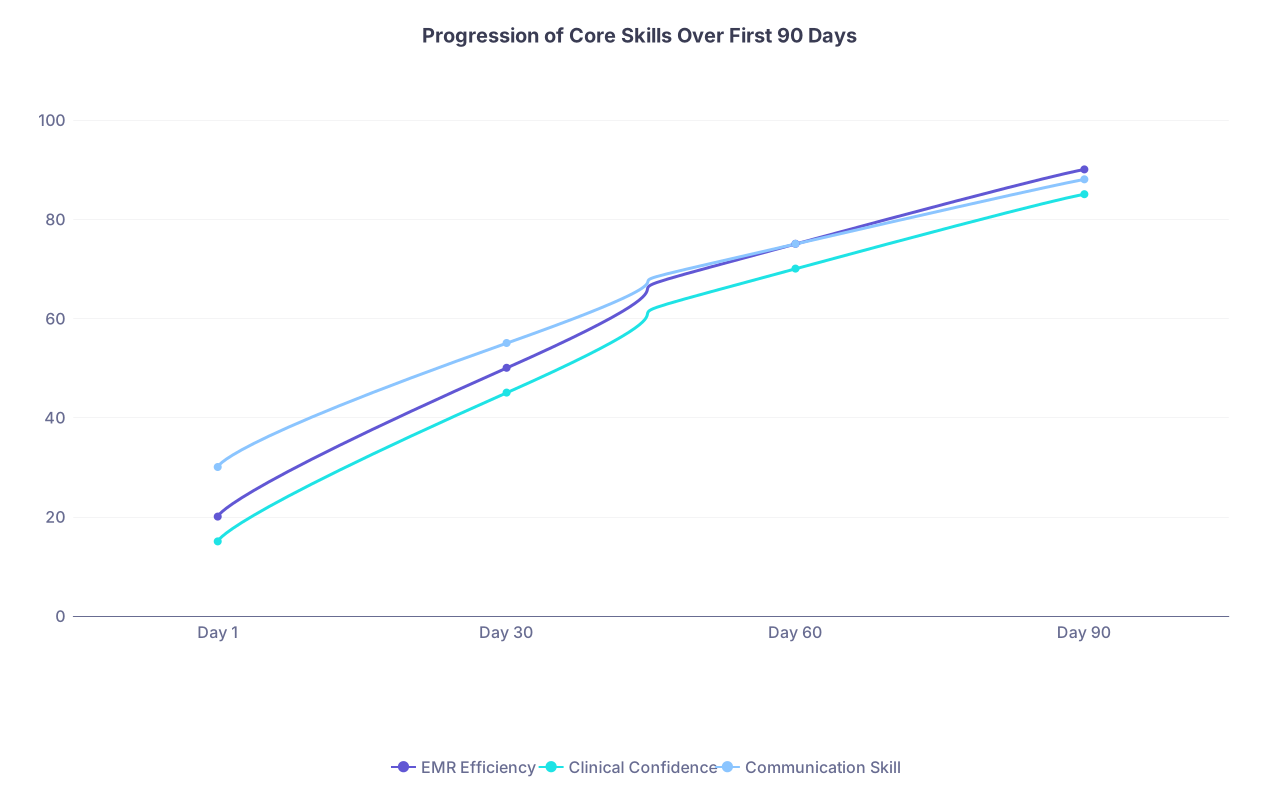
| Category | EMR Efficiency | Clinical Confidence | Communication Skill |
|---|---|---|---|
| Day 1 | 20 | 15 | 30 |
| Day 30 | 50 | 45 | 55 |
| Day 60 | 75 | 70 | 75 |
| Day 90 | 90 | 85 | 88 |
Week 12 (Days 84–90): Future‑Facing Tasks and Strategic Positioning
The first 90 days end, but your trajectory is just getting locked in.
This final week you should:
- Identify 1–2 faculty aligned with your interests (cards, pulm, heme/onc, etc.)
- Send a concise email:
- “I’m an IMG intern interested in [field]. Once the year settles, I’d love to help with any small project or QI work you have, even if it’s just data collection.”
- Send a concise email:
- Clarify long‑term visa and career path:
- Meet briefly with GME/visa coordinator:
- Timeline for renewals
- Any constraints for moonlighting or travel
- Meet briefly with GME/visa coordinator:
- Clean up loose ends:
- Outstanding notes or incomplete charts
- Required online modules
- Missed vaccines or occupational health follow‑up
At this point, if you’ve followed this timeline, people should describe you like this:
- “Solid.”
- “Learns fast.”
- “Communicates clearly despite being trained abroad.”
- “I’d trust them with more responsibility next year.”
That’s exactly where you want to be.
Quick 90‑Day Checklist for IMGs in Friendly Programs
Use this as a blunt yes/no scorecard:
By day 7, you should have:
- Active badge, EMR access, scrubs, parking
- Clear understanding of visa point person
- Seen at least one full day of your primary service workflow
By day 30, you should have:
- Presented independently on rounds
- Written multiple complete admission and progress notes
- Received at least one piece of explicit performance feedback
- No outstanding HR, license, or occupational health tasks
By day 60, you should have:
- Active or in‑process full training license and prescribing credentials
- Stable daily workflow that gets notes and discharges done on time
- At least one faculty mentor who knows you by name and performance
By day 90, you should have:
- Clear feedback from leadership about how you are doing overall
- One or two possible future directions (fellowship, QI, research) identified
- A reputation as reliable, communicative, and steadily improving
FAQ (Exactly 2 Questions)
1. I’m struggling with spoken English and speed on rounds in the first month. What should I prioritize right now?
Prioritize clarity over speed. Before rounds, write down your one‑liner and the top 3 active problems for each patient in simple, short sentences. Practice presenting out loud to yourself or a co‑intern in a quiet room. Ask your senior to listen to one presentation per day and correct phrasing and structure. Also, script a few standard lines—introductions to consultants, how you discuss plans with families—and reuse those. Improvement in the first 2–3 weeks matters more than being perfect on day 1.
2. How do I know if a program is truly IMG‑friendly in those first 90 days?
Watch what happens when you struggle. In genuinely IMG‑friendly programs, seniors and faculty step in with concrete help, not blame; coordinators proactively remind you about visa or licensing tasks; feedback is specific (“shorten your presentations by doing X”), not vague (“you need to be more confident”); and you see other IMGs in upper years thriving, not just surviving. If you ask for help early and the consistent response is guidance, not punishment, you’re in the right place.
Open your calendar right now and block 15 minutes at the end of each week for the next 12 weeks. Label it “90‑day check‑in” and use that slot to review this timeline and adjust what you do in the coming week.