
The way most IMGs approach interview season is upside down. They obsess over “perfect answers” and completely ignore the weekly system that actually gets supportive PDs to remember—and rank—them.
You’re not competing with perfection. You’re competing with structure. The IMGs who win interview season treat it like a calendar-driven project, not a series of random Zoom calls.
Here’s the week‑by‑week strategy I’d use if I were an IMG targeting genuinely IMG‑friendly, supportive program directors.
6–8 Weeks Before Your First Interview: Build the Supportive-PD Map
At this point you should stop guessing which programs are “IMG‑friendly” and start building an evidence-based list.
Week 1: Create Your IMG-Friendly Program Dashboard
Your one job this week: build a system.
- Open a spreadsheet or Notion board. Columns:
- Program name
- City/state
- IMG percentage in current residents
- Visa sponsorship (J-1 / H-1B / None)
- Average Step scores (if known)
- Alumni from your country / school
- Program director name + email
- Coordinator name + email
- PD reputation (supportive / unknown / avoid)
- Notes (red flags, strengths, call structure, didactics)
- Use:
- Program websites → check resident photos and bios
- FREIDA → filter by “Accepts IMGs” and “Visa sponsorship”
- Current residents’ LinkedIn and hospital profile pages
- Reddit/SDN threads—but weighted lightly; lots of noise there
Your goal by the end of Week 1: 30–60 realistic, IMG‑friendly programs segmented like this:
| Tier | Description | Target Count |
|---|---|---|
| A | Very IMG-heavy, strong visa support, known kind PD | 10-15 |
| B | Moderate IMG presence, decent support, neutral PD | 15-25 |
| C | Light IMG presence but open history, mixed reports | 10-20 |
If you’re already late in the season and have invites, backfill this data for every program that invited you. Yes, even the “reach” ones.
Week 2: Identify Supportive PD Signatures
Now you refine. At this point you should stop thinking “IMG‑friendly = high IMG percentage.” That’s necessary, not sufficient.
This week, you’re looking for supportive PD behavior:
- Website and social media:
- PD letters that mention:
- Wellness
- Mentorship
- Remediation support
- Individualized education plans
- Posts highlighting:
- IMG achievements
- Visa match successes
- Residents with nontraditional paths
- PD letters that mention:
- Signs a PD is trouble:
- Website flexing: “We only take the best of the best” with no mention of teaching
- Obsession with Step scores, no talk of culture
- Online reviews calling the place “malignant,” “sink or swim,” “no teaching”
Action steps this week:
- Watch 1–2 grand rounds or teaching videos from your top 10 programs on YouTube or hospital sites. Pay attention to:
- How faculty talk to residents
- Whether IMGs present and ask questions comfortably
- Send 3–5 short, respectful emails to current IMG residents:
- Subject: “Quick question from an IMG applicant”
- Keep to 5–7 lines. Ask 2–3 concrete questions:
- “How is visa processing handled?”
- “How does the PD respond when residents struggle?”
- “Does the program support Step 3 timing/ECFMG paperwork?”
By the end of Week 2, flag your top 10–15 “most supportive” programs. These are where you’ll pour most of your pre‑ and post‑interview energy.
4–5 Weeks Before First Interview: Script, Stories, and Tech
At this point you should have your program map. Now you build your personal “interview operating system.”
Week 3: Core Story Bank + Red Flag Prep
Your job this week: stop winging your answers.
Create a story bank document with 8–12 concrete stories:
- Clinical impact
- Team conflict
- Failure / mistake
- Ethical dilemma
- Difficult patient/family
- Working with limited resources
- Learning from feedback
- Leadership / initiative
For each story:
- Situation (2 lines max)
- Your actions (specific, behavioral)
- Outcome (prefer numbers: “reduced wait time by 20%”)
- Reflection (what changed in your practice)
Now layer the IMG reality into your prep:
- Prepare tight answers for:
- “Why did you choose to train in the U.S.?”
- “Tell me about any gaps in your CV.”
- “Why are your Step scores [X]?” (if low or uneven)
- “What challenges have you faced as an IMG?”
- Build 1–2 versions:
- Short (30–45 seconds)
- Long (90 seconds) with more detail if they dig deeper
Do not memorize monologues. Bullet points only. If you sound like you’re reading, PDs tune you out.
Week 4: Tech Rehearsal and Environment Lock-In
If you are doing virtual interviews, this week is non‑negotiable.
Checklist:
- Camera:
- Use laptop camera or external; eye level; no “looking down” angle
- Sit 2–3 feet back; frame mid‑chest and up
- Audio:
- Wired headphones > wireless (less risk)
- Test for background noise; avoid loud fans, open windows
- Background:
- Simple, clean wall or shelf
- No bed in frame if you can avoid it
- Neutral lighting; avoid backlighting from windows
Do 2–3 mock interviews this week:
- One with a friend who will be brutally honest
- One recorded solo: ask common questions; record your answers; watch back
- One focused entirely on your “weak spots” (gaps, scores, visa)
By the end of Week 4, you should:
- Have one stable interview location
- Know your camera, audio, and lighting settings exactly
- Have at least 10 practiced but not robotic stories ready to deploy
Week-by-Week During Interview Season
Now we’re in the real season. Assume ~8–10 weeks of active interviewing.
I’ll break it down by a “standard” week. Adjust dates as your invites and interviews shift.
Week 1 of Interviews: First Impressions and Data Capture
At this point you should stop worrying about “perfect answers” and focus on systems that capture information.
Early Week (Mon–Tue): Pre-Interview Dossiers
For every upcoming interview (ideally 3–5 days before):
Create a 1-page dossier per program (yes, actually 1 page):
- Top section:
- PD name, APD(s), chief residents
- Number of residents/year
- Visa policy
- Primary hospital(s)
- Middle:
- 3 reasons this program fits you (specific, not generic)
- 2 concerns/questions you want to clarify
- Bottom:
- Names and short notes on any faculty you might meet:
- “Dr. Smith – interest in heart failure, IMG from India”
- “Dr. Lee – APD, wellness committee”
- Names and short notes on any faculty you might meet:
Spend 20–30 minutes max per program. Set a timer so you don’t disappear into a research hole.
Midweek (Wed–Fri): Interview Execution + Same-Day Notes
On every interview day, after you log off, you have a 30‑minute window where your memory is fresh. Use it.
Post‑interview same‑day tasks:
- Open your program spreadsheet
- Immediately rate:
- Gut feel (1–10)
- PD supportiveness (1–10)
- Resident happiness (1–10)
- IMG culture safety (1–10)
- Write “3 things I liked, 2 things I didn’t”:
- Examples:
- Liked: “PD talked about remediation support without shame”
- Liked: “Multiple IMGs as chiefs”
- Didn’t: “No mention of visa processing timeline”
- Didn’t: “Residents looked exhausted; dodged questions about workload”
- Examples:
This is what saves you in February when you’re building rank lists and all programs blur together.
Weekend: Gratitude + Targeted Follow-Up
By Sunday night, you should have sent:
- Individualized thank‑you emails to:
- PD
- APDs
- Any faculty who interviewed you
- Chief residents who spent time with you
Content formula (short, no fluff):
- Explicit thanks for their time
- One specific detail from your conversation or the day
- One sentence linking that detail to your fit/interest
- Clear, calm interest statement (no begging)
Example: “Speaking with you about how you support residents pursuing cardiology fellowships, especially IMGs, confirmed that your program aligns with my goals. I’d be excited to continue my training at [Program].”
Do not copy‑paste the same email to everyone. They compare.
Week 2–4 of Interviews: Momentum, Targeted Outreach, Signal Reinforcement
You’re in the thick of it now. The risk here is chaos. At this point you should run your weeks like a clinic schedule.
Monday: Schedule Recon and Damage Control
- Check your email and spam folders for invites/cancellations
- Confirm upcoming interview dates and times (time zones especially)
- For IMG‑supportive programs you haven’t heard from:
- Send 2–3 carefully chosen “interest” emails only if:
- You have a real connection (alumni, rotation, research)
- You can articulate why you fit them (not “you’re my dream program” nonsense)
- Send 2–3 carefully chosen “interest” emails only if:
Content for a brief interest email (to coordinator or APD, not always PD):
- Who you are (name, AAMC/ERAS ID, IMG from X, current status)
- Prior interaction (observership, rotation, email contact with resident)
- 2 specific reasons for your interest
- Short closing: “If my application remains under consideration, I would be very grateful.”
Do not send weekly “checking in” spam. That’s how you get remembered for the wrong reason.
Tue–Thu: Interview + PD Behavior Tracking
Interview days stay the same structure. But now you add one more lens: How do PDs behave with IMGs specifically?
During each interview and Q&A:
Watch for supportive PD signs:
- They acknowledge systemic barriers IMGs face without blaming you
- They describe specific support structures:
- Dedicated IMG mentorship
- ECFMG/visa coordinator help
- USMLE/Step 3 planning built into schedule
- They use language like:
- “We meet residents where they are”
- “We don’t punish people for asking for help”
- “We’ve successfully supported IMGs going into [competitive fellowship]”
Watch for red flags:
- “We expect everyone to perform at the same level from day one” (no support)
- “We don’t really treat IMGs differently; we just expect them to adjust quickly”
- Evasive when you ask about remediation or residents who struggled
Same-day, add to your spreadsheet:
- PD supportive quote (exact words if you can recall)
- Any moment that made you think “These people will have my back” or “These people will throw me under the bus”
This is the difference between matching where you survive vs. where you grow.
Friday: Story Refinement and Pattern Recognition
By now, certain questions keep coming up. Use Friday to sharpen.
- Review:
- Which of your stories landed well?
- Where did you ramble?
- Which questions caught you off guard?
Adjust:
- Tighten any answer that went longer than 90 seconds
- Swap out one story that felt weak for a stronger one from your experience
- Add 1–2 new “program‑specific” questions for supportive PD programs, for example:
- “How do you identify a resident who is quietly struggling?”
- “Can you tell me about a time you supported an IMG through a challenge here?”
Weekend: Strategic Ranking Snapshot
You’re not making a final rank list yet. But each weekend you do a mini‑ranking of programs you interviewed that week.
Rank within the week:
- Would fight to match here
- Safe and solid
- Only if needed
Alongside, maintain a cumulative ranking that you update weekly. Just rough. Gut‑driven with notes.
Week 5–7: Late-Season Positioning and Genuine Interest Signals
This is when anxiety peaks. Your classmates start flexing about “15 interviews” and “top‑tier programs.” Ignore them. At this point you should focus on depth with IMG‑supportive programs, not chasing fantasy.
Early Week: Identify Your True Top 5–7
From your spreadsheet, pick your true top 5–7 programs where:
- PD appears genuinely supportive
- Resident culture felt safe, especially for IMGs
- Visa or ECFMG issues are clearly supported
- You could actually see yourself happy there
For those programs only, you’ll escalate your signals.
Midweek: Thoughtful Post-Interview Touchpoints
For your top tier only (not everyone):
- If there’s been radio silence for 2–3 weeks post‑interview, send:
- A brief update email to PD or APD:
- One new achievement (publication, Step 3 pass, new responsibility)
- One sentence reaffirming interest with a specific reason
- Short, professional, no pressure
- A brief update email to PD or APD:
If you haven’t interviewed at a top supportive program yet but are scheduled:
- Re‑review their materials and update your dossier
- Ask current IMG residents 1–2 higher-level questions:
- “How has the PD supported your career plans specifically?”
- “If you had to choose again, would you rank this #1? Why or why not?”
Weekend: Burnout Management and Consistency Check
Late season is where IMGs start sounding tired and desperate. PDs pick up on it.
Weekend tasks:
- Short mock interview focused only on:
- “Why our program?”
- “What will you bring to our program?”
- “Tell me about yourself” (this decays fast as you get tired)
- 15–20 minutes of honest reflection:
- Are you still consistent in how you talk about your goals?
- Are your answers about being an IMG turning defensive or apologetic?
If yes, reset. Your IMG status is context, not a crime to explain.
Final 2–3 Weeks: Ranking and Last Communications
Interviews are winding down or over. At this point you should stop obsessing over “Did I say the right thing?” and instead build a rational, self‑protective rank list.
Week 8: Hard Rank List Draft
Use your spreadsheet ratings and notes. For every program you interviewed:
Ask yourself three blunt questions:
- Did the PD feel like someone I could tell bad news to?
- Did the residents seem like people who’d cover me on my worst day?
- Is this a place where an IMG can advance, not just survive?
Any program that fails #1 or #2 goes to the bottom, no matter how “prestigious.” I’ve seen IMGs destroyed by malignant “name” programs and then struggle to recover.
Build your draft rank order focusing on:
- PD supportiveness
- Visa/ECFMG reliability
- Educational quality
- Culture with IMGs
Then adjust for personal factors (location, family, cost of living) only after the first pass.
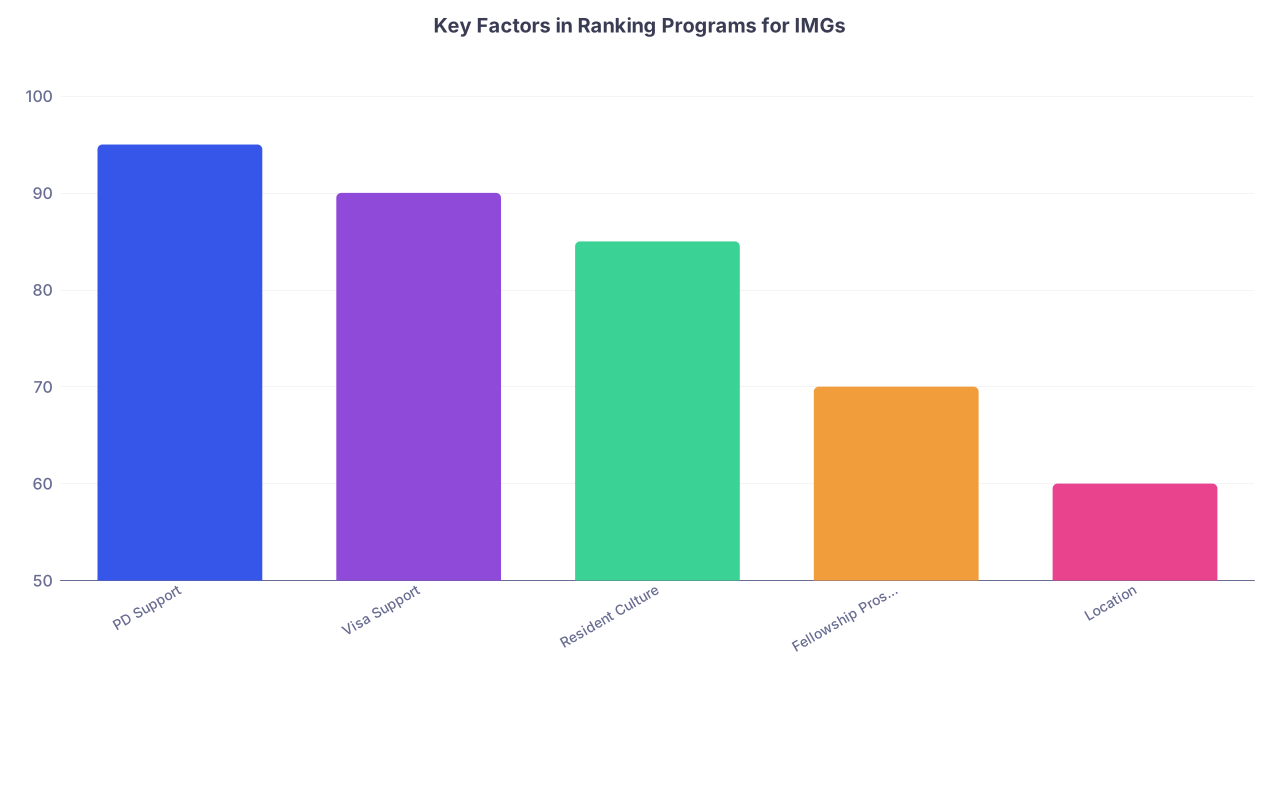
| Category | Value |
|---|---|
| PD Support | 95 |
| Visa Support | 90 |
| Resident Culture | 85 |
| Fellowship Prospects | 70 |
| Location | 60 |
Week 9: Final Communication with Top Program(s)
Depending on your specialty and country rules, you may or may not send a clear “I will rank you highly” or “#1” message. For IMGs aiming at supportive PDs, one honest signal can help.
For your true #1 choice only:
- One concise email to PD:
- Explicit gratitude for the interview season
- One or two specific reasons their program is your top choice
- Clear but professional interest:
- If allowed: “I intend to rank [Program] as my first choice.”
- If uncertain/varies: “I will be ranking [Program] very highly.”
Do not send “you are my #1” to multiple programs. PDs talk. Coordinators talk. It backfires.
If you have 2–3 programs clustered at the top and don’t want to make a hard #1 statement:
- Send “strong interest” emails instead:
- “I will be ranking [Program] very highly because…”
But again—only to truly supportive‑seeming places where you’d be glad to match.
Visual Timeline: From Pre-Season to Rank List
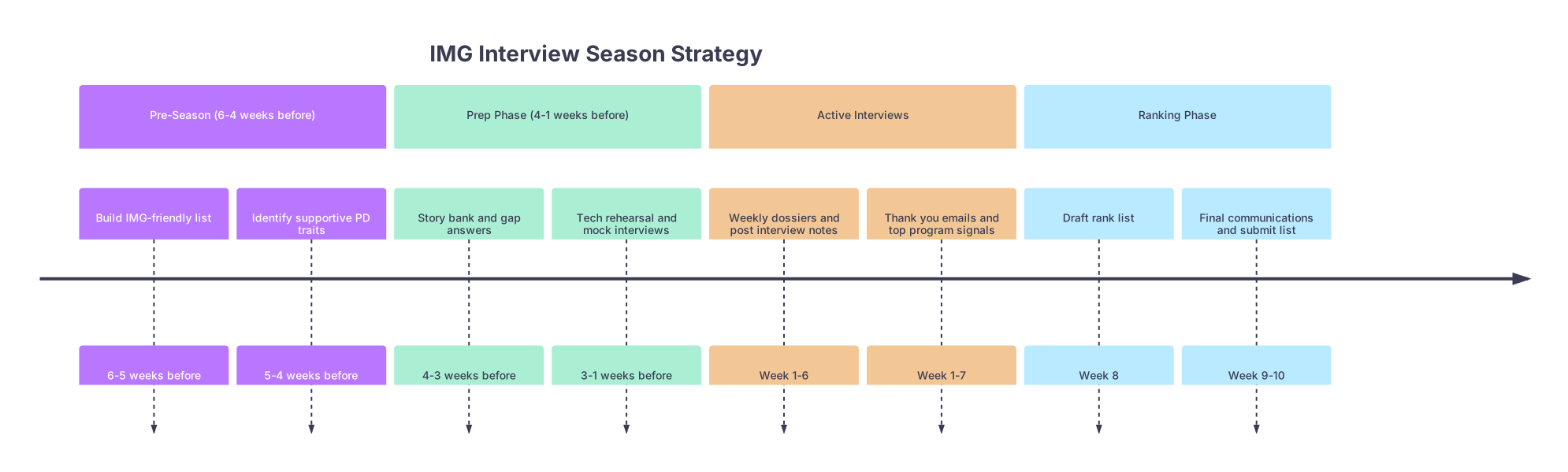
| Period | Event |
|---|---|
| Pre-Season (6-4 weeks before) - Build IMG-friendly list | 6-5 weeks before |
| Pre-Season (6-4 weeks before) - Identify supportive PD traits | 5-4 weeks before |
| Prep Phase (4-1 weeks before) - Story bank and gap answers | 4-3 weeks before |
| Prep Phase (4-1 weeks before) - Tech rehearsal and mock interviews | 3-1 weeks before |
| Active Interviews - Weekly dossiers and post interview notes | Week 1-6 |
| Active Interviews - Thank you emails and top program signals | Week 1-7 |
| Ranking Phase - Draft rank list | Week 8 |
| Ranking Phase - Final communications and submit list | Week 9-10 |
Sample Weekly Schedule During Peak Season
Here’s what a single high‑intensity interview week might look like.
| Day | Morning | Afternoon | Evening |
|---|---|---|---|
| Monday | Review week’s interviews | Update dossiers | Light story review |
| Tuesday | Interview A | Same-day notes | Thank-you drafts |
| Wednesday | Free / observership / work | Short mock interview | Outreach to residents (1–2 msgs) |
| Thursday | Interview B | Same-day notes | Quick walk + decompress |
| Friday | Interview C | Same-day notes + spreadsheet | Rank weekly programs |
| Saturday | 60–90 min review only | Rest / personal life | |
| Sunday | Thank-you emails sent | Adjust cumulative rank list | 15–20 min light prep |
A Quick Word on Over- and Under‑Doing It
Two failure modes I keep seeing:
- The IMG who emails PDs weekly, sends 3‑page thank‑you essays, and tries to “network” their way into a spot. Supportive PDs see this as anxiety, not professionalism.
- The IMG who does zero follow‑up, forgets program details, and then builds a rank list based on city name and hearsay.
You want the middle path:
- Structured, weekly tasks
- Targeted communication with your true top choices
- Ruthless attention to PD behavior and resident culture
Wrap up with this in mind:
- Supportive PDs are not a mystery; they leave a trail—online, in how residents talk about them, and in how they talk about failure and support. Track that every week.
- Interview season isn’t about any single brilliant answer. It’s a calendar game. The IMGs who win are the ones who stick to a simple, weekly system.
- Your rank list should follow one rule: choose the places where you’ll be backed when things go wrong, not just praised when things go right.