The biggest mistake IMGs make is waiting until after graduation to get “serious” about residency. By then, many IMG‑friendly spots are already effectively spoken for.
You need to lock in your relationship with IMG‑friendly programs before you walk across that stage.
Below is a concrete, time‑anchored checklist from 18 months before graduation through Match week. Month by month. Then week by week when things get tight. If you follow this, you are not guessing which programs like IMGs—you are already on their radar.
18–15 Months Before Graduation: Laying the Groundwork
At this point you should stop thinking “someday I’ll apply to the Match” and start building a targeted IMG‑friendly universe.
1. Build Your Initial IMG‑Friendly List (Target: 40–80 Programs)
Do this even if you have not taken your USMLEs yet.
- Decide your realistic specialty tier:
- High‑IMG: Internal Medicine, Family Medicine, Pediatrics, Psychiatry, Pathology, Neurology.
- Mixed: OB/GYN, General Surgery prelims, Transitional Year.
- Use tools that actually reflect IMG data:
- NRMP “Charting Outcomes in the Match” (look at IMG match rates by specialty).
- FREIDA (filter for “Accepts international medical graduates” and “Sponsorship of visas”).
- Program websites—look at current residents’ medical schools.
| Filter Type | What You Look For |
|---|---|
| Visa | J-1 and/or H-1B supported |
| Current Residents | ≥ 30–40% IMGs |
| USMLE Policy | No explicit attempt limit |
| Graduation Cutoff | ≥ 5 years since graduation |
| Funding Type | Community / University-affiliated |
Create a spreadsheet with columns for:
- Program name, ACGME ID, city/state
- Visa type supported
- % IMGs in residency
- Graduation year cutoff
- USMLE minimums / number of attempts allowed
- Observership/externship or elective options
- Contact information (program coordinator, email, phone)
You will live in this sheet for the next year.
2. Lock Your USMLE Timeline Against Graduation
At this point you should map backward from your graduation date.
- Aim for:
- Step 1 / Step 2 CK both completed at least 4–6 months before ERAS opens in September.
- OET and ECFMG certification completed by December of application year at the latest.
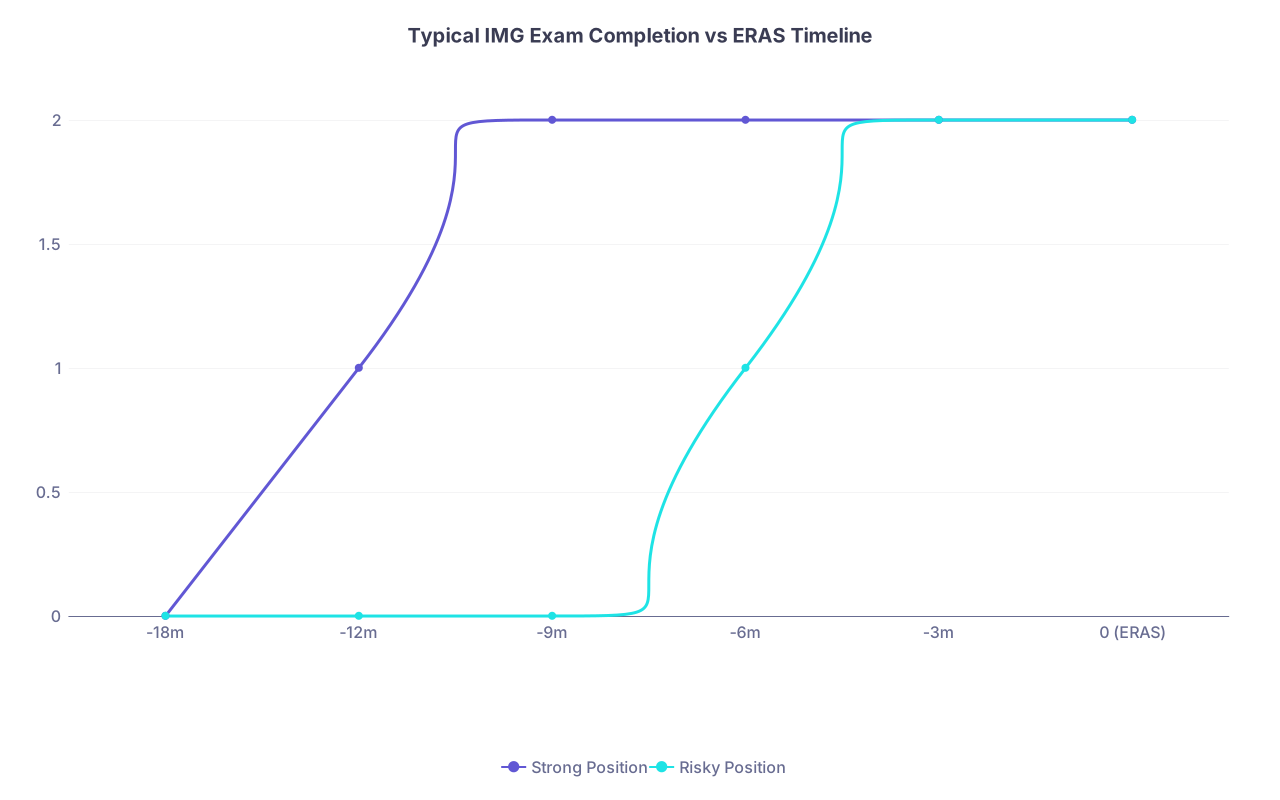
| Category | Strong Position | Risky Position |
|---|---|---|
| -18m | 0 | 0 |
| -12m | 1 | 0 |
| -9m | 2 | 0 |
| -6m | 2 | 1 |
| -3m | 2 | 2 |
| 0 (ERAS) | 2 | 2 |
(Values are cumulative exams done: 0=none, 1=Step 1, 2=Step 1+Step 2. You want the “strong” curve.)
Commit to exam dates in writing—with your school and with yourself. IMG‑friendly programs do not have patience for “pending Step 2” when rank lists are due.
14–12 Months Before Graduation: Deep Research and Early Contact
Now you move from a generic list to a priority list of IMG‑friendly programs that match you, not some ideal candidate on Reddit.
3. Stratify Your Programs: Green / Yellow / Red
At this point you should classify each program:
- Green:
- Clearly IMG‑friendly (multiple IMGs per class).
- Visa support and your visa type aligns (often J‑1).
- Your expected Step scores are at or above their residents’ averages.
- Yellow:
- Some IMGs; maybe 1–2 per class.
- Stricter USMLE cutoffs; might need a stronger application.
- Red:
- Rare IMGs, or they require things you do not have (US MD/DO, no visa, top‑tier research).
You will apply broadly, but you will court the Green and some of the Yellow.
4. Start Soft Contact with Programs
IMGs who match early into “friendly” programs usually did not appear out of nowhere.
At 12–14 months before graduation you should:
- Email coordinators at your top 20–30 IMG‑friendly programs:
- Introduce yourself briefly (school, graduation year, specialty of interest).
- Ask a targeted question:
- “Do you offer observerships or virtual electives to final‑year IMGs?”
- “Is there a preferred way for IMGs to engage with your program before ERAS?”
- Keep emails short and professional. Three paragraphs max.
Track every response (or non‑response) in your sheet. Programs that engage politely and answer questions clearly are usually more IMG‑friendly in real life too.
11–9 Months Before Graduation: Secure US Clinical Experience with the Right Programs
At this point you should be actively building US clinical experience (USCE)—ideally where you want to match.
5. Prioritize Rotations in IMG-Friendly Systems
You do not need a famous name hospital. You need the right ecosystem.
Target:
- Community or community‑based university hospitals.
- Known IMG‑friendly systems: examples include BronxCare, Brookdale, Maimonides, various HCA hospitals, etc. (This changes over time. Look at current resident lists.)
- Rotations attached to ACGME programs with:
- Many IMGs in residency.
- Historical willingness to take rotators as residents.
When you select electives/observerships:
- Choose 2–3 months in the US if possible.
- Spread across 2–3 different programs, not 1 site for all time.
- Aim for at least one rotation where you realistically could apply and be competitive.
6. Tell Attendings You Are Targeting Residency—Explicitly
Most IMGs stay too quiet. Then they are surprised when letters are generic.
During your rotation (especially weeks 3–4):
- Say: “Doctor X, I am graduating in [month/year] and will be applying to [specialty] programs this fall. Your program is on my short list because of its support for IMGs. I would value your feedback on how to strengthen my application.”
- Ask if they are comfortable writing a strong LOR if performance remains good.
You want:
- 2–3 US letters, ideally:
- 1 from an IMG‑friendly academic or core faculty.
- 1 from a PD or APD if possible.
- All on US hospital letterhead.
This is what really “locks you in” at IMG‑friendly programs: they know your face, your work ethic, and your name when your ERAS shows up.
8–6 Months Before Graduation: Score, Certify, and Narrow Your List
Now things get serious. You are moving from preparation into application mode.
7. Finalize Scores and ECFMG Strategy
At this point you should:
- Have Step 1 done.
- Be scheduling or sitting for Step 2 CK with the goal of score release no later than August before the application cycle.
If you are not on track:
- Push aggressively to finish Step 2 CK. Late Step 2 tanks IMG chances at many “friendly” programs that want complete files early.
- Start OET planning early so you can complete ECFMG certification before ranking season.
8. Trim and Prioritize Your Final Program Targets
With scores in hand (or very close), update your Green/Yellow/Red list.
Move programs based on:
- Their stated or observed Step score expectations.
- How many IMGs they currently train.
- Whether they responded to your early emails or hosted you in rotation.
At this point you should:
- Identify a Core 40–60 programs you will court actively (emails, virtual events, rotations if possible).
- Keep an extended list of 80–120 programs you may apply to, depending on competitiveness and budget.
5–3 Months Before Graduation: Pre‑ERAS Positioning
You are entering the final stretch before ERAS season. This is where many IMGs drift; you will not.
9. Clean Up Your Application Profile
At this point you should:
- Polish your CV:
- Clarify research (poster vs oral, local vs national).
- Fix inconsistent dates and roles.
- Organize documents:
- Medical school transcript.
- MSPE timeline with your dean.
- Verified translations if needed.
Start your personal statement now, not in August:
- Write a base statement for your main specialty (e.g., Internal Medicine).
- Identify 3–4 specific, IMG‑friendly programs you might customize short paragraphs for (especially if you rotated there).
10. Deep‑Dive Program Websites for Hidden Requirements
IMG‑friendly does not mean “easy.” They still have rules.
For each Green/Yellow program:
- Check RECENT information on:
- USMLE attempts allowed.
- Minimum US clinical experience required (3 months, 6 months, “none required”).
- Maximum years since graduation.
- Visa specifics (only J‑1 vs J‑1 and H‑1B).
Update your spreadsheet:
- Mark any newly disqualified programs.
- Flag especially welcoming ones (explicit statements like “We welcome IMGs” are gold).
This is how you avoid wasting applications on programs that will auto‑screen you out.
2 Months Before Graduation: ERAS Build & Strategic Outreach
Now the clock is loud. At this point you should be building your ERAS application and quietly reminding IMG‑friendly programs you exist.
11. Build ERAS with IMG-Friendly Programs in Mind
You are not writing for a generic audience. You are writing for coordinators who know how IMGs succeed in their environment.
In ERAS:
- Experiences:
- Emphasize:
- US clinical roles (even observerships).
- Longitudinal commitments (multi‑year research, continuous volunteering).
- Underplay random, one‑week shadowing back home unless exceptional.
- Emphasize:
- Publications:
- Separate peer‑reviewed from local conference posters clearly.
- Personal statement:
- Mention meaningful US experiences, especially in similar patient populations as your top programs (e.g., underserved, immigrant communities).
12. Targeted Pre‑ERAS Contact
Two to four weeks before ERAS opens:
- Send short update emails to:
- Any program where you rotated.
- Any PD or APD who showed interest.
- A few key coordinators at your top 10–15 IMG‑friendly programs.
Structure:
- 3–4 sentences:
- Name, school, graduation month.
- Specialty and your most recent accomplishment (Step 2 score, completed USCE, upcoming ECFMG certification).
- Politely state you will be applying to their program and appreciated prior interaction.
This is not begging. It is reminding them you exist when they later see your name in a stack of 4,000.
Graduation Month: Final Prep Before Application Launch
At this point you should be graduating with your documentation pipeline under control.
13. Confirm Every Document Will Hit On Time
You want no surprises.
- Confirm with your medical school:
- Transcript transmission timeline to ECFMG.
- MSPE draft and release date.
- Confirm with letter writers:
- That letters are uploaded to ERAS or sent to ECFMG.
- That they mention your US clinical work clearly and specifically.
If you are delayed on any exam or certification:
- Email your top IMG‑friendly programs after ERAS opens:
- Explain your timeline honestly.
- Give exact expected completion dates.
ERAS Opens: Application Submission Month
This is where your year of preparation either pays off—or not. At this point you should act quickly and precisely.
14. Submit Early and Broadly
For IMGs, timing is a selection criterion.
- Submit your applications within 1–3 days of ERAS opening for programs.
- Apply broadly:
- Competitive specialty: often 80–120+ programs.
- Less competitive: 60–80 may suffice, but more is rarely harmful if budget allows.
Do not “wait for Step 2 score” if it is coming late. Submit, then email updates later. Many IMG‑friendly programs will review updates.
15. Tailor a Subset of Programs You Want Most
You will not customize 100 applications. But you should give special attention to 10–20 IMG‑friendly programs where you truly fit.
For these:
- Slightly adjust personal statement to mention:
- Shared mission (underserved, teaching focus, research type).
- Your rotation there, if applicable.
- In ERAS experiences, consider:
- Reordering items so the most relevant USCE appears first.
This is how you quietly upgrade your odds without going insane.
2–8 Weeks After Application Submission: Interview Season Begins
At this point you should shift from “builder” to “manager.”
16. Systematic Response to Interview Invites
IMG‑friendly programs often send blocks of invites, then waitlist.
You must:
- Check email and interview portals multiple times daily.
- Accept or schedule interviews quickly—within hours if possible.
- Keep a live calendar with time zones clearly labeled.
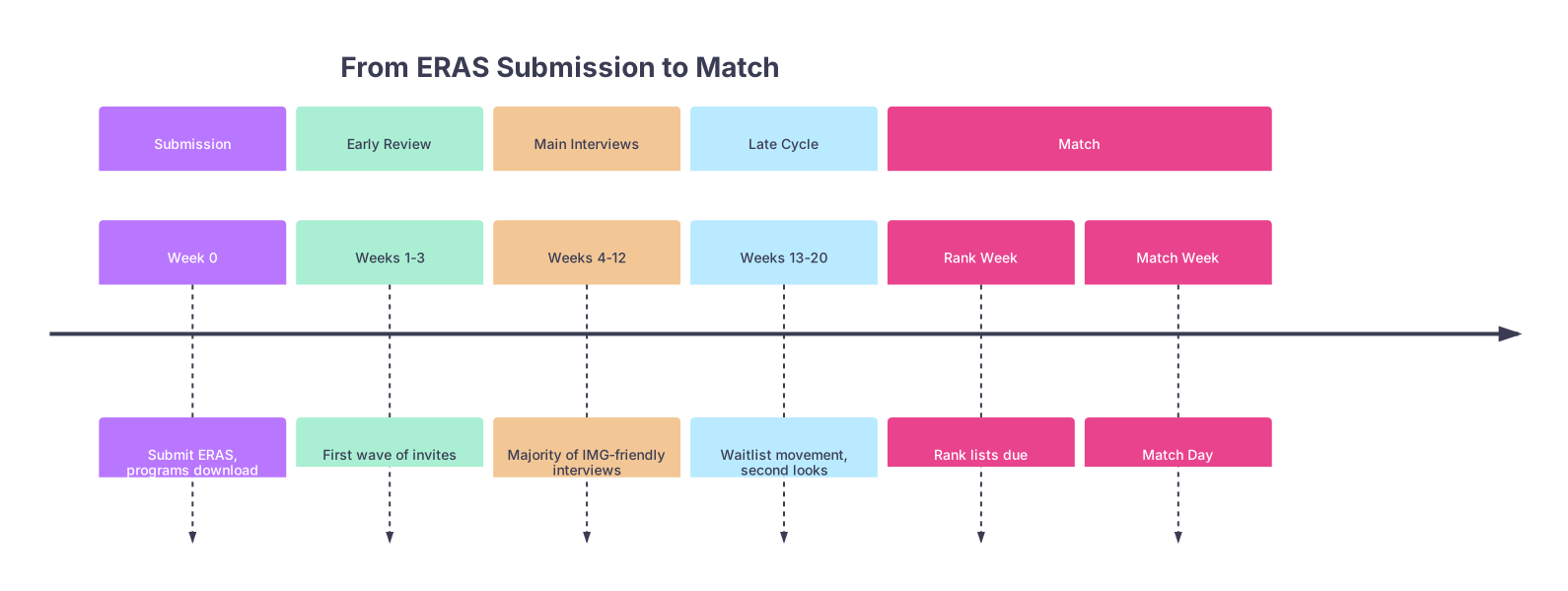
| Period | Event |
|---|---|
| Submission - Week 0 | Submit ERAS, programs download |
| Early Review - Weeks 1-3 | First wave of invites |
| Main Interviews - Weeks 4-12 | Majority of IMG-friendly interviews |
| Late Cycle - Weeks 13-20 | Waitlist movement, second looks |
| Match - Rank Week | Rank lists due |
| Match - Match Week | Match Day |
17. Keep Warm Contact with Key IMG-Friendly Programs
During interview season:
- For programs that have not responded after 4–6 weeks:
- One polite email to the coordinator/PD:
- Reiterate your interest.
- Update them on any new scores or achievements.
- One polite email to the coordinator/PD:
- For places where you rotated:
- Ask your attending or mentor if they are comfortable mentioning your name to the PD.
Do not spam. One well‑timed email is enough.
Late Interview Season: Waitlists, Second Looks, and Ranking
At this point you should be realistic and strategic, not desperate.
18. Use Second Looks Intelligently
Some IMG‑friendly programs care about second looks. Others do not.
- Good reasons to do a second look:
- It is a top‑tier program for you.
- Travel is feasible and not financially catastrophic.
- The PD or faculty seemed engaged and encouraged contact.
- When you go:
- Be early.
- Attend morning report or rounds.
- Re‑introduce yourself briefly to faculty you met.
But do not blow your entire budget on second looks at random places that barely know you.
19. Rank List Strategy for IMGs
Your rank list should be honest, but not naive.
At this point you should:
- Rank programs in true order of preference where you realistically think you could train.
- Do not push an “unfriendly” academic name to the top over a stable, IMG‑heavy community program you liked more.
- Pay attention to:
- Visa reliability.
- Resident happiness (ask actual IMGs there, not only faculty).
- Board pass rates.
IMGs who play “prestige games” with their rank list often end up in SOAP. Or worse, unmatched.
Match Week: Last Chance to Leverage IMG-Friendly Programs
If you reach Match Week, one of two things happens. You match, or you do not. You need a plan for both.
20. If You Match
At this point you should:
- Immediately handle visa paperwork with your GME office.
- Thank every mentor and attending who helped you. Especially at IMG‑friendly sites. You will send future students their way.
21. If You Do Not Match (or Partially Match)
You will be in the SOAP chaos. IMG‑friendly behavior now is different.
During SOAP:
- Target programs that historically take IMGs or prelims.
- Lean on any faculty champions who can call on your behalf.
After SOAP (if still unmatched):
- Use your existing IMG‑friendly sheet as the foundation for:
- Off‑cycle prelim/transitional spots.
- Research positions and clinical fellowships at IMG‑friendly hospitals.
- Email PDs:
- Attach CV and brief cover letter.
- Emphasize:
- Graduation date.
- USCE.
- USMLE scores.
- Visa status.
This is hard. But the IMGs who get through it are the ones who had organized data long before Match Week.
What You Should Do Today
Do not bookmark this and forget it.
Open a blank spreadsheet right now and create these columns: Program name, city/state, visa type, % IMGs, graduation cutoff, USMLE policy, USCE offered, contact, notes. Then add five programs you believe are IMG‑friendly and start filling in real data.
Once that sheet exists, you have started locking in IMG‑friendly programs before graduation. Without it, you are just hoping.