
It's March 1. You just wrapped up an observership at a mid-sized community hospital in the U.S. The attending said, “You’re solid. If you apply here, email me.”
Match applications open in about six months. Right now you have:
- No U.S. residency experience beyond observerships
- A couple of polite “feel free to use me as a reference” emails
- A rough CV. No personal statement. No program list.
At this point you should be thinking one thing:
How do I turn “nice observership” into “IMG-friendly residency interview” in half a year?
This is your six-month, step-by-step countdown. I’m going to assume:
- You’re an IMG with at least one U.S. observership or externship done or in progress
- You’re targeting mostly IMG-friendly programs (community, some university-affiliated)
- You’re aiming for the very next ERAS cycle
If you’re a year out, you’re ahead. Good. Use this anyway and stretch the months.
Big Picture: The Six-Month Arc
Before we go month-by-month, here’s how your energy should shift over time.
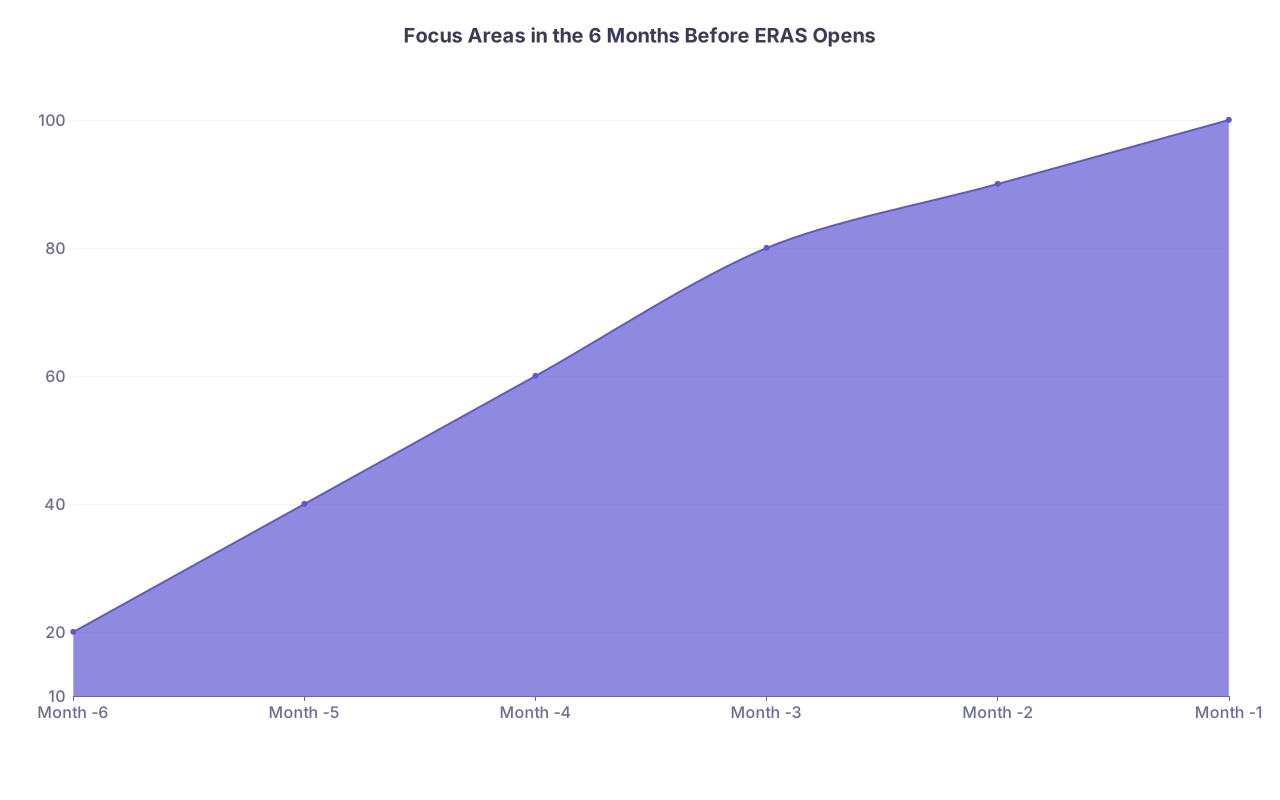
| Category | Value |
|---|---|
| Month -6 | 20 |
| Month -5 | 40 |
| Month -4 | 60 |
| Month -3 | 80 |
| Month -2 | 90 |
| Month -1 | 100 |
Months -6 to -4: Build capital
- Strong letters from observerships
- Contacts at IMG-friendly programs
- Fix gaps: Step 2, OET, ECFMG status, clinical recency
Months -3 to -1: Convert capital
- ERAS polishing
- Targeted networking with prior observers and coordinators
- Program list refinement
- Pre-interview “soft touches”
If you’re just floating, “seeing how it goes,” you’ll waste the observership advantage. Do not do that.
Month -6: Lock In Your Foundations
You’re six months from ERAS opening (roughly March if you’re aiming for September).
At this point you should:
- Confirm your exam and certification status
- Step 1: passed (ideally already done)
- Step 2 CK: passed or scheduled with score back before programs review apps (by Oct/Nov latest; earlier is better)
- OET/IELTS done if needed
- ECFMG certification: either done or on track
If Step 2 CK is not yet scheduled, schedule it now. Not “soon.” Now.
Clarify your observership story Write down:
- Hospitals/clinics where you observed
- Dates
- Attendings you worked with
- Specific things you did:
- “Pre-rounded on 4–6 patients each day, wrote mock notes”
- “Presented at case conference once per week”
This becomes:
- ERAS Experience entries
- Talking points for your personal statement
- Bullet points you can email back to attendings to remind them who you are
Identify who can realistically write you strong letters From each observership, ask yourself:
- Did I work with this attending closely for at least 3–4 weeks?
- Did I present cases, get feedback, show up early/leave late?
- Did they see my work ethic and clinical reasoning?
You want 3–4 strong letters, with at least:
- 1–2 from U.S. physicians in your target specialty
- 1 from someone clearly affiliated with a residency program if possible
Make a list. Name, email, role, hospital, how they know you, what you did together.
- Outline your specialties and program types
You cannot wing “I’ll see what I match into.” You need a dominant plan.
Pick:
- Primary specialty (e.g., Internal Medicine)
- Backup if necessary and realistic (e.g., Family Medicine or IM-prelim if Step scores allow)
Then aim for largely IMG-friendly programs.
| Program Type | Example Target Count | Notes |
|---|---|---|
| Community IM | 80–120 | High IMG proportion |
| University-affiliated | 20–40 | Filter for historic IMG intake |
| Prelim IM | 10–20 | Only if strategy includes this |
You’re not picking exact programs yet. Just lanes.
Month -5: Turn Observerships into Letters and Contacts
Five months out (around April) the clock is very loud.
At this point you should:
- Ask for letters of recommendation – properly Do not send a vague “Can you please write me a LOR?” email. No.
Send something more like:
- A short reminder of who you are and what you did
- Your updated CV
- A draft personal statement (even if rough, or at least a one-page career summary)
- A clear ask: “Would you feel comfortable writing me a strong letter of recommendation for Internal Medicine residency?”
If they hesitate, thank them and do not use that letter. A lukewarm letter can kill you quietly.
- Gather supporting documents for letter writers
Once they agree, send:
- ERAS letter ID (when available, or warn them it’s coming soon)
- Deadline you’re aiming for (I tell people: before August 15)
- Bullet list of:
- Your responsibilities during observership
- Memorable cases you worked on
- One or two traits you hope they’ll highlight (e.g., “adaptability as an IMG, strong clinical reasoning, patient communication”)
Make their job easier -> better letter.
- Re-engage your observership programs strategically
Do not vanish. Send update emails like:
- “I recently passed Step 2 CK with a score of XXX, thank you again for your mentorship during my observership in [month/year]. I’m planning to apply to Internal Medicine this cycle and will be strongly considering [Hospital Name].”
If the program is IMG-friendly, you want them thinking:
- “Oh right, that IMG was solid. Let’s watch for their application.”
- Start your personal statement draft Not the final version. A messy first draft is fine.
Include:
- Why this specialty (specific patients or experiences from observerships, not generic “I like solving complex cases”)
- How your background as an IMG adds value
- Concrete U.S. clinical experiences (by name)
- A forward-looking paragraph about training in an IMG-friendly, diverse setting
You’ll rewrite this several times, but you need a starting point now.
Month -4: Build Your Application Spine
Four months out (around May) you’re building the skeleton of your ERAS application.
At this point you should:
- Draft your ERAS Experience entries
For each observership, job, and volunteer role:
- Clear title: “Clinical Observer – Internal Medicine”
- Institution: Full name, city, state
- Dates
- 3–5 specific bullet points
Example bullet:
- “Observed management of 15–20 inpatients per day in a 300-bed community hospital, focusing on chronic disease management and discharge planning.”
- “Delivered weekly case presentations to attending physicians, incorporating differential diagnosis and evidence-based management.”
Don’t write vague fluff like “enhanced my communication skills.” Show what you did.
- Document non-U.S. clinical work properly IMGs with recent non-U.S. clinical work can either look strong or invisible, depending on how they write it.
Focus on:
- Breadth: inpatient/outpatient, procedures
- Responsibility: were you the primary physician, or a junior trainee?
- Volume: approximate patient numbers per day or per clinic
- Identify IMG-friendly programs using data, not vibes
Stop guessing. Look at:
- Program websites: resident roster pictures, names, countries of grad
- FREIDA and program sites for:
- % of IMGs in current residents
- Whether they sponsor visas (J-1/H-1B)
- Alumni networks: where did grads from your school match?
Build a working spreadsheet with columns:
- Program name
- City/state
- IMG %
- Visa sponsorship (Y/N)
- Observership/externship availability (Y/N)
- Personal contact there? (Y/N and name)
This becomes your master document.
- Patch obvious CV gaps
- No recent clinical activity in the last 12 months? Bad.
- Get something: free clinic, telehealth scribe, research assistant.
- No U.S. experience at all?
- You should be actively arranging at least one more U.S. clinical experience starting ASAP, even if it overlaps with ERAS opening. It still helps for interview season and showing recency.
- No recent clinical activity in the last 12 months? Bad.
Month -3: Clean, Polish, and Target
Three months out (around June). The application is no longer theoretical.
At this point you should:
- Finalize your personal statement to 90% One primary statement per specialty. Don’t write five versions chasing micro-niches.
Make sure:
- The first paragraph is concrete. E.g., a specific patient from your observership that changed how you practice.
- Observerships are framed as:
- Evidence you know U.S. systems and culture
- Bridge between prior training and U.S. residency
- There’s a clear reason you want IMG-friendly, community-focused training (phrase it your way, but you get the point).
- Confirm letter status with writers
Very simple, respectful follow-up email:
- Thank them again
- Confirm they still plan to upload by mid-August
- Attach updated CV and personal statement again
If someone has gone completely silent, identify a backup letter writer now.
- Do a hard review of your exam profile vs. specialty choice
Be blunt with yourself:
- Step 1 pass / Step 2 CK <220: competitive categorical spots in very desirable cities are less likely. You should overload on community, IMG-heavy programs, maybe consider backup specialty.
- Strong scores (>240) but old YOG: still an issue; you must emphasize continued clinical activity and academic involvement.
If your primary specialty is absurd for your stats (e.g., Derm with 220), pivot now. Not in August.
- Refine your program list draft
Based on:
- Your scores
- Your visa status
- Your observership locations and letter writers
Strong move: intentionally overweight programs where:
- You did observerships
- Your letter writers have influence or known connections
- The program explicitly states they consider IMGs and sponsor visas
Month -2: ERAS Build-Out and Pre-Launch Networking
Two months out (around July). This is execution month.
At this point you should:
Complete your ERAS core sections
- Biographical, education, exam scores, experiences, publications
Everything entered, formatted, and reviewed at least twice.
- Biographical, education, exam scores, experiences, publications
Polish every Experience entry Quick test:
- Is every bullet specific and action-based?
- Does it avoid vague filler like “improved my knowledge”?
- Does it show responsibility, not just observation?
Align your narrative across PS, CV, and letters Ask yourself:
- If a PD read my PS, my Experience section, and my LORs, would they clearly see:
- My main specialty target
- My core strengths
- Why I fit IMG-friendly, teaching-focused programs?
- If a PD read my PS, my Experience section, and my LORs, would they clearly see:
If your story feels scattered (“I love surgery, but also pediatrics, but also research”), fix it now.
- Do targeted, non-cringey networking
Use your observership connections intelligently:
- Email attendings:
- Thank them again for the opportunity
- Let them know your planned application specialty and that you’ll be applying to [X Hospital]
- Politely mention: “If there are any opportunities to contribute (research, case reports, QI projects), I’d be eager to help.”
- Email attendings:
Some will ignore you. That’s fine. You only need a few to respond.
Also:
- Reach out to current residents you met during observerships
- Ask 2–3 focused questions:
- How many IMGs in your program now?
- Where do they tend to come from?
- Any advice specific to applying as an IMG to your program?
- Ask 2–3 focused questions:
Do not open with “Can you get me an interview?” They hate that. I’ve seen those messages screenshot in resident chats.
Month -1: Final Build, Program List, and Launch Strategy
One month left (roughly August). ERAS opens soon.
At this point you should:
- Lock in your program list tiers
Divide into 3 groups:
- Tier 1: Programs where you have some connection
- Observerships done
- Letter writer works there
- You’ve spoken to residents or coordinators
- Tier 2: High-IMG, visa-friendly community and university-affiliated programs with stats in your range
- Tier 3: Stretch programs or less clearly IMG-friendly ones, if you have extra budget
- Tier 1: Programs where you have some connection
You should know:
- Where you’ll apply on Day 1
- Where you might add later depending on interview yield
Confirm all letters are uploaded or imminent Check ERAS:
- If any letter is still missing and the writer is unresponsive after polite reminders, pivot to your backup writer now. Do not wait until the day before applications go out.
Finalize your personal statement and proofreading At this point:
- The content shouldn’t be changing anymore
- You’re just catching:
- Typos
- Grammar errors
- Repetitive phrases
Have at least one person with U.S. training read it. Ideally someone who knows what residency PDs usually see.
- Prepare program-specific communication templates You’re not mass-emailing everyone spam. But you are going to send a handful of very targeted notes.
Draft:
- A short email you can adapt to:
- Past observership programs
- Programs where your letter writers have connections
Something like:
- 1–2 sentence re-introduction
- Mention of your prior observership or connection
- Confirmation that you’ll be applying this cycle in [specialty] and strongly considering their program
- Very brief sentence on why (e.g., diverse patient population, strong training in [X area], high IMG representation)
You’ll personalize these, but the template saves you time in early September.
ERAS Opening Week: Execution
The portal opens. People stall. You shouldn’t.
At this point you should:
- Submit early but not sloppy
Aim to have:
- ERAS fully ready
- Program list mostly decided
- Letters either in or clearly on their way
Submitting in the first 1–2 weeks is fine. Do not rush so fast you introduce careless errors.
- Apply strategically, not frantically For IMGs, the instinct is “apply to everything.” That’s how you burn money and energy.
Use your spreadsheet. Prioritize:
- High IMG presence
- Visa support aligned with your needs
- Any prior connection
Add stretch programs if budget allows, but don’t waste 40 applications on glamorous places that have taken zero IMGs in five years.
- Send your targeted connection emails
Within 7–10 days of submission:
- Email attendings from observerships:
- Let them know you’ve submitted
- Mention that you applied to their program (if true)
- For a few top IMG-friendly programs where you have some connection, a brief, respectful email to the coordinator or chief resident is acceptable.
- Email attendings from observerships:
Do not send novels. Four to five sentences max.
Early Interview Season (Weeks After Submission)
This isn’t the main focus of your six-month plan, but observerships still matter here.
At this point you should:
Translate observerships into stories For interviews, practice describing:
- A specific patient or scenario from your observership that showed you can adapt to U.S. medicine
- How you handled uncertainty or a knowledge gap as an IMG
- What you learned about teamwork and communication in U.S. hospitals
Leverage observership programs for signal boosts If you get an interview at a place where:
- You did an observership or
- Your letter writer works there
Let that attending know:
- Thank them again
- Share that you’ve received an interview there
- Ask if they have any advice
Sometimes they’ll quietly mention your name to someone. That can tilt you from “ranked low” to “ranked realistically.”
Visual Timeline: Six-Month Countdown

| Period | Event |
|---|---|
| Month -6 - Confirm exams and ECFMG status | Exams, certification, observership review |
| Month -6 - Identify potential letter writers | List attendings, contacts |
| Month -5 - Request letters of recommendation | Formal asks, send CV and draft PS |
| Month -5 - Reconnect with observership programs | Update emails, soft networking |
| Month -4 - Build ERAS experience draft | Detailed bullets, roles, responsibilities |
| Month -4 - Map IMG friendly programs | Spreadsheet of targets |
| Month -3 - Refine specialty focus | Align scores, specialty choice |
| Month -3 - Tighten personal statement | 90 percent finalized |
| Month -2 - Complete ERAS sections | Bio, exams, experiences |
| Month -2 - Targeted networking | Residents, coordinators, research offers |
| Month -1 - Finalize program list | Tiered strategy |
| Month -1 - Confirm all letters | Backup writers if needed |
| ERAS Open - Submit application | Early, clean submission |
| ERAS Open - Send targeted follow up emails | Observership and connection programs |
Quick Comparison: How Observerships Actually Help
| Area | Weak Use of Observership | Strong Use of Observership |
|---|---|---|
| Letters | Generic “to whom” note | Specific, detailed LOR |
| ERAS Experience | 1-line description | Concrete responsibilities |
| Networking | No follow-up | Targeted, respectful updates |
| Personal Statement | Barely mentioned | Central to specialty narrative |
| Program Targeting | Random list | Weighted toward observership sites |
Final Takeaways
- Observerships only help if you aggressively convert them into letters, stories, and connections within 3–6 months. Passive observers get forgotten.
- Your six-month plan should move from building capital (letters, experience, relationships) to spending it strategically (ERAS, program list, targeted emails).
- IMG-friendly programs notice applicants who already understand their environment. Use your observerships to prove you’re not guessing what U.S. residency feels like—you’ve already been in the building.