
The worst timing mistake IMGs make is contacting programs either way too early or just after it actually mattered.
You’re not trying to “say hello.” You’re trying to appear on a program’s radar at the exact moments when they’re building interview lists, reconsidering borderline apps, and filling late cancellations. That’s timing. And most people get it wrong.
Here’s your pre‑interview contact timeline, broken down month‑by‑month, week‑by‑week, and sometimes day‑by‑day, so you know exactly when to contact IMG‑friendly programs directly — and when to shut up and wait.
Big Picture: When Program Emails Actually Matter
Before we go month‑by‑month, anchor this in reality.
There are three windows when direct contact from an IMG can move the needle:
Pre‑screening / pre‑download window
- Goal: Make sure you’re not silently filtered out.
- Best for: Borderline candidates, non‑traditional CVs, visa‑requiring applicants.
Active interview offer window
- Goal: Nudge a “maybe” to a “yes.”
- Best for: Applicants with some connection (home country, observership, mentor, geographic tie).
Late‑cycle / cancellation window
- Goal: Catch leftover or last‑minute interview slots.
- Best for: Strong applicants under‑interviewed for their profile.
Everything else? Mostly spam to their eyes.
Now let’s walk the real timeline.
4–6 Months Before ERAS Submission (April–June)
At this point you do not email programs asking for interviews. You’d just look naive.
You’re laying groundwork.
April–May: Identify True IMG‑Friendly Targets
At this point you should:
- Build a shortlist of genuinely IMG‑friendly programs by specialty.
- Use:
- NRMP Charting Outcomes / Program Director Survey
- Program websites (look at current residents’ schools and countries)
- Alumni from your med school
- FREIDA filters (IMG %, visa sponsorship)
| Category | Target Number |
|---|---|
| Core programs | 25–40 |
| Stretch programs | 10–15 |
| Safety programs | 10–20 |
| Total per specialty | 45–65 |
At this point you should only contact programs for structured reasons:
- To clarify visa policies (J‑1 vs H‑1B)
- To ask about US clinical experience requirements
- To confirm minimum score or graduation year cutoffs
These are logistical, factual questions. Keep them short, respectful, and rare.
Do NOT:
- Send CVs.
- Ask “Will you consider my application?”
- Ask “Can you please review my profile?”
That’s a fast route to their trash folder.
0–4 Weeks Before ERAS Submission (Early–Late August)
This is when serious applicants start thinking strategically about contact.
Many programs quietly update their websites and criteria during this window. You need to know if you’re wasting applications.
At this point you should:
-
- Confirm: still IMG‑friendly? Still sponsor visas?
- Look again at current residents — any new IMGs added?
Targeted clarification emails — only when necessary
You can contact programs directly when:- Their site is contradictory (e.g., “no visas” on one page, “J‑1 considered” on another).
- Graduation year cutoffs are unclear.
- They’ve changed requirements (e.g., now requiring Step 3 for H‑1B).
Your email here is purely informational, not promotional.
Wrong email in August:
“Dear Program Director, please review my attached CV and consider me for an interview…”
Right email in August:
“Dear Coordinator, I’m an international medical graduate planning to apply this cycle. Your website lists J‑1 sponsorship, but ERAS currently shows ‘no visa sponsorship.’ Could you please confirm which is correct for this year?”
You’re laying the credibility foundation: you look precise, respectful, and literate. Not desperate.
ERAS Submission Week (Early–Mid September)
This is where many IMGs blow it by firing off “I applied, please notice me” emails the same day ERAS opens. Programs are swamped. Your message is noise.
At this point you should:
- Submit ERAS early (ideally within the first 3–5 days of opening).
- Do not email the same day you submit.
Wait.
5–10 Days After You Submit ERAS
Now some programs begin downloading and screening applications. This is your first real window.
For IMG‑friendly programs where you’re a reasonably close fit, you can send a brief, one‑time introductory email if either:
- You have a real connection (home country, language, observership, research with their faculty, geographic tie), or
- You’re a borderline candidate but with one strong hook (Step scores, significant research, unique experience).
At this point you should:
- Send a concise, 1‑paragraph email to:
- Program Coordinator or
- A specific faculty member you genuinely know / worked with
(not mass‑emailed to 50 addresses)
Purpose:
- Flag that your ERAS application is complete.
- Highlight 1–2 specific, program‑relevant strengths.
- Mention one specific reason you’re interested in them.
No attachments. No begging. No long biographies.
Late September–October: Main Screening & Early Invites
This is where timing makes or breaks IMGs.
Many IMG‑friendly internal medicine and family medicine programs start sending out interviews between late September and mid‑October. Some community programs wait slightly longer, but decisions are forming here.
At this point you should divide programs into three groups:
- High‑priority IMG‑friendly programs where you are competitive
- Programs where you’re borderline for their norms
- Programs where you overshoot them (you’re stronger than their median)
Week‑by‑Week Approach
Week 1–2 after invites start (roughly late Sept–early Oct)
At this point you should:
- Watch your email and ERAS closely.
- Give programs at least 10–14 days from when they start sending invites before pinging them.
No interviews yet from a program heavily known to be IMG‑friendly that usually invites profiles like yours?
This is your first “expression of interest” window.
Email rules now:
- One email per program.
- Short, respectful, specific.
You’re aiming for something like:
“I understand you receive many applications; I wanted to briefly express my strong interest in your program given [specific, real reason], and to let you know my ERAS application is complete.”
Do this only for:
- Programs where your profile is at least near their usual range
- Programs with a history of interviewing IMGs like you
Not 80 programs. More like 10–20 high‑yield, IMG‑friendly targets.
Mid‑October–November: Secondary Contact & Re‑Positioning
By this point:
- The initial wave of interview offers has gone out.
- Some candidates have declined.
- Some programs realize they under‑invited IMGs and correct.
This is where well‑timed IMG contact can absolutely work. I’ve seen borderline candidates pick up 3–5 extra interviews here.
At this point you should:
- Assess your interview count vs. target
- For IMGs in IM/FM:
- Solid but not stellar profile → aim for 8–12 interviews.
- Strong profile → 12–15+.
- For more competitive specialties → numbers vary, but if you’re sitting at 0–3 by late October, it’s time to be proactive.
- For IMGs in IM/FM:
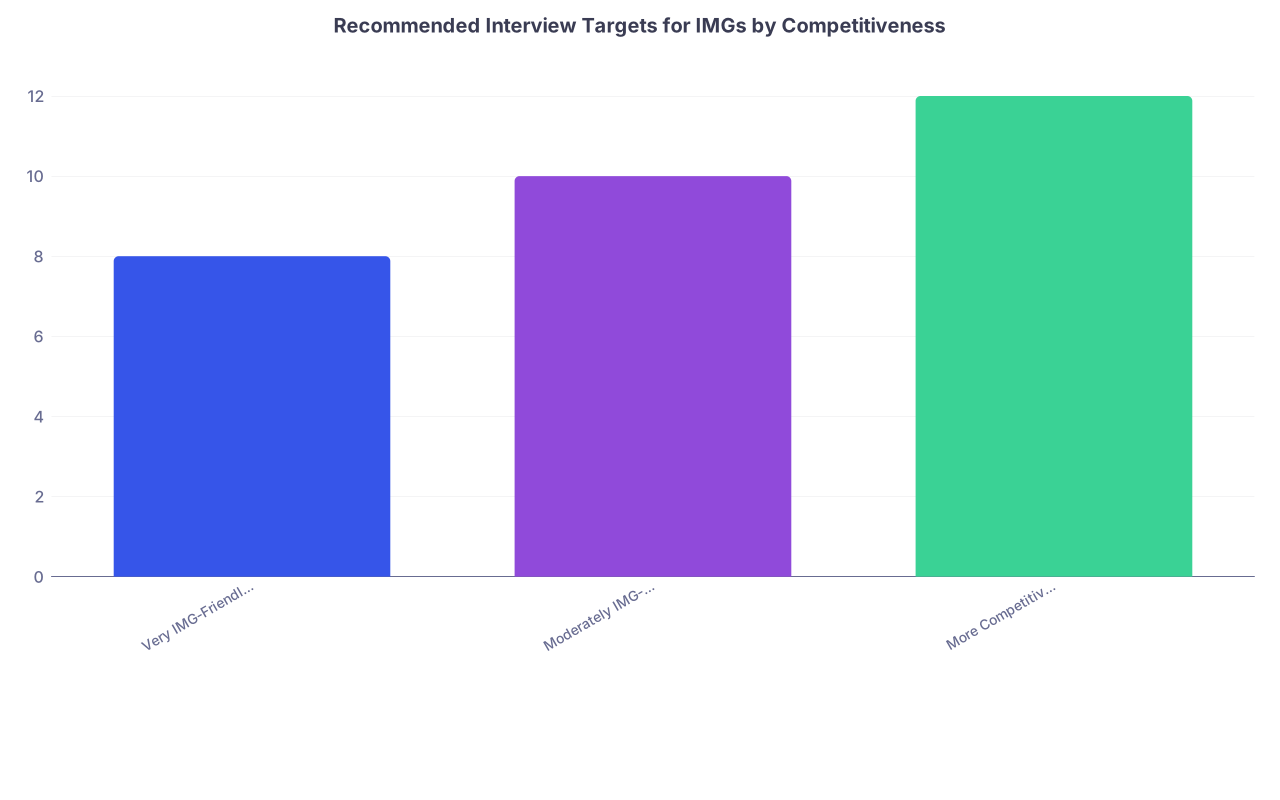
| Category | Value |
|---|---|
| Very IMG-Friendly (FM) | 8 |
| Moderately IMG-Friendly (IM) | 10 |
| More Competitive (Neuro/Peds) | 12 |
- Decide who to contact again
You can justify a second, carefully timed email to:
- Programs you emailed once before invites started
- Programs that are explicitly IMG‑friendly and have many IMGs current or former
- Programs in regions where you have a legitimate tie (family, prior USCE, long‑term residency plans)
Timing For Second Contact
- Ideally 3–5 weeks after you know they started sending interviews.
- Also smart right after:
- They extend an interview wave (you see on forums/Discords)
- A major conference ends (they resume normal operations)
This time your strategy shifts slightly:
If you have new information, lead with it:
- New Step 3 pass
- New US clinical experience
- Recent publication / accepted abstract
- VISA status resolved (e.g., now eligible for J‑1)
If not, focus on:
- Reaffirming genuine interest
- One or two program‑specific reasons rooted in what you’ve read about them
Do not send a third follow‑up if they ignore this second one. That just labels you as high‑maintenance.
Late November–December: Late‑Cycle & Cancellation Window
This is your last real pre‑interview leverage period.
Many programs:
- Have had some cancellations.
- Realize they under‑interviewed certain groups (including IMGs).
- Need to fill a few remaining interview days in December or January.
At this point you should:
- Review your numbers honestly
- Substantially below a safe interview count?
Then this is not the time to be shy.
- Targeted “cancellation slot” emails
You can now explicitly but politely mention:
“…if any interview cancellations occur later in the season, I’d be very grateful to be considered for an available slot.”
Send these to:
- IMG‑friendly community programs
- Programs where you’re clearly within their usual range
- Programs in locations you’d realistically attend on short notice
Timing ideas:
- Around US holidays (Thanksgiving, mid‑December) when people cancel or no‑show.
- Early December, when some programs realize they mis‑calculated their numbers.
You’re essentially telling programs:
“I’m interested, I’m flexible, and I’m easy to plug into a cancellation spot.”
What About Calling Programs?
Phone calls are high‑risk, low‑reward if done badly.
At this point you should consider calling only if:
- You have a genuine update (new Step score, Step 3 pass, visa clearance).
- Or you’re responding to their specific instruction (“call the office if you have questions”).
Cold calls just to ask “Am I getting an interview?” are almost always a mistake.
What To Actually Say (By Phase)
Let’s tie this to scripts by timeline.
Early Clarification (April–August)
Subject: Clarification about visa sponsorship
- One sentence about who you are.
- One sentence about your question.
- One sentence of thanks.
That’s it.
Post‑Submission / Pre‑Invite (Late September)
Subject: ERAS application – [Your Name], [Specialty]
- 1 line: Who you are and what you applied for.
- 1–2 lines: One specific connection/hook + why their program.
- 1 line: “My ERAS application is complete and I would be honored to be considered for an interview.”
Late‑Cycle / Cancellations (Nov–Dec)
Subject: Continued interest in [Program Name] and interview availability
- 1 line: You applied earlier in the cycle.
- 1–2 lines: Why you remain particularly interested in this program.
- 1 line: Mention you’d be grateful to be considered if cancellations open additional interview spots.
- 1 line: You’re flexible and can accommodate short‑notice scheduling.
Visual: Season Timeline For IMG Contact
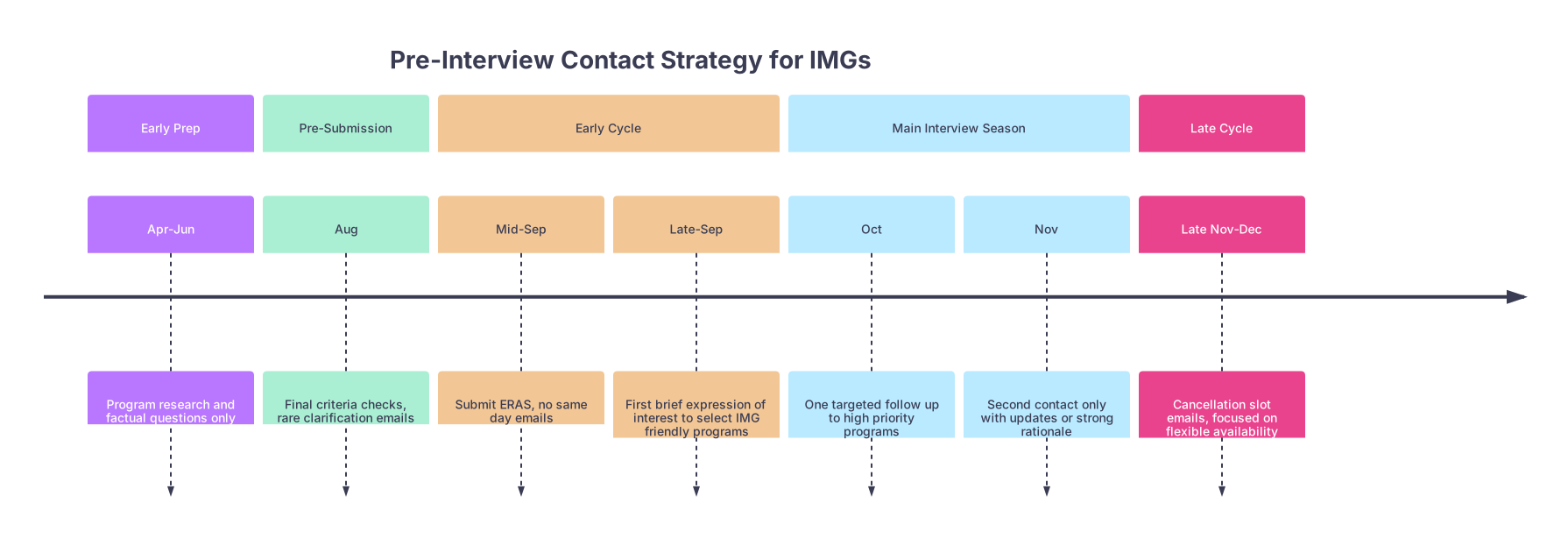
| Period | Event |
|---|---|
| Early Prep - Apr-Jun | Program research and factual questions only |
| Pre-Submission - Aug | Final criteria checks, rare clarification emails |
| Early Cycle - Mid-Sep | Submit ERAS, no same day emails |
| Early Cycle - Late-Sep | First brief expression of interest to select IMG friendly programs |
| Main Interview Season - Oct | One targeted follow up to high priority programs |
| Main Interview Season - Nov | Second contact only with updates or strong rationale |
| Late Cycle - Late Nov-Dec | Cancellation slot emails, focused on flexible availability |
Common Timing Mistakes IMGs Make
I’ve watched applicants repeat the same errors every year.
Mass emailing 50+ programs on ERAS opening day
- Result: You look spammy and unprofessional.
Contacting programs weekly
- Result: You get silently blacklisted as “needy”.
Waiting until January to send the first email
- By then, the interview list is basically done. You’re begging for scraps.
Contacting highly competitive academic programs while ignoring community IMG havens
- Your time is better spent where IMGs actually match.
Not adjusting strategy based on interview count
- If you have 0–2 interviews by early November as an IMG in IM/FM, that’s a major signal to escalate smart, targeted outreach.
Quick Timeline Checklist
Use this as your sanity guide.
April–June
- Build IMG‑friendly program list
- Send rare factual emails (visa, cutoffs) only when necessary
August
- Re‑check website criteria and resident backgrounds
- Clarify conflicting information via short emails
Early–Mid September
- Submit ERAS early
- Do not email on submission day
Late September–Early October
- Track when programs start sending invites
- Send first expression‑of‑interest emails to 10–20 top IMG‑friendly programs where you’re competitive
Late October–November
- Review interview count vs target
- Send one thoughtful follow‑up to selected programs, especially with updates
Late November–December
- Identify programs likely to have cancellations
- Send targeted “available for cancellation spots” emails
- Stay flexible for short‑notice invites
FAQ (Exactly 2 Questions)
1. Should I ever email the program director directly, or only the coordinator?
Emailing the PD can be appropriate, but not for generic “please consider me” messages. If you have a real connection (you met at a conference, did an observership there, worked on a paper together, share a mentor who introduced you), then a short, respectful email to the PD is fine and can be powerful. For everyone else, default to the program coordinator — they control the logistics and often filter communications. If you email both, do not send two separate messages; include both on the same thread.
2. Is it better to contact IMG‑friendly programs before or after they start sending interviews?
If you have no updates and no special connection, your strongest timing is usually right after they start sending interviews — not before, not months earlier. Before invites, they’re still setting filters and thinking in bulk; your email is easy to ignore. Once invites go out, they’re evaluating specific people and looking at the gray zone around their cutoffs. That’s when a short, targeted email from a plausible IMG applicant can bump you from “maybe later” to “let’s invite them now.”
Remember:
- Contacting programs too often hurts you more than not contacting at all.
- The best emails are short, specific, and timed to real decision points — not your anxiety.
- Focus on IMG‑friendly programs during their actual screening and reshuffling windows, and you give yourself a genuine shot at extra interviews.