
62% of psychiatrists who start in academics leave for non‑academic practice within 10 years.
People assume that is about money. A lot of the time, it is not. It is about teaching expectations that balloon, admin that quietly multiplies, and call structures that look reasonable on paper but wreck your life on the wrong service.
Let me break this down specifically: academic vs private psych through three levers that actually change your day-to-day life.
- Teaching loads
- Admin time
- Call structures
I am not going to talk abstract “work–life balance.” I am going to talk: how many notes, how many meetings, how many middle‑of‑the‑night calls, and what it really feels like as a resident and attending in each environment.
1. Big Picture: What Changes Between Academic and Private Psych?
Before we dissect teaching, admin, and call, you need a baseline comparison. Because many residents pick “academics” or “private” based on vibes they absorbed from attendings, not on the actual job mechanics.
| Dimension | Academic Psych | Private Psych (Group / Solo) |
|---|---|---|
| Teaching Load | Moderate–High | Low–None |
| Admin Time | High (committees, documentation) | Moderate–High (billing, systems) |
| Call Structure | Usually formal, shared, hospital | Variable, often lighter or none |
| Control Over Panel | Low–Moderate | High |
| Schedule Predict. | Moderate | High (outpatient) / Low (inpt) |
That table hides a key point: “admin time” is not the same admin in academia vs private.
In academics, admin means:
– Faculty meetings
– Committees
– GME requirements
– Evaluation forms for residents and med students
– Quality metrics projects you never asked for
In private, admin means:
– Prior auths
– Billing and coding issues
– EMR and practice‑management headaches
– Negotiating with hospital or group leadership
– Dealing with insurers and contracts
Neither is free. They just hurt in different ways.
Now let us go line by line.
2. Teaching Loads: Who You Teach, How Often, and What That Actually Costs You
In psychiatry, you are almost never just “seeing patients and going home.” You are usually also teaching someone. The question is how many, how often, and with what expectations.
Academic Psych: Teaching Is Part of Your RVU
In a typical academic department (think: university hospital + residency program + med school), your job description explicitly includes education. Not optional. Core.
Who you teach:
- Medical students on clerkship and electives
- Psychiatry residents (PGY‑1 to PGY‑4)
- Sometimes fellows (child psych, addiction, consult, geriatric, C‑L, forensic)
- Occasionally NPs/PA students, psychology interns
Reality on a standard academic inpatient or consult service:
- Most days you have at least one learner
- Frequently 2–4 learners (MS3 + MS4 + PGY‑1 + PGY‑3, for example)
- You are expected to:
– Supervise interviews
– Co‑sign notes
– Give mini‑lectures on rounds
– Provide formal feedback
– Fill out evaluations in the med school/residency evaluation system
Typical structure people ignore: your department chair may tell you “0.1 FTE protected for education.” That sounds fine. In practice, that might mean:
- 4–6 hours / week “protected”
- But you are really doing 10–12 hours / week of teaching, supervision, and evaluations if you are not phoning it in
The hidden time sinks:
- End‑of‑block written evaluations for each learner (those 10–15 minutes per eval add up)
- Remediation meetings for struggling residents or students
- GME‑mandated milestones, CCC meetings, program evaluation committee meetings
- That med student who needs a letter, plus a 30‑minute feedback meeting, plus email iterations on their draft personal statement
On busy services, especially consult‑liaison, this creates a very specific tension: you can either
- Run a tight, efficient, “attending does most of the talking” model and keep the clinical day sane but shortchange the learners, or
- Let the learners run the visits and interviews, which is better for them but adds 1–2 hours to your day
If you care about teaching (and most early‑career academic psychiatrists do), you choose #2. Then you get home late, again, and you are not sure why your day never ends on time when “the volume is not that bad.”
I have watched junior attendings burn out not from caseload, but from being genuinely invested teachers without enough protected time.
Where academic teaching can feel good:
- Chronic psych units or specialty clinics (e.g., psychosis, mood disorders) where residents follow patients longitudinally
- Outpatient continuity clinics where teaching is integrated into scheduled time and you can block a real “teaching hour” middle of the day
- Programs with true teaching FTE carved out (e.g., 0.3 FTE residency education, 0.7 FTE clinical)
These environments let you teach without always paying for it with your evenings.
Private Psych: Teaching Light, If At All
In pure private practice, teaching is either:
- Nonexistent
- Occasional and voluntary (e.g., agreed to take a rotator once a year)
You are not typically:
- Supervising residents regularly
- Filling out a dozen formal evaluations per month
- Sitting in on CCC/PEC/GME meetings
Most private psychiatrists who “teach” do one of three things:
Volunteer faculty / adjunct:
– A half‑day a week supervising residents at an academic clinic
– Occasional lectures for the department
Lifestyle impact: contained, predictable, and you can quit.Rotating learners in a group practice:
– Med students or residents do short elective blocks
– You might spend 1–2 hours / week debriefing
Lifestyle impact: mild, often energizing because you control the terms.Internal teaching only:
– Educating therapists or NPs in your group
– No GME paperwork, no milestone forms
The difference: in private, teaching is almost never required for your job security or promotion. It is additive, often optional, and usually narrower in scope.
That is why a lot of people who truly love teaching stay academic. You lose that constant stream of learners in pure private.
But if you are lifestyle‑focused? Less teaching almost always equals:
- Fewer interruptions
- Less documentation overhead
- No long feedback forms at midnight
3. Admin Time: Bureaucracy vs Business
Psychiatry is paperwork‑heavy regardless of practice model. You cannot escape notes, documentation, or prior auths. But the flavor of admin work changes massively between academics and private.
Academic Psych: Meetings, Metrics, and “Protected Time” That Is Not
Here is what academic admin usually looks like once you are faculty:
Core recurring obligations:
- Department meetings (monthly, sometimes more)
- Division meetings (inpatient, outpatient, C‑L, etc.)
- Faculty development sessions
- GME meetings if you are involved with residency or fellowship
- Quality improvement projects, M&M, case conferences
Layer on:
- Annual reviews with your chair
- Goal‑setting documents
- Promotion packets and “academic portfolio” if you want to move from assistant to associate professor
Then add what nobody advertises on interview day:
- EMR upgrades and mandatory training modules
- Repeated online modules: HIPAA, safety, infection control, harassment, etc.
- “System initiatives” around suicide screening, patient satisfaction, throughput — each with its own meetings and dashboards
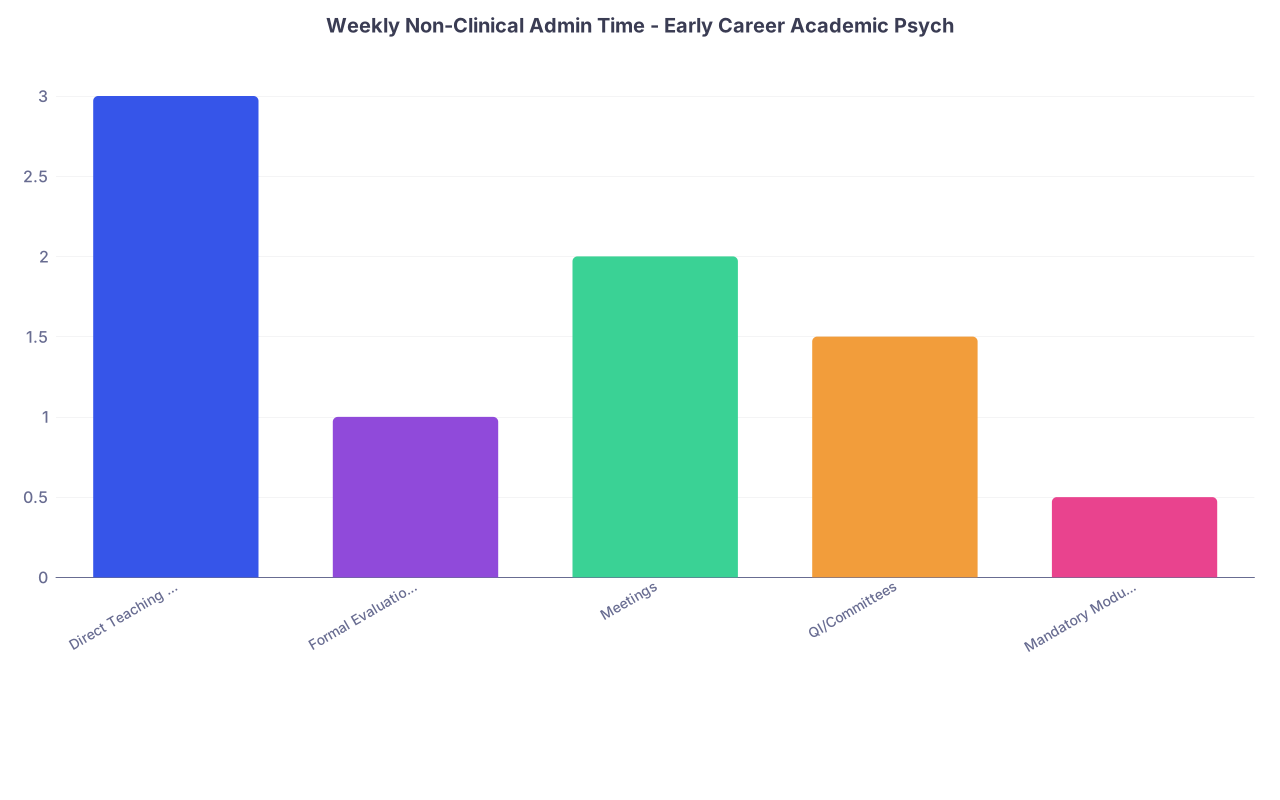
| Category | Value |
|---|---|
| Direct Teaching Prep | 3 |
| Formal Evaluations | 1 |
| Meetings | 2 |
| QI/Committees | 1.5 |
| Mandatory Modules | 0.5 |
That is ~8 hours a week of non‑clinical, non‑RVU admin if you have active educational and committee roles. Some weeks more.
Residents feel this too:
- Program surveys
- Semiannual feedback meetings
- Milestones paperwork
- Block evaluations of each rotation
- “Wellness” sessions that cut into your only free afternoon
None of this is evil. Some of it is necessary. But it is time that is not seeing patients, not reading, not resting.
The critical point: in academics, your “extra jobs” rarely disappear just because your week is clinically busy. That 7 a.m. QI meeting still happens, even if your consult service exploded yesterday.
Private Psych: Less Committee Stuff, More Business Headaches
In private practice, you usually trade bureaucratic meetings for business and finance friction.
What admin looks like in a typical private outpatient setting:
- Prior auths for meds, TMS, ECT, partial programs
- Billing problems: rejected claims, underpayments, coding questions
- Occasional chart audits from insurers
- EMR/template customization, note optimization
- Negotiating call coverage or schedule with hospital or group partners
If you own or co‑own a practice, layer on:
- HR issues (hiring, firing, mediating staff conflicts)
- Lease negotiations
- Vendor issues (billing company, IT, phone system)
- Contracting with payors (paneling, renegotiating rates)
It is less “there is a 90‑minute faculty meeting a month” and more “your biller just told you two insurers did not pay you for 3 months and you need to fix it this week.” Different kind of stress.
But here is where lifestyle can be better:
- You choose how many meetings to have.
- You can outsource some admin (billing, phones, even prior auth services).
- You do not have GME/promotion documentation unless you voluntarily take it on.
The big mistake new private psychiatrists make is underestimating admin early. For the first 1–2 years of building a practice, expect:
- 5–10 hours / week of pure business/admin when ramping up
- Then, if you structure it well, 2–4 hours / week once steady
In a good group practice with strong support, you can get this down to a very tolerable level. In a poorly run one, you can drown in unpaid admin.
Bottom line:
Academic admin = meetings, evaluations, system projects.
Private admin = money, insurers, practice operations.
You pick which headache you prefer.
4. Call Structures: Who Carries the Pager and When It Ruins Your Week
Psychiatry call is usually “soft” compared with surgical fields. But soft does not mean trivial. Sleeping with a pager is still sleeping with a pager.
The structure of call is one of the most lifestyle‑defining differences between academic and private settings.
Residency: Academic vs Community Psych Call
During residency, your experience will be shaped more by hospital type than by future career plans. But you should still pay attention; it previews your attending life.
Typical academic residency call patterns (examples I have actually seen):
- PGY‑1:
– In‑house overnight call on psychiatry units and ED psych consults
– Frequency: q4–q6 depending on program (sometimes paired with neurology or medicine early on) - PGY‑2:
– Heavy C‑L and ED psych call, often home call with in‑house backup - PGY‑3–4:
– Mostly home call, backup for junior residents, rare in‑house nights
Call intensity clusters around:
- ED and C‑L coverage at large tertiary centers
- Nights with a high volume of involuntary holds, agitation, med recs, and suicide assessments
The good news: most academic programs are very conscious of duty‑hour compliance. You get post‑call days. You are not working 28‑hour stretches weekly.
Community or hybrid programs may have:
- Less specialty ED traffic
- More straightforward inpatient call (covering 20–30 patients vs a 60‑bed behemoth)
- Less fellow coverage at night (so residents handle more directly)
Ask current residents:
- How many calls per month at each PGY level?
- How many pages overnight on average?
- How often do attendings actually come in for backup?
Because the step from resident call to attending call in the same system is often just… losing your post‑call day.
Academic Attending Call: Formal, Predictable, and Sometimes Heavier
In academic psych, attending call is usually:
- Structured and scheduled far in advance
- Shared across a defined pool of attendings
- Typically a mix of:
– Inpatient coverage
– ED / C‑L backup
– Resident supervision
Patterns I see in major academic centers:
- 1 weekday night of home call every 2–3 weeks
- 1 weekend (Fri–Sun) of home call every 1–2 months
- Some services require an attending to physically round on inpatients on weekend mornings, others are phone‑only while residents staff
The catch: academic centers often run the psych ED or serve as regional referral centers. So you are the one:
- Being called about complex boarding cases in the ED
- Approving involuntary holds and emergency meds
- Managing high‑acuity transfers and disposition decisions at strange hours
If the system has a psych hospitalist model, call may be lighter (dedicated hospitalists take most of it). If not, outpatient attendings share the same call pool.
A subtle problem: as departments struggle to recruit, call pools shrink. That “1 weekend every 2 months” can quietly become 1 in 6, then 1 in 4. The lifestyle cost goes up fast.
Private Practice Call: Anything From “None” to “Every Other Night”
Private psychiatrists can land in several very different call worlds.
Pure outpatient, no hospital privileges, cash‑based or concierge
– Many have essentially no formal call.
– Maybe a cell number for urgent messages, but true emergencies are sent to 911/ED.
– If the structure is tight (clear boundaries), this is as lifestyle‑friendly as psych gets.Outpatient with shared group call
– Group practice of, say, 8 psychiatrists, rotating call for urgent patient issues and coverage.
– Call might be by phone only, minimal overnight calls.
– Weeknight call every 1–2 weeks, weekend call every couple of months.Private inpatient / contracted hospital coverage
– You admit/manage your own inpatients at a community hospital or psych facility.
– Call can be:
– Home call with occasional trips in, or
– In‑house weekend rounding on your census– If you are one of a small number of psychiatrists on staff, you might be on call more often than you want.
Locums or per‑diem psych
– Call varies wildly by contract.
– Sometimes you can choose 100% no‑call assignments.
– Other times call is baked into the pay rate.
The key distinction: in private, you can design a career with essentially zero meaningful call if you choose carefully:
- 100% outpatient
- No hospital or ED coverage
- Clear written policies on after‑hours coverage and emergency procedures
Many lifestyle‑focused psychiatrists head this direction after burning out on academic call systems.
5. Putting It Together: Matching Your Priorities to Reality
Psychiatry is already one of the more lifestyle‑friendly specialties. But within psych, academic vs private changes the texture of your life.
Here is the honest trade:
| Priority / Preference | Academic Psych Fits Better | Private Psych Fits Better |
|---|---|---|
| Loves daily teaching | Yes | Only if adjunct/volunteer |
| Wants maximal schedule control | Limited | Strong (esp. outpatient only) |
| Tolerates frequent meetings | Necessary | Optional / less formal |
| Wants minimal after‑hours interruptions | Depends heavily on system | Very possible (no hospital, no call) |
| Wants clear promotion ladder | Yes (titles, ranks) | No formal ladder, but more autonomy |
| Hates dealing with insurers/billing | Partially shielded | Needs a group or strong admin support |
FAQ (exactly 5 questions)
1. Is academic psychiatry always worse for lifestyle than private practice?
No. Some academic psych jobs are extremely lifestyle‑friendly: light call, strong hospitalist coverage, genuine protected time, and reasonable teaching loads. A well‑structured academic outpatient job with a strong hospitalist service can beat a chaotic private inpatient gig by a mile. The problem is variability. Academic systems drift toward more meetings, more committees, and rising clinical demands over time. You need to interrogate the specific job, not the label.
2. How much teaching is “normal” for an academic psychiatrist?
On most academic services, expect learners at least 50–80% of your clinical sessions. That might mean a resident and/or med student almost every clinic or inpatient day. Teaching time (direct and indirect) commonly eats 4–10 hours per week between supervision, bedside teaching, and evaluations. Programs that claim “0.1 FTE for teaching” but place multiple learners with you most of the week are, frankly, undercounting the real time cost.
3. Can I work in private practice and still teach regularly?
Yes, but you have to be deliberate. The cleanest model is joining a local academic department as voluntary or adjunct faculty. You might supervise a resident clinic half‑day weekly, take residents for an outpatient elective, or give a recurring lecture series. That preserves your private‑practice autonomy while letting you teach without absorbing the full academic admin burden. Just be clear up front about time expectations and whether any compensation or CME support is attached.
4. What psych jobs have the least call and admin burden overall?
The consistently lightest models I see are: high‑functioning group outpatient practices with good admin staff, no hospital/ED responsibilities, and well‑defined policies for after‑hours coverage (often phone‑only, shared, and low volume). Cash‑based or concierge outpatient psych can be even lighter on prior auth and billing headaches. On the academic side, some pure outpatient roles with no inpatient or ED responsibilities and no major educational leadership duties can be very manageable, but those are less common and can vanish when departments get short‑staffed.
5. If I hate meetings and bureaucracy, does that automatically rule out academic psychiatry?
It makes academic life harder, but it does not absolutely rule it out if you are strategic. You can aim for roles with minimal committee work (less leadership, more pure clinical + supervision), avoid major admin titles, and focus on teaching and direct care. However, academic structures tend to accumulate mandatory meetings and system projects around you. If your tolerance for bureaucracy is near zero, a well‑run private group or independent outpatient setup will align better with your temperament over a 20‑year career.
Key points to carry forward:
- Academic vs private psych are not just about pay; they are structurally different in teaching expectations, admin load, and call.
- You can build an extremely lifestyle‑friendly psychiatry career, but only if you are ruthless and specific about how much teaching, admin, and call you are actually signing up for.